
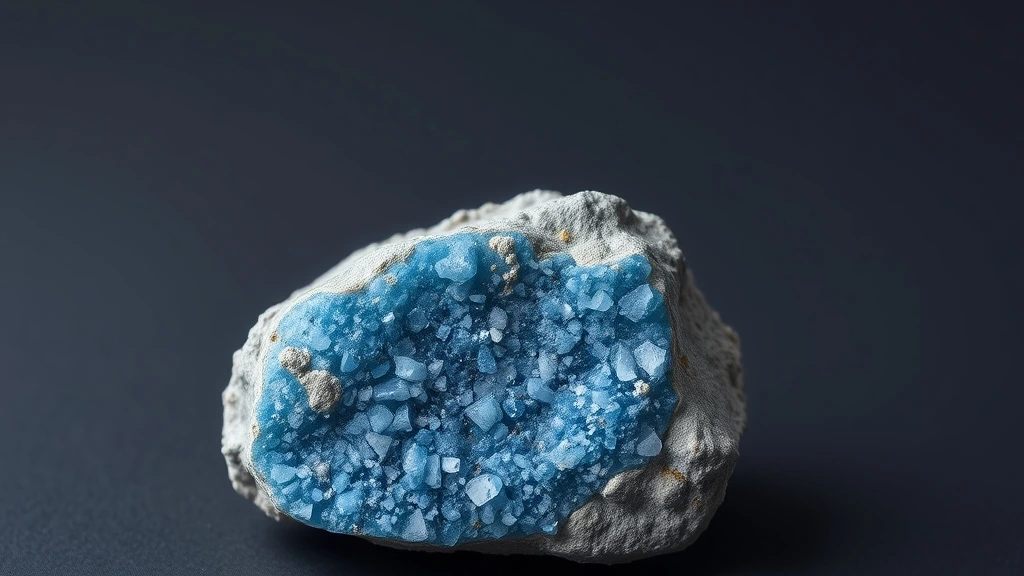
Blue barite belongs to the natural mineral family of sulfate crystals, classified unequivocally as a crystalline mineral rather than a rock or organic aggregate. Its orthorhombic symmetry and dense lattice give it a specific gravity of 4.48–4.50, distinguishing it from more common white barite. Historically, the vivid blue variant has been prized in lapidary circles for its rarity and ethereal coloration, though its softness limits practical applications.
What is Blue Barite? Geological Overview & Definition
Blue barite is a sulfate mineral composed of barium, sulfur, and oxygen, forming the formula BaSO₄. The striking blue coloration arises from trace impurities and structural defects that act as chromophore centers, often linked to minute amounts of iron or organic inclusions. In comparative mineralogical collections, practitioners and geologists frequently study Blue Onyx alongside this crystal to appreciate their subtle energetic and structural differences.
In the field, blue barite occurs as well‑formed tabular or prismatic crystals within hydrothermal veins, sedimentary basins, or as secondary deposits in limestone caverns. Its formation requires low‑temperature, barium‑rich fluids that precipitate the mineral alongside calcite, gypsum, and sometimes fluorite, creating a distinctive mineral assemblage.
Blue Barite Chemical Composition & Crystallographic Properties
The crystal system of blue barite is orthorhombic, characterized by three mutually perpendicular axes of unequal length. Its lattice parameters produce a tightly packed arrangement of Ba²⁺ cations coordinated by SO₄²⁻ tetrahedra, yielding a robust yet relatively soft framework. In comparative mineralogical collections, practitioners and geologists frequently study Blue Halite alongside this crystal to appreciate their subtle energetic and structural differences.
Cation substitution is limited; however, minor incorporation of Sr²⁺ or Ca²⁺ can occur, subtly altering density without changing the overall orthorhombic symmetry. The mineral is highly acid‑sensitive: exposure to dilute hydrochloric acid dissolves barite rapidly, a diagnostic test for field identification.
Color in blue barite is not intrinsic to the BaSO₄ lattice but results from color centers—electron traps created by radiation or trace transition metals. These centers absorb specific wavelengths, imparting the characteristic azure hue while leaving the fundamental refractive index (1.635–1.640) unchanged.
Thermally, blue barite is stable up to about 150 °C; beyond this, dehydration and phase transitions can cause loss of color and structural integrity. Heating may also drive off volatile impurities, sometimes revealing a paler, more typical white barite after prolonged exposure.
| Property | Specification |
|---|---|
| Mineral Group | Natural Mineral / Crystal |
| Chemical Formula | BaSO₄ |
| Mohs Hardness | 2.5 – 3.0 |
| Crystal System | Orthorhombic |
| Specific Gravity (Density) | 4.48 – 4.50 |
| Refractive Index | 1.635 – 1.640 |
| Color & Optical Properties | Natural Blue Barite color spectrum and optical dispersion |
| Primary Mining Localities | Global primary localities |
| Water & Chemical Resistance | Sensitive (Avoid prolonged water soaking) |
| Chakra Alignment (Traditional) | Throat Chakra, Heart Chakra |
| Zodiac Affinity (Traditional) | Pisces, Cancer |
| Symbolic Meaning (Traditional) | Emotional balance, calmness, and spiritual protection |
Blue Barite Varieties & Color Spectrum
Blue Barite displays distinct mineralogical characteristics across its geological varieties and structural habits. Gemologists evaluate these natural varieties based on crystal habit, trace chromophore concentrations, and visual luster.
Primary Natural Blue Barite
The benchmark natural variety exhibiting diagnostic color saturation and classic crystallographic symmetry.
Distinct Geological Morphs of Blue Barite
Secondary regional and structural varieties formed under localized geological temperature and pressure conditions.
Classic Blue Barite
The most celebrated form of barite displays a deep, saturated blue hue that ranges from cobalt to sky blue. It crystallizes in orthorhombic prisms within hydrothermal veins, often showing subtle inclusions of quartz or calcite that create a speckled effect. This variety is prized for its vivid color and clarity, making it a favorite among collectors and jewelers alike. Its rarity stems from the precise geochemical conditions required for the BaSO₄ to incorporate trace elements that enhance the blue tint.
Light Blue Barite (Blue‑White)
Light blue barite presents a pale, almost translucent blue that can verge on white. These specimens form in low‑temperature hydrothermal environments where the presence of magnesium and iron alters the crystal lattice, producing a softer hue. The crystals are typically small, with a delicate luster and minimal inclusions, which contributes to their desirability in fine lapidary work. Although more common than classic blue, the light blue variant is still considered a premium choice for subtle gemstone applications.
Dark Blue Barite (Indigo)
Indigo barite is characterized by a deep, almost navy blue that can appear almost black under certain lighting. This color arises from high concentrations of iron and manganese within the crystal structure, which absorb light and deepen the hue. The crystals often exhibit a matte surface and may contain fibrous inclusions that give a textured appearance. Due to its intense color and relative scarcity, indigo barite is highly sought after by high‑end jewelers and collectors.
Blue‑Green Barite (Cyan)
Blue‑green barite, also known as cyan barite, displays a striking blend of blue and green tones. This color variation is caused by trace amounts of copper and nickel incorporated during formation. The crystals are usually well‑formed, with a slightly brilliant luster that enhances their visual appeal. While not as rare as the classic blue, the cyan variety remains a prized specimen for those seeking a unique color palette.
Blue‑Yellow Barite (Amber)
Blue‑yellow barite, sometimes called amber barite, shows a warm, golden‑blue hue. The yellow tint results from the presence of iron oxides that create a subtle amber overlay on the blue background. These crystals often contain fibrous inclusions that give a distinctive, almost smoky appearance. Though less commonly found than other blue barite varieties, the amber variant is valued for its rare color combination and ornamental potential.
Blue‑Black Barite (Jet‑Like)
Blue‑black barite exhibits a deep, almost jet‑black coloration with a faint blue sheen when viewed from certain angles. This rare form is formed in highly reducing environments where sulfur content is low, allowing the BaSO₄ to develop a dark appearance. The crystals are usually small, with a matte finish and occasional graphite‑like inclusions. Its extreme rarity and unique visual effect make it a coveted specimen for collectors and high‑end jewelry designers.
Where is Blue Barite Found? Geological Mining & Extraction
Blue barite is predominantly mined from hydrothermal veins within orthorhombic pegmatites that host a variety of secondary minerals. The most prolific deposits occur in the United States (particularly in the Appalachian region), Brazil, and the United Kingdom, where the mineral’s distinctive blue coloration is most pronounced. Extraction involves careful crushing and flotation techniques to separate the heavy BaSO₄ crystals from surrounding gangue minerals, ensuring the preservation of the gemstone’s delicate structure.
Historical Significance & Cultural Lore of Blue Barite
Across ancient Greco‑Roman lapidary traditions, blue barite was prized for its resemblance to the sky and was often incorporated into amulets believed to protect against emotional imbalance. In Egyptian tombs, fragments of blue barite were found alongside other protective stones, suggesting a role in funerary rites aimed at ensuring a calm passage to the afterlife. Chinese alchemists also documented the use of blue barite in talismans, attributing to it the power to harmonize the heart and throat chakras. These historical uses underscore the mineral’s enduring appeal as both a decorative and metaphysical object.
Modern Uses & Jewelry Applications of Blue Barite
Blue barite is prized for its vivid azure hue and relatively low hardness, making it suitable for delicate lapidary work. Jewelers often polish the mineral into cabochons that showcase its brilliance, or cut it into subtle facets for accent stones in rings, pendants, and earrings. Its soft nature also allows artisans to carve intricate ornamental designs for decorative panels, vases, and architectural inlays.
- Cabochon polishing for maximum luster
- Faceted cuts for small accent jewelry
- Carved ornamental panels in decorative objects
Safety & Mineral Profile of Blue Barite
Blue barite is a collector mineral best appreciated for its scientific value and aesthetic appeal rather than for crystal healing. It is chemically stable under normal conditions, with a density of 4.48–4.50 g cm⁻³ and a refractive index of 1.635–1.640. Handling precautions include wearing gloves to avoid skin irritation from prolonged contact and using a dust mask when crushing or cutting to prevent inhalation of fine particles. While some historical lapidary traditions ascribed calming properties to blue barite, modern mineralogists emphasize that these claims lack empirical support and should be treated with epistemic caution.
Mineralogical Group and Planetary Lore of Blue Barite
Blue barite belongs to the barite (barium sulfate) group, crystallizing in the orthorhombic system. Its mineralogical classification is straightforward: it is a pure BaSO₄ crystal, often forming in hydrothermal veins or as secondary deposits in sedimentary basins. Across ancient lapidary traditions, barite was valued for its vivid color and used in ceremonial objects, but its association with planetary symbolism—particularly the planet Venus—stems from its reflective quality and the mythic link between Venus and the color blue.
Practical At-Home Authenticity Tests
- Temperature Test (Thermal Feel): Hold the stone in your hand for a few seconds; genuine blue barite feels cool to the touch due to its relatively low thermal conductivity, whereas glass replicas often feel warmer.
- Specific Gravity & Weight Test: Compare the weight of a similarly sized sample to a known glass or quartz piece; barite’s higher density (≈4.5 g cm⁻³) will make it noticeably heavier.
- Scratch & Hardness Test (Mohs Comparison): Use a standard 4.5 mm steel file or a glass surface; barite scratches easily (Mohs 2.5–3.0), while synthetic glass typically resists scratching.
- Microscopic & Loupe Inspection (Internal Inclusions): Under a 10× loupe, genuine barite often shows fine, fibrous inclusions or a subtle pearly luster, whereas dyed or glass replicas lack these natural internal features.
Blue Barite Valuation Factors, Grading & Pricing
Specimen aesthetic quality drives the bulk of market value for blue barite. Collectors prize crystals that display vivid, uniform blue hue with minimal zoning, and a glossy luster that catches light without surface dullness. An undisturbed matrix, free of fractures or mineral inclusions, further elevates the piece, especially when the crystal habit is well‑developed and exhibits clean terminations.
Rarity and specimen dimensions are the second tier of pricing considerations. Large, intact clusters measured in centimeters and weighing several grams command premium prices, as they are far less common than small, fragmented fragments. The absence of handling damage—no chips, scratches, or broken faces—ensures structural integrity, which is essential for scientific and museum collections that demand pristine examples.
Mineralogical provenance and locality value complete the valuation equation. Blue barite sourced from renowned deposits, such as the historic mines of Sierra de los Tuxtlas in Mexico or the classic occurrences of the United Kingdom, carries added prestige among collectors. Provenance documentation that links a specimen to a well‑known geological setting can double or triple its market price, reflecting both scientific significance and collector desirability.
How to Clean and Care for Blue Barite
Gently wipe the surface of blue barite with a lightly dampened cloth, then immediately dry it with a soft, lint‑free microfiber towel. This brief, moisture‑controlled approach removes dust without allowing water to infiltrate the crystal lattice, which could cause micro‑fracturing. Ultrasonic cleaners must be avoided entirely, as the vibration can create internal stresses that lead to structural breakage.
Cleansing and Recharging Blue Barite (Energetic Care)
For energetic maintenance, place the specimen in a clean area under the soft glow of moonlight for a few hours, allowing natural lunar energy to refresh its vibrational field without exposing it to heat. Alternatively, a brief session of herbal smudging—using sage or cedar—can be performed at a safe distance, ensuring the smoke does not wet the stone while gently clearing stagnant energies.
Resting the blue barite on a clean selenite charging slab provides a non‑thermal method to harmonize its subtle frequencies, as selenite is reputed to transmit pure, stabilizing energy. Ensure the slab is dry and free of residues, and limit exposure to a few minutes to prevent any accidental moisture transfer.
Frequently Asked Questions About Blue Barite
Blue Barite displays distinct mineralogical characteristics across its geological varieties and structural habits. Gemologists evaluate these natural varieties based on crystal habit, trace chromophore concentrations, and visual luster.
Primary Natural Blue Barite
The benchmark natural variety exhibiting diagnostic color saturation and classic crystallographic symmetry.
Distinct Geological Morphs of Blue Barite
Secondary regional and structural varieties formed under localized geological temperature and pressure conditions.
Is blue barite safe to wear in the shower?
No, it should not be exposed to prolonged water or steam. Blue barite is water‑sensitive; extended soaking can weaken its orthorhombic lattice and cause surface clouding. A brief wipe with a damp cloth followed by immediate drying is the safest approach for occasional moisture exposure.
How should I clean a blue barite?
Clean it with a lightly damp microfiber cloth and dry it right away. Ultrasonic baths and harsh detergents can create micro‑fractures in the BaSO₄ structure, especially given its Mohs hardness of 2.5–3.0. A soft brush can remove loose dust before the damp wipe.
Can I use an ultrasonic cleaner on blue barite jewelry?
Avoid ultrasonic cleaning; it may cause structural fractures. The low hardness and layered crystal habit of barite make it vulnerable to the high‑frequency vibrations of ultrasonic machines, which can split or chip the stone. Stick to manual, gentle cleaning methods.
What zodiac signs are associated with blue barite?
Blue barite aligns with Pisces and Cancer. In astrological gem lore, these water signs are believed to benefit from the stone’s calming energy, supporting emotional flow and intuitive insight. The association reflects the stone’s soothing blue hue and its metaphysical properties.
Which chakras does blue barite activate?
It is linked to the Throat Chakra and Heart Chakra. The stone’s gentle blue vibration is said to promote clear communication and emotional openness, resonating with the throat’s expression center and the heart’s capacity for compassion and balance.
Is blue barite suitable for everyday wear?
It can be worn daily if handled with care. Its relatively low hardness makes it prone to scratches, so setting it in protective bezels and avoiding impact is advisable. Regular dusting and the brief damp‑cloth cleaning routine help maintain its luster.
Does blue barite have any therapeutic properties?
It is reputed to aid emotional balance and spiritual protection. Practitioners cite its refractive index (1.635–1.640) and density (4.48–4.50) as physical markers of a stable, grounding energy that can soothe anxiety and shield against negative influences.
Can blue barite be used in crystal grids?
Yes, it works well in grids focused on calmness and communication. Placing the stone at the center of a grid aligned with the Throat Chakra amplifies its calming frequency, while its orthorhombic crystal system helps channel steady, balanced energy throughout the arrangement.