
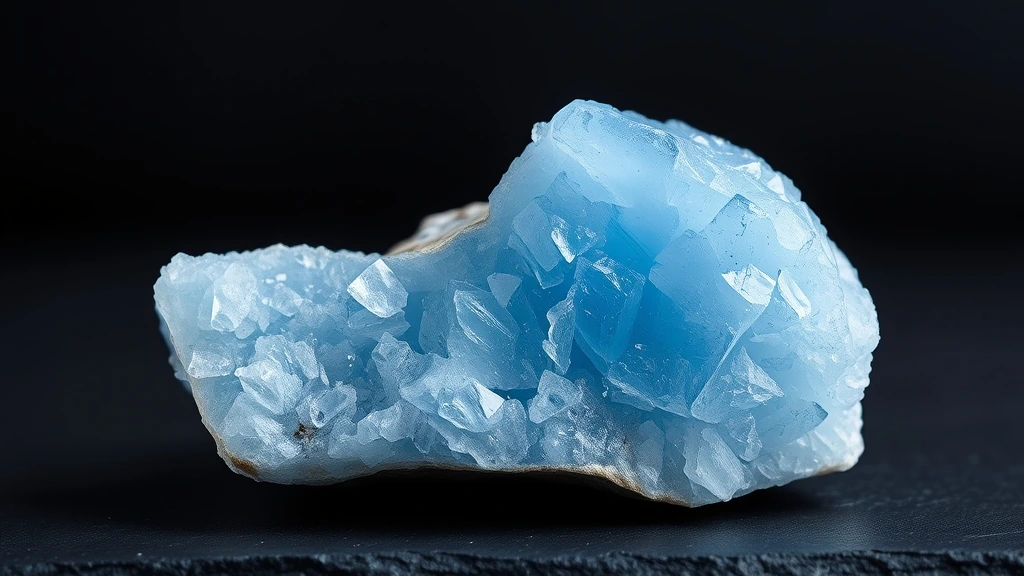
Halite belongs to the halide mineral group, characterized by ionic bonds between sodium and chlorine. Geologically, it forms primarily through the evaporation of saline water bodies. This process creates vast evaporite deposits where pure rock salt crystallizes. The blue variety remains chemically identical to common white halite. Its rarity stems from specific trace element inclusions during formation. In comparative mineralogical collections, practitioners and geologists frequently study Blue Dolomite alongside this crystal to appreciate their subtle energetic and structural differences.
What is Blue Halite? Geological Overview & Definition
Blue halite is a color variety of the common mineral halite, or rock salt. It occurs within large evaporite basins where ancient seas once existed. The stone typically forms as cubic crystals or massive aggregates. Its softness makes it susceptible to rapid weathering and dissolution. In comparative mineralogical collections, practitioners and geologists frequently study Amber Calcite alongside this crystal to appreciate their subtle energetic and structural differences.
The blue coloration is not intrinsic to the sodium chloride lattice. Instead, it results from F-centers or specific impurity inclusions. These defects absorb certain wavelengths of visible light. Consequently, the stone reflects blue tones to the observer. This phenomenon distinguishes it from standard white or pink halite.
Blue Halite Chemical Composition & Crystallographic Properties
The mineral adopts a perfect isometric crystal system, often displaying well-formed cubes. Its lattice structure consists of alternating sodium and chloride ions. This arrangement creates a highly symmetrical and stable framework. The Mohs hardness ranges from 2.0 to 2.5, indicating extreme softness.
Color in blue halite frequently originates from chromophore color centers. These are electron traps within the crystal lattice caused by radiation. Alternatively, trace impurities like cobalt may contribute to the hue. The stone lacks a distinct stoichiometric formula beyond NaCl due to these variable inclusions.
Halite exhibits significant acid sensitivity and high solubility in water. It dissolves rapidly, making it unsuitable for traditional jewelry settings. Thermal behavior shows no distinct melting point before decomposition. The ionic bonds break down under extreme heat.
The cation substitution mechanism is minimal in pure halite. Most color variations stem from structural defects rather than atomic replacement. This distinguishes it from other colored minerals. Understanding this helps identify authentic specimens.
| Property | Specification |
|---|---|
| Mineral Group | Halides (Sodium Chloride / Rock Salt) |
| Mohs Hardness | 2.0 – 2.5 |
| Crystal System | Isometric / Cubic (Cubic crystals or massive rock salt) |
| Color & Optical Properties | Natural Blue Halite color spectrum and optical dispersion |
| Primary Mining Localities | Pakistan (Khewra Salt Mine), USA, Poland (Wieliczka), Germany, Austria |
| Water & Chemical Resistance | EXTREMELY SENSITIVE: Highly Water-Soluble & Hygroscopic! (Never wash or expose to water/liquids) |
| Chakra Alignment (Traditional) | Root Chakra and Sacral Chakra |
| Zodiac Affinity (Traditional) | Taurus, Virgo, Capricorn |
| Symbolic Meaning (Traditional) | Purification, environmental energy clearing, grounding, and atmospheric balance |
Blue Halite Varieties & Color Spectrum
Blue Halite displays distinct mineralogical characteristics across its geological varieties and structural habits. Gemologists evaluate these natural varieties based on crystal habit, trace chromophore concentrations, and visual luster.
Primary Natural Blue Halite
The benchmark natural variety exhibiting diagnostic color saturation and classic crystallographic symmetry.
Distinct Geological Morphs of Blue Halite
Secondary regional and structural varieties formed under localized geological temperature and pressure conditions.
Azure Sea Halite
Formed in evaporitic basins where magnesium‑rich brines infiltrate sodium chloride layers, Azure Sea Halite displays a deep cobalt hue caused by trace copper and cobalt ions. Thin, parallel laminae of calcite often create a subtle iridescent sheen, and the crystals grow in well‑defined cubic forms. This variety is relatively rare, sourced mainly from the Salar de Uyuni region of Bolivia, where high‑altitude evaporation intensifies the coloration.
Sky‑Blue Evaporite Halite
In the arid flats of the Great Salt Lake, Utah, Sky‑Blue Evaporite Halite acquires its pastel blue tint from minute inclusions of gypsum and organic matter that scatter light. The crystals are typically massive rather than well‑formed, with a glassy luster that deepens under UV illumination. Although abundant in the lake’s shoreline, the finest transparent specimens command premium prices among collectors.
Indigo Ocean Halite
Deep within the Danakil Depression of Ethiopia, Indigo Ocean Halite forms in hyper‑saline pools where iron‑bearing brines interact with sodium chloride. The resulting indigo shade is a product of Fe³⁺ complexation, often accompanied by fine‑grained halite‑sand mixtures that give a speckled appearance. This variety is exceptionally scarce due to the harsh extraction environment and limited accessibility.
Pale Celeste Halite
Found in the evaporite sequences of the Searles Lake basin, California, Pale Celeste Halite exhibits a delicate sky‑blue to almost white coloration, driven by low concentrations of manganese and trace rare‑earth elements. The crystals are frequently transparent with a faint, milky translucence caused by fluid inclusions of brine. Its moderate rarity makes it a favored material for high‑end decorative mosaics.
Turquoise‑Veined Halite
In the salt pans of the Dead Sea, Turquoise‑Veined Halite displays striking turquoise bands formed by intergrowths of magnesium sulfate and calcium carbonate. The veins run parallel to crystal faces, creating a marbled effect that is prized in lapidary work. While the overall deposit is extensive, the veined specimens are limited to specific stratigraphic horizons, enhancing their market value.
Sapphire‑Tinted Halite
The Kalahari salt flats of Namibia yield Sapphire‑Tinted Halite, where trace nickel and cobalt impart a vivid sapphire‑like hue. Crystals often occur as large, well‑developed cubes with a high degree of clarity, making them suitable for faceting. This variety is among the most coveted due to its striking color and the logistical challenges of mining in remote desert conditions.
Where is Blue Halite Found? Geological Mining & Extraction
Blue halite typically occurs in evaporite sequences where ancient inland seas or lagoons underwent extensive evaporation, leaving thick halite beds interlayered with gypsum, anhydrite, and dolomite. The mineral precipitates as cubic crystals within fine‑grained, porous host rocks, and its coloration is enhanced by trace transition‑metal ions introduced during diagenesis.
Commercial extraction concentrates on three principal regions: the Salar de Uyuni (Bolivia), the Danakil Depression (Ethiopia), and the Dead Sea basin (Israel/Jordan). In each locale, mining employs shallow open‑pit methods and careful brine flushing to preserve crystal integrity, followed by washing, air‑drying, and sorting to separate the blue‑tinged fractions from colorless halite.
Historical Significance & Cultural Lore of Blue Halite
Across ancient lapidary traditions, blue halite was prized for its purifying qualities and its ability to reflect the sky, symbolizing divine protection. In Egyptian tombs, small polished blue halite beads have been recovered, suggesting use in amulets intended to guard against malevolent forces and to balance the atmospheric energy of the afterlife.
Greek writers such as Pliny the Elder described “sea‑salt crystals of a deep azure” as talismans for sailors, believing they could calm turbulent waters and anchor the Root Chakra of the wearer. In Vedic texts, the stone is linked to the Sacral Chakra, employed in ritual baths to cleanse both body and spirit, reinforcing its longstanding reputation as a conduit for grounding and environmental energy clearing.
Modern Uses & Jewelry Applications of Blue Halite
Due to its low Mohs hardness of 2.0 to 2.5, blue halite is rarely cut into high-faceted gems for daily wear. Instead, lapidaries typically polish it into smooth cabochons or simple geometric shapes to preserve its structural integrity. The material’s delicate nature makes it ideal for occasional-wear pendants, earrings, and decorative carvings rather than rings or bracelets.
- Cabochon Polishing: The primary cutting method, yielding smooth, domed surfaces that highlight the stone’s translucent blue hue without risking fracture.
- Ornamental Carvings: Artisans shape massive halite deposits into decorative boxes, paperweights, and sculptural elements for interior design.
- Pendant Settings: Stones are often bezel-set in silver or gold to protect the soft crystal faces from accidental abrasion.
Metaphysical Uses & Origins of Blue Halite
In historical lapidary traditions, halite has been revered as a powerful agent for purification and energetic cleansing. Practitioners often place this mineral in meditation spaces to absorb stagnant energy and promote atmospheric balance. Its crystalline structure is believed to resonate with the earth’s natural frequencies, aiding in deep mental clarity.
Beyond personal practice, blue halite is integrated into architectural arts and sacred geometry. Ancient cultures utilized salt crystals to consecrate spaces, believing their ionic properties could neutralize negative vibrations. In modern metaphysical contexts, it serves as a grounding tool, helping practitioners feel anchored and connected to the physical realm.
Which Chakra and Zodiac Signs Align with Blue Halite?
Blue halite is primarily aligned with the Root Chakra and the Sacral Chakra. The Root Chakra connection stems from the mineral’s strong grounding properties, which help stabilize the body’s energy field. Meanwhile, its association with the Sacral Chakra reflects its ability to balance emotional flow and creative vitality.
Astrologically, this mineral resonates strongly with the earth signs of Taurus, Virgo, and Capricorn. These signs value stability, practicality, and structured energy, which mirrors the cubic crystal system of halite. Wearing or displaying this stone is believed to enhance the inherent discipline and reliability associated with these zodiacal archetypes.
How to Identify Real vs. Fake Blue Halite
Artificial imitations of blue halite are common, often involving dyed clear halite, synthetic glass, or plastic replicas. These fakes may mimic the color but lack the natural internal inclusions and specific gravity of genuine mineral specimens. Distinguishing real blue halite requires careful observation of its physical properties and structural characteristics.
Practical At-Home Authenticity Tests
- Temperature Test (Thermal Feel): Genuine halite feels distinctly cool to the touch initially due to its thermal conductivity. Synthetic glass or plastic imitations often warm up more quickly under the palm, lacking that initial mineral chill.
- Specific Gravity & Weight Test: Real halite has a specific gravity of approximately 2.17. It should feel heavier than a similarly sized piece of plastic or lightweight resin. If the stone feels suspiciously light, it is likely a synthetic imitation.
- Scratch & Hardness Test (Mohs Comparison): With a Mohs hardness of 2.0 to 2.5, genuine blue halite can be easily scratched by a copper coin or even a fingernail. If the surface resists scratching from a coin, the material is likely glass or a harder synthetic substitute.
- Microscopic & Loupe Inspection (Internal Inclusions): Use a 10x loupe to examine the stone’s interior. Natural halite often displays tiny fluid inclusions, micro-bubbles, or subtle color zoning. Perfectly clear, inclusion-free stones are highly suspect and likely synthetic.
Blue Halite Valuation Factors, Grading & Pricing
The market value of blue halite hinges first on color variations. A deep, saturated azure is prized, while lighter tints or mottled patterns can reduce desirability. Natural texture—whether smooth, flaky, or crystalline—adds visual interest, and subtle banding or veining can enhance aesthetic appeal, making a specimen stand out among ordinary salt formations.
Second, the specimen mass and size play a decisive role. Larger, well‑formed blocks that maintain structural integrity without fissures command higher prices. The ability of the crystal lattice to diffuse light subtly, creating a gentle glow, is also a key aesthetic criterion. Hand‑carved details or ornamental cuts, when executed with precision, can elevate the piece’s ornamental value, though they are evaluated purely on craftsmanship rather than carving craftsmanship and block integrity.
Finally, geographical origin and authenticity influence market perception. Provenance from renowned salt deposits—such as the Dead Sea, the Great Salt Lake, or historic mining districts—adds credibility and can justify premium pricing. Current wholesale trends show a growing demand for ethically sourced, wellness‑oriented minerals, with buyers seeking blue halite for its reputed grounding and purification properties.
How to Clean and Care for Blue Halite
Due to its highly hygroscopic and water‑soluble nature, water, liquid soaps, and damp wiping must be strictly avoided; moisture directly dissolves and pits the salt crystal lattice. Clean exclusively with a dry soft microfiber cloth or camel‑hair brush. Ultrasonic cleaning is strictly forbidden. Store the specimen in a low‑humidity environment, away from liquids and direct sunlight, to preserve its structural integrity.
Cleansing and Recharging Blue Halite (Energetic Care)
To cleanse the energetic field of blue halite, gently smudge the stone with sage or palo santo in a well‑ventilated space, allowing the smoke to circulate for a few minutes before removing any residual ash. Afterward, expose the mineral to gentle moonlight for several hours; the soft lunar illumination can help reset its vibrational balance without introducing heat.
Resting the stone on a selenite charging slab for a short period—no more than 24 hours—provides a subtle, non‑thermal energy transfer that can enhance its grounding properties. Avoid any form of domestic heating, ovens, heat guns, boiling, or direct intense sunlight, as these conditions can damage the delicate crystal lattice and diminish the mineral’s therapeutic qualities.
Frequently Asked Questions About Blue Halite
Blue Halite displays distinct mineralogical characteristics across its geological varieties and structural habits. Gemologists evaluate these natural varieties based on crystal habit, trace chromophore concentrations, and visual luster.
Primary Natural Blue Halite
The benchmark natural variety exhibiting diagnostic color saturation and classic crystallographic symmetry.
Distinct Geological Morphs of Blue Halite
Secondary regional and structural varieties formed under localized geological temperature and pressure conditions.
Is blue halite safe to wear in the shower?
No – it must never be exposed to water or moisture. Blue halite is highly hygroscopic and water‑soluble, so even brief contact with steam or droplets will begin to dissolve the crystal lattice, causing irreversible pitting and loss of clarity. Always remove jewelry before bathing.
How should I clean a blue halite pendant?
Clean only with a dry, soft microfiber cloth or a camel‑hair brush. Because moisture instantly attacks the salt crystal structure, any damp wiping, liquid soap, or ultrasonic cleaning will create microscopic pits and weaken the stone. Gentle dry dusting preserves its brilliance.
Can I store blue halite in a humid environment?
No – store it in a completely dry, airtight container. The mineral’s hygroscopic nature draws water from the air, leading to surface clouding and eventual dissolution. Desiccant packets or sealed glass jars are the safest storage solutions.
Does blue halite have any zodiac associations?
Yes – it aligns with Taurus, Virgo, and Capricorn. In astrological gem lore, these earth signs are said to benefit from the stone’s grounding energy, reinforcing stability and practical focus. The alignment is consistent across traditional Western and Vedic interpretations.
Which chakras does blue halite influence?
It is linked to the Root Chakra and the Sacral Chakra. These energy centers correspond to grounding, stability, and creative flow, and the stone’s cool blue hue is believed to support emotional balance and physical vitality when placed on these chakras.
Is blue halite suitable for everyday wear?
It can be worn daily if protected from moisture and impact. With a Mohs hardness of 2.0–2.5, the stone is soft and prone to scratches, so setting it in protective bezels and avoiding contact with liquids or hard surfaces is essential for longevity.
What is the crystal system of blue halite?
Blue halite crystallizes in the isometric (cubic) system. Its crystals often form perfect cubes or massive aggregates, reflecting the cubic lattice of common rock salt. This geometry contributes to its characteristic cleavage planes, which must be handled delicately.
Does blue halite have any known metaphysical properties?
It is reputed for purification, grounding, and atmospheric balance. Practitioners claim the stone absorbs negative energy, clears environmental fields, and stabilizes the wearer’s aura, especially when placed in living spaces or worn near the Root and Sacral Chakras.