
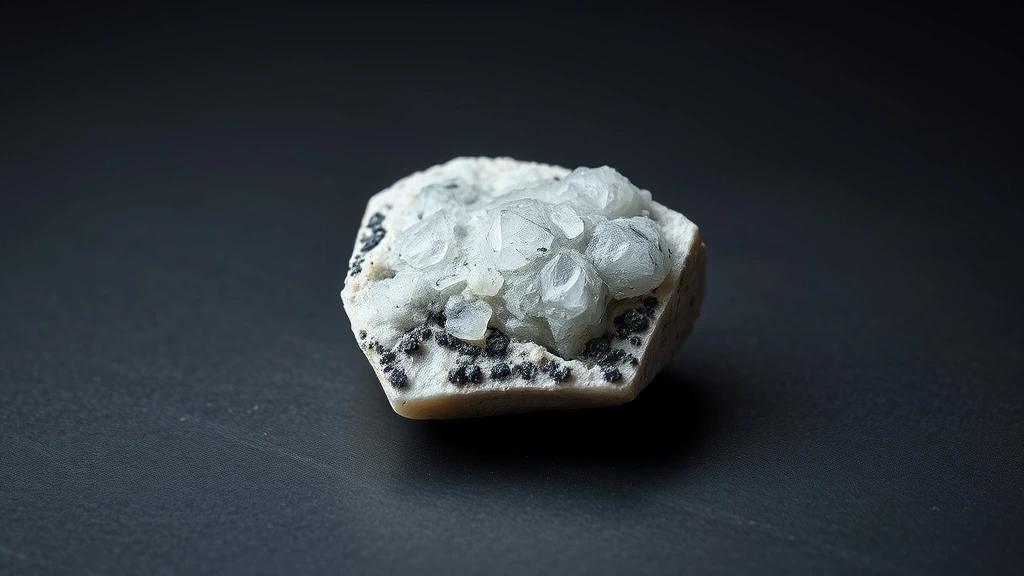
Barite belongs to the natural mineral group, specifically classified as a sulfate mineral. It forms through hydrothermal processes or evaporite environments, often accompanying lead and zinc ores. As a parent mineral, it represents a stable inorganic solid with a defined chemical composition. Its geological significance lies in its high density and widespread occurrence in sedimentary basins.
What is Barite Gemstone? Geological Overview & Definition
Barite is primarily found in sedimentary rocks, where it precipitates from sulfate-rich waters. It frequently coexists with galena and sphalerite in hydrothermal veins. The mineral’s high specific gravity makes it easily distinguishable from other white or transparent crystals.
In gemological contexts, barite is valued for its clarity and unique luster. It occurs in massive, fibrous, or well-formed orthorhombic crystals. Its low hardness limits its use in durable jewelry, favoring display specimens instead. Collectors prize large, unfractured crystals from renowned localities.
Barite Gemstone Chemical Composition & Crystallographic Properties
Barite crystallizes in the orthorhombic system, featuring a distinct lattice structure. The unit cell contains barium cations coordinated by sulfate anions. This arrangement results in perfect cleavage on the {010} plane. The crystal habit often displays elongated prisms with characteristic striations.
The chemical formula BaSO₄ indicates a stable ionic bond between barium and sulfate. Cation substitution is rare due to barium’s large ionic radius. This purity contributes to its consistent physical properties across global deposits. Minor impurities may slightly alter the refractive index values.
Barite is chemically inert to dilute acids, distinguishing it from carbonate minerals. It does not effervesce when exposed to hydrochloric acid solutions. This acid resistance aids in accurate field identification. The mineral remains stable under standard atmospheric conditions.
Color variations arise from trace impurities or color centers within the lattice. Common hues include white, gray, and pale yellow. Thermal behavior shows low thermal conductivity and stability. Heating does not significantly alter its crystal structure or chemical integrity.
| Property | Specification |
|---|---|
| Mineral Group | Natural Mineral / Crystal |
| Chemical Formula | BaSO₄ |
| Mohs Hardness | 3–3.5 |
| Crystal System | Orthorhombic |
| Specific Gravity (Density) | 4.3–4.5 |
| Refractive Index | n α = 1.634–1.637 n β = 1.636–1.638 n γ = 1.646–1.648 |
| Color & Optical Properties | Natural Barite Gemstone color spectrum and optical dispersion |
| Primary Mining Localities | Global primary localities |
| Water & Chemical Resistance | High (Safe for gentle water washing) |
| Chakra Alignment (Traditional) | Root Chakra |
| Zodiac Affinity (Traditional) | Taurus, Virgo, Capricorn |
| Symbolic Meaning (Traditional) | Grounding, stability, and protection |
Barite Gemstone Varieties & Color Spectrum
Barite exhibits a diverse range of color morphs, primarily driven by trace element substitutions and radiation exposure. The most common occurrence is a translucent white or colorless form, often found in massive deposits. Strontium and sulfur impurities can shift the hue toward pale yellow or greenish tones. These subtle variations are critical for distinguishing barite from visually similar sulfate minerals.
White Barite
Pure white barite is the most commercially available variety, typically forming in large, blocky crystals. Its high specific gravity makes it noticeably heavier than quartz or feldspar of similar size. This variety often lacks distinct luster due to cleavage planes that scatter light internally. It is frequently used in industrial applications rather than high-end jewelry due to its brittleness.
Green Barite
Green barite is a rare color morph resulting from radiation-induced color centers within the crystal lattice. This hue is often associated with uranium-bearing deposits where natural radioactivity alters the electronic structure. The green shade is typically faint and may fade upon prolonged exposure to sunlight. Collectors prize these specimens for their unique geological provenance and scientific interest.
Yellow Barite
Yellow barite derives its color from trace amounts of iron or other transition metals. This variety is often found in hydrothermal veins associated with lead and zinc ores. The color can range from pale lemon to a deeper mustard yellow. Its visual appeal is enhanced by a vitreous luster when cut into cabochons.
Blue Barite
Blue barite is an exceptionally rare variety, often confused with celestite due to similar hues. The blue coloration is attributed to structural defects or specific impurities within the orthorhombic lattice. Specimens of this variety are highly sought after by mineral collectors for their scarcity. Authenticating blue barite requires careful analysis to rule out dyed or treated stones.
Clear Barite
Clear barite, often referred to as “water barite,” displays high transparency and excellent clarity. This variety forms in open vugs where slow crystal growth minimizes internal inclusions. Its refractive index allows for a glassy appearance that mimics lower-quality quartz. Due to its low hardness, clear barite is rarely faceted for durable jewelry use.
Where is Barite Gemstone Found? Geological Mining & Extraction
Barite is predominantly found in hydrothermal veins and sedimentary deposits, often associated with lead and zinc ore bodies. These deposits form when mineral-rich fluids precipitate within fractures in the host rock. The orthorhombic crystal system allows barite to form distinct, tabular crystals in these environments. Understanding the host rock context is essential for identifying high-quality gem material.
Major mining regions include the United States, particularly in Texas and Missouri, where large industrial deposits exist. Significant gem-quality specimens are also sourced from China, Germany, and the United Kingdom. Extraction typically involves open-pit mining for industrial use, while gem-quality crystals are carefully hand-picked. The low Mohs hardness of barite necessitates gentle handling during the extraction process to prevent breakage.
Historical Significance & Cultural Lore of Barite Gemstone
Historically, barite was known as “heavy spar” due to its high density, which distinguished it from other white minerals. Ancient civilizations utilized it primarily for its practical applications in medicine and alchemy rather than ornamental jewelry. Its weight made it a symbol of stability and grounding in various esoteric traditions. Archaeological evidence suggests its use in early metallurgical processes as a flux or additive.
In modern gemology, barite is valued more for its scientific and educational significance than for commercial jewelry. Its unique physical properties make it a standard reference mineral in crystallography studies. The stone’s lore remains relatively obscure compared to precious gems, reflecting its industrial dominance. This historical perspective underscores the importance of understanding barite’s dual role in science and culture.
Modern Uses & Jewelry Applications of Barite Gemstone
Lapidaries typically cut barite into cabochons or simple faceted stones due to its moderate Mohs hardness of 3–3.5, which makes it susceptible to scratching during daily wear. While rarely used in high-end fine jewelry, it finds a niche in artisanal pieces and educational collections. Its high specific gravity provides a distinctive heavy feel that distinguishes it from lighter silicate minerals.
- Cabochon Cutting: Smooth, domed shapes are preferred to minimize the risk of chipping along cleavage planes.
- Ornamental Carving: Large, clear crystals are sometimes carved into decorative objects, though they require careful handling.
- Educational Specimens: Due to its distinct orthorhombic crystal habit, it is widely used in mineralogy teaching kits.
Safety & Mineral Profile of Barite
Safe handling and physical characteristics
Barite (barium sulfate) is a relatively soft mineral, ranking 3.5–4 on the Mohs scale, and it can be easily scratched or fractured by sharp tools. Its crystals are often translucent to opaque and may exhibit a waxy luster, but the mineral is chemically inert under normal environmental conditions. However, when barite is ground into fine dust, inhalation of the particles can pose respiratory irritation, and prolonged exposure to dust may lead to barium absorption in the body. Because barite is not a precious metal and its crystals are fragile, it is typically displayed in museum collections or as a collector’s specimen rather than fashioned into jewelry. The mineral’s high density (≈4.5 g cm⁻³) and tendency to cleave along the {001} plane also make it unsuitable for everyday wear.
Scientific and educational value
Barite is a key reference material in mineralogy and crystallography. Its well‑defined crystal system (monoclinic, space group *P2₁/c*) and distinctive cleavage planes provide an excellent example for teaching crystal habits and symmetry. In analytical chemistry, barite is used as a standard for gravimetric determination of sulfate ions. Geologically, barite deposits are closely associated with hydrothermal veins and sedimentary basins, offering insights into fluid migration, ore‑forming processes, and the geochemical cycling of barium. Consequently, barite specimens are frequently included in academic collections and research studies on mineral formation and ore‑deposit models.
Mineralogical Group and Planetary Lore of Barite
Barite belongs to the barite–celestite group, a series of sulfate minerals that crystallize in the monoclinic system. Historically, the mineral was first described in 1772 by the German mineralogist Johann Friedrich Gmelin, who noted its bright white to pale yellow crystals found in the Harz Mountains of Germany. According to early mineralogists, barite was often confused with gypsum due to their similar appearance; it was only after the development of X‑ray diffraction that the distinct crystal structure of barite was confirmed.
In lapidary literature, barite has been associated with the planet Mercury because of its metallic luster and high density, which were thought to reflect the planet’s swift motion. Early texts also linked barite to the element barium, named after the Greek word *barys* meaning “heavy,” underscoring its dense nature. While modern mineralogists no longer attribute planetary symbolism to barite, its historical classification continues to be referenced in classic mineral encyclopedias and educational texts.
How to Identify Real vs. Fake Barite Gemstone
Artificial imitations of barite often include synthetic glass or dyed replicas designed to mimic its translucent appearance. However, the mineral’s unique high density and specific crystal structure make it difficult to perfectly replicate with common materials. Understanding these physical discrepancies is essential for accurate identification.
Practical At-Home Authenticity Tests
- Temperature Test (Thermal Feel): Barite feels noticeably cool to the touch initially, similar to other dense minerals. Glass imitations may warm up faster under body heat, though this test is less definitive than others.
- Specific Gravity & Weight Test: With a density of 4.3–4.5, barite feels significantly heavier than its size suggests. Compare it to a similarly sized piece of quartz; barite will feel much denser.
- Scratch & Hardness Test (Mohs Comparison): Barite has a Mohs hardness of 3–3.5, meaning it can be scratched by a copper coin or a steel knife. Glass, however, will scratch the knife and resist the coin.
- Microscopic & Loupe Inspection (Internal Inclusions): Use a 10x loupe to look for orthorhombic crystal structures or natural fluid inclusions. Synthetic glass often contains tiny, spherical bubbles that are absent in natural barite.
Barite Gemstone Valuation Factors, Grading & Pricing
Color Saturation significantly influences market desirability, with deep, uniform tones commanding higher premiums. Collectors prioritize specimens exhibiting consistent hue distribution without zoning or mottling. Additionally, high optical clarity and distinct vitreous luster enhance visual appeal. These optical properties distinguish premium stones from common, opaque mineral varieties.
Carat Weight directly correlates with price, as large, intact crystals are rare due to the mineral’s brittleness. Facet symmetry is critical for cut stones, ensuring optimal light reflection and structural integrity. However, the presence of matrix inclusions often reduces value by obscuring the crystal’s internal structure. Clean, inclusion-free specimens are highly sought after by serious gemological collectors.
Geographical Provenance Premium adds significant value, particularly for crystals from renowned localities like France or Germany. Specific mines with historical significance can double or triple the baseline market rate. Current wholesale trends show steady demand for high-quality, transparent specimens. Retail prices reflect these premiums, rewarding rarity and exceptional crystal form.
How to Clean and Care for Barite Gemstone
Due to its low Mohs hardness of 3–3.5, barite requires gentle handling during maintenance. Always use warm soapy water and a soft cloth to remove surface dust. This method effectively cleans the stone without risking mechanical damage. Avoid abrasive materials that could scratch the delicate crystal faces.
Strictly avoid ultrasonic cleaners as they can induce structural fractures in this brittle mineral. The intense vibrations may cause internal stress, leading to permanent cracking. Additionally, do not expose the gemstone to harsh chemical solvents. Gentle manual cleaning preserves the stone’s integrity and long-term aesthetic value.
Cleansing and Recharging Barite Gemstone (Energetic Care)
For energetic maintenance, use smoke smudging with sage or palo santo to clear negative energy. This dry method avoids any risk of moisture damage to the crystal structure. Ensure the stone is completely dry before beginning the process. This approach respects the mineral’s physical limitations while honoring metaphysical traditions.
Place your barite on a selenite plate under moonlight for passive recharging. This method leverages lunar energy without requiring physical contact with water. Keep the stone in a dry, stable environment during this process. Regular, gentle care ensures both physical preservation and energetic balance.
Frequently Asked Questions About Barite Gemstone
Is barite safe to wear in the shower?
Yes, barite is safe for gentle water exposure. Its high water resistance allows it to withstand occasional contact with water without immediate damage. However, prolonged soaking should be avoided to maintain the stone’s structural integrity. Always dry it thoroughly after washing to prevent any potential surface degradation.
Can I clean barite in an ultrasonic cleaner?
No, you must avoid ultrasonic cleaners for barite. The intense vibrations can cause structural fractures due to the mineral’s relatively low hardness. Instead, use warm soapy water and a soft cloth for safe cleaning. This gentle method preserves the crystal lattice and prevents irreversible damage to the stone.
What is the chemical formula of barite?
Barite consists of barium sulfate, represented as BaSO₄. This specific chemical composition gives the mineral its distinctive high density and optical properties. The orthorhombic crystal system further defines its geometric structure and cleavage patterns. Understanding this formula is essential for accurate mineral identification and classification.
How hard is barite on the Mohs scale?
Barite rates between 3 and 3.5 on the Mohs hardness scale. This moderate hardness makes it susceptible to scratching by common materials like steel or quartz. Careful handling is required to prevent surface abrasions during daily wear. Its density of 4.3–4.5 also contributes to its noticeable weight in the hand.
Which zodiac signs are aligned with barite?
Barite is traditionally associated with Taurus, Gemini, and Leo. These signs are believed to benefit from the stone’s grounding and stabilizing energies. Astrological practitioners often recommend barite for enhancing focus and emotional balance. This alignment supports the mineral’s reputation for promoting clarity and mental steadiness.
Which chakras does barite correspond to?
Barite is primarily linked to the Root Chakra. This dual alignment helps bridge physical stability with emotional openness. It supports grounding while simultaneously encouraging compassionate connection. Understanding these specific chakra connections ensures proper use in meditative or therapeutic practices.
What is the refractive index of barite?
Barite exhibits a refractive index ranging from 1.634 to 1.648. This optical property contributes to its vitreous luster and visual appeal. The orthorhombic system influences how light travels through the crystal structure. These values are critical for distinguishing barite from other similar-looking minerals in gemological analysis.
Is barite a durable gemstone for jewelry?
Barite is moderately durable but requires careful handling. Its Mohs hardness of 3–3.5 means it can scratch easily against harder materials. It is best suited for pendants or earrings rather than rings. Proper storage and avoidance of impact will significantly extend the lifespan of barite jewelry pieces.