
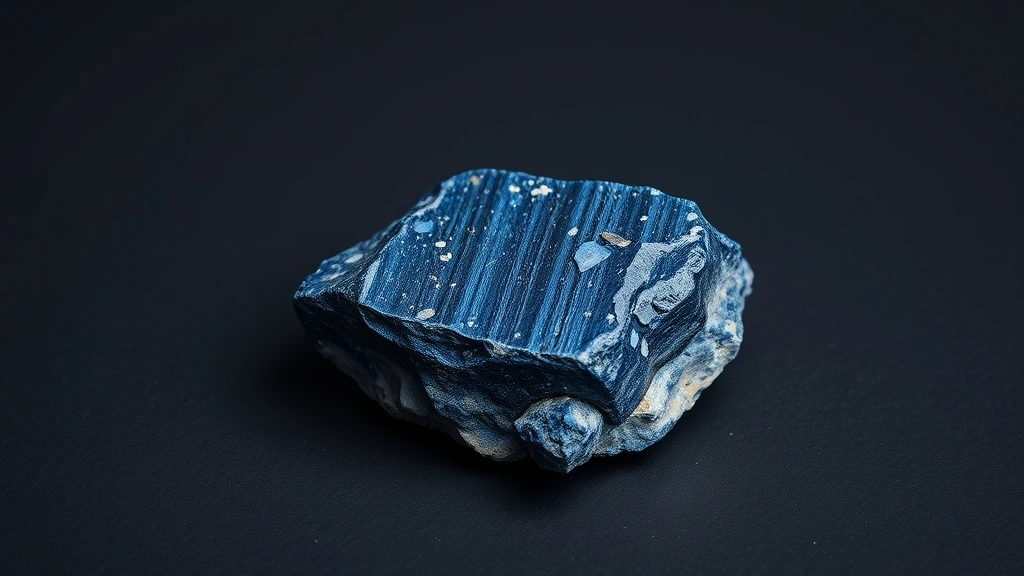
Blue kyanite belongs to the natural mineral/crystal category and is classified within the triclinic crystal system, the most asymmetrical of the seven systems. It forms elongated, bladed crystals that develop in metamorphic environments where aluminum‑rich rocks are subjected to high pressure. The mineral’s distinctive pleochroism and perfect basal cleavage make it a favored material for both scientific study and ornamental use, while its density of 3.53–3.61 g/cm³ underscores its compact atomic packing.
What is Blue Kyanite? Geological Overview & Definition
Blue kyanite is a metamorphic silicate that crystallizes in the triclinic system, typically occurring in schist and gneiss zones of regional metamorphism. Its formation requires temperatures between 400 °C and 600 °C and pressures of 4–10 kbar, conditions that promote the rearrangement of aluminosilicate layers into the characteristic blade‑like habit.
Across ancient lapidary traditions, blue kyanite has been prized for its striking color and its ability to split cleanly along perfect cleavage planes, a property that ancient artisans exploited for carving beads and inlay work. Its rarity in the blue spectrum is due to trace chromophore ions, primarily iron and titanium, which substitute into the crystal lattice and generate the vivid coloration. In comparative mineralogical collections, practitioners and geologists frequently study Chlorite On Quartz alongside this crystal to appreciate their subtle energetic and structural differences.
Blue Kyanite Chemical Composition & Crystallographic Properties
The mineral’s ideal composition is Al₂SiO₅, yet natural specimens often exhibit minor cation substitution where Fe³⁺, Ti⁴⁺, or Mg²⁺ replace aluminum, subtly altering physical properties without changing the overall stoichiometry. These substitutions are responsible for the blue hue and can affect the refractive index, which typically lies between 1.734 and 1.737. In comparative mineralogical collections, practitioners and geologists frequently study Chinese Bladed Calcite alongside this crystal to appreciate their subtle energetic and structural differences.
Blue kyanite’s triclinic lattice is defined by three unequal axes intersecting at oblique angles, resulting in the lowest symmetry among crystal systems. This asymmetry produces the mineral’s pronounced perfect basal cleavage, allowing it to split into thin, flexible sheets that can be polished to a high luster.
The mineral is acid‑sensitive; exposure to strong acids can partially dissolve the surface, especially along cleavage planes, because the Al–O bonds are vulnerable to proton attack. Consequently, cleaning and setting procedures for jewelry must avoid harsh chemical agents.
When heated above approximately 500 °C, blue kyanite undergoes a reversible phase transition to andalusite, another Al₂SiO₅ polymorph, releasing stored strain energy. This thermal behavior is exploited in laboratory settings to study pressure–temperature histories of metamorphic rocks, providing insight into the tectonic forces that created the stone.
| Property | Specification |
|---|---|
| Mineral Group | Natural Mineral / Crystal |
| Chemical Formula | Al₂SiO₅ |
| Mohs Hardness | 4.5 – 7.0 |
| Crystal System | Triclinic |
| Specific Gravity (Density) | 3.53 – 3.61 |
| Refractive Index | 1.734 – 1.737 |
| Color & Optical Properties | Natural Blue Kyanite color spectrum and optical dispersion |
| Primary Mining Localities | Global primary localities |
| Water & Chemical Resistance | Sensitive (Avoid prolonged water soaking) |
| Chakra Alignment (Traditional) | Throat Chakra, Third Eye Chakra |
| Zodiac Affinity (Traditional) | Taurus, Libra, Virgo |
| Symbolic Meaning (Traditional) | Clarity of thought, truth, and effective communication |
Blue Kyanite Varieties & Color Spectrum
Blue Kyanite displays distinct mineralogical characteristics across its geological varieties and structural habits. Gemologists evaluate these natural varieties based on crystal habit, trace chromophore concentrations, and visual luster.
Primary Natural Blue Kyanite
The benchmark natural variety exhibiting diagnostic color saturation and classic crystallographic symmetry.
Distinct Geological Morphs of Blue Kyanite
Secondary regional and structural varieties formed under localized geological temperature and pressure conditions.
Classic Blue Kyanite
The most widely recognized variety exhibits a deep azure hue, often with a subtle greenish tint. It crystallizes in slender, needle‑like aggregates within quartz‑rich pegmatites. Inclusions of quartz and feldspar give the stone a slightly speckled appearance, while its high refractive index (1.734–1.737) produces a striking brilliance. Classic blue kyanite is moderately common, especially in the United States and Brazil, making it the staple of the gemstone market.
Light Blue Kyanite
Light blue kyanite displays a translucent, almost pale cerulean color that fades to a milky white at the edges. This variety forms in high‑temperature pegmatites where magnesium and calcium impurities are minimal. The crystals are typically shorter and more rounded, with fine, parallel striations that enhance its delicate luster. Light blue kyanite is rarer than its darker counterpart, prized by collectors for its subtlety.
Green‑Blue Kyanite
Green‑blue kyanite is a hybrid hue, blending emerald green with a blue base. The green tint arises from trace amounts of chromium or vanadium incorporated during crystallization. It often occurs in sodium‑rich pegmatites, producing a slightly opaque, mottled texture. Due to its uncommon coloration, green‑blue kyanite commands a premium in the fine‑stone market.
Black‑Blue Kyanite
Black‑blue kyanite is distinguished by a deep indigo that borders on black. The darkness results from high concentrations of iron and manganese during formation. This variety is typically found in feldspar‑rich pegmatites and exhibits a matte, almost satin finish. Black‑blue kyanite is extremely rare, with most specimens sourced from limited deposits in the United States and Russia.
Red‑Blue Kyanite
Red‑blue kyanite showcases a striking crimson‑blue blend, a result of iron‑oxide inclusions. The stone’s color is highly variable, ranging from a subtle blush to a vivid scarlet overlay. It forms in granite‑associated pegmatites where iron is abundant. Due to its limited supply, red‑blue kyanite is a coveted specimen among high‑end collectors.
Blue‑Green Kyanite (Zultanite)
Blue‑green kyanite, also known as Zultanite, exhibits a fluctuating color that shifts between blue and green under different lighting. This optical phenomenon is caused by anisotropic crystal structure and the presence of chromium. The stone is typically found in sodium‑rich pegmatites and is highly prized for its color‑changing properties. Zultanite is exceptionally rare, with most specimens originating from Turkey and the United States.
Where is Blue Kyanite Found? Geological Mining & Extraction
Blue kyanite is predominantly extracted from quartz‑rich pegmatites that form in the late stages of granite crystallization. These pegmatites host a complex assemblage of feldspar, mica, and accessory minerals, providing the ideal environment for kyanite to grow in elongated, needle‑like crystals. The most productive regions include the United States (particularly the Appalachian and New England areas), Brazil (Southeast Brazil), Russia (Siberia), and Turkey (Kars province). Mining operations typically involve open‑pit or underground methods, with careful sorting to preserve the delicate crystal structures.
Extraction of blue kyanite requires meticulous processing to avoid fracturing the fragile crystals. After crushing the host rock, the material is subjected to gravity separation and magnetic sorting to isolate kyanite from quartz and feldspar. The resulting concentrate is then hand‑polished or laser‑cut to enhance its optical properties. Due to the mineral’s sensitivity to heat, thermal treatment is avoided, ensuring that the natural refractive index and color remain intact.
Historical Significance & Cultural Lore of Blue Kyanite
Across ancient lapidary traditions, blue kyanite was revered for its association with the throat chakra and the third eye chakra, symbolizing clear communication and spiritual insight. In Vedic texts, kyanite was used as a protective amulet, believed to ward off negative energies and promote mental clarity. Archaeological finds in the Indus Valley and early Chinese tombs reveal small kyanite beads, indicating its use in ritual adornment and as a status symbol.
In Greco‑Roman culture, kyanite was fashioned into cameos and came to be associated with the goddess Athena, representing wisdom and strategic warfare. Egyptian artisans occasionally incorporated kyanite into jewelry, leveraging its deep blue hue to complement the turquoise and lapis lazuli favored by royalty. Throughout these civilizations, the stone’s distinctive color and crystalline form made it a sought‑after material for both ornamental and metaphysical purposes.
Modern Uses & Jewelry Applications of Blue Kyanite
Blue kyanite is prized for its vivid azure hue and optical clarity, making it a favorite in contemporary lapidary work. Skilled cutters transform the mineral into smooth cabochons or intricately faceted stones that highlight its natural pleochroism. The material’s moderate hardness allows for delicate ornamental carving, producing pendants, earrings, and decorative panels that showcase its subtle play of light.
- Cabochon: Polished, rounded surfaces emphasize color and translucency.
- Faceted: Precision cuts reveal internal planes and enhance brilliance.
- Ornamental carving: Thin slices or carved motifs for jewelry and decorative art.
Metaphysical Properties & Traditional Meaning of Blue Kyanite
According to historical traditions and metaphysical lore, blue kyanite is revered for its ability to clarify thought and foster effective communication. Across ancient Mediterranean and Vedic lapidary lore, the stone is associated with the Throat Chakra, encouraging honest expression, and the Third Eye Chakra, enhancing intuition and insight. Emotional resonance is described as calming, reducing anxiety while promoting a sense of inner peace. Spiritual attributes include the amplification of truth, the encouragement of mindful listening, and the facilitation of clear, purposeful action.
Which Chakra and Zodiac Signs Align with Blue Kyanite?
The stone’s energetic profile aligns precisely with the Throat Chakra and the Third Eye Chakra, supporting vocal clarity and visionary insight. These chakras are traditionally linked to the zodiac signs Taurus, Libra, and Virgo, which emphasize stability, balance, and analytical precision. The alignment underscores blue kyanite’s role in grounding thoughts while encouraging thoughtful communication.
How to Identify Real vs. Fake Blue Kyanite
Artificial imitations of blue kyanite often appear as synthetic glass or dyed quartz, lacking the mineral’s characteristic pleochroism and internal structure. Real blue kyanite exhibits a distinct thermal feel and a specific gravity that distinguishes it from lighter glass substitutes.
Practical At-Home Authenticity Tests
- Temperature Test (Thermal Feel): Hold the stone in your hand; genuine kyanite feels cool to the touch, whereas glass warms quickly.
- Specific Gravity & Weight Test: Compare the stone’s weight to a known quartz sample of the same size; kyanite should feel noticeably heavier.
- Scratch & Hardness Test (Mohs Comparison): Use a standard Mohs kit; kyanite should scratch glass (Mohs 5.5) but be scratched by a steel file (Mohs 6.5).
- Microscopic & Loupe Inspection (Internal Inclusions): Under magnification, real kyanite shows fibrous, needle‑like inclusions; glass replicas appear uniform and inclusion‑free.
Blue Kyanite Valuation Factors, Grading & Pricing
The market prize for blue kyanite hinges first on color saturation. Deep, vivid blues with a uniform hue command the highest premiums, while pale or mottled tones are priced lower. Collectors also value the stone’s natural energetic luster, which enhances perceived vibrancy under both natural and artificial light.
Next, crystal size & weight (grams) drives valuation. Larger, well‑formed prisms that weigh several grams fetch superior prices, especially when presented in raw, uncut form that showcases the mineral’s characteristic striations. Tumbled pieces with a high‑gloss polish are also prized, but any matrix inclusions or fractures reduce the gram‑based price per unit.
Finally, ethical sourcing & locality premium influences both holistic and collector markets. Specimens harvested from responsibly managed mines in Brazil, the United States, or Madagascar attract buyers willing to pay extra for traceable provenance and minimal environmental impact. Provenance from regions with historic lapidary traditions can further elevate price due to cultural significance.
How to Clean and Care for Blue Kyanite
Cleaning blue kyanite should be limited to a brief wipe with a lightly dampened cloth followed immediately by thorough drying with a soft, dry microfiber towel. This method removes surface dust without allowing moisture to penetrate the crystal lattice, which could cause micro‑fractures. Ultrasonic cleaners must be avoided, as the rapid vibrations can split the mineral along its perfect cleavage planes.
Cleansing and Recharging Blue Kyanite (Energetic Care)
For energetic maintenance, gently smudge the stone with aromatic sage or cedar, allowing the rising smoke to pass over its surface without direct contact. This practice is believed to clear stagnant energies while preserving the crystal’s structural integrity.
Alternatively, place the kyanite on a clean selenite slab or expose it to soft moonlight for several hours, letting the subtle lunar energy replenish its vibrational field. Both methods are safe, dry, and respect the mineral’s sensitivity to heat and moisture.
Frequently Asked Questions About Blue Kyanite
Blue Kyanite displays distinct mineralogical characteristics across its geological varieties and structural habits. Gemologists evaluate these natural varieties based on crystal habit, trace chromophore concentrations, and visual luster.
Primary Natural Blue Kyanite
The benchmark natural variety exhibiting diagnostic color saturation and classic crystallographic symmetry.
Distinct Geological Morphs of Blue Kyanite
Secondary regional and structural varieties formed under localized geological temperature and pressure conditions.
Is blue kyanite safe to wear in the shower?
Blue kyanite is water-sensitive and should not be worn during prolonged water exposure. The mineral’s triclinic crystal structure can weaken when subjected to extended soaking. Remove jewelry before showering or swimming to prevent potential structural damage.
How should I clean my blue kyanite jewelry?
Wipe the stone briefly with a damp cloth and dry it immediately. Avoid using ultrasonic cleaners, as the vibrations may cause structural fractures in the gemstone. Gentle, dry microfiber polishing is the safest method for maintaining its luster.
What is the chemical formula of blue kyanite?
The chemical formula for kyanite is Al₂SiO₅. This composition identifies it as an aluminosilicate mineral formed under high pressure. Its unique chemical bonding contributes to its distinct optical and physical properties.
What is the Mohs hardness of blue kyanite?
Kyanite exhibits anisotropic hardness, ranging from 4.5 to 7.0. The stone is harder when measured parallel to its crystal axis but softer perpendicular to it. This directional hardness requires careful handling to avoid chipping or scratching.
Which zodiac signs are aligned with blue kyanite?
Blue kyanite is traditionally associated with Taurus, Libra, and Virgo. These earth and air signs resonate with the stone’s grounding and clarifying energies. Wearing it may support mental clarity and balanced communication for these individuals.
Which chakras does blue kyanite activate?
This gemstone primarily activates the Throat Chakra and Third Eye Chakra. It is believed to enhance truthful expression and intuitive perception. Meditators often use it to align these energy centers for improved focus.
What is the refractive index of blue kyanite?
The refractive index of kyanite ranges from 1.734 to 1.737. This high value indicates significant light dispersion and brilliance. The optical properties make it visually striking in faceted gemstone cuts.
Does blue kyanite dissolve in water?
No, blue kyanite does not dissolve in water, but it is water-sensitive. Prolonged soaking can compromise its structural integrity over time. It is best to keep the stone dry and avoid humid environments for extended periods.