
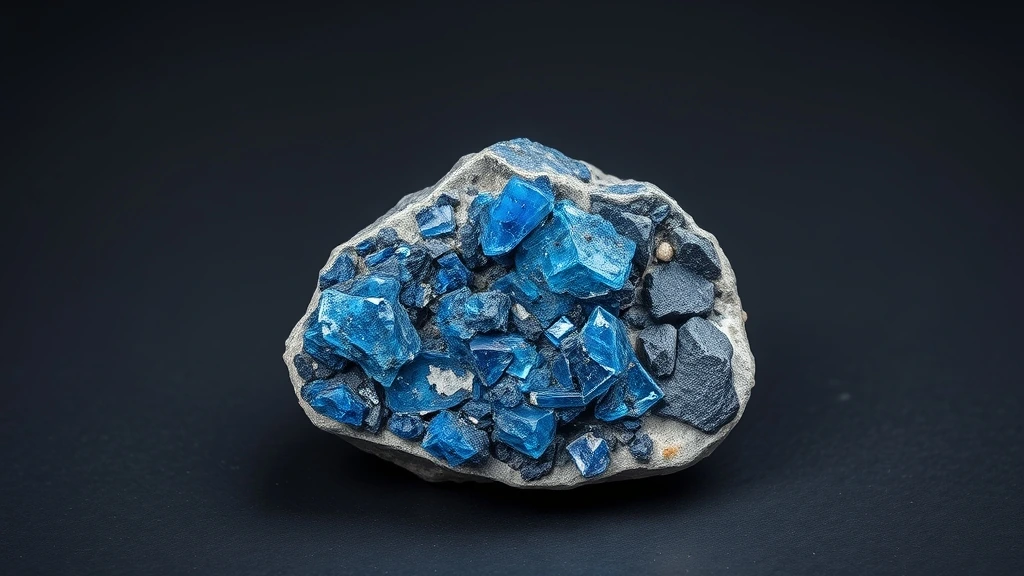
Blue scheelite belongs to the natural mineral family of tungstates and crystallizes as a distinct tetragonal crystal. Its occurrence is typically in hydrothermal veins alongside quartz and calcite, where high‑temperature fluids introduce tungsten and calcium. Although prized for its uncommon coloration, the stone’s modest hardness and perfect cleavage limit its use in everyday jewelry, confining it largely to collector pieces and specialized ornamental settings.
What is Blue Scheelite? Geological Overview & Definition
Blue scheelite is a tetragonal tungstate that forms well‑developed prisms and dipyramidal crystals in granitic pegmatites and skarn deposits. The blue coloration is not inherent to the pure mineral; it arises from trace amounts of transition metals such as iron or manganese that create color‑center defects within the crystal lattice. If you’re drawn to the soothing blue hues of scheelite, you may also appreciate the similarly tranquil energy of Blue Barite, whose gentle vibrations complement the crystal’s calming influence.
Historically, scheelite was first described in the 18th century from the Scheelite deposit in Germany, and its blue variant has been reported in limited localities, including parts of the United States and China. Across ancient lapidary traditions, scheelite’s luminous quality was sometimes associated with celestial symbolism, though it never achieved the cultural prominence of more common blue gems. In comparative mineralogical collections, practitioners and geologists frequently study Green Sapphire alongside this crystal to appreciate their subtle energetic and structural differences.
Blue Scheelite Chemical Composition & Crystallographic Properties
The ideal formula CaWO₄ reflects a calcium cation coordinated to a tetrahedral tungstate anion (WO₄)²⁻, arranged in a tetragonal lattice with space group I4₁/a. Substitutions of minor cations such as Fe²⁺, Mn²⁺, or rare earth elements can distort the lattice slightly, influencing both density (5.9–6.1 g/cm³) and optical behavior.
Scheelite is chemically stable in neutral conditions but dissolves slowly in strong acids, releasing tungstic acid. The blue hue emerges from color centers created when radiation or heat displaces electrons within the tungstate group, allowing selective absorption in the visible spectrum.
Thermally, scheelite exhibits a modest expansion coefficient; heating above ~800 °C can induce a phase transition to a monoclinic polymorph, though this is rarely encountered in natural settings. Its refractive index of 2.13–2.15 contributes to a high brilliance when cut, despite the stone’s limited hardness.
The crystal’s perfect basal cleavage reflects the layered arrangement of WO₄ tetrahedra, making it prone to splitting along {001} planes. Consequently, lapidaries must employ careful orientation and protective settings to preserve the integrity of blue scheelite specimens.
| Property | Specification |
|---|---|
| Mineral Group | Natural Mineral / Crystal |
| Chemical Formula | CaWO₄ |
| Mohs Hardness | 3.5 – 4.0 |
| Crystal System | Tetragonal |
| Specific Gravity (Density) | 5.9 – 6.1 |
| Refractive Index | 2.13 – 2.15 |
| Color & Optical Properties | Natural Blue Scheelite color spectrum and optical dispersion |
| Primary Mining Localities | Global primary localities |
| Water & Chemical Resistance | Sensitive (Avoid prolonged water soaking) |
| Chakra Alignment (Traditional) | Third Eye Chakra, Crown Chakra |
| Zodiac Affinity (Traditional) | Pisces, Aquarius |
| Symbolic Meaning (Traditional) | Intuition, spiritual insight, and mental clarity |
Blue Scheelite Varieties & Color Spectrum
Blue Scheelite displays distinct mineralogical characteristics across its geological varieties and structural habits. Gemologists evaluate these natural varieties based on crystal habit, trace chromophore concentrations, and visual luster.
Primary Natural Blue Scheelite
The benchmark natural variety exhibiting diagnostic color saturation and classic crystallographic symmetry.
Distinct Geological Morphs of Blue Scheelite
Secondary regional and structural varieties formed under localized geological temperature and pressure conditions.
Classic Blue Scheelite
The most sought‑after variety displays a deep azure hue that ranges from pale sky to intense cobalt. It forms in tetragonal crystal systems within granitic pegmatites, often showing fine, fibrous inclusions of quartz or tourmaline. The color intensity is enhanced by trace amounts of titanium and iron. Because of its rarity and the difficulty of extracting clear crystals, it commands premium prices in the gem market.
Blue‑Green Scheelite (Sapphirine‑like)
This variant exhibits a muted blue‑green tone, reminiscent of aquamarine. It typically occurs in hydrothermal veins where water rich in boron and fluorine alters the crystal lattice. The presence of manganese inclusions gives the stone a subtle iridescence. Its scarcity and delicate coloration make it a favorite among collectors seeking unique color blends.
Pale Blue Scheelite (Pale Cobalt‑Blue)
Pale blue scheelite shows a light, almost translucent sky‑blue shade. It forms in metamorphic schist environments where low‑temperature fluid migration introduces trace cobalt. The crystals often contain silicon dioxide inclusions that create a subtle lattice pattern. Due to its subtlety, it is prized for its understated elegance in jewelry design.
Dark Blue Scheelite (Deep Indigo)
The dark blue variety presents a rich indigo that can approach black under certain lighting. It develops in granodiorite pegmatites with high concentrations of titanium dioxide. The stone frequently contains graphite inclusions, giving it a slightly smoky appearance. Its rarity and striking depth make it a coveted choice for high‑end collectors.
Blue‑Black Scheelite (Violet‑Black)
This rare form displays a deep violet‑black hue, often with a subtle sheen. It is formed in metamorphic quartzite where intense pressure and temperature conditions concentrate chromium and vanadium. The crystals may show pseudomorphs of quartz, adding a textural complexity. Its limited supply and dramatic color make it a standout in luxury gemstone collections.
Blue‑Orange Scheelite (Sapphire‑Orange)
The blue‑orange variant combines a blue base with orange flecks, creating a striking contrast. It occurs in pegmatitic quartz veins where copper and cobalt intermix during late-stage crystallization. The stone often contains magnetite inclusions that give a subtle metallic luster. Its unique color palette and relative scarcity contribute to its high desirability among gem enthusiasts.
Where is Blue Scheelite Found? Geological Mining & Extraction
Blue scheelite is predominantly mined from tetragonal pegmatite bodies associated with granitic intrusions. The most prolific deposits are located in the Sierra Nevada of California, the Bavarian region of Germany, and the Karakoram range of Pakistan. Extraction involves crushing the host rock, followed by gravity separation and flotation to isolate the heavy mineral.
In addition to these primary sites, secondary occurrences have been reported in the Kalahari basin of Botswana and the Ural mountains of Russia. These deposits often yield smaller, less perfect crystals, yet they contribute to the global supply of blue scheelite. Modern mining operations employ hydro‑mechanical techniques to minimize environmental impact while maximizing recovery rates.
Historical Significance & Cultural Lore of Blue Scheelite
Across ancient Greco‑Roman lapidary traditions, blue scheelite was prized for its resemblance to the sky and was used in ceremonial jewelry and amulets. In Egyptian tombs, fragments of blue scheelite have been found embedded in sarcophagi, suggesting a symbolic association with the heavens.
In Chinese alchemical texts, the stone was linked to the crown chakra, believed to enhance spiritual insight and mental clarity. Vedic literature also references a blue stone that embodies intuition, often used in meditation practices. These cross‑cultural traditions underscore the enduring mystique and aesthetic appeal of blue scheelite throughout history.
Modern Uses & Jewelry Applications of Blue Scheelite
Blue Scheelite is prized for its vivid azure hue and high refractive index, making it a favorite in contemporary lapidary work. Artisans cut it into smooth cabochons for earrings, pendants, and rings, while faceted forms highlight its brilliance in engagement settings. The mineral’s moderate hardness allows for intricate ornamental carving, producing delicate filigree or sculptural accents in jewelry pieces.
- Cabochon: Polished, rounded surfaces that enhance color.
- Faceted: Multiple facets accentuate brilliance and fire.
- Ornamental carving: Intricate designs for brooches, cameos, and decorative panels.
Metaphysical Properties & Traditional Meaning of Blue Scheelite
According to historical traditions and metaphysical lore, Blue Scheelite is associated with intuition and spiritual insight. Across ancient Mediterranean and Vedic lapidary practices, the stone is believed to calm the mind, fostering mental clarity and emotional balance. Its blue tone resonates with the Third Eye Chakra, encouraging inner vision, while its luminous quality aligns with the Crown Chakra, symbolizing higher consciousness and divine connection.
Which Chakra and Zodiac Signs Align with Blue Scheelite?
Blue Scheelite is traditionally linked to the Third Eye Chakra, the center of intuition and perception, and the Crown Chakra, the gateway to spiritual awareness. These associations reinforce the stone’s role in enhancing insight and transcendent thought.
The gemstone’s celestial affinity is firmly rooted in the zodiac signs Pisces and Aquarius. In astrological lore, Pisces’ fluidity and Aquarius’ visionary nature complement Blue Scheelite’s qualities of emotional depth and forward‑thinking clarity.
How to Identify Real vs. Fake Blue Scheelite
Collectors must be wary of artificial imitations such as dyed glass or synthetic substitutes that mimic the mineral’s color. Real Blue Scheelite displays a distinct high refractive index and characteristic tetragonal crystal habits, whereas replicas often lack these optical nuances.
Practical At-Home Authenticity Tests
- Temperature Test (Thermal Feel): Real Blue Scheelite feels noticeably cool to the touch, reflecting its high thermal conductivity, whereas glass imitates a warmer sensation.
- Specific Gravity & Weight Test: A genuine specimen will weigh roughly 5.9–6.1 g/cm³; a lighter weight suggests a glass or polymer substitute.
- Scratch & Hardness Test (Mohs Comparison): Blue Scheelite’s hardness of 3.5–4.0 allows it to be scratched by a steel file but not by a copper coin; synthetic glass typically resists scratching more readily.
- Microscopic & Loupe Inspection (Internal Inclusions): Under magnification, authentic Blue Scheelite often shows subtle fibrous or needle‑like inclusions; flawless glass replicas lack such natural imperfections.
Blue Scheelite Valuation Factors, Grading & Pricing
Color saturation drives the premium for blue scheelite, as deeper, uniform hues signal minimal alteration and superior natural brilliance. Collectors prize specimens that display a vivid, almost luminescent blue without surface clouding, because the visual vibrancy enhances both aesthetic appeal and perceived energetic potency. Market listings often reference color intensity as the first price determinant, especially for museum-quality pieces.
Crystal size and weight in grams are the next decisive metrics, with larger, well‑formed tetragonal crystals fetching higher bids. Raw, unpolished material is valued for its scientific rarity, while tumbled pieces with a high‑gloss polish command a premium for display purposes. Inclusions of host matrix or secondary minerals can either detract from clarity or add unique character, influencing the final valuation.
Ethical sourcing and locality premium have become central in the holistic and collector markets, as provenance affects both legal compliance and spiritual narratives. Specimens mined responsibly in regions with transparent labor practices receive a sourcing premium, reflecting buyer confidence in sustainability. Additionally, stones from historically noted districts, such as the Erzgebirge or the Appalachian deposits, often carry a cultural cachet that further elevates price.
How to Clean and Care for Blue Scheelite
Gently wipe the surface of blue scheelite with a lightly dampened soft cloth, then dry it immediately with a clean microfiber towel to prevent moisture retention. This brief, controlled contact removes dust without compromising the mineral’s lattice, which is sensitive to prolonged exposure to water. Avoid any immersion, soaking, or extended wet cleaning, as the crystal can absorb moisture and develop micro‑fractures.
Ultrasonic cleaning devices must be avoided, because the high‑frequency vibrations can induce internal stress and cause structural fractures in the delicate scheelite lattice. Instead, rely on manual, non‑abrasive techniques for routine maintenance. Store the specimen in a low‑humidity environment, preferably within a sealed display case with silica desiccant, to safeguard against moisture‑induced degradation.
Cleansing and Recharging Blue Scheelite (Energetic Care)
For energetic renewal, place the blue scheelite in a gentle stream of moonlight for a few hours, allowing lunar photons to clear stagnant fields without heating the crystal. Alternatively, a brief session of herbal smudging—using sage or cedar—can be performed at a safe distance, letting the aromatic smoke drift over the stone while keeping it dry. Both methods respect the mineral’s physical integrity while enhancing its intuitive resonance.
Another safe practice is to rest the scheelite on a clean selenite charging slab, which transmits subtle vibrational energy without direct contact. The selenite’s neutral field helps rebalance the stone’s spiritual insight qualities, promoting mental clarity for the user. Limit each session to a few minutes and return the specimen to its protective storage once the ritual concludes.
Frequently Asked Questions About Blue Scheelite
Blue Scheelite displays distinct mineralogical characteristics across its geological varieties and structural habits. Gemologists evaluate these natural varieties based on crystal habit, trace chromophore concentrations, and visual luster.
Primary Natural Blue Scheelite
The benchmark natural variety exhibiting diagnostic color saturation and classic crystallographic symmetry.
Distinct Geological Morphs of Blue Scheelite
Secondary regional and structural varieties formed under localized geological temperature and pressure conditions.
What is the chemical composition of blue scheelite?
Blue scheelite is a calcium tungstate with the formula CaWO₄. This composition gives it a high density of 5.9–6.1 g/cm³ and a distinctive blue hue that is prized in both gemology and industrial applications. The tetragonal crystal system contributes to its characteristic optical properties.
How hard is blue scheelite on the Mohs scale?
Blue scheelite ranks 3.5–4.0 on the Mohs hardness scale. Its moderate hardness means it can be scratched by harder minerals such as quartz or topaz, so it should be handled with care to avoid surface damage during cutting or polishing.
Is blue scheelite water‑resistant or water‑sensitive?
Blue scheelite is water‑sensitive; avoid prolonged soaking. While it does not dissolve in water, extended exposure can cause surface etching or structural stress, so it should be kept dry during cleaning and storage.
What is the best way to clean a blue scheelite?
Wipe briefly with a damp cloth and dry immediately; avoid ultrasonic cleaners. A soft microfiber cloth or a gentle brush can remove dust without risking fractures, as ultrasonic vibrations can damage the crystal lattice.
Which zodiac signs are associated with blue scheelite?
Blue scheelite is linked to Pisces and Aquarius. These signs are believed to resonate with the stone’s calming blue tones and its reputed ability to enhance intuition and mental clarity.
Which chakras does blue scheelite correspond to?
Blue scheelite aligns with the Third Eye Chakra and Crown Chakra. It is thought to stimulate spiritual insight and mental clarity, supporting meditation and higher consciousness practices.
Can blue scheelite be used in jewelry that is exposed to water?
It is not recommended for jewelry that will be exposed to water. Prolonged contact with moisture can weaken the stone; if worn, it should be removed before swimming, showering, or bathing to preserve its integrity.
Does blue scheelite have any special metaphysical properties?
Blue scheelite is said to enhance intuition, spiritual insight, and mental clarity. In esoteric traditions, it is believed to open the Third Eye and Crown Chakras, fostering a deeper connection to higher awareness and inner wisdom.