
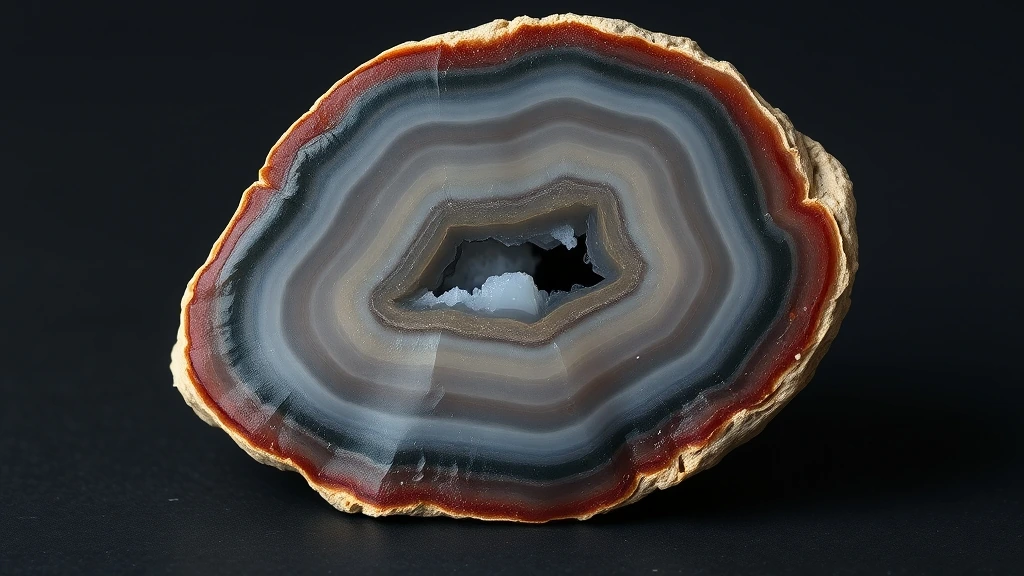
Botswana agate belongs to the broader family of silicates, specifically the chalcedony subgroup of cryptocrystalline quartz. These fine-grained aggregates form in volcanic or sedimentary settings where silica-rich fluids precipitate within fissures and cavities, creating the characteristic banded patterns that define agates worldwide.
What is Botswana Agate? Geological Overview & Definition
Botswana agate is a cryptocrystalline quartz aggregate that crystallizes in the trigonal system. Its fibrous microstructure results from repeated silica precipitation, producing concentric bands that vary in color and texture. The stone is typically found in volcanic tuff or sedimentary breccia, where silica-rich fluids migrate and deposit in cavities. These geological environments give Botswana agate its distinctive banding and relative hardness.
Botswana Agate Chemical Composition & Crystallographic Properties
The mineral’s chemical identity is SiO₂, with no significant cation substitution; the structure remains a pure quartz lattice. In the trigonal crystal system, the quartz lattice is composed of SiO₄ tetrahedra linked in a continuous framework, giving the stone its mechanical strength. Because the composition is stoichiometric, Botswana agate is largely acid-resistant and does not react with dilute acids, unlike many other silicate minerals. Color variations arise from trace chromophores such as iron, manganese, or titanium, which create localized color centers within the silica matrix. Thermal stability is high; the stone retains its structure and color up to about 800 °C, beyond which it begins to dehydrate and may alter to other quartz polymorphs.
| Property | Specification |
|---|---|
| Mineral Group | Silicates (Chalcedony / Cryptocrystalline Quartz) |
| Chemical Formula | SiO₂ (Silicon Dioxide) |
| Mohs Hardness | 6.5 – 7.0 |
| Crystal System | Trigonal (Microcrystalline / Cryptocrystalline fibrous aggregates) |
| Specific Gravity (Density) | 2.60 – 2.65 |
| Refractive Index | 1.544 – 1.553 |
| Color & Optical Properties | Natural Botswana Agate color spectrum and optical dispersion |
| Primary Mining Localities | Brazil, Uruguay, Turkey, India, Madagascar |
| Water & Chemical Resistance | High (Safe for gentle warm water and mild soap; avoid harsh acids and chlorine) |
| Chakra Alignment (Traditional) | Root Chakra and Sacral Chakra |
| Zodiac Affinity (Traditional) | Gemini, Virgo, Taurus |
| Symbolic Meaning (Traditional) | Grounding, emotional balance, physical endurance, and protection |
Botswana Agate Varieties & Color Spectrum
Botswana Agate displays distinct mineralogical characteristics across its geological varieties and structural habits. Gemologists evaluate these natural varieties based on crystal habit, trace chromophore concentrations, and visual luster. In comparative mineralogical collections, practitioners and geologists frequently study Cobra Jasper alongside this crystal to appreciate their subtle energetic and structural differences.
Primary Natural Botswana Agate
The benchmark natural variety exhibiting diagnostic color saturation and classic crystallographic symmetry.
Distinct Geological Morphs of Botswana Agate
Secondary regional and structural varieties formed under localized geological temperature and pressure conditions.
Botswana Blue‑Band Agate
Formed in silica‑rich cavities within trachytic tuffs, this variety displays parallel bands of deep cobalt‑blue alternating with milky white. Microscopic chalcedony fibers create a subtle iridescence that catches light at low angles. The blue hue is rare in southern African agates, making specimens highly sought after by collectors. In comparative mineralogical collections, practitioners and geologists frequently study Blue Pacific Agate alongside this crystal to appreciate their subtle energetic and structural differences.
Red‑Fire Agate
Developed in the oxidizing zones of basaltic lava flows, the Red‑Fire Agate exhibits vivid vermilion and orange streaks set against a translucent amber matrix. Iron oxide inclusions produce the fiery coloration, while fine cryptocrystalline quartz gives a smooth polish. Its striking palette is limited to a few pockets near the Okavango Delta, enhancing its market value.
Green‑Moss Agate (Botswana Moss)
This variety grows in silica‑filled fractures of dolomitic limestone, where chlorite and epidote replace portions of the silica, forming moss‑like green patterns. The result is a delicate network of fern‑like veins that appear to float within a translucent brown base. Green‑Moss Agate is relatively abundant locally but prized internationally for its unique botanical mimicry.
Zebra‑Stripe Agate
Zebra‑Stripe Agate originates from silica‑saturated sandstones, where rhythmic layering of siliceous and iron‑rich bands creates bold black‑white striping reminiscent of a zebra’s coat. The alternating bands are often accentuated by fine calcite inclusions that add a subtle sheen. Though more common than the blue‑band, high‑contrast specimens command premium prices in the gemstone market.
Botswana Pink Agate
Developed in the weathered zones of granitic intrusions, this agate displays soft rose‑pink hues infused with fine rutile needle inclusions that produce a delicate chatoyancy. The pink coloration stems from trace manganese and titanium within the silica lattice. Its gentle palette and occasional fluorescence under UV light make it a favorite for ornamental jewelry.
Desert Sunset Agate
Found in the alluvial gravels of the Kalahari fringe, Desert Sunset Agate shows a gradient of amber, burnt orange, and deep brown, mimicking a desert horizon at dusk. Thin layers of hematite and goethite create the warm banding, while the overall translucency is enhanced by micro‑crystalline quartz. Its striking visual narrative and relative scarcity in the trade elevate its desirability among collectors.
Where is Botswana Agate Found? Geological Mining & Extraction
Botswana’s agates are chiefly hosted in silicified volcanic tuffs and basaltic lava flows that blanket the central plateau, especially around the Ghanzi and Kgalagadi districts. These rocks underwent secondary silica deposition during hydrothermal alteration, filling fractures with microcrystalline chalcedony that later crystallized into agate bands.
Modern extraction relies on small‑scale open‑pit mining and hand‑picking from alluvial deposits along seasonal riverbeds such as the Okavango and Boteti. Miners employ low‑impact techniques—sieving, washing, and manual sorting—to preserve the delicate banding while ensuring a steady supply for both local artisans and the international gemstone market.
Historical Significance & Cultural Lore of Botswana Agate
Across ancient lapidary traditions, agates from southern Africa were traded along trans‑Saharan routes, reaching Egyptian markets where they were carved into amulets for protective and grounding purposes. Archaeological sites in the Nubian region have yielded Botswana‑origin agate beads, indicating their high esteem among early Nile Valley societies.
In Vedic and early Chinese texts, agate’s stabilizing energy was linked to the Root and Sacral Chakras, promoting physical endurance and emotional balance. Contemporary practitioners still reference these historic attributions, integrating Botswana agate into modern meditation and healing practices.
Modern Uses & Jewelry Applications of Botswana Agate
Botswana Agate is highly prized by lapidaries for its exceptional durability and vibrant, banded patterns that respond well to polishing. The stone’s Mohs hardness of 6.5 to 7.0 allows it to withstand daily wear without significant abrasion, making it ideal for rings and bracelets. Lapidary artists frequently cut these specimens into cabochons to showcase their smooth, eye-like inclusions and flowing color gradients.
- Cabochon Cutting: Polished into smooth, domed shapes to highlight the stone’s natural “eye” patterns and deep blue or green bands.
- Faceted Jewelry: Cut into standard gem shapes for pendants and earrings, where the refractive index of 1.544 – 1.553 provides a subtle, glassy luster.
- Ornamental Carving: Used in decorative art, bookends, and architectural accents due to its resistance to chipping and ease of shaping.
- Tumbling Stones: Often included in rock tumbling kits because the material polishes to a high, vitreous finish with minimal effort.
Metaphysical Properties & Traditional Meaning of Botswana Agate
According to historical traditions and metaphysical lore, Botswana Agate is revered as a powerful stone of stability and emotional resilience. Ancient Mediterranean and Vedic lapidary practices often associated banded silicates with the earth’s enduring strength and protective energy. Practitioners believe the stone’s layered structure mirrors the complexity of human emotion, offering a sense of emotional balance during turbulent times.
In esoteric circles, this gemstone is frequently employed to foster physical endurance and mental clarity. It is thought to anchor the wearer’s energy, preventing spiritual scattering and promoting a steady, grounded presence. The stone’s deep, earthy tones are said to resonate with the body’s physical plane, supporting recovery and vitality.
Which Chakra and Zodiac Signs Align with Botswana Agate?
Botswana Agate is canonically aligned with the Root Chakra and the Sacral Chakra. The Root Chakra connection stems from the stone’s grounding properties, which help stabilize the body’s energy field and promote a sense of security. Meanwhile, its association with the Sacral Chakra reflects its ability to support creative flow and emotional regulation, bridging physical stability with personal expression.
Astrologically, this gemstone resonates strongly with the signs of Taurus, Gemini, and Virgo. For Taurus, it reinforces their innate need for security and material stability. Gemini benefits from its clarifying influence, helping to organize their rapid mental activity, while Virgo finds support in its purifying and detail-oriented energy. These alignments highlight the stone’s versatility in supporting both earth and air sign energies.
How to Identify Real vs. Fake Botswana Agate
The market for Botswana Agate includes various artificial imitations, such as synthetic glass, plastic resins, and dyed chalcedony. These fakes often mimic the stone’s banded appearance but lack the natural geological complexity and specific gravity of genuine material. Identifying these replicas requires careful observation of surface luster, internal structure, and physical properties that distinguish natural SiO₂ from man-made alternatives.
Practical At-Home Authenticity Tests
- Temperature Test (Thermal Feel): Genuine agate feels noticeably cool to the touch initially and warms slowly, whereas plastic or glass imitations often reach room temperature more quickly or feel warmer immediately.
- Specific Gravity & Weight Test: Real Botswana Agate has a density of 2.60 – 2.65, making it feel heavier than its size suggests compared to lighter plastic or some glass substitutes.
- Scratch & Hardness Test (Mohs Comparison): With a Mohs hardness of 6.5 – 7.0, genuine agate will not be scratched by a steel knife or paperclip, while softer imitations like plastic or dyed quartzite may show visible marks.
- Microscopic & Loupe Inspection (Internal Inclusions): Using a 10x loupe, look for natural flow lines and mineral inclusions; synthetic glass often contains tiny, spherical air bubbles or swirls that are absent in natural cryptocrystalline structures.
Botswana Agate Valuation Factors, Grading & Pricing
The market value of Botswana agate hinges first on color saturation. Stones with vivid, evenly distributed bands command higher prices, as their natural energetic luster enhances visual appeal and perceived metaphysical potency. A specimen with muted hues or uneven banding typically fetches a lower premium, reflecting its reduced vibrancy.
Second, crystal size and weight play a decisive role. Larger, heavier pieces—measured in grams—are preferred for display and investment, especially when they exhibit a high-quality tumbled polish. The presence of natural matrix inclusions can add character, but excessive fracturing or irregularities may diminish desirability, underscoring the importance of a balanced, well-formed specimen.
Finally, ethical sourcing and locality premium influence collector demand. Botswana agate sourced from responsible, traceable mines carries a premium in holistic and collector markets, as buyers increasingly value transparency and sustainable practices. Provenance from reputable Botswana deposits can elevate a stone’s status, reflecting both its geological uniqueness and the ethical integrity of its acquisition.
How to Clean and Care for Botswana Agate
Gentle physical cleaning of Botswana agate should be performed with warm soapy water, using a mild detergent and a soft brush or cloth. After rinsing, dry the stone thoroughly with a clean, lint‑free towel to prevent water spots. Avoid ultrasonic cleaners, especially if the specimen has been dyed, heavily fractured, or treated, as vibration can damage delicate banding or surface integrity.
Cleansing and Recharging Botswana Agate (Energetic Care)
To cleanse the energetic field of Botswana agate, place the stone in a quiet, shaded area and allow it to absorb ambient lunar energy during a full moon. Alternatively, resting the agate on a selenite slab or a clean, white cloth can facilitate subtle charge transfer without exposing the crystal to heat or direct sunlight, preserving its structural integrity. These dry, low‑energy methods respect the mineral’s lattice while supporting its metaphysical properties.
Frequently Asked Questions About Botswana Agate
Botswana Agate displays distinct mineralogical characteristics across its geological varieties and structural habits. Gemologists evaluate these natural varieties based on crystal habit, trace chromophore concentrations, and visual luster.
Primary Natural Botswana Agate
The benchmark natural variety exhibiting diagnostic color saturation and classic crystallographic symmetry.
Distinct Geological Morphs of Botswana Agate
Secondary regional and structural varieties formed under localized geological temperature and pressure conditions.
Is Botswana agate safe to wear in the shower?
Yes, it is safe for gentle warm water and mild soap exposure. The stone possesses high water resistance, making it suitable for daily wear during bathing. However, you should strictly avoid harsh acids and chlorine found in some shampoos or pool water to preserve its surface integrity.
How should I clean my Botswana agate jewelry?
Warm soapy water is the ideal cleaning method for solid agates. Use a soft cloth to gently wipe the surface, removing oils and dirt without causing damage. Avoid using ultrasonic cleaners if the specimen is dyed, heavily fractured, or has undergone other treatments.
What is the chemical composition of Botswana agate?
It is composed entirely of silicon dioxide, or SiO₂. This pure quartz variety forms through the slow precipitation of silica within volcanic rock cavities over millions of years. Its cryptocrystalline fibrous aggregates create the distinctive banded patterns seen in polished stones.
Which zodiac signs are aligned with Botswana agate?
The primary aligned signs are Gemini, Virgo, and Taurus. These earth and air signs resonate with the stone’s stabilizing energy. Wearing this gemstone is believed to enhance mental clarity for Geminis and physical endurance for Taurus natives.
Which chakras does Botswana agate activate?
It primarily activates the Root Chakra and Sacral Chakra. These energy centers govern feelings of security, stability, and creative flow. The stone’s earthy tones help ground the wearer, fostering a deep sense of physical and emotional balance.
How hard is Botswana agate on the Mohs scale?
It registers between 6.5 and 7.0 on the Mohs hardness scale. This high durability makes it highly resistant to scratches from everyday objects like keys or coins. It is an excellent choice for rings and bracelets that experience frequent contact and wear.
Is Botswana agate suitable for daily jewelry wear?
Yes, its durability makes it ideal for everyday accessories. With a density of 2.60 to 2.65, it feels substantial yet comfortable on the skin. Its refractive index of 1.544 to 1.553 provides a pleasant waxy luster that enhances its visual appeal over time.
Does Botswana agate require special storage conditions?
No, it does not require special storage conditions. Unlike softer minerals, it can be stored in a standard jewelry box without risk of damage. Just ensure it is kept away from extreme heat or direct sunlight to maintain its natural color saturation.