
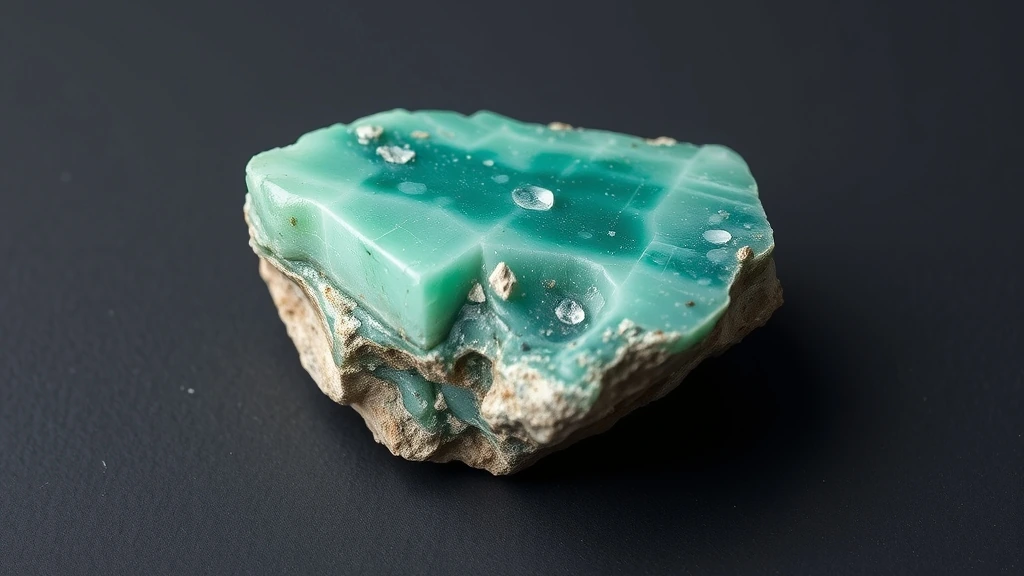
Chrysoprase belongs to the extensive quartz group within the silicate mineral family. As a natural mineral rather than a synthetic compound, it forms through the slow precipitation of silica-rich solutions. The presence of nickel ions within the crystal lattice dictates its distinctive apple-green hue. This geological origin distinguishes it from other green gemstones like emerald or jadeite.
What is Chrysoprase Gemstone? Geological Overview & Definition
Chrysoprase is defined as a microcrystalline silica gemstone where the crystal structure is too fine to be seen with the naked eye. It typically forms in hydrothermal veins associated with nickel-bearing ultramafic rocks. The term derives from Greek words meaning “golden grass,” reflecting its translucent, grassy green appearance.
Geologically, it is classified as a varietal quartz rather than a distinct mineral species. Its formation requires specific geochemical conditions where nickel substitutes for silicon in the lattice. This substitution process occurs over millions of years in stable geological environments. Understanding this context is vital for authenticating genuine specimens in the market.
Chrysoprase Gemstone Chemical Composition & Crystallographic Properties
The primary chemical formula is SiO₂, representing silicon dioxide with trace nickel impurities. The crystal system is trigonal for the quartz variety, though some sources note monoclinic moganite associations. This structural arrangement allows for the incorporation of nickel ions without disrupting the overall lattice integrity significantly.
The green coloration stems from chromophore color centers created by nickel ions replacing silicon atoms. These electronic transitions absorb light in the red spectrum, reflecting green wavelengths to the observer. The refractive index ranges from 1.530 to 1.543, contributing to its glassy luster.
Chrysoprase exhibits moderate acid sensitivity, as silica can dissolve in strong hydrofluoric acid. Thermal behavior is stable under normal jewelry conditions, but extreme heat may alter the color. The density typically falls between 2.651 and 2.91 g/cm³, depending on the nickel content.
The cation substitution of nickel for silicon is the key mineralogical feature. This process creates the unique optical properties that define the gemstone. Proper identification requires confirming both the silica matrix and the nickel-induced coloration.
| Property | Specification |
|---|---|
| Mineral Group | Natural Mineral / Crystal |
| Chemical Formula | SiO₂ |
| Mohs Hardness | 6.0–7.0 |
| Crystal System | Trigonal (quartz), monoclinic (moganite) |
| Specific Gravity (Density) | 2.651–2.91 |
| Refractive Index | 1.530 – 1.543 |
| Color & Optical Properties | Natural Chrysoprase Gemstone color spectrum and optical dispersion |
| Primary Mining Localities | Global primary localities |
| Water & Chemical Resistance | High (Safe for gentle water washing) |
| Chakra Alignment (Traditional) | Heart Chakra |
| Zodiac Affinity (Traditional) | Taurus, Libra |
| Symbolic Meaning (Traditional) | Emotional healing, harmony, and the manifestation of love |
Chrysoprase Gemstone Varieties & Color Spectrum
Australian Moganite Chrysoprane
Formed in the moganite polymorph of quartz within Precambrian sandstones of Western Australia, this variety displays a vivid apple‑green hue caused by trace nickel. Microscopic inclusions of rutile give a subtle silkiness, while the crystal habit is typically massive rather than prismatic. Its rarity stems from the limited geographic extent of moganite‑bearing host rocks, making high‑quality stones highly prized by collectors.
Brazilian Nickel‑Rich Chrysoprase
Brazil’s Minas Gerais province yields the classic emerald‑green chrysoprase, where Ni²⁺ ions substitute for Al³⁺ in the quartz lattice. The stones often contain fluid‑filled cavities that later calcify, producing a distinctive “eye‑dot” pattern visible under magnification. Because the deposits are extensive yet selectively mined for gem‑grade material, medium‑quality stones are common, while flawless, deep‑green crystals remain scarce.
Tanzanian Micro‑Inclusion Chrysoprase
In the Tanzanian Rift Valley, chrysoprase crystallizes in silicified volcanic tuffs, incorporating minute hematite specks that create a faint golden shimmer. The color ranges from pastel mint to saturated jade, with the specks acting as natural light‑diffusing inclusions. This regional morph is valued for its unique optical play, though mining is limited to small artisanal operations, enhancing its exclusivity.
Ukrainian “Krasny” Chrysoprase
Ukraine’s Kirovohrad Oblast hosts chrysoprase within pegmatitic quartz veins that exhibit a rare pink‑tinged green, attributed to trace manganese alongside nickel. The stones often show parallel growth zoning, visible as faint banding under polarized light. Although the deposit is modest, the distinctive hue commands premium prices on the international market.
Madagascan “Green Fire” Chrysoprase
Madagascar’s eastern highlands produce chrysoprase in metamorphosed basaltic breccias, where high‑temperature fluids enrich the quartz with nickel, yielding an intense, almost fluorescent green. Micro‑fractures filled with silica create a subtle internal glow when illuminated. The combination of vivid color and exceptional clarity makes this variety one of the most sought‑after, though extraction is challenging due to rugged terrain.
Canadian “Lake Superior” Chrysoprase
Found in the Lake Superior region’s ancient volcanic ash layers, this chrysoprase is noted for its cool, sea‑foam green tone and occasional chlorite inclusions that impart a faint mica‑like sheen. The stones are typically massive aggregates rather than well‑formed crystals, but their consistent hue and low impurity levels have attracted gem cutters worldwide. Limited mining permits keep supply modest, preserving its market allure.
Where is Chrysoprase Gemstone Found? Geological Mining & Extraction
Chrysoprase primarily occurs in nickel‑enriched quartz veins hosted by pegmatites, volcanic tuffs, and metamorphic breccias. The mineral’s formation requires oxidizing conditions that mobilize Ni²⁺ ions, allowing them to substitute into the silica lattice during late‑stage hydrothermal activity. These geological settings produce the characteristic apple‑green color and often trap fluid‑filled cavities that later become diagnostic inclusions.
The most productive mining districts include Brazil’s Minas Gerais, Western Australia’s Pilbara, Tanzania’s Rift Valley, and Ukraine’s Kirovohrad region. Extraction typically involves open‑pit or small‑scale artisanal mining, followed by hand‑sorting to isolate gem‑grade material. After removal, stones undergo careful washing, drying, and preliminary grading before being sent to cutting centers for final polishing.
Historical Significance & Cultural Lore of Chrysoprase Gemstone
Ancient Egyptians prized chrysoprase for its emerald‑like brilliance, using it in amulets and funerary jewelry as early as the Old Kingdom. Archaeological finds from the tomb of Tutankhamun include a chrysoprase scarab, indicating its role in protective rites and the belief that the stone could safeguard the soul in the afterlife.
In classical antiquity, Greeks and Romans associated chrysoprase with Venus, the goddess of love, attributing to it powers of emotional healing and harmony. Medieval alchemists recorded its use in talismans to promote manifestation of love, a tradition that persists in modern chakra practices where the stone is linked to the heart chakra.
Modern Uses & Jewelry Applications of Chrysoprase Gemstone
Chrysoprase is primarily cut into cabochons to maximize its vibrant green color and smooth luster, which is essential for its aesthetic appeal. While faceting is possible, the stone’s moderate Mohs hardness of 6.0–7.0 requires careful handling to prevent chipping during the polishing process. Lapidaries often favor rounded shapes to highlight the stone’s characteristic “apple-green” hue without compromising structural integrity.
- Cabochon Jewelry: Ideal for rings, pendants, and earrings where the smooth, domed surface enhances the stone’s glow.
- Ornamental Carving: Historically used for cameos, intaglios, and decorative inlays due to its workability and rich coloration.
- Faceted Gems: Less common but suitable for smaller stones where precision cutting can reveal subtle internal patterns.
Metaphysical Properties & Traditional Meaning of Chrysoprase Gemstone
According to historical traditions and metaphysical lore, chrysoprase is revered as a stone of emotional healing and profound inner harmony. Practitioners believe it soothes the heart, dissolves resentment, and fosters a deep sense of peace within the wearer. This gemstone is often associated with the manifestation of love, encouraging users to open their hearts to genuine connection and compassion.
The stone’s gentle energy is thought to balance the Heart Chakra, promoting emotional stability and reducing anxiety. By aligning with this central energy center, chrysoprase helps individuals navigate complex emotional landscapes with grace. It serves as a reminder to cultivate self-love and extend that same warmth to others, fostering lasting relationships.
Which Chakra and Zodiac Signs Align with Chrysoprase Gemstone?
Chrysoprase is canonically aligned with the Heart Chakra, the energy center governing love, compassion, and emotional balance. This connection makes it particularly effective for individuals seeking to heal past emotional wounds or enhance their capacity for empathy. The stone’s soothing green energy resonates directly with this chakra, promoting a sense of wholeness and inner peace.
In astrological terms, chrysoprase is specifically aligned with Taurus and Libra. These earth and air signs, respectively, benefit from the stone’s stabilizing and harmonizing properties. Taurus finds grounding and security, while Libra experiences enhanced balance and diplomatic grace. This dual alignment ensures the stone supports both emotional depth and social harmony.
How to Identify Real vs. Fake Chrysoprase Gemstone
Distinguishing genuine chrysoprase from imitations requires attention to subtle visual and physical cues, as synthetic glass and dyed chalcedony are common fakes. Artificial replicas often display a uniform, unnatural color distribution that lacks the organic variation found in natural stones. Additionally, synthetic materials may exhibit refractive index values that deviate slightly from the natural range of 1.530 to 1.543.
Practical At-Home Authenticity Tests
- Temperature Test (Thermal Feel): Hold the stone against your cheek or wrist; genuine chrysoprase feels cool to the touch initially due to its thermal conductivity, whereas plastic or glass imitations warm up more quickly.
- Specific Gravity & Weight Test: Compare the stone’s weight to a similarly sized piece of quartz; chrysoprase has a density of 2.651–2.91, making it slightly heavier than standard quartz but lighter than dense glass.
- Scratch & Hardness Test (Mohs Comparison): Gently rub the stone against a steel file; genuine chrysoprase (Mohs 6.0–7.0) should not scratch easily, while softer imitations like dyed chalcedony may show minor abrasions.
- Microscopic & Loupe Inspection (Internal Inclusions): Examine the stone under a 10x loupe for natural inclusions or color zoning; synthetic glass often appears too perfect or contains tiny bubbles, while dyed stones may show color concentration along cracks.
Chrysoprase Gemstone Valuation Factors, Grading & Pricing
The primary driver of value is Color Saturation, specifically the intense apple-green hue derived from nickel impurities. Uniformity across the stone’s surface significantly enhances its aesthetic appeal and market desirability. High-quality specimens also exhibit excellent optical clarity and a distinct vitreous luster that maximizes light return.
Market pricing heavily depends on Carat Weight, as larger, high-quality stones are exceptionally rare in global deposits. Facet symmetry and cut precision further influence the final valuation by optimizing the gemstone’s brilliance. The presence of matrix inclusions or visible cracks can substantially reduce the stone’s commercial worth.
Geographical Provenance Premium often elevates prices for stones from renowned Australian or South African sources. Wholesale rates fluctuate based on supply chain stability and current retail demand trends. Buyers should expect significant price variances between raw cabochons and precision-cut faceted gems.
How to Clean and Care for Chrysoprase Gemstone
To maintain the stone’s integrity, always use warm soapy water and a soft, lint-free cloth for gentle cleaning. This method effectively removes surface oils and dust without risking damage to the delicate structure. Rinse thoroughly with lukewarm water to ensure no soap residue remains on the surface.
It is critical to avoid ultrasonic cleaners entirely, as the high-frequency vibrations can induce structural fractures. Chrysoprase contains natural fissures that are susceptible to stress from aggressive mechanical cleaning methods. Always dry the gemstone carefully with a soft towel to prevent water spots.
Cleansing and Recharging Chrysoprase Gemstone (Energetic Care)
For energetic maintenance, utilize smoke smudging with sage or palo santo to clear stagnant energy. This dry method respects the mineral’s physical structure while aligning with its heart chakra associations. Ensure the stone is completely dry before beginning this ritualistic cleansing process.
Place the gemstone on a selenite plate under moonlight for passive recharging and energy restoration. This approach avoids any contact with water, ensuring the stone remains physically secure. Regularly inspect the stone for any new surface scratches during these care sessions.
Frequently Asked Questions About Chrysoprase Gemstone
What is the chemical composition of chrysoprase?
Chrysoprase is a variety of chalcedony composed of silicon dioxide (SiO₂). It belongs to the quartz family and inherits quartz’s trigonal crystal structure, though some specimens show monoclinic moganite intergrowths. The vibrant green hue comes from trace nickel ions replacing silicon in the lattice.
How hard is chrysoprase and can it be used in everyday jewelry?
With a Mohs hardness of 6.0–7.0, chrysoprase is suitable for most daily‑wear pieces. This rating means it resists scratches from common metals but can be nicked by harder gemstones or abrasive cleaners. Regular polishing with a soft cloth keeps its glossy finish intact.
Is chrysoprase safe to wear while washing hands or in the rain?
Yes, chrysoprase has high water resistance and is safe for gentle water washing. Warm, soapy water and a soft cloth will remove residues without harming the stone. Avoid prolonged soaking or harsh detergents, as extended exposure could weaken any natural surface fissures.
Can I clean chrysoprase with an ultrasonic cleaner?
No, ultrasonic cleaning is not recommended for chrysoprase. The rapid vibrations can create micro‑fractures in the quartz matrix, especially in stones with internal inclusions. Stick to manual cleaning with warm soapy water and a lint‑free cloth to preserve integrity.
Which zodiac signs are traditionally linked to chrysoprase?
Chrysoprase is associated with the zodiac signs Taurus and Libra. Astrologers believe the stone amplifies these signs’ grounding and diplomatic qualities, encouraging balanced decision‑making. Wearing chrysoprase may reinforce the natural traits attributed to these earth‑air combinations.
Which chakra does chrysoprase resonate with?
The gemstone is aligned with the Heart Chakra. In energy work, chrysoprase is thought to open the heart center, promoting emotional healing, harmony, and the manifestation of love. Meditative practices often place the stone over the chest to enhance these effects.
How can I tell if a chrysoprase specimen is genuine?
Authentic chrysoprase displays a uniform, apple‑green color with a translucent to opaque body. Under magnification, genuine stones reveal fine chalcedony micro‑fibers and occasional nickel‑rich inclusions. Synthetic or dyed alternatives often lack the subtle internal sheen and may show uneven coloration.
Does chrysoprase have any notable optical properties for gem cutters?
Its refractive index ranges from 1.530 to 1.543, giving a gentle brilliance when faceted. The modest dispersion produces a soft glow rather than fire, making it ideal for cabochons and smooth‑cut beads. Skilled cutters maximize the stone’s natural translucency while minimizing stress points.