
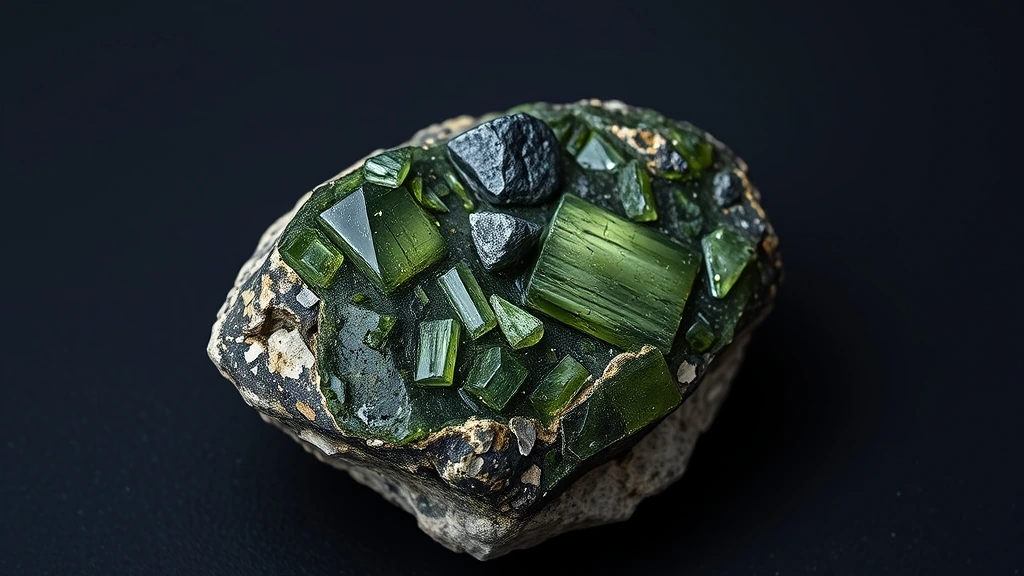
Epidote belongs to the Natural Mineral / Crystal group, forming primarily in metamorphic and igneous environments. Its geological significance stems from its stability under varying pressure and temperature conditions. As a common accessory mineral, it provides critical insights into the tectonic history of rock formations. Understanding its parent group context is essential for accurate gemological identification and valuation.
What is Epidote Gemstone? Geological Overview & Definition
Epidote is a widespread accessory mineral found in metamorphic rocks like schists and gneisses. It frequently occurs in igneous rocks such as granites and diorites. The stone’s presence often indicates specific metamorphic grades and fluid activity during rock formation.
As a gemstone, epidote is valued for its vibrant green hues and crystal clarity. While rarely cut into large faceted gems, it is popular in cabochons and small stones. Its geological definition remains rooted in its silicate structure and formation processes.
Epidote Gemstone Chemical Composition & Crystallographic Properties
Epidote crystallizes in the monoclinic crystal system, characterized by a single non-right angle. Its lattice structure features a unique arrangement of Si₂O₇ and SiO₄ groups. This specific geometry influences its cleavage and fracture patterns.
The mineral’s green color arises from Fe³⁺ chromophores within the crystal lattice. Cation substitution, particularly involving aluminum and iron, modifies its refractive index range. These substitutions are critical for determining optical properties and gem quality.
Epidote exhibits moderate acid sensitivity, reacting slowly with strong acids. Its thermal behavior shows stability up to moderate temperatures before structural changes occur. Understanding these properties ensures proper care and accurate gemological assessment.
| Property | Specification |
|---|---|
| Mineral Group | Natural Mineral / Crystal |
| Chemical Formula | Ca₂ Al₂ Fe³⁺ (SiO₄ )(Si₂ O₇ )O(OH) |
| Mohs Hardness | 6–7 |
| Crystal System | monoclinic crystal system |
| Specific Gravity (Density) | 3.38–3.49 |
| Refractive Index | n α = 1.715–1.751 n β = 1.725–1.784 n γ = 1.734–1.797 |
| Color & Optical Properties | Natural Epidote Gemstone color spectrum and optical dispersion |
| Primary Mining Localities | Global primary localities |
| Water & Chemical Resistance | High (Safe for gentle water washing) |
| Chakra Alignment (Traditional) | Heart Chakra, Solar Plexus Chakra |
| Zodiac Affinity (Traditional) | Taurus, Virgo, Capricorn |
| Symbolic Meaning (Traditional) | Emotional balance, patience, and grounding |
Epidote Gemstone Varieties & Color Spectrum
Green Epidote (Classic Verdant)
Formed in metamorphic schists and gneisses where calcium‑aluminum‑iron silicates replace plagioclase during greenschist‑facies conditions, this variety displays a vivid pistachio to deep forest green. Microscopic albite twinning and occasional chlorite inclusions give a subtle chatoyancy. High‑grade stones from the Alps and the Himalayas are prized for their uniform hue and are considered moderately rare.
Yellow‑Brown Epidote (Rhodonite‑Tinted)
Developing in hydrothermal veins intersecting limestone, iron oxidation imparts a warm amber to brownish‑yellow tone. The presence of pargasite and fine‑grained quartz inclusions creates a honey‑like translucency. Specimens from the Ural Mountains exhibit the most saturated coloration, making them collectible but not scarce.
Black Epidote (Tanzanite‑Like)
Rarely encountered, this variety forms in high‑pressure metamorphic zones where manganese substitutes for iron, darkening the crystal lattice. It shows a deep, almost opaque black with occasional metallic sheen from sulfide inclusions. Tanzanian and Brazilian occurrences are the primary sources, and the stone’s scarcity drives a high market premium.
Pink Epidote (Rosy Blush)
A product of low‑temperature hydrothermal alteration of feldspathic rocks, trace manganese and titanium give a delicate pink to salmon hue. Fine‑grained mica flakes often appear as shimmering specks, enhancing its visual appeal. Limited finds in Madagascar and the western United States make pink epidote exceptionally rare among collectors.
Blue‑Green Epidote (Aquamarine‑Shade)
Seen in basaltic lava flows where fluid‑rich chlorite‑epidote assemblages crystallize, this morph exhibits a striking teal to turquoise coloration. Thin‑section studies reveal exsolution lamellae of actinolite that produce a subtle iridescence. High‑quality stones from the Philippines are prized for jewelry and are moderately uncommon.
Vesuvianite‑Mixed Epidote (Hybrid)
Occurring in contact metamorphic aureoles, epidote intergrows with vesuvianite, creating a mottled green‑white pattern. The intergrowth often traps calcite veining, giving a marbled appearance. Italian and Mexican deposits yield the finest hybrids, valued for their unique texture and considered relatively rare.
Where is Epidote Gemstone Found? Geological Mining & Extraction
Epidote crystallizes chiefly in metamorphic schists, gneisses, and greenschist‑facies rocks, where calcium‑rich fluids replace plagioclase during regional metamorphism. It also occurs in hydrothermal veins cutting limestone and in basaltic lava flows where fluid‑rock interaction produces epidote‑chlorite assemblages.
Major mining districts include the Alps (Switzerland, Italy), the Ural Mountains (Russia), the Himalayas (India, Nepal), and the Tanzanian Rift Valley, where open‑pit and underground methods extract ore from serpentinized ultramafic bodies. Smaller but notable sources are found in Madagascar, the Philippines, and the western United States, where artisanal miners hand‑sort pegmatitic gravels for gem‑grade crystals.
Historical Significance & Cultural Lore of Epidote Gemstone
Ancient Greeks called epidote “emerald‑stone” and used it in intaglio seals, believing it protected against poison. Roman mosaics from Pompeii depict green epidote inlays, while Byzantine jewelry incorporated the stone as a symbol of renewal and fertility.
In East Asian tradition, especially in Japan’s Heian period, epidote was ground into pigment for lacquerware, thought to channel the protective energy of the forest. Indigenous peoples of the Andes embedded epidote beads in ceremonial necklaces, attributing to it the power to ward off evil spirits and bring agricultural abundance.
Modern Uses & Jewelry Applications of Epidote Gemstone
Epidote’s vibrant pistachio‑green to yellow‑gold hues make it a favorite for both cabochon and faceted settings, allowing lapidaries to showcase its pleochroism and moderate brilliance. Artisans often cut the stone in shallow domes to emphasize its silky luster, while deeper facets highlight its birefringence. In addition to rings and pendants, epidote is carved into ornamental beads, miniature sculptures, and decorative inlays for high‑end furniture.
- Cabochon pendants and brooches that display the stone’s chatoyant glow
- Faceted earrings and rings for a subtle sparkle without overwhelming brilliance
- Ornamental carvings such as figurines, vases, and inlaid panel work
Metaphysical Properties & Traditional Meaning of Epidote Gemstone
According to historical traditions and metaphysical lore, epidote is regarded as a stone of renewal, encouraging personal growth and the release of old patterns. It is said to foster emotional balance, helping the wearer move from fear to confidence while nurturing compassion toward others. The gemstone’s earthy green tone is believed to ground intentions, aligning the heart’s desires with practical action.
Which Chakra and Zodiac Signs Align with Epidote Gemstone?
Epidote resonates most strongly with the Root Chakra, supporting stability, security, and a sense of belonging in the material world. Simultaneously, it activates the Heart Chakra, promoting unconditional love, empathy, and emotional healing. This dual‑chakra connection is thought to bridge practical concerns with heartfelt aspirations.
In astrology, epidote is traditionally linked to Taurus, Gemini, and Leo. Taurus benefits from the stone’s grounding influence, enhancing perseverance and sensual appreciation. Gemini finds mental clarity and communicative confidence, while Leo experiences amplified creative fire and charismatic leadership. No other zodiac signs are associated with epidote in the canonical alignment.
How to Identify Real vs. Fake Epidote Gemstone
Artificial imitations of epidote include dyed quartz, colored glass, and synthetic resin that mimic its green hue but lack the mineral’s distinctive optical properties. Synthetic glass often appears too uniform, while dyed replicas may show uneven coloration under light. Recognizing these differences requires careful observation of weight, hardness, and internal features.
Practical At-Home Authenticity Tests
- Temperature Test (Thermal Feel): Natural epidote feels cool to the touch and retains that coolness longer than glass or plastic, which quickly warm to skin temperature.
- Specific Gravity & Weight Test: With a density of 3.38–3.49 g/cm³, genuine epidote feels noticeably heavier than quartz or glass of comparable size; a simple water displacement test can confirm this range.
- Scratch & Hardness Test (Mohs Comparison): Using a steel nail (hardness ~5.5) or a quartz point (hardness 7), epidote should resist scratching from the nail but may show a faint micro‑scratch from quartz, reflecting its 6–7 Mohs rating.
- Microscopic & Loupe Inspection (Internal Inclusions): Under 10×–30× magnification, real epidote reveals characteristic elongated, needle‑like inclusions and a faint striated texture, whereas glass shows smooth, bubble‑free interiors.
Epidote Gemstone Valuation Factors, Grading & Pricing
The primary driver of value is Color Saturation, specifically the intensity of the green hue. Gemologists assess how uniform the tone appears across the entire stone surface. High-grade specimens exhibit a rich, deep green with minimal zoning or color banding.
Carat Weight significantly influences pricing, as large, eye-clean crystals are exceptionally rare in nature. Facet symmetry ensures optimal light return, enhancing the stone’s visual appeal. The presence of matrix or heavy inclusions typically reduces the overall market value.
Geographical Provenance Premium can elevate prices for stones from renowned localities like Brazil or Austria. Wholesale rates generally remain stable, but retail prices fluctuate based on cut quality. Demand for unique, high-clarity specimens continues to drive premium pricing in the gem market.
How to Clean and Care for Epidote Gemstone
To maintain the stone’s integrity, always use warm soapy water and a soft cloth for cleaning. Gently wipe the surface to remove oils and dust without applying excessive pressure. This method effectively restores luster while respecting the gemstone’s physical structure.
It is critical to avoid ultrasonic cleaners entirely to prevent structural fractures. The internal crystal lattice of epidote can be sensitive to high-frequency vibrations. Always dry the stone thoroughly with a lint-free cloth after washing to prevent water spotting.
Cleansing and Recharging Epidote Gemstone (Energetic Care)
For energetic maintenance, utilize safe dry methods that respect the mineral’s chemical stability. Smoke smudging with sage or palo santo is an effective, non-invasive technique. This practice clears perceived negative energy without exposing the stone to moisture or heat.
Alternatively, place the epidote on a selenite plate under moonlight for recharging. This gentle approach aligns with the stone’s natural properties and avoids physical stress. Ensure the environment is dry to protect the gemstone’s long-term aesthetic and structural quality.
Frequently Asked Questions About Epidote Gemstone
What is the chemical composition of epidote?
Epidote is a calcium‑aluminum‑iron silicate mineral. Its formula is Ca₂Al₂Fe³⁺(SiO₄)(Si₂O₇)O(OH), combining isolated SiO₄ tetrahedra with double‑chain Si₂O₇ groups. This structure gives epidote its characteristic green to brown hues and contributes to its moderate hardness of 6–7 on the Mohs scale.
How hard is epidote compared to other gemstones?
Epidote ranks 6–7 on the Mohs hardness scale. This places it between orthoclase feldspar and quartz, making it suitable for everyday jewelry but still vulnerable to scratches from harder stones like sapphire or diamond. Careful handling and regular polishing help maintain its brilliance.
Is epidote safe to wear in water or rain?
Yes, epidote is highly water‑resistant and safe for gentle washing. You can rinse it under lukewarm water or clean it with a soft cloth without fear of damage. However, avoid prolonged soaking in harsh chemicals, as prolonged exposure may affect the surface luster over time.
How should I clean my epidote jewelry?
Clean epidote with warm, soapy water and a soft cloth. Gently wipe the stone to remove oils and dust, then pat dry with a lint‑free towel. Ultrasonic cleaners are discouraged because the rapid vibrations can cause micro‑fractures in the crystal lattice, compromising durability.
Which zodiac signs are associated with epidote?
Epidote is linked to Taurus, Gemini, and Leo. These signs are said to benefit from the stone’s grounding energy and its ability to stimulate personal growth. Wearing epidote during astrological events may enhance confidence and promote a balanced emotional outlook.
Which chakras does epidote influence?
Epidote resonates with the Root Chakra and the Heart Chakra. It is believed to anchor physical vitality while simultaneously opening the heart to compassion and love. This dual alignment makes it popular in meditation practices aimed at grounding and emotional healing.
Can epidote be used in ring settings despite its brittleness?
Epidote can be set in rings, but protective settings are advisable. A bezel or channel setting shields the stone’s edges from impact, reducing the risk of chipping. Regular inspections by a jeweler ensure that any micro‑fractures are addressed before they enlarge.
What are the typical refractive indices of epidote?
Epidote’s refractive indices range from nα = 1.715–1.751 to nγ = 1.734–1.797. These values produce a moderate brilliance with noticeable pleochroism, especially in well‑cut stones. The optical properties help gemologists distinguish epidote from similar green minerals such as peridot or jade.