
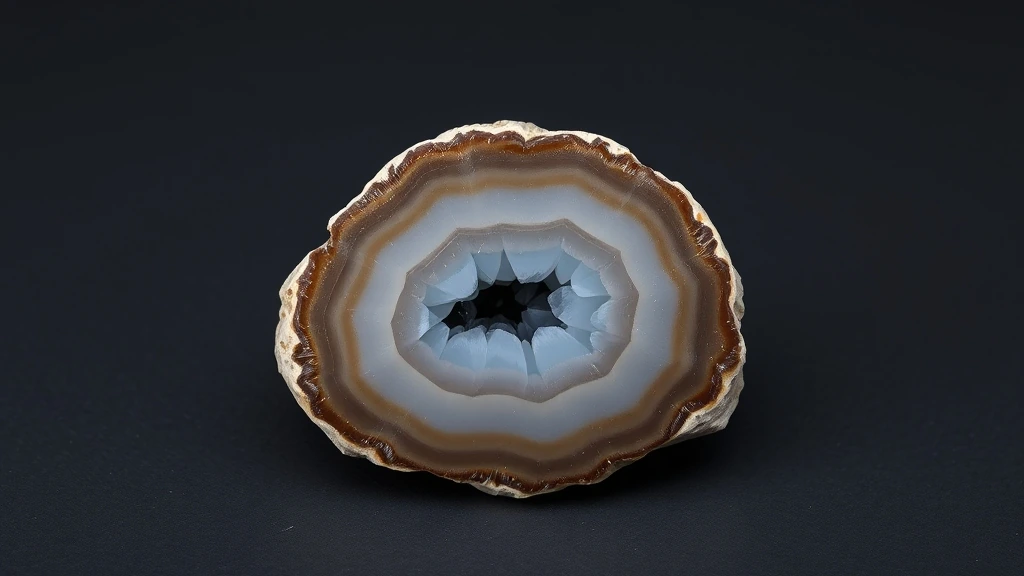
Flower agate belongs to the extensive silicate mineral group, specifically classified as a variety of chalcedony. It forms through the slow precipitation of silica-rich solutions within volcanic rock cavities over millions of years. The stone’s defining characteristic is the presence of organic inclusions, often resembling floral patterns, suspended within the cryptocrystalline quartz matrix. These delicate structures result from the fossilization of ancient plant matter or diatoms, creating a unique aesthetic that distinguishes it from standard banded agates.
What is Flower Agate? Geological Overview & Definition
Flower agate is a cryptocrystalline silica gemstone characterized by its translucent to opaque appearance and internal organic inclusions. These inclusions, often derived from ancient diatoms or plant fossils, create striking floral patterns that contrast with the surrounding chalcedony host rock. The stone typically displays a spectrum of earthy tones, including greens, yellows, and browns, which enhance the visual depth of the floral motifs. While the delicate, organic blooms of flower agate often evoke a sense of gentle ethereality, collectors seeking a more rugged, earthy aesthetic might turn to Moroccan Agate, which features bold, swirling patterns of deep browns and greens.
Geologically, this variety forms in volcanic basalt cavities where silica-rich fluids cool slowly, allowing for the delicate preservation of organic structures. The resulting fibrous aggregates lack visible crystal faces, giving the stone a smooth, waxy luster when polished. This unique formation process ensures that each specimen possesses a distinct pattern, making no two flower agates identical in their internal architecture. In comparative mineralogical collections, practitioners and geologists frequently study Crazy Lace Agate alongside this crystal to appreciate their subtle energetic and structural differences.
Flower Agate Chemical Composition & Crystallographic Properties
The fundamental chemical identity of flower agate is silicon dioxide (SiO₂), sharing the same composition as pure quartz. However, it exists as a microcrystalline aggregate rather than a single large crystal, resulting in a trigonal crystal system at the microscopic level. The individual silica fibers are so small that they cannot be resolved by the naked eye, creating a uniform, dense structure. This cryptocrystalline nature contributes to the stone’s high durability and resistance to scratching.
Color variations in flower agate arise from trace cation substitutions and impurities within the silica lattice, such as iron or manganese. These elements act as chromophores, absorbing specific wavelengths of light to produce the stone’s characteristic earthy hues. The organic inclusions themselves may also contain carbon-based compounds that influence the overall color palette. Thermal stability is generally high, though extreme heat can potentially alter the organic inclusions, leading to discoloration or cracking.
| Property | Specification |
|---|---|
| Mineral Group | Silicates (Chalcedony / Cryptocrystalline Quartz) |
| Chemical Formula | SiO₂ (Silicon Dioxide) |
| Mohs Hardness | 6.5 – 7.0 |
| Crystal System | Trigonal (Microcrystalline / Cryptocrystalline fibrous aggregates) |
| Specific Gravity (Density) | 2.60 – 2.65 |
| Refractive Index | 1.544 – 1.553 |
| Color & Optical Properties | Natural Flower Agate color spectrum and optical dispersion |
| Primary Mining Localities | Brazil, Uruguay, Turkey, India, Madagascar |
| Water & Chemical Resistance | High (Safe for gentle warm water and mild soap; avoid harsh acids and chlorine) |
| Chakra Alignment (Traditional) | Root Chakra and Sacral Chakra |
| Zodiac Affinity (Traditional) | Gemini, Virgo, Taurus |
| Symbolic Meaning (Traditional) | Grounding, emotional balance, physical endurance, and protection |
Flower Agate Varieties & Color Spectrum
Flower Agate displays distinct mineralogical characteristics across its geological varieties and structural habits. Gemologists evaluate these natural varieties based on crystal habit, trace chromophore concentrations, and visual luster.
Primary Natural Flower Agate
The benchmark natural variety exhibiting diagnostic color saturation and classic crystallographic symmetry.
Distinct Geological Morphs of Flower Agate
Secondary regional and structural varieties formed under localized geological temperature and pressure conditions.
Rose‑Petal Agate
Formed in silica‑rich cavities of volcanic tuffs, Rose‑Petal Agate displays delicate pink bands that mimic blooming petals. The microcrystalline quartz matrix incorporates iron oxide inclusions, giving the hue a warm, translucent glow. Found chiefly in Brazil’s Rio Grande do Sul, this variety is moderately rare and prized for its soft, romantic palette.
Blue‑Lace Agate
Blue‑Lace Agate originates in the hydrothermal veins of the Czech Republic, where low‑temperature fluids deposit silica alongside copper and manganese traces. The result is a striking blue‑white lace pattern that overlays a milky base, often with fine radial fissures. Its limited geographic occurrence makes it a collector’s favorite, especially when the lace appears crisp and uninterrupted.
Green‑Floral Agate
In the basaltic flows of Namibia, Green‑Floral Agate develops as thin, fern‑like inclusions of chlorite and serpentine within the silica framework. The emerald‑green veining creates a floral motif that seems to unfurl across the stone’s surface. This variety is scarce due to the precise temperature‑pressure regime required for chlorite stabilization, adding to its market value.
Red‑Spotted Agate
Red‑Spotted Agate forms in the sedimentary layers of the United States’ Colorado Plateau, where manganese‑rich fluids precipitate ruby‑red hematite speckles amid a translucent quartz host. The contrast between the deep red spots and the pale background yields a dramatic, speckled appearance. While more abundant than other flower agates, high‑quality specimens with uniform spotting remain sought after.
Black‑Vein Agate
Black‑Vein Agate is harvested from the volcanic ash deposits of Mexico’s Michoacán region, where carbonaceous material infiltrates the silica gel during solidification. The deep black veins intersect a light‑gray matrix, producing a bold, graphic pattern reminiscent of stylized blossoms. Its rarity stems from the need for precise carbon content and slow cooling, making it a distinctive addition to gemstone collections.
Golden‑Sun Agate
Golden‑Sun Agate emerges in the alluvial gravels of Uruguay, where iron oxide and goethite crystals embed within the quartz, creating sun‑kissed golden filaments that radiate from a creamy base. The interplay of metallic sheen and translucent quartz gives the stone a luminous quality prized in high‑end jewelry. Though more plentiful than other flower agates, gem‑grade material with vivid gold threads is comparatively limited.
Where is Flower Agate Found? Geological Mining & Extraction
Flower agate typically occurs in cryptocrystalline silica that fills vesicles of volcanic tuffs, rhyolitic lava flows, and basaltic ash layers. The mineral precipitates from low‑temperature hydrothermal solutions, often alongside chalcedony, jasper, and opal, creating the characteristic floral patterns that define the gemstone.
Major extraction sites include Brazil’s Rio Grande do Sul, the Czech Republic’s Bohemian Massif, Namibia’s Otavi Mountainland, and the United States’ Colorado Plateau. In each locale, miners employ careful hand‑sorting and low‑impact blasting to preserve the delicate banding, then wash and grade the material before it enters the global gemstone market.
Historical Significance & Cultural Lore of Flower Agate
Across ancient lapidary traditions, flower agate was valued for its grounding qualities and decorative appeal. In Greco‑Roman mosaics, fragments of the stone adorned floor patterns, while Egyptian artisans set polished cabochons in amulets intended to protect the wearer from harm.
In Vedic texts, the stone is linked to the Root and Sacral Chakras, believed to foster emotional balance and physical endurance. Chinese jade workshops of the Han dynasty occasionally incorporated flower agate into ornamental hairpins, attributing to it the power to ward off negative energies.
Modern Uses & Jewelry Applications of Flower Agate
Flower agate is prized for its delicate floral banding and translucent hues, making it a favorite for cabochon pendants, rings, and earrings. Lapidaries often employ a wet saw to preserve the micro‑crystalline texture while shaping smooth domes. Artisans also facet select stones to highlight light play, and skilled carvers produce ornamental beads, intaglios, and small sculpture elements for decorative objects.
- Cabochon pendants showcasing blooming patterns
- Faceted rings that accentuate refractive sparkle
- Carved beads and intaglios for vintage‑style jewelry
- Decorative plaques and small figurines for interior design
Metaphysical Properties & Traditional Meaning of Flower Agate
According to historical traditions and metaphysical lore, flower agate is regarded as a stone of grounding and emotional balance, echoing the nurturing cycles of nature. Across ancient Mediterranean and Vedic lapidary records, it is said to soothe anxiety, promote physical endurance, and act as a protective barrier against negative energies. The stone’s gentle energy is believed to encourage creativity while anchoring the wearer in the present moment, fostering a sense of inner stability.
Which Chakra and Zodiac Signs Align with Flower Agate?
In universal esoteric systems, flower agate resonates most strongly with the Root Chakra, supporting foundational stability, and the Sacral Chakra, enhancing creative flow and emotional expression. Practitioners use the stone during meditation to reinforce these energy centers, encouraging both physical grounding and passionate vitality.
Astrologically, the gemstone is aligned with the signs of Gemini, Virgo, and Taurus. Gemini benefits from its communicative clarity, Virgo finds reinforcement of practical discernment, and Taurus experiences amplified sensual appreciation and steadfastness. These alignments are consistently cited in traditional astrological gem correspondences.
How to Identify Real vs. Fake Flower Agate
Artificial imitations of flower agate include dyed quartz, synthetic glass, and resin composites that mimic the floral banding but lack the authentic micro‑crystalline structure. Such replicas often display overly uniform colors, a glassy luster, or a noticeably lighter weight. Careful observation and simple tests can reveal these differences, helping collectors avoid costly misidentifications.
Practical At-Home Authenticity Tests
- Temperature Test (Thermal Feel): Real flower agate feels cool to the touch and retains that coolness longer than glass or plastic, which quickly warm to skin temperature.
- Specific Gravity & Weight Test: With a density of 2.60‑2.65 g/cm³, genuine agate feels heavier than synthetic glass (≈2.5 g/cm³) when compared side‑by‑side of similar size.
- Scratch & Hardness Test (Mohs Comparison): Using a steel file (Mohs ~5.5), a genuine stone will resist scratching, whereas glass or dyed quartz may show surface marks; a diamond tip will leave a faint scratch on authentic agate.
- Microscopic & Loupe Inspection (Internal Inclusions): Under 10× magnification, natural flower agate reveals fine, irregular banding and microscopic fissures, while synthetic imitations often display uniform bubbles or a flawless surface.
Flower Agate Valuation Factors, Grading & Pricing
The market first judges a specimen by color saturation. Deep, vivid pinks and reds that radiate from the characteristic floral patterns command premium prices, while muted or uneven hues are discounted. Even subtle variations in tone can signal natural formation versus dye‑enhanced material, influencing collector confidence.
Next, crystal size & weight (grams) drive pricing tiers. Larger, intact pieces that weigh several grams and display a uniform, polished surface fetch higher offers than small fragments or raw, unpolished nodules. Natural matrix inclusions such as quartz veining add intrigue, but excessive fractures or heavy polishing that removes the floral pattern reduce value.
Finally, ethical sourcing & locality premium shapes demand in both holistic and collector circles. Specimens mined from recognized Turkish or Brazilian deposits with documented fair‑trade practices attract a surcharge, reflecting both provenance pride and sustainability concerns. Buyers increasingly verify origin certificates, rewarding responsibly extracted flower agate over unverified stock.
How to Clean and Care for Flower Agate
Warm, soapy water is ideal for solid flower agate. Gently immerse the stone in lukewarm water mixed with a mild, pH‑neutral soap, then use a soft brush or cloth to remove surface dirt. Rinse thoroughly with clean water and pat dry with a lint‑free microfiber towel. Avoid ultrasonic cleaners if the piece has been dyed, shows significant fractures, or has undergone any surface treatment, as the vibrations can exacerbate damage.
Cleansing and Recharging Flower Agate (Energetic Care)
For holistic upkeep, place the stone in a bowl of dried sage or cedar smudge smoke for a few minutes, allowing the gentle aromatic vapors to clear lingering energetic residue. Ensure the smudge source is distant enough to prevent any moisture from reaching the agate’s surface, then wipe the stone dry with a soft cloth.
Alternatively, rest the agate on a clean selenite slab under the light of a waning or full moon for several hours, permitting lunar energy to refresh its vibrational field. This method requires no heat or direct sunlight, preserving the crystal lattice while enhancing its grounding and emotional‑balancing properties.
Frequently Asked Questions About Flower Agate
Flower Agate displays distinct mineralogical characteristics across its geological varieties and structural habits. Gemologists evaluate these natural varieties based on crystal habit, trace chromophore concentrations, and visual luster.
Primary Natural Flower Agate
The benchmark natural variety exhibiting diagnostic color saturation and classic crystallographic symmetry.
Distinct Geological Morphs of Flower Agate
Secondary regional and structural varieties formed under localized geological temperature and pressure conditions.
What is the chemical composition of flower agate?
Flower agate is composed entirely of silicon dioxide (SiO₂), the same mineral as standard quartz. This pure silica structure gives the stone its characteristic trigonal crystal system and high chemical stability. Unlike organic gemstones, it does not contain carbon or other volatile elements.
How hard is flower agate on the Mohs scale?
Flower agate rates between 6.5 and 7.0 on the Mohs hardness scale. This durability makes it resistant to scratches from common household materials like steel or glass. It is robust enough for daily wear in rings and bracelets without significant surface wear.
Is flower agate safe to wear in the shower?
Yes, flower agate is safe for gentle warm water and mild soap exposure. However, you should avoid harsh acids, chlorine, and prolonged hot water immersion. These elements can degrade any surface treatments or cause discoloration in dyed specimens over time.
Can I use an ultrasonic cleaner on flower agate?
Warm soapy water is the ideal cleaning method for solid agates. You must avoid ultrasonic cleaners if the specimen is dyed, heavily fractured, or treated. High-frequency vibrations can loosen internal inclusions or strip artificial colorants from the stone.
Which zodiac signs are aligned with flower agate?
Flower agate is traditionally associated with Gemini, Virgo, and Taurus. These earth and air signs benefit from the stone’s grounding properties. Wearing this gemstone is believed to enhance focus and emotional stability for these specific astrological profiles.
Which chakras does flower agate activate?
This gemstone primarily activates the Root Chakra and Sacral Chakra. It supports physical endurance and emotional balance by anchoring energy to the earth. This dual alignment helps stabilize the wearer’s foundation and creative flow simultaneously.
What is the density of flower agate?
Flower agate has a specific gravity ranging from 2.60 to 2.65. This moderate density is typical for cryptocrystalline silica varieties. It feels substantial in the hand but remains lighter than denser minerals like garnet or topaz.
How should I store flower agate jewelry?
Store flower agate in a soft pouch or separate compartment to prevent surface scratches. Although hard, it can still be abraded by diamonds or sapphires. Keep it away from direct sunlight to preserve the vibrancy of its internal floral inclusions.