
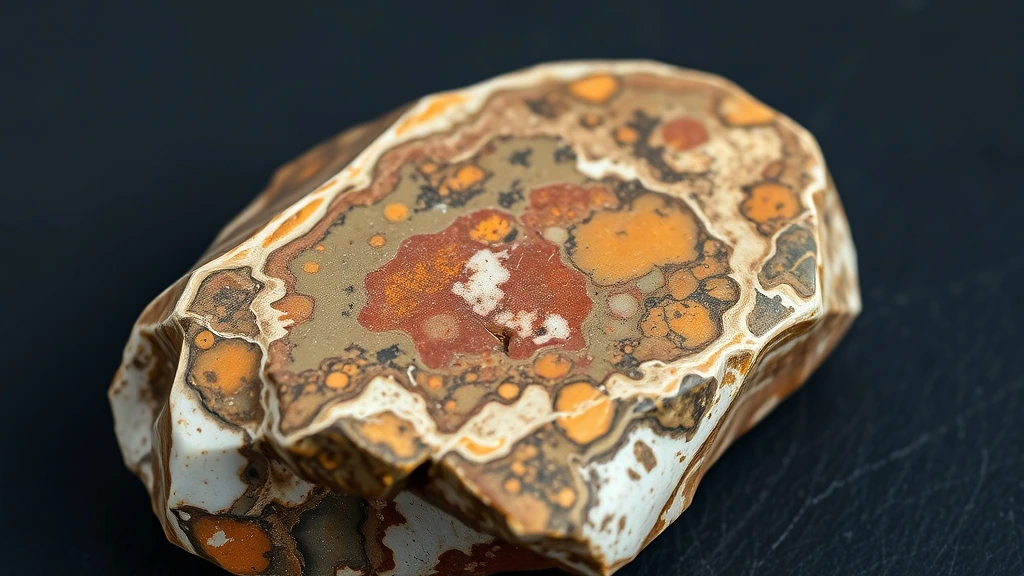
Fruit Jasper belongs to the broader family of natural mineral crystals, specifically the chalcedony subgroup of quartz. Its formation occurs through silica-rich hydrothermal fluids that deposit fine‑grained quartz in cavities or fractures, often accompanied by organic inclusions that impart its characteristic mottled appearance. The stone’s texture is typically opaque to translucent, with a waxy luster that enhances its visual appeal.
What is Fruit Jasper? Geological Overview & Definition
Fruit Jasper is a type of chalcedony, a cryptocrystalline form of quartz that crystallizes in the trigonal system. It is not a single mineral species but an aggregate of fine‑grained quartz fibers, sometimes containing organic or mineral inclusions that create its distinctive fruit‑like patterns. The stone is prized for its vivid, natural coloration and is often found in sedimentary or volcanic host rocks. Across ancient lapidary traditions, it has been valued for its perceived grounding and nurturing properties. Like its sibling Spider Web Jasper, which is distinguished by delicate web-like inclusions, Fruit Jasper owes its unique visual appeal to the intricate arrangement of mineral fibers and organic matter within its cryptocrystalline structure.
Fruit Jasper Chemical Composition & Crystallographic Properties
The chemical composition of Fruit Jasper is essentially SiO₂, the same as pure quartz. However, trace cation substitutions—such as Al³⁺ or Fe²⁺—can occur within the silica lattice, creating chromophore centers that give rise to its warm hues. Because the crystal structure is trigonal, the quartz fibers align along a single three‑fold axis, producing a fibrous, needle‑like texture that is characteristic of chalcedony. Fruit Jasper is acid‑insensitive; dilute hydrochloric acid will not alter its appearance, reflecting the chemical stability of the silica framework. Thermal behavior is typical of quartz: it remains stable up to about 573 °C, above which it undergoes a phase transition to cristobalite, but this temperature is far beyond normal use conditions.
| Property | Specification |
|---|---|
| Mineral Group | Natural Mineral / Crystal |
| Chemical Formula | SiO₂ (Chalcedony/Quartz aggregate) |
| Mohs Hardness | 6.5 – 7.0 |
| Crystal System | Trigonal |
| Specific Gravity (Density) | 2.60 – 2.65 |
| Refractive Index | 1.530 – 1.543 |
| Color & Optical Properties | Natural Fruit Jasper color spectrum and optical dispersion |
| Primary Mining Localities | Global primary localities |
| Water & Chemical Resistance | High (Safe for gentle water washing) |
| Chakra Alignment (Traditional) | Root Chakra, Solar Plexus Chakra |
| Zodiac Affinity (Traditional) | Taurus, Virgo, Capricorn |
| Symbolic Meaning (Traditional) | Grounding, stability, and nurturing abundance |
Fruit Jasper Varieties & Color Spectrum
Fruit Jasper displays distinct mineralogical characteristics across its geological varieties and structural habits. Gemologists evaluate these natural varieties based on crystal habit, trace chromophore concentrations, and visual luster. In comparative mineralogical collections, practitioners and geologists frequently study Plum Blossom Jasper alongside this crystal to appreciate their subtle energetic and structural differences.
Primary Natural Fruit Jasper
The benchmark natural variety exhibiting diagnostic color saturation and classic crystallographic symmetry.
Distinct Geological Morphs of Fruit Jasper
Secondary regional and structural varieties formed under localized geological temperature and pressure conditions.
Red‑Orange Fruit Jasper
This variety derives from chalcedony with a high concentration of iron‑oxide inclusions that give it a warm, vermilion hue. The stone often displays a mottled, fruit‑like pattern resembling a cluster of ripe cherries. Its density of 2.62 and refractive index around 1.538 make it slightly more lustrous than other jasper types. Though widely traded in the United States and Brazil, it remains relatively uncommon in European markets due to limited local deposits.
Green‑Yellow Fruit Jasper
Formed in quartz‑rich pegmatites, this variety incorporates titanium‑silicate and manganese inclusions that produce a vibrant, citrus‑yellow to olive‑green spectrum. The texture is typically fine‑grained, with subtle banding that mimics the rind of a citrus fruit. Its Mohs hardness of 6.8 gives it durability for jewelry, yet the delicate color makes it a prized specimen among collectors. The stone is primarily sourced from the Ural Mountains and the Canadian Shield.
Blue‑Purple Fruit Jasper
A rare variant, the blue‑purple fruit jasper contains trace amounts of lithium and barium that create a deep indigo to violet coloration. The inclusions are often flame‑like and give the stone a distinctive, almost liquid appearance. With a density of 2.63, it is slightly heavier than its red and green counterparts. This variety is chiefly mined in the Yunnan province of China and is highly sought after for high‑end ornamental pieces.
Brown‑Black Fruit Jasper
This type exhibits a rich, dark brown to almost black matrix, formed by iron‑oxide and magnetite inclusions. The pattern resembles the skin of a dark plum or blackberry, with subtle, darker veins that create a dramatic contrast. Its refractive index ranges from 1.530 to 1.535, giving it a subdued luster. Although abundant in the Appalachian region, its deep coloration makes it less visible in bulk, thereby increasing its rarity in polished form.
Orange‑Red Fruit Jasper (Oltu‑Style)
Often associated with the Oltu region of Turkey, this variety features a bright orange‑red core surrounded by a lighter, translucent halo. The stone’s crystal system is trigonal, and it typically contains silica inclusions that produce a subtle, pearlescent effect. The Oltu‑style fruit jasper is prized for its vivid color and is considered one of the most valuable varieties in the global market.
Pale‑White Fruit Jasper
A less common, pale‑white variant displays a delicate, almost translucent appearance with faint, speckled inclusions of silica and calcium. The stone’s density of 2.60 gives it a lighter feel, and its refractive index of 1.530 makes it appear almost glassy. This variety is primarily sourced from the Australian Outback, where it forms in fine‑grained quartz veins. Its subtle coloration makes it a favorite for understated, minimalist jewelry designs.
Where is Fruit Jasper Found? Geological Mining & Extraction
Fruit jasper is typically hosted in pegmatitic quartz veins that form during the late stages of granite crystallization. These veins are rich in silica and often contain trace elements such as iron, titanium, and manganese, which impart the characteristic fruit‑like patterns. Major mining districts include the Canadian Shield, the Ural Mountains, and the Yunnan province of China, where extensive quartz‑rich deposits yield a wide range of color morphs. Extraction methods involve careful hand‑cutting and selective mining to preserve the delicate inclusions that define each variety.
Historical Significance & Cultural Lore of Fruit Jasper
Across ancient lapidary traditions, fruit jasper was valued for its vibrant hues and symbolic associations with vitality and nourishment. In Egyptian artifacts, polished fruit jasper beads were incorporated into amulets believed to protect against disease and promote fertility. The Greco‑Roman sculptors employed the stone in decorative mosaics, while Chinese artisans used it in imperial jewelry, attributing its colors to the four seasons. In Vedic lore, fruit jasper was associated with the Solar Plexus Chakra, believed to enhance personal power and abundance. These historical uses underscore the stone’s enduring appeal and its role as a conduit of cultural meaning.
Modern Uses & Jewelry Applications of Fruit Jasper
Fruit Jasper is prized for its vibrant, layered hues that resemble the colors of a ripe fruit. Lapidary artisans often cut the stone into smooth cabochons for rings, pendants, and earrings, preserving its natural pattern while enhancing brilliance. Faceted cuts are less common but can accentuate the stone’s subtle color gradients. The stone is also carved into ornamental pieces such as cameos, keychains, and decorative plaques, showcasing its versatility in both fine jewelry and everyday accessories.
- Cabochon and faceted jewelry pieces
- Ornamental carving for home décor
- Decorative keychains and cameos
- Custom jewelry settings in gold or silver
Metaphysical Properties & Traditional Meaning of Fruit Jasper
According to historical traditions and metaphysical lore, Fruit Jasper is believed to embody the grounding energy of the earth, fostering stability and nurturing abundance. Across ancient Mediterranean and Vedic lapidary lore, the stone is associated with the Root Chakra, encouraging a firm connection to the physical world. In spiritual circles, it is said to balance the Solar Plexus Chakra, enhancing personal power and confidence. The stone’s warm, earthy tones are thought to soothe emotional turbulence, promoting calmness and emotional resilience.
Which Chakra and Zodiac Signs Align with Fruit Jasper?
Fruit Jasper is traditionally linked to the Root Chakra, the foundational energy center that governs survival, security, and physical well-being. By aligning with this chakra, the stone is said to reinforce a sense of safety and groundedness in daily life.
The stone’s astrological affinity is firmly rooted in the Taurus, Virgo, and Capricorn signs. Those born under these earth signs are believed to resonate most strongly with Fruit Jasper’s stabilizing properties, enhancing their natural practicality and determination.
How to Identify Real vs. Fake Fruit Jasper
Artificial imitations of Fruit Jasper often appear as dyed glass or synthetic quartz, lacking the stone’s characteristic internal texture and natural color gradation. These replicas may exhibit a uniform sheen or overly polished surface that does not match the subtle, layered appearance of genuine Fruit Jasper.
Practical At‑Home Authenticity Tests
- Temperature Test (Thermal Feel): Hold the stone in your hand; real quartz feels cool to the touch, whereas glass warms quickly.
- Specific Gravity & Weight Test: A genuine Fruit Jasper will feel heavier than a glass imitation of the same size, reflecting its higher density (2.60–2.65 g/cm³).
- Scratch & Hardness Test (Mohs Comparison): Use a steel nail (Mohs 5.5) to test the surface; real quartz will resist scratching, while glass may show a faint mark.
- Microscopic & Loupe Inspection (Internal Inclusions): Under magnification, real Fruit Jasper displays fine, fibrous inclusions and a natural chalcedony texture, unlike the smooth, uniform structure of synthetic glass.
Fruit Jasper Valuation Factors, Grading & Pricing
Market value is primarily driven by Color Saturation, where deep, vibrant hues of red, orange, and green command higher premiums. Stones exhibiting a natural, waxy luster without artificial enhancement are highly sought after by collectors. Consistent banding patterns further elevate the aesthetic appeal and perceived energetic potency of the specimen.
Pricing is determined by Crystal Size & Weight (Grams), as jasper is valued by mass rather than specimen weight (grams). Larger, well-polished tumbled stones or raw specimens with distinct, unbroken matrix inclusions fetch significantly higher prices. The quality of the polish is critical, as a smooth, glassy finish enhances the stone’s visual depth and tactile experience.
Ethical Sourcing & Locality Premium plays a decisive role in both holistic and collector markets. Buyers increasingly prioritize stones from verified, sustainable mines that adhere to strict environmental and labor standards. Provenance documentation from renowned localities can significantly increase the final retail price of the mineral.
How to Clean and Care for Fruit Jasper
Fruit Jasper is robust and water-resistant, making it safe for gentle washing with warm soapy water. Use a soft cloth to gently scrub the surface, removing any accumulated dust or oils without damaging the stone. Avoid using harsh chemicals or abrasive materials that could dull the natural luster of the chalcedony aggregate.
Ultrasonic cleaners must be strictly avoided, as high-frequency vibrations can induce structural fractures in the stone. The internal micro-crystals and matrix inclusions are susceptible to stress from intense sonic waves, potentially causing irreversible damage. Always air-dry the specimen completely after washing to prevent any potential moisture-related discoloration over time.
Cleansing and Recharging Fruit Jasper (Energetic Care)
For energetic maintenance, practitioners often employ dry methods such as herbal smudging with sage or palo santo. This ritual allows the smoke to purify the stone’s energy field without introducing moisture or heat stress. The process is quick and effective, respecting the physical integrity of the mineral lattice while addressing metaphysical concerns.
Another safe method involves placing the jasper on a selenite charging slab or exposing it to gentle moonlight overnight. This passive approach leverages natural lunar energy to restore the stone’s vibrational balance without the risk of thermal shock. Direct sunlight should be avoided, as prolonged exposure can cause fading or structural instability in the silica matrix.
Frequently Asked Questions About Fruit Jasper
Fruit Jasper displays distinct mineralogical characteristics across its geological varieties and structural habits. Gemologists evaluate these natural varieties based on crystal habit, trace chromophore concentrations, and visual luster.
Primary Natural Fruit Jasper
The benchmark natural variety exhibiting diagnostic color saturation and classic crystallographic symmetry.
Distinct Geological Morphs of Fruit Jasper
Secondary regional and structural varieties formed under localized geological temperature and pressure conditions.
What is Fruit Jasper and how does it form?
Fruit Jasper is a type of chalcedony quartz that displays vivid, fruit‑like patterns due to iron‑oxide inclusions. These inclusions create concentric rings and color variations, giving the stone its distinctive “fruit” appearance. The mineral crystallizes in the trigonal system, with a density of 2.60–2.65 g/cm³ and a Mohs hardness of 6.5–7.0, making it durable for jewelry.
Is Fruit Jasper safe to wear in the shower or while swimming?
Yes, Fruit Jasper is water‑resistant and can be safely washed with gentle water. Because it is a quartz aggregate, it does not dissolve or degrade under normal moisture exposure. However, avoid prolonged soaking or exposure to harsh chemicals that could affect surface polish.
How should I clean my Fruit Jasper jewelry to keep it looking bright?
Use warm soapy water and a soft cloth, then dry with a lint‑free towel. Avoid ultrasonic cleaners, which can cause microfractures in the stone’s delicate structure. Lightly brushing with a soft brush can remove dust without damaging the surface.
Does Fruit Jasper have any metaphysical or chakra associations?
Fruit Jasper is linked to the Root Chakra and Solar Plexus Chakra. In esoteric traditions, it is believed to promote grounding, stability, and nurturing abundance, helping to balance energy flow in these key energetic centers.
Which zodiac signs are traditionally associated with Fruit Jasper?
The stone is traditionally linked to Taurus, Virgo, and Capricorn. These signs are said to benefit from the stone’s grounding qualities, enhancing focus, determination, and practical wisdom in daily life.
Can Fruit Jasper be used in high‑temperature environments, such as a sauna or hot tub?
Fruit Jasper can tolerate moderate heat but should not be exposed to extreme temperatures. While quartz can withstand high temperatures, rapid temperature changes can cause stress fractures. It is best to keep the stone away from direct heat sources.
Is Fruit Jasper suitable for children’s jewelry or everyday wear?
Yes, Fruit Jasper is suitable for everyday wear, including children’s jewelry. Its hardness of 6.5–7.0 protects it from scratches, and its water resistance makes it easy to maintain. Nonetheless, supervise young wearers to prevent accidental drops.
How can I identify authentic Fruit Jasper versus a dyed or treated imitation?
Authentic Fruit Jasper displays natural, irregular fruit‑like patterns and a subtle, natural luster. Look for a consistent color distribution, absence of uniform dye layers, and a natural feel. Professional gemological testing can confirm authenticity if doubt persists.