
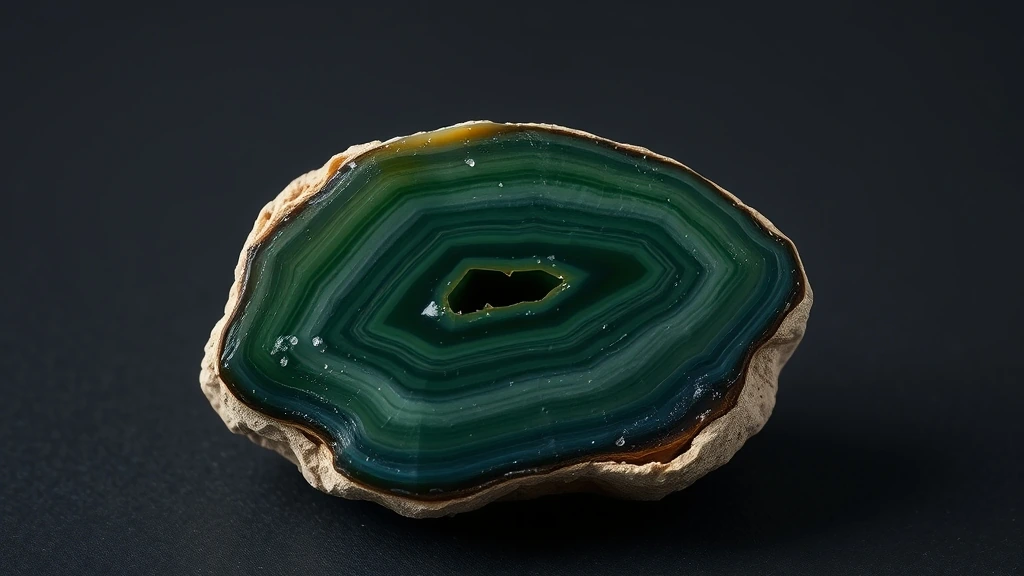
Green Banded Agate belongs to the chalcedony subgroup within the broader silicate mineral family. It forms through the slow deposition of microcrystalline quartz in cavities of volcanic or sedimentary rocks. This process creates intricate, parallel bands of varying green hues. The stone is fundamentally a cryptocrystalline aggregate rather than a single large crystal. Its fibrous texture results from the interlocking growth of tiny quartz fibers.
What is Green Banded Agate? Geological Overview & Definition
Green Banded Agate is a banded variety of chalcedony characterized by alternating layers of green and lighter tones. These bands form as silica-rich solutions precipitate in cycles within geological voids. The green coloration often stems from trace impurities or iron oxides. This rhythmic deposition creates the stone’s signature striped appearance.
Geologically, it is classified as a cryptocrystalline quartz aggregate with a trigonal symmetry at the microscopic level. The bands represent different stages of mineral precipitation over time. Each layer reflects slight changes in the chemical environment during formation. This natural layering makes every specimen unique in its pattern. In comparative mineralogical collections, practitioners and geologists frequently study Lattice Lace Agate alongside this crystal to appreciate their subtle energetic and structural differences.
Green Banded Agate Chemical Composition & Crystallographic Properties
The fundamental chemical formula is SiO₂, indicating pure silicon dioxide without significant stoichiometric variation. The crystal system is trigonal, manifesting as microcrystalline or cryptocrystalline fibrous aggregates. Individual quartz fibers align in parallel arrays, creating the banded structure. This fibrous aggregate nature defines its macroscopic appearance. In comparative mineralogical collections, practitioners and geologists frequently study Kiwi Jasper alongside this crystal to appreciate their subtle energetic and structural differences.
The lattice structure consists of tightly packed silica tetrahedra linked by oxygen atoms. Cation substitution is minimal, as the structure is highly stable and saturated. The green color arises from chromophore centers, often involving iron impurities. These trace elements alter light absorption within the crystal lattice.
The stone exhibits high acid sensitivity only to strong hydrofluoric acid, which dissolves silica. It is otherwise chemically inert and resistant to most environmental acids. Thermal behavior is stable, with no significant phase changes at standard jewelry temperatures. The refractive index ranges from 1.544 to 1.553, contributing to its glassy luster.
| Property | Specification |
|---|---|
| Mineral Group | Silicates (Chalcedony / Cryptocrystalline Quartz) |
| Chemical Formula | SiO₂ (Silicon Dioxide) |
| Mohs Hardness | 6.5 – 7.0 |
| Crystal System | Trigonal (Microcrystalline / Cryptocrystalline aggregates) |
| Specific Gravity (Density) | 2.60 – 2.65 |
| Refractive Index | 1.544 – 1.553 |
| Color & Optical Properties | Natural Green Banded Agate color spectrum and optical dispersion |
| Primary Mining Localities | Brazil, Uruguay, Turkey, India, Madagascar |
| Water & Chemical Resistance | High (Safe for gentle warm water and mild soap; avoid harsh acids and chlorine) |
| Chakra Alignment (Traditional) | Root Chakra and Sacral Chakra |
| Zodiac Affinity (Traditional) | Gemini, Virgo, Taurus |
| Symbolic Meaning (Traditional) | Grounding, emotional balance, physical endurance, and protection |
Green Banded Agate Varieties & Color Spectrum
Green banded agate exhibits a diverse range of chromatic expressions derived from trace mineral impurities within the silica matrix. The most common green hue stems from ferrous iron (Fe²⁺) inclusions, which impart a soft, earthy verdant tone to the stone. Some specimens display a deeper, more saturated green caused by the presence of chlorite or glauconite particles dispersed throughout the fibrous structure.
Moss Agate
Moss agate is distinguished by its intricate, plant-like inclusions that resemble submerged aquatic vegetation or fern fronds. These dendritic patterns form when iron and manganese oxides precipitate within the cavities of the host rock during crystallization. The green coloration typically arises from chlorite or glauconite minerals trapped within the silica gel, creating a striking contrast against the translucent background.
Green Chert Agate
This variety features a more uniform, opaque green coloration with subtle banding that lacks the distinct dendritic inclusions of moss agate. The hue is primarily driven by microscopic trace amounts of nickel, chromium, or copper ions incorporated within the cryptocrystalline quartz structure. Geologically, it often forms in volcanic or hydrothermal environments where trace amounts of nickel, copper, or chromium are introduced by silica‑rich fluids, imparting the characteristic green tint.
Brazilian Green Agate
Sourced predominantly from the Minas Gerais region, this trade variety is known for its vibrant, consistent green bands and high clarity. The stone frequently exhibits a polished luster that enhances the visibility of its concentric banding patterns. Its geological origin is linked to volcanic tuff deposits where silica-rich fluids cooled rapidly, trapping green-tinted minerals in distinct layers.
Siberian Green Agate
Historically prized for its deep, forest-green tones, this variety originates from the Ural Mountains region of Russia. The color intensity is attributed to trace amounts of nickel- or copper-bearing minerals embedded within the chalcedony matrix. Collectors value its dense, compact structure and the subtle play of light across its polished surface, which reveals fine, parallel banding.
Australian Green Agate
Found in the arid regions of Western Australia, this variety often displays a unique combination of green and brownish-grey bands. The formation is associated with ancient volcanic activity that created numerous geodes filled with silica gel. The green hues result from trace amounts of copper or iron interacting with the silica during the slow cooling process of the mineral.
Where is Green Banded Agate Found? Geological Mining & Extraction
Green banded agate primarily forms in volcanic and sedimentary rock formations where silica-rich fluids infiltrate cavities and cool over millions of years. The most significant deposits are located in Brazil, India, and Russia, where extensive mining operations extract large quantities of raw material. In Brazil, agate is often found in alluvial deposits derived from the erosion of older volcanic rocks, facilitating easier collection and processing.
Extraction methods typically involve open-pit mining or riverbed dredging, depending on the specific geological context of the deposit. In regions like India, agate nodules are frequently recovered from weathered basalt flows that have been broken down by natural erosion. The raw stones are then transported to processing facilities where they are cut, tumbled, and polished to reveal their internal banding and color variations.
Historical Significance & Cultural Lore of Green Banded Agate
Ancient civilizations revered agate for its perceived protective properties and its association with stability and endurance. In Greco-Roman culture, the stone was often carved into cameos and intaglios depicting deities or mythological scenes, symbolizing divine favor and strength. Egyptian artisans also utilized agate in funerary objects and amulets, believing it would guide the soul through the afterlife and provide spiritual protection.
Throughout Vedic traditions in India, agate was considered a stone of grounding and physical vitality, often used in rituals to enhance focus and resilience. Archaeological findings in Mesoamerican sites reveal agate beads and carvings that served as status symbols and offerings to deities. These historical uses underscore the stone’s enduring appeal as a symbol of emotional balance and physical endurance across diverse global cultures.
Modern Uses & Jewelry Applications of Green Banded Agate
Lapidaries primarily cut green banded agate into cabochons to showcase its distinct, parallel banding patterns. The stone’s Mohs hardness of 6.5 to 7.0 ensures it maintains a high polish and resists daily wear. Its durable nature makes it ideal for rings, pendants, and ornamental carvings.
- Cabochon Cutting: Smooth, domed surfaces highlight the vibrant green and white banding without obscuring the pattern.
- Intaglio Carving: Historically used for seals and signets due to its resistance to chipping.
- Ornamental Objects: Frequently carved into paperweights, vases, and architectural accents for interior design.
- Beadwork: Polished beads are popular in artisan jewelry for their consistent color distribution.
Metaphysical Properties & Traditional Meaning of Green Banded Agate
According to historical traditions and metaphysical lore, this stone is revered for its grounding capabilities. Ancient Mediterranean and Vedic texts often associated agate with stability and emotional balance. Practitioners believe it fosters physical endurance and provides a sense of protection during times of stress.
The green hues specifically symbolize growth, renewal, and the revitalization of the body’s energy systems. It is traditionally used to anchor the spirit to the earth, promoting calmness and resilience.
Which Chakra and Zodiac Signs Align with Green Banded Agate?
Green banded agate is canonically aligned with the Root Chakra and the Sacral Chakra. The Root Chakra connection supports stability and survival instincts, while the Sacral Chakra alignment enhances creativity and emotional flow. This dual resonance helps balance physical grounding with creative expression.
Astrologically, the stone is associated with Gemini, Virgo, and Taurus. These earth and air signs benefit from the stone’s ability to harmonize mental activity with physical stability. It is not traditionally linked to other zodiac signs in standard gemological astrology.
How to Identify Real vs. Fake Green Banded Agate
Artificial imitations of green banded agate include synthetic glass, plastic resins, and dyed chalcedony. Glass imitations often lack the natural fibrous structure of genuine agate and may contain trapped bubbles. Dyed replicas can exhibit uneven color saturation, particularly in the crevices of the bands.
Practical At-Home Authenticity Tests
- Temperature Test (Thermal Feel): Genuine agate feels cool to the touch initially and warms slowly. Glass and plastic imitations warm up much faster under body heat.
- Specific Gravity & Weight Test: Real agate has a density of 2.60 to 2.65. It feels heavier than glass or plastic of the same size. Compare it against a known genuine stone for accuracy.
- Scratch & Hardness Test (Mohs Comparison): With a Mohs hardness of 6.5 to 7.0, agate will scratch glass but not steel. It will not be scratched by a steel knife blade.
- Microscopic & Loupe Inspection (Internal Inclusions): Use a 10x loupe to check for microcrystalline structures. Glass often shows swirls or bubbles, while natural agate displays fine, fibrous inclusions and natural banding irregularities.
Green Banded Agate Valuation Factors, Grading & Pricing
The foremost determinant of market value is color saturation. Stones that display vivid, deep greens with crisp banding command premium prices, as the visual vibrancy signals minimal dyeing and superior natural formation. Collectors also prize a lively internal luster that catches light without artificial enhancement, linking aesthetic appeal to perceived energetic potency.
Next, crystal size & weight (grams) play a pivotal role. Larger, heavier specimens that retain a solid, unfractured core are priced higher, especially when presented in raw form that showcases natural texture. Tumbled pieces with a high‑gloss polish can fetch additional value, yet any visible matrix inclusions or fractures reduce the price, because they interrupt the seamless banded pattern.
Finally, ethical sourcing & locality premium influences both holistic and collector markets. Agates mined responsibly in regions with transparent labor practices attract buyers willing to pay extra for provenance assurance. When a stone originates from historically renowned locales—such as the Brazilian or African banded agate belts—its cultural narrative adds a layer of desirability that can significantly boost the final price.
How to Clean and Care for Green Banded Agate
Warm soapy water is ideal for solid green banded agate; gently immerse the stone in lukewarm water with a mild, pH‑neutral soap, then rinse with clean water and pat dry with a soft microfiber cloth. Avoid harsh acids, chlorine, or any abrasive scrubbing agents, as they can dull the natural luster. Ultrasonic cleaners should be skipped if the specimen shows any signs of dye, heavy fracturing, or surface treatment, because vibration may exacerbate cracks or strip coloration. Store the cleaned agate in a low‑humidity pouch or box, away from direct sunlight, to preserve both its physical integrity and its subtle energetic qualities.
Cleansing and Recharging Green Banded Agate (Energetic Care)
For holistic maintenance, place the agate on a clean selenite slab for several hours, allowing the neutralizing properties of selenite to draw out lingering negative energies without exposing the stone to heat. Alternatively, a brief session of gentle herbal smudging—using sage or cedar—can refresh the stone’s aura, provided the smoke is directed lightly and the agate is not saturated.
Moonlight exposure offers a natural, low‑impact method to recharge the stone; set the agate on a windowsill or outdoor tray during a clear night, allowing soft lunar photons to permeate the crystal lattice. This practice aligns with traditional metaphysical lore and avoids any thermal stress, ensuring the green banded agate retains its structural and energetic balance.
Frequently Asked Questions About Green Banded Agate
Green Banded Agate displays distinct mineralogical characteristics across its geological varieties and structural habits. Gemologists evaluate these natural varieties based on crystal habit, trace chromophore concentrations, and visual luster.
Primary Natural Green Banded Agate
The benchmark natural variety exhibiting diagnostic color saturation and classic crystallographic symmetry.
Distinct Geological Morphs of Green Banded Agate
Secondary regional and structural varieties formed under localized geological temperature and pressure conditions.
Is green banded agate safe to wear in the shower?
Yes, it is water‑resistant for gentle warm water and mild soap. The cryptocrystalline SiO₂ structure does not dissolve in water, but prolonged exposure to harsh acids, chlorine, or hot steam can etch the surface and fade any dye treatments, so brief showers are fine.
How should I clean a green banded agate that has become dull?
Warm soapy water and a soft brush are ideal for routine cleaning. Use lukewarm water with a mild detergent, gently scrub with a soft‑bristled brush, then rinse and pat dry with a lint‑free cloth. Avoid abrasive pads, ultrasonic baths, or any acidic solutions that could damage the banding.
Can I use an ultrasonic cleaner on my green banded agate?
Generally avoid ultrasonic cleaning, especially if the stone is dyed or fractured. The high‑frequency vibrations can loosen surface treatments and exacerbate micro‑cracks in the trigonal microcrystalline aggregate, leading to loss of color or structural integrity.
Does green banded agate have any astrological associations?
It aligns with the zodiac signs Gemini, Virgo, and Taurus. In traditional metaphysical lore, these signs are linked to communication, analytical precision, and grounded stability, qualities that practitioners believe are amplified by the stone’s earthy green hues.
Which chakras does green banded agate support?
It is associated with the Root Chakra and the Sacral Chakra. These energy centers correspond to grounding and emotional balance, and the stone’s verdant bands are thought to help anchor physical vitality while fostering creative flow.
Is green banded agate suitable for everyday jewelry?
Yes, its Mohs hardness of 6.5‑7.0 makes it durable for daily wear. While resistant to scratches from most household items, it should still be protected from hard impacts and harsh chemicals to preserve the natural banded pattern and any applied dyes.
How can I tell if a green banded agate has been treated or dyed?
Look for unusually vivid or uniform coloration that differs from natural banding. Treated specimens often show a consistent green saturation across the stone, and a faint oily residue may appear under magnification; untreated agates display more varied, earthy tones and natural inclusions.
What is the typical density of green banded agate, and why does it matter?
Its density ranges from 2.60 to 2.65 g/cm³. This relatively low density reflects the silica‑rich, cryptocrystalline composition, influencing how the stone feels in the hand and how it settles in settings; a correct density also helps gemologists distinguish it from heavier minerals like garnet or tourmaline.