
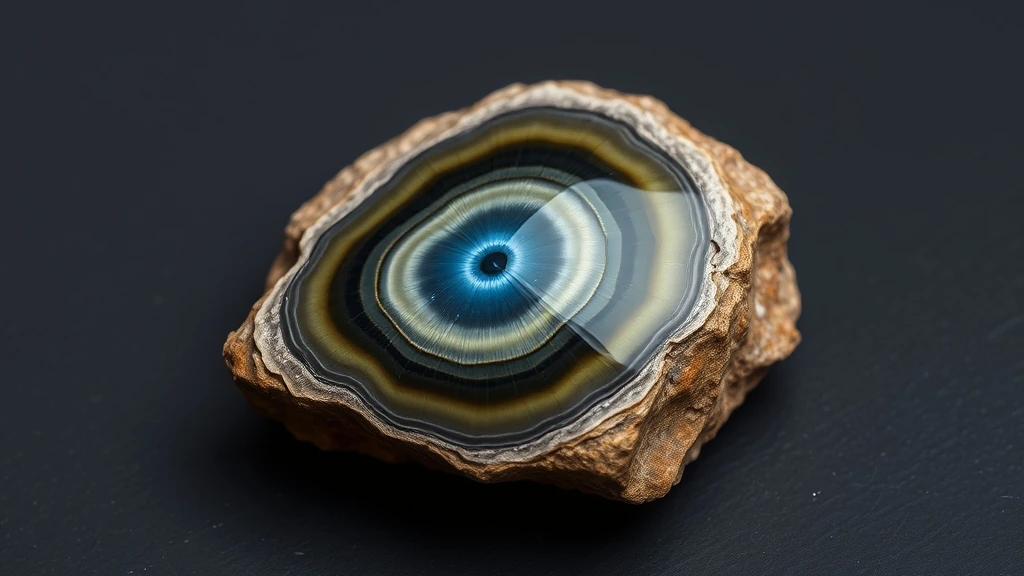
Hawk’s Eye is a fibrous variety of chalcedony, a cryptocrystalline form of quartz that crystallizes in the trigonal system. Its parent mineral group is the broader quartz family, which includes many cryptocrystalline and microcrystalline aggregates. The stone’s characteristic bands arise from parallel intergrowths of iron‑rich inclusions within the silica matrix, giving it a striking optical effect that has fascinated lapidaries for centuries.
What is Hawk’s Eye (blue Tiger’s Eye)? Geological Overview & Definition
Hawk’s Eye is a fibrous chalcedony that displays a unique combination of blue and gold or amber bands. The bands result from iron‑oxide (Fe₂O₃/FeO) inclusions aligned along the fibrous growth direction, creating a chatoyant or “eye‑like” effect. This stone is typically found in quartz veins and pegmatites, often associated with other cryptocrystalline minerals such as agate and jasper. Its fibrous texture and banding make it a prized material in both ornamental jewelry and historical lapidary art.
Hawk’s Eye (blue Tiger’s Eye) Chemical Composition & Crystallographic Properties
The chemical composition of Hawk’s Eye is essentially SiO₂, with trace iron oxides acting as chromophores. The crystal system is trigonal, belonging to the hexagonal crystal family with a three‑fold rotational axis. Within the lattice, silicon tetrahedra are linked by oxygen, while iron ions substitute for silicon or occupy interstitial sites, creating localized color centers that absorb specific wavelengths. In comparative mineralogical collections, practitioners and geologists frequently study Cheetah Jasper alongside this crystal to appreciate their subtle energetic and structural differences.
The stone is acid‑insensitive, showing no reaction to dilute hydrochloric acid, which is typical of pure silica. Thermal treatment can alter the iron oxidation state, shifting the hue from blue to more greenish or brownish tones, but the fibrous structure remains intact. The fibrous growth pattern is a hallmark of cryptocrystalline quartz, where the fibers are too fine to be resolved under optical microscopy but produce a distinct optical sheen. In comparative mineralogical collections, practitioners and geologists frequently study Bumblebee Jasper alongside this crystal to appreciate their subtle energetic and structural differences.
Across geological contexts, Hawk’s Eye remains a fibrous chalcedony with a trigonal lattice, its iron inclusions providing both its color and its unique optical properties.
| Property | Specification |
|---|---|
| Mineral Group | Natural Mineral / Crystal |
| Chemical Formula | SiO₂ (with Fe₂O₃/FeO inclusions) |
| Mohs Hardness | 6.5 – 7.0 |
| Crystal System | Trigonal |
| Specific Gravity (Density) | 2.64 – 2.71 |
| Refractive Index | 1.530 – 1.540 |
| Color & Optical Properties | Natural Hawk’s Eye (blue Tiger’s Eye) color spectrum and optical dispersion |
| Primary Mining Localities | Global primary localities |
| Water & Chemical Resistance | High (Safe for gentle water washing) |
| Chakra Alignment (Traditional) | Third Eye Chakra, Crown Chakra |
| Zodiac Affinity (Traditional) | Sagittarius, Aquarius |
| Symbolic Meaning (Traditional) | Clairvoyance, spiritual insight, and mental clarity |
Hawk’s Eye (blue Tiger’s Eye) Varieties & Color Spectrum
Hawk’s Eye (blue Tiger’s Eye) displays distinct mineralogical characteristics across its geological varieties and structural habits. Gemologists evaluate these natural varieties based on crystal habit, trace chromophore concentrations, and visual luster.
Primary Natural Hawk’s Eye (blue Tiger’s Eye)
The benchmark natural variety exhibiting diagnostic color saturation and classic crystallographic symmetry.
Distinct Geological Morphs of Hawk’s Eye (blue Tiger’s Eye)
Secondary regional and structural varieties formed under localized geological temperature and pressure conditions.
Classic Blue Hawk’s Eye
Formed in trigonal quartz through the parallel alignment of hematite and goethite platelets, this variety displays a vivid sapphire‑blue chatoyancy. The Fe₂O₃ inclusions create a silky sheen that shifts with illumination, and the stone typically occurs in medium‑grade clarity. It is most common in Brazil’s Minas Gerais region, yet remains prized for its intense hue.
Green‑Blue (Aquamarine) Hawk’s Eye
A rare morph where trace chromium substitutes into the iron lattice, imparting a turquoise‑green tint to the classic blue. The gemstone exhibits a softer, more diffused chatoyancy and often contains fine rutile needles that enhance its iridescence. Found primarily in Namibia’s Etosha deposits, collectors value its unique chromatic blend.
Gray‑Blue (Pietersite‑Like) Hawk’s Eye
This variant incorporates fine mica and silica‑rich inclusions, producing a smoky, steel‑blue background with a subtle cat’s‑eye effect. The mineral’s refractive index of 1.53‑1.54 accentuates the depth of color, while the presence of micro‑fractures can create a marbled appearance. It is sourced from the Zambian Copperbelt, where pegmatitic veins intersect metamorphic schists.
Lavender‑Blue Hawk’s Eye
An exceptionally scarce form where minute vanadium impurities shift the hue toward a pale lavender‑blue. The stone’s Mohs hardness of 6.5‑7.0 allows for precise faceting, revealing a delicate, almost ethereal sheen. Limited occurrences have been reported from the Kalahari region of South Africa, making it a collector’s gem.
Oceanic Blue Hawk’s Eye
Developed in marine sedimentary environments, this variety incorporates calcite and dolomite cement, yielding a bright, sea‑foam blue with high transparency. The density of 2.64‑2.71 g/cm³ distinguishes it from terrestrial counterparts, and its smooth surface reflects light in a watery luster. Primary deposits are located along the coastal basins of Sri Lanka’s gem fields.
Trade‑Name “Blue Tiger’s Eye”
Often marketed in the gemstone trade, this commercial label groups together the above natural hues under a single brand. While the term emphasizes the cat’s‑eye effect, it can include both genuine quartz specimens and glass‑filled imitations. Authentic pieces are identified by their characteristic chatoyancy and lack of synthetic fillers.
Where is Hawk’s Eye (blue Tiger’s Eye) Found? Geological Mining & Extraction
Hawk’s Eye forms in silica‑rich pegmatites that intrude granitic host rocks, where iron oxides precipitate as parallel fibers during slow cooling. The mineral’s crystal habit aligns with the host’s stress fields, producing the distinctive chatoyant bands that define the gemstone. Mining typically involves selective hand‑picking of vein‑filled nodules to preserve the delicate fiber orientation.
Major extraction zones include Brazil’s Minas Gerais, Namibia’s Etosha, and Zambia’s Copperbelt, each offering distinct color morphs linked to local geochemistry. In Sri Lanka, coastal alluvial deposits yield the oceanic blue variant, recovered through small‑scale dredging and dry‑sieving of river gravels. Sustainable practices are increasingly adopted to minimize environmental impact in these regions.
Historical Significance & Cultural Lore of Hawk’s Eye (blue Tiger’s Eye)
Across ancient lapidary traditions, blue hawk’s eye was carved into amulets for clairvoyance and mental clarity, a belief echoed in Greco‑Roman texts that praised its protective qualities for travelers. Egyptian tomb inventories from the New Kingdom list polished quartz eyes, likely representing early forms of the stone used to ward off evil and guide the soul in the afterlife.
In Vedic astrology, the gem aligns with the Third Eye Chakra and is invoked in rituals to enhance spiritual insight, while Chinese imperial collections prized it for its ability to focus the mind during scholarly pursuits. Throughout these cultures, the stone’s shimmering cat’s‑eye effect symbolized the watchful gaze of divine guardians, reinforcing its enduring metaphysical reputation.
Modern Uses & Jewelry Applications of Hawk’s Eye (blue Tiger’s Eye)
Hawk’s Eye is prized for its silky sheen and subtle blue‑tawny banding, making it a favorite for cabochon and faceted pieces that showcase its natural play of light. Lapidaries often cut the stone into polished domes, oval cabochons, or elongated facets that accentuate the fibrous texture. The gemstone is also carved into ornamental motifs for pendants, rings, and brooches, where its subtle iridescence enhances visual depth.
- Cabochon: smooth, polished domes or ovals
- Faceted: brilliant or rose cuts that highlight banding
- Ornamental carving: pendants, rings, brooches, and decorative plaques
Metaphysical Properties & Traditional Meaning of Hawk’s Eye (blue Tiger’s Eye)
According to historical traditions and metaphysical lore, Hawk’s Eye is believed to sharpen clarity of thought and enhance spiritual insight. Across ancient Mediterranean and Vedic lapidary lore, the stone is associated with the Third Eye Chakra, fostering intuition, and the Crown Chakra, promoting higher consciousness. Practitioners claim that wearing Hawk’s Eye calms emotional turbulence, encourages mental focus, and supports the seeker in navigating complex life decisions. The gemstone’s subtle blue undertones are said to resonate with the Aquarius and Sagittarius energies, amplifying forward‑thinking and philosophical exploration.
Which Chakra and Zodiac Signs Align with Hawk’s Eye (blue Tiger’s Eye)?
Hawk’s Eye is traditionally linked to the Third Eye Chakra, the center of intuition and perception. This alignment encourages the wearer to trust inner guidance and develop heightened awareness of subtle energies.
The stone also resonates with the Crown Chakra, the gateway to spiritual realms and universal consciousness. Its connection to the Sagittarius and Aquarius zodiac signs reflects themes of exploration, wisdom, and humanitarian ideals, reinforcing the stone’s role as a catalyst for personal growth and enlightened vision.
How to Identify Real vs. Fake Hawk’s Eye (blue Tiger’s Eye)
Artificial imitations of Hawk’s Eye often appear as synthetic glass or dyed quartz, lacking the natural fibrous inclusions and characteristic refractive index. Synthetic replicas may display uniform coloration, absence of banding, or a glassy luster that betrays their non‑natural origin.
Practical At-Home Authenticity Tests
- Temperature Test (Thermal Feel): Hold the stone in your palm; a genuine Hawk’s Eye will feel cool to the touch due to its higher thermal conductivity compared to glass.
- Specific Gravity & Weight Test: Measure the stone’s weight in a calibrated scale and compare it to its volume; real Hawk’s Eye should have a specific gravity between 2.64 and 2.71, noticeably heavier than synthetic glass.
- Scratch & Hardness Test (Mohs Comparison): Use a standard Mohs hardness kit; Hawk’s Eye should scratch quartz (Mohs 7) but not be scratched by a steel file (Mohs 5.5), confirming a hardness of 6.5–7.0.
- Microscopic & Loupe Inspection (Internal Inclusions): Examine the stone under a jeweler’s loupe; authentic Hawk’s Eye will display fine fibrous inclusions and a subtle blue‑tawny banding pattern, whereas replicas often show uniform color or artificial striations.
Hawk’s Eye (blue Tiger’s Eye) Valuation Factors, Grading & Pricing
The market first gauges color saturation, noting the depth of the vivid blue‑gray chatoyancy that distinguishes Hawk’s Eye from its brown counterpart. Stones displaying a uniform, intense hue with a sharp, luminous band are prized, while muted or uneven tones reduce price. Collectors also value the stone’s natural energetic luster, which is most apparent under direct lighting.
Crystal size & weight (grams) form the second pricing pillar, with larger, heavier pieces commanding higher premiums. Raw, unpolished material is typically less expensive than tumbled, high‑gloss finishes that reveal the stone’s characteristic silky sheen. Natural matrix inclusions, such as quartz veins or iron‑oxide patches, can either enhance uniqueness or detract from value depending on buyer preference.
Ethical sourcing & locality premium increasingly influence both holistic and collector markets. Specimens mined responsibly in regions with transparent labor practices attract higher bids, especially when provenance can be documented. A provenance premium also applies to stones sourced from historically significant deposits, where cultural heritage adds an intangible allure for discerning buyers.
How to Clean and Care for Hawk’s Eye (blue Tiger’s Eye)
Gentle cleaning with warm soapy water and a soft cloth preserves the stone’s surface without compromising its structural integrity. Use a mild, pH‑neutral soap, dip a soft microfiber cloth in lukewarm water, and wipe the gem lightly, avoiding abrasive motions. After cleaning, pat the stone dry with a clean, dry cloth and store it in a low‑humidity pouch to prevent moisture buildup.
Cleansing and Recharging Hawk’s Eye (blue Tiger’s Eye) (Energetic Care)
For energetic renewal, place the stone on a selenite charging slab for several hours, allowing the neutral selenite to absorb and release any stagnant energy. Alternatively, a brief exposure to gentle moonlight, preferably during a waning phase, can refresh the stone’s vibrational field without introducing heat stress.
A traditional herbal smudging, using sage or cedar, can be performed by passing the stone through the rising smoke for a few seconds, then allowing it to rest on a clean cloth. This method clears lingering impressions while respecting the mineral’s physical stability, ensuring both aesthetic and metaphysical qualities remain vibrant.
Frequently Asked Questions About Hawk’s Eye (blue Tiger’s Eye)
Hawk’s Eye (blue Tiger’s Eye) displays distinct mineralogical characteristics across its geological varieties and structural habits. Gemologists evaluate these natural varieties based on crystal habit, trace chromophore concentrations, and visual luster.
Primary Natural Hawk’s Eye (blue Tiger’s Eye)
The benchmark natural variety exhibiting diagnostic color saturation and classic crystallographic symmetry.
Distinct Geological Morphs of Hawk’s Eye (blue Tiger’s Eye)
Secondary regional and structural varieties formed under localized geological temperature and pressure conditions.
Is Hawk’s Eye safe to wear in the shower?
Yes, Hawk’s Eye is highly water-resistant and safe for gentle washing. The stone’s silica-based structure ensures it does not dissolve or degrade upon exposure to moisture. You can confidently wear it during daily activities, including showering. Just ensure the water is not scalding hot to preserve any organic inclusions.
How should I clean my Hawk’s Eye jewelry?
Use warm soapy water and a soft cloth for routine maintenance. This gentle approach removes oils and dirt without damaging the delicate chatoyant surface. Avoid abrasive materials that could scratch the stone. Regular cleaning enhances the visual play of light within the mineral.
Can I use an ultrasonic cleaner on Hawk’s Eye?
No, you should avoid ultrasonic cleaners to prevent structural fractures. The high-frequency vibrations can stress the internal iron oxide inclusions, potentially causing micro-cracks. Stick to manual cleaning methods for best results. This precaution preserves the integrity of the stone’s fibrous texture.
What is the chemical composition of Hawk’s Eye?
It consists primarily of silicon dioxide with iron oxide inclusions. The formula is SiO₂, containing Fe₂O₃ or FeO particles responsible for the blue hue. These inclusions create the distinctive chatoyancy effect. Understanding this composition helps in proper identification and care.
Which zodiac signs are aligned with Hawk’s Eye?
Sagittarius and Aquarius are the primary zodiac signs associated with this stone. These air and fire signs resonate with the mental clarity properties of the gem. Wearing it may enhance intuitive abilities for these individuals. The alignment supports spiritual growth and focused energy in daily life.
Which chakras does Hawk’s Eye activate?
It primarily aligns with the Third Eye and Crown Chakras. These energy centers govern intuition and higher consciousness, making the stone ideal for meditation. The blue tones stimulate mental clarity and spiritual insight. Users often report heightened awareness during contemplative practices.
How hard is Hawk’s Eye on the Mohs scale?
It rates between 6.5 and 7.0 on the Mohs hardness scale. This makes it durable enough for everyday jewelry wear. The quartz matrix provides significant resistance to scratches from common materials. However, it is still susceptible to damage from harder gemstones like diamond.
What is the refractive index of Hawk’s Eye?
The refractive index ranges from 1.530 to 1.540. This optical property contributes to its distinctive sheen and luster. The value helps gemologists distinguish it from similar materials. Accurate measurement ensures proper identification during professional appraisal processes.