
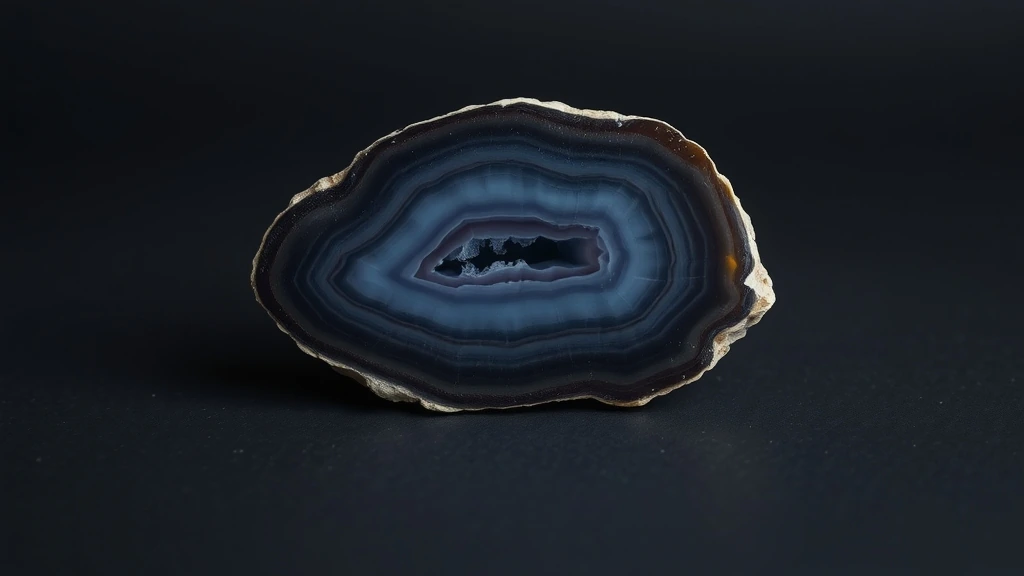
Iris agate belongs to the broader family of silicates, specifically the chalcedony subgroup of cryptocrystalline quartz. These microcrystalline aggregates form through the slow precipitation of silica from hydrothermal fluids within volcanic or sedimentary host rocks. The resulting fibrous textures give the stone its characteristic iridescent banding, while the fine grain size ensures a smooth, glassy luster.
What is Iris Agate? Geological Overview & Definition
Iris agate is a cryptocrystalline quartz variant distinguished by its subtle, sky‑like coloration and fine fibrous structure. It typically forms in secondary cavities of volcanic or sedimentary rocks, where silica‑rich fluids deposit interlocking quartz fibers. The stone’s name derives from its resemblance to the human iris, with layered bands that shift in hue under different lighting. Though it shares many properties with other agates, its muted palette and delicate texture set it apart in lapidary circles.
Iris Agate Chemical Composition & Crystallographic Properties
The mineral’s composition is essentially SiO₂, with no significant cation substitution; however, trace elements such as Fe²⁺/Fe³⁺ and Ti⁴⁺ can introduce subtle color variations. Its crystal system is Trigonal, manifesting as microcrystalline or cryptocrystalline fibrous aggregates that align along the c‑axis. The lattice is characterized by a hexagonal close‑packed arrangement of oxygen atoms surrounding silicon tetrahedra, giving rise to the stone’s inherent stability. Acid sensitivity is minimal; dilute hydrochloric acid does not alter its structure, reflecting the robustness of the quartz framework. Chromophore color centers, often due to iron or titanium, create the iris‑like banding through light interference within the fibrous matrix. Thermal behavior remains stable up to 573 °C, beyond which the quartz may undergo phase transitions, but typical gemstone temperatures pose no risk to its integrity.
| Property | Specification |
|---|---|
| Mineral Group | Silicates (Chalcedony / Cryptocrystalline Quartz) |
| Chemical Formula | SiO₂ (Silicon Dioxide) |
| Mohs Hardness | 6.5 – 7.0 |
| Crystal System | Trigonal (Microcrystalline / Cryptocrystalline fibrous aggregates) |
| Specific Gravity (Density) | 2.60 – 2.65 |
| Refractive Index | 1.544 – 1.553 |
| Color & Optical Properties | Natural Iris Agate color spectrum and optical dispersion |
| Primary Mining Localities | Brazil, Uruguay, Turkey, India, Madagascar |
| Water & Chemical Resistance | High (Safe for gentle warm water and mild soap; avoid harsh acids and chlorine) |
| Chakra Alignment (Traditional) | Root Chakra and Sacral Chakra |
| Zodiac Affinity (Traditional) | Gemini, Virgo, Taurus |
| Symbolic Meaning (Traditional) | Grounding, emotional balance, physical endurance, and protection |
Iris Agate Varieties & Color Spectrum
Iris Agate displays distinct mineralogical characteristics across its geological varieties and structural habits. Gemologists evaluate these natural varieties based on crystal habit, trace chromophore concentrations, and visual luster. While Iris Agate is prized for its iridescent play of color, collectors often compare its structural complexity to the distinctive banded patterns found in Timor Agate, which offers a contrasting yet equally compelling geological narrative.
Primary Natural Iris Agate
The benchmark natural variety exhibiting diagnostic color saturation and classic crystallographic symmetry.
Distinct Geological Morphs of Iris Agate
Secondary regional and structural varieties formed under localized geological temperature and pressure conditions.
Rainbow Iris
Formed in silica‑rich cavities of volcanic tuff, Rainbow Iris displays banded iridescence that shifts from pink to violet under angled light. Microscopic crystalline fibrous aggregates create the play of color, while minute quartz inclusions scatter light for a luminous effect. This variety is relatively common in Brazil’s Minas Gerais region, yet high‑grade specimens with vivid banding are prized by collectors.
Blue‑Green Iris
Blue‑Green Iris originates in the hydrothermal veins of the Czech Republic, where low‑temperature silica fluids precipitate within microcrystalline chalcedony matrices. The stone’s signature is a deep teal hue interlaced with fine white bands, caused by fluid‑filled micro‑fractures that refract light. Its rarity stems from the narrow temperature window required for formation, making large, evenly colored pieces scarce on the market. In comparative mineralogical collections, practitioners and geologists frequently study Guinea Fowl Quartz alongside this crystal to appreciate their subtle energetic and structural differences.
Fire Iris
Fire Iris is distinguished by fiery orange‑red bands that contrast sharply with translucent white layers. Developed in the basaltic lava flows of the United States’ Oregon Cascades, the coloration results from iron oxide inclusions oxidizing during slow cooling. The intense chromatic contrast and limited geographic source render Fire Iris one of the most sought‑after commercial varieties.
Black‑Veined Iris
Found primarily in the volcanic ash deposits of Italy’s Sardinia island, Black‑Veined Iris exhibits deep charcoal bands traversing a milky background. The dark veins are composed of graphitic carbon inclusions that align with the stone’s fibrous growth pattern. Because the carbon‑rich veins are fragile and prone to fracture, high‑quality material is relatively rare and commands premium prices.
Lavender Iris
Lavender Iris occurs in the rhyolitic tuffs of Mexico’s Central Plateau, where silica‑rich fluids interact with trace manganese to produce a soft purple tint. The stone’s visual signature includes delicate, wavy bands that fade gracefully toward the edges, a result of gradual diffusive zoning during crystallization. Although the deposits are extensive, only a narrow band of the tuff yields the prized lavender hue, limiting supply.
Golden Iris
Golden Iris is a regional trade name for agate from the Indian state of Gujarat, where sulfur‑bearing fluids impart a warm amber coloration to the silica bands. The gemstone’s hallmark is a honey‑like sheen that intensifies after polishing, due to light‑scattering micro‑inclusions within the cryptocrystalline matrix. While the deposits are abundant, gem‑quality stones with uniform golden bands are uncommon, enhancing their market desirability.
Where is Iris Agate Found? Geological Mining & Extraction
Iris Agate typically occurs in silica‑filled cavities of volcanic tuffs, rhyolites, and basaltic lava flows, where rapid cooling fosters the growth of microcrystalline chalcedony. The mineral’s cryptocrystalline texture develops alongside fibrous quartz aggregates, often interspersed with iron oxide, carbon, or manganese inclusions that dictate its color palette.
Major extraction sites include Brazil’s Minas Gerais, the Czech Republic’s Bohemian Massif, Oregon’s Cascade Range, Sardinia’s volcanic ash fields, Mexico’s Central Plateau, and Gujarat’s sandstone basins. Mining is largely artisanal, employing hand‑picked extraction from open pits or small underground adits, followed by careful wet‑sieving to separate agate nodules from host rock.
Historical Significance & Cultural Lore of Iris Agate
Across ancient Greco‑Roman lapidary traditions, Iris Agate was carved into intaglios and signet rings, valued for its protective aura and ability to balance emotions. Roman writers such as Pliny the Elder described the stone’s “rainbow fire” as a talisman against disease, a belief echoed in Egyptian burial goods where agate amulets guarded the afterlife.
In early Vedic texts, the gemstone was associated with the Root and Sacral Chakras, believed to ground the wearer and enhance physical endurance. Chinese jade workshops of the Han dynasty incorporated Iris Agate into ceremonial pendants, attributing it with the power to harmonize the energies of Gemini, Virgo, and Taurus, thereby linking celestial influence with earthly stability.
Modern Uses & Jewelry Applications of Iris Agate
Iris agate is prized for its subtle banding and vibrant hues, making it a favorite in contemporary lapidary work. Artisans often polish the stone into cabochons for earrings, pendants, and rings, or cut it into facets for more elaborate pieces that showcase its internal patterns. In addition, the durable crystal structure allows for intricate ornamental carving in architectural décor, tableware, and decorative panels.
- Cabochon: smooth, polished surfaces ideal for jewelry.
- Faceted: sharp cuts that enhance light play.
- Carved: detailed motifs for ornamental objects.
Metaphysical Properties & Traditional Meaning of Iris Agate
According to historical traditions and metaphysical lore, iris agate is believed to ground the wearer while fostering emotional equilibrium. Across ancient Mediterranean and Vedic lapidary lore, the stone is associated with the Root Chakra, anchoring the individual to the earth, and the Sacral Chakra, nurturing creativity and sensuality. Practitioners claim that its balanced energy supports physical endurance and offers protection against negative influences, echoing the stone’s role in early protective amulets.
Which Chakra and Zodiac Signs Align with Iris Agate?
Iris agate’s energetic profile aligns explicitly with the Root Chakra and the Sacral Chakra, promoting stability and emotional harmony. These chakras are traditionally linked to the stone’s grounding and creative qualities, reinforcing its use in meditation and healing practices.
The gemstone’s celestial affinity is firmly rooted in the zodiac signs Gemini, Virgo, and Taurus. In astrological tradition, these signs are associated with communication, practicality, and sensual appreciation, all of which resonate with iris agate’s symbolic attributes.
How to Identify Real vs. Fake Iris Agate
Artificial imitations of iris agate often appear as dyed glass or synthetic quartz, lacking the stone’s natural fibrous texture and subtle banding. Genuine iris agate displays a characteristic microcrystalline structure and a slightly higher density than common glass.
Practical At-Home Authenticity Tests
- Temperature Test (Thermal Feel): Hold the stone in your hand; real quartz feels noticeably cooler than synthetic glass after a few seconds.
- Specific Gravity & Weight Test: Compare the stone’s weight to a known quartz sample of the same size; iris agate should be slightly heavier due to its higher density.
- Scratch & Hardness Test (Mohs Comparison): Use a steel nail or a glass surface; real iris agate should resist scratching, reflecting a hardness of 6.5–7.0, whereas glass will show marks.
- Microscopic & Loupe Inspection (Internal Inclusions): Under magnification, authentic iris agate reveals fibrous aggregates and fine inclusions, while dyed replicas appear uniformly clear or show artificial patterns.
Iris Agate Valuation Factors, Grading & Pricing
Market valuation primarily hinges on Color Saturation, where deep, vivid hues command premium pricing over pale or washed-out specimens. Collectors seek stones exhibiting intense visual vibrancy, often displaying iridescent flashes that shift under direct light. The natural energetic luster of the surface further enhances desirability, distinguishing high-grade material from lower-quality, matte-finish variants.
Pricing is determined by Crystal Size & Weight (Grams), with larger specimens commanding significantly higher per-gram rates in the market. Raw stones are valued for their natural matrix inclusions, while tumbled pieces are graded strictly on polish quality and surface integrity. Dimensional consistency and the absence of surface fractures are critical metrics for assessing overall commercial viability.
Ethical Sourcing & Locality Premium significantly influences pricing in both holistic and collector markets. Provenance from renowned, historically significant deposits often adds a substantial premium to the base valuation. Buyers increasingly prioritize transparent supply chains, rewarding vendors who can verify responsible extraction and fair labor practices.
How to Clean and Care for Iris Agate
For routine maintenance, Warm soapy water is the ideal cleaning method for solid, untreated agate specimens. Submerge the stone in lukewarm water with a drop of mild, pH-neutral soap to dissolve surface oils and dust. Gently agitate the stone to ensure all crevices are cleaned, then rinse thoroughly under running water to remove all soap residue.
Avoid using Ultrasonic cleaners if the specimen is dyed, heavily fractured, or has undergone thermal treatments. These high-frequency vibrations can exacerbate existing micro-fractures or leach out artificial colorants, permanently damaging the stone’s aesthetic value. Always inspect the piece for structural integrity before selecting any mechanical cleaning method.
Cleansing and Recharging Iris Agate (Energetic Care)
Holistic practitioners often employ Herbal smudging to clear perceived energetic stagnation from the stone. Pass the agate gently through the smoke of sage or palo santo, allowing the aromatic vapors to interact with the surface. This dry method ensures no moisture or heat is introduced, preserving the mineral’s physical stability.
Alternatively, place the stone on a Selenite charging slab or expose it to gentle moonlight overnight for recharging. This passive approach allows the crystal lattice to rest without exposure to intense sunlight or artificial heat sources. Such methods align with safe handling protocols, ensuring the stone remains structurally sound while undergoing energetic maintenance.
Frequently Asked Questions About Iris Agate
Iris Agate displays distinct mineralogical characteristics across its geological varieties and structural habits. Gemologists evaluate these natural varieties based on crystal habit, trace chromophore concentrations, and visual luster.
Primary Natural Iris Agate
The benchmark natural variety exhibiting diagnostic color saturation and classic crystallographic symmetry.
Distinct Geological Morphs of Iris Agate
Secondary regional and structural varieties formed under localized geological temperature and pressure conditions.
Is Iris Agate safe to wear in the shower?
Yes, it is generally safe for gentle warm water and mild soap. The stone’s quartz composition provides high water resistance, making it durable against occasional moisture. However, you should avoid prolonged exposure to harsh acids, chlorine, or extreme heat. These elements can degrade surface treatments or weaken any natural fissures over time.
How should I clean my Iris Agate jewelry?
Use warm soapy water and a soft brush for routine maintenance. This method effectively removes oils and dirt without damaging the stone’s surface. Always rinse thoroughly and dry with a lint-free cloth. Avoid abrasive cleaners that could scratch the polished finish of the gemstone.
Can I use an ultrasonic cleaner on Iris Agate?
Proceed with caution, especially if the stone is dyed or treated. While solid, untreated agates tolerate ultrasonic cleaning, the vibrations can exacerbate existing fractures. If your specimen has visible inclusions or color enhancement, stick to manual cleaning with warm soapy water. This prevents potential damage to delicate internal structures.
Which zodiac signs are aligned with Iris Agate?
Gemini, Virgo, and Taurus are the primary aligned signs. In historical lapidary traditions, these earth and air signs resonate with the stone’s grounding properties. Wearing this gemstone is believed to enhance mental clarity and emotional stability. It serves as a talisman for balance and physical endurance for these individuals.
Which chakras does Iris Agate activate?
It primarily activates the Root Chakra and Sacral Chakra. These energy centers govern stability, survival, and creative expression. The stone’s banded patterns are thought to harmonize earth energies within the body. Practitioners use it to foster a sense of security and emotional flow.
What is the Mohs hardness of Iris Agate?
It ranges from 6.5 to 7.0 on the Mohs scale. This makes it quite durable for everyday jewelry use. It resists scratches from common household materials like copper or iron. However, it can still be scratched by harder minerals like topaz or diamond.
What is the chemical composition of Iris Agate?
It is composed of Silicon Dioxide (SiO₂). This cryptocrystalline quartz variety features microscopic fibers that create its unique banded appearance. The density typically falls between 2.60 and 2.65 g/cm³. This composition ensures long-term stability and resistance to chemical weathering.
Does Iris Agate require special storage conditions?
Store it in a soft pouch or separate jewelry box. This prevents contact with harder gemstones that could cause surface abrasions. Keep it away from direct sunlight to preserve color integrity. Avoid stacking it with other hard minerals to maintain its polished aesthetic.