
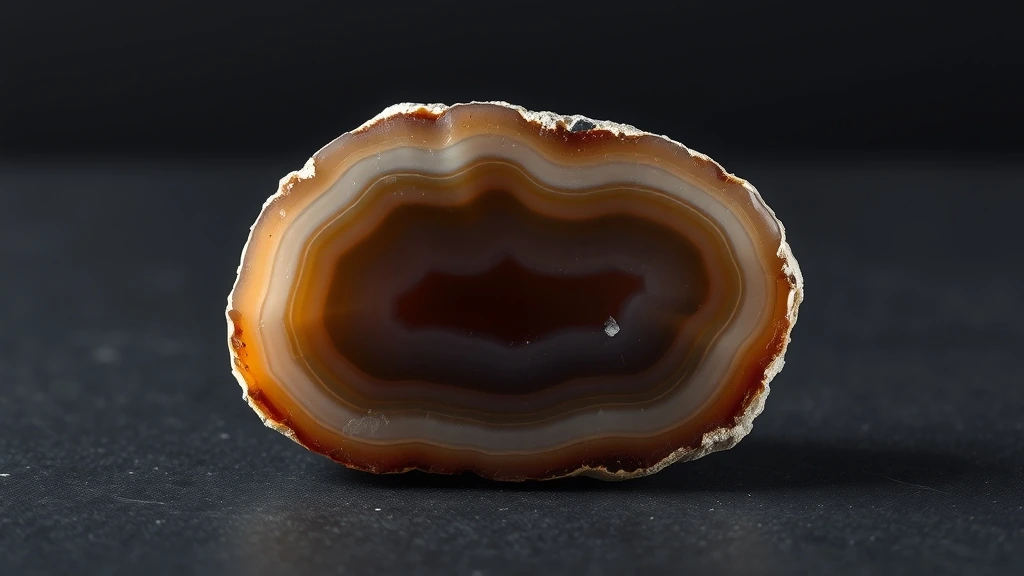
Mexican agate belongs to the silicate family, specifically the chalcedony subgroup of cryptocrystalline quartz. Formed in volcanic tuff and sedimentary cavities, its fibrous aggregates develop under low‑temperature hydrothermal conditions that promote concentric banding. The stone’s microstructure consists of interlocking quartz microcrystals, giving it a smooth, waxy luster and a density of 2.60–2.65 g/cm³. Its resilient hardness and striking colors have made it a staple in Mesoamerican lapidary art for centuries.
What is Mexican Agate? Geological Overview & Definition
Mexican agate is a cryptocrystalline silica rock composed of tightly packed quartz fibers that lack visible crystal faces to the naked eye. The banded patterns arise from periodic variations in impurity concentrations, chiefly iron oxides and manganese, which act as natural pigments during formation.
Geologically, the agate forms in volcanic ash layers and alluvial deposits across central and northern Mexico, where silica‑rich solutions infiltrate cavities and solidify. Over time, repeated cycles of deposition and silica precipitation create the characteristic concentric and radial banding that defines agate worldwide. In comparative mineralogical collections, practitioners and geologists frequently study Indonesia Agate alongside this crystal to appreciate their subtle energetic and structural differences.
Mexican Agate Chemical Composition & Crystallographic Properties
The aggregate is fundamentally SiO₂, yet it does not possess a single, uniform crystal lattice; instead, it comprises countless micro‑crystals aligned in a trigonal (microcrystalline/cryptocrystalline fibrous) arrangement. This trigonal symmetry is inherited from the underlying quartz framework, despite the rock‑like appearance. In comparative mineralogical collections, practitioners and geologists frequently study Green Banded Agate alongside this crystal to appreciate their subtle energetic and structural differences.
Within the fibrous matrix, minor cation substitutions—principally Fe³⁺, Mn²⁺, and trace Ti⁴⁺—replace silicon in the lattice, generating chromophore color centers that produce the stone’s reds, oranges, and browns. These impurities are responsible for the vivid banding and are stable under normal atmospheric conditions.
Mexican agate is acid‑sensitive; exposure to strong acids can dissolve the silica framework, especially along fracture surfaces where the microcrystals are less tightly bound. Consequently, cleaning should employ mild, pH‑neutral solutions to preserve surface integrity.
Thermally, the agate remains stable up to approximately 573 °C, the quartz α‑β transition temperature, after which the microcrystalline structure may undergo reversible changes in refractive index. This thermal resilience contributes to its durability in both ornamental and industrial applications.
| Property | Specification |
|---|---|
| Mineral Group | Silicates (Chalcedony / Cryptocrystalline Quartz) |
| Chemical Formula | SiO₂ (Silicon Dioxide) |
| Mohs Hardness | 6.5 – 7.0 |
| Crystal System | Trigonal (Microcrystalline / Cryptocrystalline fibrous aggregates) |
| Specific Gravity (Density) | 2.60 – 2.65 |
| Refractive Index | 1.544 – 1.553 |
| Color & Optical Properties | Natural Mexican Agate color spectrum and optical dispersion |
| Primary Mining Localities | Brazil, Uruguay, Turkey, India, Madagascar |
| Water & Chemical Resistance | High (Safe for gentle warm water and mild soap; avoid harsh acids and chlorine) |
| Chakra Alignment (Traditional) | Root Chakra and Sacral Chakra |
| Zodiac Affinity (Traditional) | Gemini, Virgo, Taurus |
| Symbolic Meaning (Traditional) | Grounding, emotional balance, physical endurance, and protection |
Mexican Agate Varieties & Color Spectrum
Mexican Agate displays distinct mineralogical characteristics across its geological varieties and structural habits. Gemologists evaluate these natural varieties based on crystal habit, trace chromophore concentrations, and visual luster.
Primary Natural Mexican Agate
The benchmark natural variety exhibiting diagnostic color saturation and classic crystallographic symmetry.
Distinct Geological Morphs of Mexican Agate
Secondary regional and structural varieties formed under localized geological temperature and pressure conditions.
Band‑ed Mexican Agate
Formed in silica‑rich volcanic tuffs, banded Mexican agate displays concentric layers of milky white, amber, and deep brown. Microscopic cryptocrystalline quartz fills the cavities, while iron oxides create the darker bands. The pattern is uniform across the state of Zacatecas, making it a common trade stone but prized for its classic elegance.
Fire Agate (Malaquita de Fuego)
Unique to the volcanic deposits of Sonora, fire agate exhibits iridescent flashes of orange, red, and gold caused by thin‑film interference within silica layers. Inclusions of hematite and goethite produce the shimmering effect, and the stone’s trigonal microstructure enhances light play. Its rarity and vivid coloration command premium prices in the gemstone market.
Blue Agate (Agata Azul)
Blue agate originates from the basaltic flows of the Sierra Madre Oriental, where trace amounts of copper and manganese tint the silica matrix a soft cerulean. The stone often contains spherical chalcedony inclusions that scatter light, giving a subtle depth. Limited outcrops make this variety scarce, and collectors value its tranquil hue for ornamental use.
Moss Agate (Ágata Musgo)
Moss agate forms in sedimentary volcanic ash beds of the state of Puebla, where mineralized plant‑like filaments of manganese oxide embed within the quartz. The resulting greenish dendritic patterns resemble moss or foliage, creating a naturalistic motif. Though more abundant than fire agate, high‑quality specimens with dense, well‑defined inclusions remain sought after.
Desert Rose Agate
Found in the arid basins of Chihuahua, desert rose agate displays rose‑pink to salmon tones interlaced with fine brown bands. The coloration stems from trace iron and manganese diffused during slow cooling of silica‑rich fluids. Its name reflects the stone’s tendency to form rounded nodules, a feature prized by lapidaries for carving.
Laguna Agate
Laguna agate occurs in the alluvial deposits of the Laguna region, where river action rounds and polishes the stones. It is characterized by translucent layers of pastel blues, greens, and yellows that shift with viewing angle. The gentle color gradient and smooth finish make it a favorite for jewelry designers, though the finest pieces are limited to a few seasonal harvests.
Where is Mexican Agate Found? Geological Mining & Extraction
Mexican agate is chiefly hosted in silica‑saturated volcanic tuffs and rhyolitic ash‑flow deposits that have undergone diagenetic silicification. The microcrystalline quartz fills vesicles and fractures, creating the characteristic banding, while trace metals impart the diverse color palette. These deposits are concentrated in the central highlands of Zacatecas, the northern basins of Sonora, and the southeastern volcanic fields of Puebla.
Extraction relies on small‑scale open‑pit mining and river‑bed panning, often performed by local cooperatives using hand tools to avoid damaging the delicate cryptocrystalline structure. After removal, stones are sorted, washed, and lightly fractured to reveal interior bands before being shipped to domestic and international markets.
Historical Significance & Cultural Lore of Mexican Agate
Across ancient Mesoamerican cultures, agate was carved into ceremonial pendants, mosaics, and burial offerings, reflecting its perceived protective qualities. The Maya and Aztec elite incorporated agate in regalia, believing the stone could channel earth energy and safeguard warriors, a belief echoed in later Greco‑Roman texts that praised agate for its grounding properties.
In early colonial records, Spanish missionaries noted that indigenous healers used agate powders in poultices to balance emotions and bolster physical endurance, aligning with the stone’s esoteric keywords of grounding and protection. Today, Mexican agate continues to be revered in contemporary metaphysical practice, linking centuries‑old traditions with modern gemstone appreciation.
Modern Uses & Jewelry Applications of Mexican Agate
Mexican agate is prized for its vibrant banding and durable hardness, making it ideal for a range of lapidary projects. Skilled cutters transform the stone into smooth cabochons that accentuate its natural patterns, or into finely faceted pieces that catch light with a subtle sparkle. The material also lends itself to ornamental carving, where artisans craft intricate motifs for pendants, brooches, or decorative panels.
- Cabochon polishing highlights banding and enhances color contrast.
- Faceted cuts increase brilliance while preserving structural integrity.
- Carved motifs often feature geometric or symbolic designs inspired by pre‑Hispanic iconography.
- The stone’s moderate density (2.60–2.65 g/cm³) allows for comfortable wear in rings and bracelets.
Metaphysical Properties & Traditional Meaning of Mexican Agate
According to historical traditions and metaphysical lore, Mexican agate is revered for its grounding energy and capacity to stabilize emotional turbulence. In ancient Mediterranean and Vedic lapidary texts, the stone is associated with balance and physical endurance, believed to fortify the wearer against stress and fatigue. Across early archaeological records, it has been used in amulets to protect travelers and in ceremonial jewelry to symbolize resilience. The stone’s warm hues are thought to stimulate the Root Chakra, anchoring the individual to the earth, while its subtle undertones resonate with the Sacral Chakra, fostering emotional harmony and creative flow.
Which Chakra and Zodiac Signs Align with Mexican Agate?
Mexican agate is traditionally linked to the Root Chakra, the foundational center of stability and survival. This alignment encourages a sense of security and groundedness, especially during periods of change or uncertainty.
The stone also harmonizes with the Sacral Chakra, the locus of emotional expression and creativity. Its vibrant banding is said to inspire artistic endeavors and enhance interpersonal connections.
The canonical zodiac signs that resonate with Mexican agate are Gemini, Virgo, and Taurus. These signs share traits of adaptability, practicality, and a grounded approach to life, mirroring the stone’s metaphysical attributes.
How to Identify Real vs. Fake Mexican Agate
Artificial imitations of Mexican agate often appear as synthetic glass or dyed quartz. These replicas may exhibit a uniform sheen, lack of natural banding, or inconsistent color gradients. Real agate displays subtle, irregular banding and a natural, slightly opaque surface that refracts light differently from polished glass.
Practical At-Home Authenticity Tests
- Temperature Test (Thermal Feel): Hold the stone in your hand; real agate feels cool to the touch, whereas glass warms quickly.
- Specific Gravity & Weight Test: Compare the stone’s weight to a known quartz sample of the same size; agate is slightly heavier due to its higher density.
- Scratch & Hardness Test (Mohs Comparison): Use a steel file or a glass plate; agate should resist scratching, showing a hardness of 6.5–7.0, while glass will show visible marks.
- Microscopic & Loupe Inspection (Internal Inclusions): Under magnification, real agate reveals fibrous or cryptocrystalline inclusions; synthetic replicas often appear uniformly clear or display artificial layering.
Mexican Agate Valuation Factors, Grading & Pricing
The first key determinant is Color Saturation. A specimen exhibiting vivid, evenly distributed bands and a natural energetic luster commands a premium, as collectors prize the visual vibrancy that reflects the stone’s geological history. The intensity of the hue, coupled with the clarity of the banding, directly influences market desirability and resale value.
The second factor concerns Crystal Size & Weight (Grams). Larger, well‑formed crystals with a smooth, tumbled polish are valued higher than smaller, raw fragments. Natural matrix inclusions, such as subtle veins or fossilized plant matter, add character and can enhance a piece’s appeal, provided they do not obscure the banding. Grading focuses on the overall mass and dimensional integrity rather than carat or tumbled polish and natural crystal geometry.
The third consideration is Ethical Sourcing & Locality Premium. Stones sourced from responsibly managed mines in Mexico, especially those with traceable provenance, attract a premium in both holistic and collector markets. Ethical sourcing assures buyers of fair labor practices and environmental stewardship, while locality prestige—particularly from renowned quarries—adds an intangible value that collectors seek.
How to Clean and Care for Mexican Agate
Gentle cleaning of solid Mexican Agate is best achieved with warm soapy water. Use a mild, non‑abrasive soap and lukewarm water, rinsing the stone with a soft brush or cloth to remove surface dirt. After rinsing, pat dry with a clean, lint‑free towel and store in a dry, low‑humidity environment. Avoid ultrasonic cleaners whenever the specimen is dyed, heavily fractured, or treated, as vibration can damage delicate inclusions or surface coatings.
Cleansing and Recharging Mexican Agate (Energetic Care)
For energetic renewal, place the agate under gentle moonlight for several hours, allowing the soft lunar energy to cleanse and recharge its vibration. Alternatively, resting the stone on a selenite charging slab can facilitate the transfer of positive, protective energies without exposing the crystal to heat or direct sunlight, thereby preserving its structural integrity.
Frequently Asked Questions About Mexican Agate
Mexican Agate displays distinct mineralogical characteristics across its geological varieties and structural habits. Gemologists evaluate these natural varieties based on crystal habit, trace chromophore concentrations, and visual luster.
Primary Natural Mexican Agate
The benchmark natural variety exhibiting diagnostic color saturation and classic crystallographic symmetry.
Distinct Geological Morphs of Mexican Agate
Secondary regional and structural varieties formed under localized geological temperature and pressure conditions.
Is Mexican agate safe to wear in the shower?
Yes, it is generally safe for brief exposure to gentle warm water. The stone’s high water resistance allows it to withstand mild soap and lukewarm temperatures without damage. However, you should avoid prolonged soaking in hot water or exposure to harsh chemicals like chlorine, which can degrade any surface treatments or natural fissures over time.
Can I clean my agate in an ultrasonic cleaner?
Warm soapy water is the ideal cleaning method for solid agates. You should strictly avoid ultrasonic cleaners if the specimen is dyed, heavily fractured, or has undergone other treatments. The high-frequency vibrations can loosen dyed pigments or exacerbate existing fractures, potentially compromising the structural integrity and aesthetic value of the gemstone permanently.
Which zodiac signs are aligned with Mexican agate?
The primary aligned signs are Gemini, Virgo, and Taurus. These earth and air signs resonate with the stone’s grounding and balancing properties. Wearing this mineral is believed to enhance their natural traits, such as practicality and communication, while providing the emotional stability needed for personal growth and physical endurance.
Which chakras does Mexican agate activate?
It is specifically associated with the Root Chakra and Sacral Chakra. This dual alignment supports both physical grounding and emotional flow. By balancing these energy centers, the stone helps users feel more anchored in reality while simultaneously fostering creativity and emotional resilience, creating a harmonious internal environment.
What is the chemical composition of Mexican agate?
The primary chemical formula is SiO₂, or silicon dioxide. This composition classifies it as a cryptocrystalline variety of quartz, characterized by extremely fine-grained silica structures. The trigonal crystal system at a microscopic level contributes to its durability and distinctive banding patterns, which are formed by successive layers of mineral deposition over geological time.
How hard is Mexican agate on the Mohs scale?
It measures between 6.5 and 7.0 on the Mohs hardness scale. This high level of hardness makes it exceptionally resistant to scratching from common materials like steel or glass. Consequently, it is an excellent choice for everyday jewelry, as it can maintain its polished surface and intricate banding patterns even under regular wear and minor accidental impacts.
Does Mexican agate require special storage conditions?
It requires minimal special care due to its high durability. You can store it in a soft pouch or jewelry box to prevent surface scratches from harder gemstones. While it is robust, keeping it away from extreme heat and direct, prolonged sunlight is advisable to preserve the vibrancy of any natural or enhanced coloration within the stone.
Is dyed Mexican agate considered a natural?
Dyed agates are considered treated natural stones rather than synthetic. The base mineral remains naturally occurring quartz, but the color has been enhanced through chemical impregnation. This treatment is a standard lapidary practice, and when disclosed, it does not diminish the stone’s value, though untreated specimens with natural banding are often more sought after by collectors.