
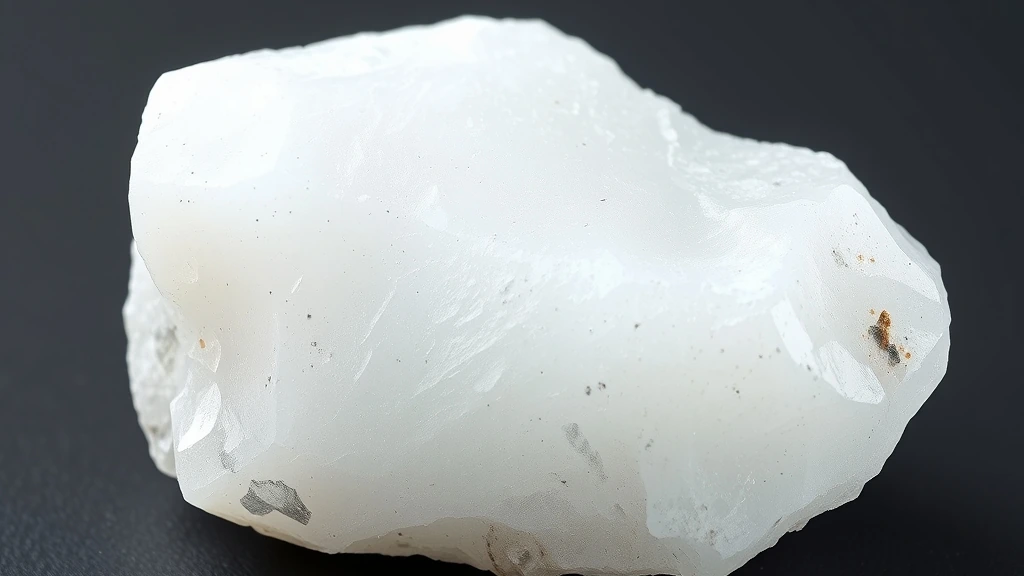
Milky Quartz belongs to the silicate family, specifically the tectosilicate subgroup of the quartz family. Its crystals grow in the trigonal (rhombohedral / trapezohedral) system, forming interlocking aggregates that fill veins and cavities in igneous and metamorphic rocks. The milky appearance results from microscopic fluid inclusions that scatter light, giving the stone its characteristic translucency.
What is Milky Quartz (snow Quartz)? Geological Overview & Definition
Milky Quartz is a variant of quartz distinguished by a pervasive cloudiness caused by countless sub‑microscopic gas bubbles or liquid inclusions. It occurs worldwide in pegmatites, hydrothermal veins, and metamorphic schists, where it crystallizes alongside feldspar, mica, and tourmaline.
The term “snow quartz” reflects its uniform white to milky coloration, which lacks the distinct banding of other quartz varieties. Despite its opaque look, the mineral retains the same crystal lattice as clear quartz, preserving its physical robustness and optical properties. In comparative mineralogical collections, practitioners and geologists frequently study Rock Crystal Necef Quartz alongside this crystal to appreciate their subtle energetic and structural differences.
Milky Quartz (snow Quartz) Chemical Composition & Crystallographic Properties
The fundamental composition of Milky Quartz is SiO₂, a simple tetrahedral network of silicon and oxygen atoms. Its trigonal (rhombohedral / trapezohedral) crystal system produces a three‑fold rotational symmetry, with each unit cell containing three SiO₄ tetrahedra linked at shared oxygen corners.
Because the quartz lattice is chemically stable, cation substitution is minimal; trace amounts of Al³⁺ or Fe³⁺ may occupy silicon sites, subtly influencing the inclusion chemistry but not altering the overall formula. The mineral is acid‑sensitive, dissolving slowly in hydrofluoric acid while remaining resistant to most weak acids.
The milky hue arises from light‑scattering inclusions that act as chromophore centers, rather than from transition‑metal pigments. These inclusions are typically fluid or gas bubbles trapped during crystal growth, which diffract light and create the characteristic opacity.
Thermally, Milky Quartz behaves like pure quartz: it expands anisotropically, exhibits a α‑β phase transition at 573 °C, and retains its structural integrity up to about 1,650 °C before melting. Heating can drive out inclusions, sometimes clearing the stone to a more transparent form.
| Property | Specification |
|---|---|
| Mineral Group | Silicates (Tectosilicates / Quartz Group) |
| Chemical Formula | SiO₂ (Silicon Dioxide) |
| Mohs Hardness | 7.0 |
| Crystal System | Trigonal (Rhombohedral / Trapezohedral) |
| Specific Gravity (Density) | 2.65 |
| Refractive Index | 1.544 – 1.553 |
| Color & Optical Properties | Natural Milky Quartz (snow Quartz) color spectrum and optical dispersion |
| Primary Mining Localities | Brazil, Madagascar, USA (Arkansas), Swiss Alps |
| Water & Chemical Resistance | High (Fully resistant to water and moisture) |
| Chakra Alignment (Traditional) | All Chakras (Universal Harmonizer) |
| Zodiac Affinity (Traditional) | All Zodiac Signs (Especially Leo and Aries) |
| Symbolic Meaning (Traditional) | Master energy amplifier, clarity, purification, and focus |
Milky Quartz (snow Quartz) Varieties & Color Spectrum
Milky quartz exhibits a wide range of opalescent hues driven by microscopic fluid inclusions. The most common form is pure white, resulting from dense suspensions of water and gas bubbles. This opalescence creates a soft, diffused light that distinguishes it from clear rock crystal.
Pure White Milky Quartz
This standard variety features a uniform, cloud-like appearance with high translucency. It forms in large, well-faceted crystals within pegmatite veins where slow cooling allows for significant fluid entrapment. Geologically, the opacity stems from nanoscopic bubbles that scatter light across the visible spectrum.
Blue-White Milky Quartz
Rare specimens display a distinct cool blue tint, often associated with specific trace element impurities. This coloration is frequently observed in deposits from the United States and Brazil. The blue flash occurs when light interacts with elongated fluid inclusions at specific angles, creating a subtle azure glow.
Greenish-White Milky Quartz
This morph exhibits a pale sage or minty hue, typically linked to microscopic chlorite or epidote inclusions. Found primarily in metamorphic terrains, these stones often contain fine, needle-like mineral traces. The greenish tint provides a unique aesthetic appeal for collectors seeking non-traditional quartz colors.
Smoky-White Milky Quartz
A transitional variety blending milky opacity with faint brownish or grayish tones. This coloration arises from natural irradiation affecting the crystal lattice structure over geological time. The smoky overtones add depth and contrast to the otherwise bright, cloudy matrix, enhancing its visual complexity.
Prismatic Milky Quartz
Characterized by exceptionally well-formed, six-sided hexagonal prisms with sharp terminations. These crystals often grow in open cavities, allowing for unobstructed development of their geometric faces. The prismatic clarity makes them highly sought after for display purposes and crystallographic study.
Where is Milky Quartz (snow Quartz) Found? Geological Mining & Extraction
Milky quartz primarily forms within granitic pegmatites, which are coarse-grained igneous rocks that cool slowly deep within the Earth’s crust. These geological formations provide the necessary space and chemical environment for large, inclusion-rich crystals to develop. The host rock often contains feldspar, mica, and other silicate minerals that accompany the quartz growth.
Major mining regions include Brazil, Madagascar, and the United States, particularly in states like North Carolina and Arkansas. Extraction methods typically involve open-pit mining or shallow tunneling to access the rich pegmatite veins. Regional provenance significantly influences the stone’s color and inclusion density, with Brazilian specimens often prized for their vibrant opalescence.
Historical Significance & Cultural Lore of Milky Quartz (snow Quartz)
Ancient civilizations revered milky quartz for its perceived ability to amplify spiritual energy and promote mental clarity. In Roman times, it was often mistaken for moonstone due to its soft, luminous glow and associated with lunar deities. Archaeological artifacts from these periods show the stone used in amulets and ceremonial objects, reflecting its high social status.
Medieval European alchemists believed milky quartz contained the “philosopher’s stone” essence due to its cloudy, ethereal appearance. This lore persisted into the modern era, where it is widely recognized as a universal harmonizer in metaphysical practices. Its enduring legacy underscores the deep cultural connection between geological formations and human spiritual interpretation.
Modern Uses & Jewelry Applications of Milky Quartz (snow Quartz)
Lapidaries value milky quartz for its translucent white body and consistent opacity, which allows for versatile cutting styles. The stone’s Mohs hardness of 7.0 ensures durability for everyday wear in rings and pendants. Its soft, cloud-like appearance makes it a popular choice for minimalist and bohemian jewelry designs.
- Cabochon Cutting: Smooth, domed surfaces are preferred to showcase the stone’s internal silica inclusions and milky luster without faceting interference.
- Faceted Jewelry: While less common, high-clarity specimens can be faceted to reveal subtle internal flashes and geometric precision.
- Ornamental Carving: Large, uniform blocks are carved into figurines, spheres, and architectural accents for interior design.
- Healing Crystals: Polished tumbles and raw points are widely sold for meditation and energy work purposes.
Metaphysical Properties & Traditional Meaning of Milky Quartz (snow Quartz)
According to historical traditions and metaphysical lore, milky quartz is revered as a master energy amplifier that promotes clarity and purification. Practitioners believe it enhances mental focus and emotional balance, acting as a universal harmonizer for the entire chakra system. Its gentle, diffused light symbolizes inner peace and the removal of stagnant energy from the physical and spiritual planes.
The stone is often associated with spiritual attunement and the ability to channel higher frequencies effectively. Users report a calming resonance that aids in meditation and deep relaxation. By aligning the body’s energy centers, it is thought to foster a sense of wholeness and universal connection.
Which Chakra and Zodiac Signs Align with Milky Quartz (snow Quartz)?
Milky quartz is uniquely aligned with All Chakras, functioning as a universal harmonizer that balances the entire energy system. It does not target a single center but instead supports the flow of prana or life force throughout the body. This makes it an ideal stone for beginners seeking comprehensive energetic alignment and stability.
In astrological practice, the stone resonates with All Zodiac Signs, offering broad compatibility and support. However, it shows particular affinity for Leo and Aries, whose fiery natures benefit from the stone’s cooling and clarifying properties. These signs often use milky quartz to temper impulsivity and enhance focused intention during creative or leadership pursuits.
How to Identify Real vs. Fake Milky Quartz (snow Quartz)
Artificial imitations of milky quartz often include synthetic glass, dyed chalcedony, or plastic replicas designed to mimic the stone’s translucent white appearance. Glass imitations typically lack natural inclusions and may exhibit bubbles or swirl marks under magnification. Dyed stones may show color concentration in fractures, which is not characteristic of natural milky quartz.
Practical At-Home Authenticity Tests
- Temperature Test (Thermal Feel): Real quartz feels cool to the touch initially and warms slowly, whereas plastic or glass may feel warmer or heat up more quickly due to different thermal conductivity.
- Specific Gravity & Weight Test: Genuine milky quartz has a specific gravity of 2.65, making it feel denser than similarly sized glass or plastic imitations.
- Scratch & Hardness Test (Mohs Comparison): With a Mohs hardness of 7.0, real quartz will scratch glass and steel but will not be scratched by a knife or copper coin.
- Microscopic & Loupe Inspection (Internal Inclusions): Use a 10x loupe to look for natural silica inclusions or fluid traps; glass imitations often contain round bubbles or lack natural internal structure.
Milky Quartz (snow Quartz) Valuation Factors, Grading & Pricing
The market first assesses color saturation; a milky quartz with a uniform, opaque white hue commands higher prices than one with clouded or uneven translucency. Visual vibrancy is judged under neutral lighting, and specimens that display a natural, subtle internal glow are prized for their energetic luster. Collectors also note the absence of surface blemishes that could diminish the stone’s perceived purity.
Next, crystal size & weight (grams) dominate pricing, with larger, heavier pieces valued for their rarity and presence. Raw, unpolished crystals fetch lower bids than tumbled or polished stones that reveal a smooth, glassy surface, while natural matrix inclusions such as tiny quartz needles can add intrigue and increase value. Weight is recorded in grams, and dimensions are measured in millimeters to standardize trade.
Finally, ethical sourcing & locality premium influences both holistic and collector markets. Stones mined from regions with transparent labor practices and minimal environmental impact attract premium buyers, especially when provenance can be traced to renowned quartz belts in Brazil or Madagascar. Ethical certification often justifies a price uplift, reflecting growing consumer demand for responsibly obtained gemstones.
How to Clean and Care for Milky Quartz (snow Quartz)
Milky quartz tolerates water well; gently wash the stone in warm water mixed with a mild soap, using a soft brush to remove surface dust. Rinse thoroughly with clean water and pat dry with a lint‑free microfiber cloth, avoiding abrasive pads that could scratch the surface. The stone is also safe for ultrasonic cleaning, provided it is not heavily fractured or already compromised by micro‑cracks.
Cleansing and Recharging Milky Quartz (snow Quartz) (Energetic Care)
For energetic renewal, place the quartz on a clean selenite charging slab and allow ambient lunar light to bathe it for several hours, a method that respects the stone’s crystal lattice while clearing residual energies. Alternatively, pass the stone through a gentle herbal smudge plume—such as sage or cedar—ensuring the smoke does not become damp, which could introduce moisture to the surface.
A brief exposure to natural moonlight or a short session of soft, indirect sunlight can also refresh the stone’s vibrational field without overheating. After each energetic session, store the quartz in a dry, soft pouch to maintain both its physical integrity and its clarified energetic state.
Frequently Asked Questions About Milky Quartz (snow Quartz)
Is Milky Quartz safe to wear in the shower?
Yes, it is fully resistant to water and moisture. The mineral’s chemical stability ensures it does not degrade or dissolve when exposed to humidity or liquid. You can safely wear your jewelry during daily activities without fear of structural damage. This makes it an excellent choice for everyday accessories that encounter frequent moisture exposure.
Can I use an ultrasonic cleaner on Milky Quartz?
It is suitable for ultrasonic cleaning unless the stone is heavily fractured. The Mohs hardness of 7.0 provides sufficient durability for standard cleaning cycles. However, inspect the specimen for internal fractures first, as intense vibrations could potentially widen existing cracks. For most intact pieces, this method effectively removes deep-seated grime safely.
What is the chemical composition of Milky Quartz?
It consists entirely of Silicon Dioxide (SiO₂) with microscopic fluid inclusions. These tiny bubbles of water or gas scatter light, creating the characteristic milky appearance. The trigonal crystal system governs its structural formation, resulting in hexagonal prisms. Understanding this composition helps explain its optical properties and physical resilience.
Which zodiac signs are most aligned with Milky Quartz?
It resonates with all zodiac signs, especially Leo and Aries. As a universal stone, it supports the energetic needs of every astrological profile. Its amplifying properties are particularly beneficial for fire signs seeking clarity and focus. This broad compatibility makes it a versatile addition to any personal collection.
How does Milky Quartz interact with chakra energy?
It functions as a universal harmonizer for all chakras. Rather than targeting a single energy center, it promotes balance across the entire system. This universal harmonizer quality aids in purification and clarity throughout the body. Practitioners use it to align and stabilize the full spectrum of energetic flow.
What is the Mohs hardness of Milky Quartz?
It measures 7.0 on the Mohs scale, making it quite durable. This hardness allows it to resist scratches from common materials like steel or glass. It is robust enough for daily wear in rings and bracelets. However, it can still be scratched by harder minerals like topaz or diamond.
Why does Milky Quartz appear cloudy or white?
The opacity is caused by microscopic fluid inclusions within the crystal lattice. These tiny bubbles scatter light, preventing it from passing through clearly. This phenomenon distinguishes it from clear rock crystal. The density of these inclusions determines the intensity of the milky effect.
How should I store Milky Quartz to prevent damage?
Store it in a soft pouch or separate compartment to avoid contact with harder gems. Although hard, it can still suffer from abrasion if rubbed against diamonds or sapphires. Keep it away from extreme heat sources to preserve its structural integrity. Proper storage maintains its aesthetic appeal and prevents accidental chipping or scratching.