
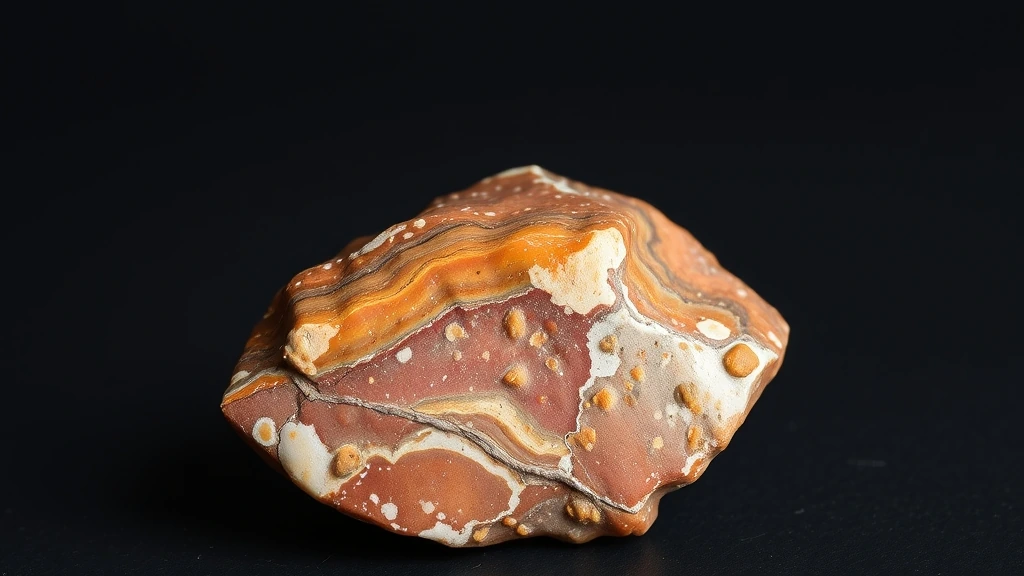
Mookaite Jasper originates from the ancient volcanic sediments of western Australia, where silica‑rich fluids infiltrated iron‑bearing sandstones and precipitated microcrystalline chalcedony. Classified as a natural mineral aggregate, it belongs to the broader quartz family yet is distinguished by its heterogeneous, banded texture. The stone’s formation reflects prolonged diagenesis, cementing fine quartz grains with iron oxides that produce its characteristic warm palette.
What is Mookaite Jasper ? Geological Overview & Definition
Mookaite Jasper is an aggregate of microcrystalline chalcedony intergrown with iron oxide pigments such as hematite and goethite. This combination yields a speckled matrix of reds, oranges, and earthy browns, each band representing subtle variations in mineral content and depositional conditions.
Although often marketed as a “jasper,” the stone lacks true jasper’s fine‑grained feldspar component; instead, its silica framework provides the primary structural backbone. The iron‑rich inclusions act as chromophore centers, imparting the vivid coloration that makes Mookaite a favored material for jewelry and ornamental carving.
Mookaite Jasper Chemical Composition & Crystallographic Properties
The silica component of Mookaite Jasper crystallizes in the trigonal crystal system, sharing the same lattice parameters as quartz (space group P3₁21 or P3₂21). Within this framework, SiO₄ tetrahedra link into continuous helices, producing the characteristic three‑fold rotational symmetry of trigonal quartz. In comparative mineralogical collections, practitioners and geologists frequently study Puddingstone alongside this crystal to appreciate their subtle energetic and structural differences.
Because the stone is an aggregate, its overall composition is best described as SiO₂ plus variable amounts of Fe₂O₃ and FeO·H₂O, reflecting the iron oxide inclusions. These cation substitutions do not alter the fundamental trigonal lattice but introduce localized strain fields that affect optical properties such as refractive index (1.530–1.544).
Mookaite’s silica matrix is acid‑sensitive; exposure to strong acids can dissolve the microcrystalline quartz, releasing silica into solution and potentially leaching iron pigments. This reactivity underscores the need for careful cleaning with neutral pH agents.
Thermally, the quartz component remains stable up to ~573 °C, the α‑β quartz transition temperature, after which the lattice expands anisotropically but retains its trigonal symmetry. Iron oxides may undergo minor oxidation changes at higher temperatures, subtly shifting the stone’s hue without compromising structural integrity.
| Property | Specification |
|---|---|
| Mineral Group | Natural Mineral / Crystal |
| Chemical Formula | SiO₂ (Chalcedony/Quartz variety) |
| Mohs Hardness | 6.5 – 7.0 |
| Crystal System | Trigonal |
| Specific Gravity (Density) | 2.60 – 2.65 |
| Refractive Index | 1.530 – 1.544 |
| Color & Optical Properties | Natural Mookaite Jasper Gemstone color spectrum and optical dispersion |
| Primary Mining Localities | Global primary localities |
| Water & Chemical Resistance | High (Safe for gentle water washing) |
| Chakra Alignment (Traditional) | Root Chakra, Sacral Chakra |
| Zodiac Affinity (Traditional) | Taurus, Virgo, Capricorn |
| Symbolic Meaning (Traditional) | Grounding, emotional stability, and creative inspiration |
Mookaite Jasper Varieties & Color Spectrum
Red Mookaite
Formed within silicified sandstone veins of the Mooki River basin, Red Mookaite displays a dominant scarlet hue interlaced with fine iron oxide streaks. The mineral matrix often contains quartz crystals that lend a subtle translucence, while occasional hematite inclusions create speckled dark spots. This variety is moderately common in local markets but prized for its vivid intensity.
Yellow Mookaite
Yellow Mookaite originates from oxidized goethite and limonite deposits, giving it a warm golden‑amber tone that fades to pale cream near the edges. Thin layers of chalcedony produce a glassy sheen, and occasional fossilized plant fragments add unique textural interest. Its abundance in the Mooki region makes it a staple for commercial jewelry, though high‑grade specimens with uniform color remain scarce.
Green Mookaite
The rare Green Mookaite derives its hue from trace amounts of chromium‑bearing minerals such as uvarovite garnet within the host sandstone. Fine‑grained calcite veins create a mottled appearance, while tiny mica flakes impart a subtle iridescence. Because chromium enrichment is localized, this variety commands premium prices and is often reserved for high‑end ornamental pieces.
Blue‑Grey Mookaite
Blue‑Grey Mookaite exhibits a muted slate coloration caused by titanium‑rich rutile inclusions and fine‑grained amphibole crystals. The stone’s surface may show faint banding reminiscent of sedimentary layering, and occasional quartz nodules add a sparkling contrast. Though less vivid than other colors, its sophisticated palette is favored by designers seeking understated elegance.
Multi‑Color Mookaite (Mookaite Mosaic)
Mookaite Mosaic combines red, yellow, green, and blue‑grey zones within a single slab, reflecting complex hydrothermal alteration processes that introduced diverse mineral phases. The interlocking pattern of quartz, hematite, and mica creates a kaleidoscopic visual signature prized by collectors. Such pieces are uncommon, as they require precise quarrying to preserve the intricate color juxtaposition.
Trade‑Name “Mookaite Sunset”
The commercial label “Mookaite Sunset” refers to slabs where sunrise‑like gradients of orange, pink, and purple dominate, produced by selective polishing of iron‑oxide‑rich layers. While not a distinct geological variety, the branding highlights the stone’s aesthetic versatility. High‑quality Sunset pieces are limited to select export batches, enhancing their market desirability.
Where is Mookaite Jasper Found? Geological Mining & Extraction
Mookaite Jasper occurs primarily within the Mooki River alluvial deposits of north‑central New South Wales, where ancient river channels have exhumed silicified sandstone and quartzite beds. The host rocks are part of the Permian Narrabri Basin, characterized by low‑grade metamorphic sequences that facilitate the precipitation of iron‑oxide and manganese minerals responsible for the stone’s colors.
Mining is largely artisanal, employing hand‑picked extraction from exposed riverbanks and shallow pit operations. Workers separate the jasper from surrounding matrix using wet sieving and manual sorting, then transport the raw blocks to local processing centers where they are cut, polished, and graded for domestic and international markets.
Historical Significance & Cultural Lore of Mookaite Jasper
Indigenous Australian groups, notably the Wiradjuri and Kamilaroi, have long valued Mookaite Jasper for ceremonial adornments and trade. Archaeological sites reveal polished beads and pendants dating back over 2,000 years, indicating the stone’s role in social exchange networks across the interior continent.
European settlers in the 19th century documented the stone’s use in colonial jewelry, attributing protective properties to its earthy tones. Folklore persists that Mookaite Jasper can ground the wearer’s energy, a belief that continues to influence contemporary metaphysical markets and reinforces the gem’s enduring cultural resonance.
Where is Mookaite Jasper Found? Geological Mining & Extraction
Mookaite Jasper occurs within the silicified radiolarian sediments of the Mooka Creek basin, embedded in ancient marine shale that has been over‑pressed by later volcanic activity. The host rock is a fine‑grained quartz‑rich matrix interlaced with iron‑oxide and manganese layers, creating the characteristic burgundy‑mustard swirls prized by collectors.
Commercial extraction is carried out by small‑scale open‑pit mining operations near the town of Mooka, Western Australia, where miners use controlled blasting and hydraulic hosing to separate the jasper nodules from surrounding matrix. After removal, the raw blocks are washed, sorted by color banding, and shipped to lapidary workshops for cutting and polishing.
Historical Significance & Cultural Lore of Mookaite Jasper
Indigenous Australian groups, notably the Yamatji peoples, have long used Mookaite fragments in ceremonial tools and ornamental pendants, believing the stone to channel earth’s stability and creative inspiration. Archaeological sites reveal polished beads and scarab‑shaped amulets dating back over 2,000 years, underscoring the gem’s enduring spiritual value.
European settlers in the late 19th century documented Mookaite’s trade among Aboriginal traders, and early mineralogists recorded its unique coloration in scientific journals. Modern metaphysical literature continues to cite Mookaite as a grounding stone for the Root and Sacral Chakras, linking ancient reverence with contemporary crystal healing practices.
Modern Uses & Jewelry Applications of Mookaite Jasper
Mookaite Jasper is prized for its earthy palette and robust hardness (6.5‑7 on the Mohs scale), making it ideal for both cabochon and faceted designs. Lapidary artisans often shape it into smooth domes that showcase its layered bands, while skilled carvers produce ornamental figurines and decorative tiles. Its durability also allows for intricate inlay work in high‑end jewelry pieces.
- Cabochon pendants and rings highlighting the stone’s natural veining
- Faceted beads and earrings that amplify sparkle without sacrificing color depth
- Ornamental carvings such as mini‑statues, wall plaques, and architectural accents
Metaphysical Properties & Traditional Meaning of Mookaite Jasper
According to historical traditions and metaphysical lore, Mookaite Jasper is a grounding stone that anchors the wearer to the physical world while nurturing creative flow. It is believed to foster emotional stability, helping individuals release anxiety and cultivate confidence in decision‑making. The stone’s warm, earthy tones are said to resonate with the heart’s desire for security and artistic expression, making it a favorite among practitioners seeking creative inspiration.
Which Chakra and Zodiac Signs Align with Mookaite Jasper ?
Mookaite Jasper is energetically linked to the Root Chakra, the foundation of physical vitality and survival instincts. Activation of this chakra is thought to reinforce a sense of safety, encouraging steady progress toward personal goals.
In astrology, the stone aligns exclusively with the Taurus, Virgo, and Capricorn signs, each embodying practicality, discipline, and a deep connection to the material world. Wearers born under these earth signs may feel the stone amplifies their innate resilience and work ethic.
How to Identify Real vs. Fake Mookaite Jasper
Artificial imitations of Mookaite Jasper include dyed chalcedony, synthetic glass, and resin composites that mimic its characteristic banding. These substitutes often lack the stone’s genuine density and subtle internal inclusions, making careful testing essential for collectors and buyers.
Practical At-Home Authenticity Tests
- Temperature Test (Thermal Feel): Real Mookaite feels cool to the touch and retains that coolness longer than glass or plastic, which quickly warm to skin temperature.
- Specific Gravity & Weight Test: With a density of 2.60‑2.65 g/cm³, authentic Mookaite feels noticeably heavier than dyed quartz or glass of similar size.
- Scratch & Hardness Test (Mohs Comparison): Using a steel nail (hardness ~5.5) will not scratch genuine Mookaite, whereas softer imitations will show visible marks.
- Microscopic & Loupe Inspection (Internal Inclusions): Under 10× magnification, natural Mookaite reveals fine, irregular inclusions and layered banding, while synthetic glass appears uniformly clear or shows bubble patterns.
Mookaite Jasper Valuation Factors, Grading & Pricing
Color Saturation is the foremost driver of price; stones displaying vivid reds, oranges, and earthy browns command premiums. Collectors also examine tone uniformity, preferring pieces where hue remains consistent across the surface. Optical clarity and a high‑shine luster further elevate market value, especially when the surface is free of dull patches.
Specimen Size & Weight influences pricing tiers, with larger specimens (typically over 5 carats) fetching exponentially higher rates. tumbled polish and natural geometry is scrutinized—well‑cut stones reflect light evenly, enhancing perceived depth. The presence of a natural matrix or inclusions can be a blessing or a penalty, depending on whether they add character without compromising structural integrity.
Geographical Provenance Premium rewards stones sourced from the historic Mooka Creek region of Western Australia, where the name originates. Provenance certificates often add 10‑15 % to wholesale prices and even more at retail, reflecting rarity and authenticity. Market trends show steady appreciation, with demand rising among both metaphysical collectors and fine‑jewelry designers.
How to Clean and Care for Mookaite Jasper
Use warm soapy water and a soft cloth to gently remove surface dust and oils. Rinse briefly with clean lukewarm water, then pat dry with a lint‑free towel. Avoid ultrasonic cleaners entirely, as the vibrations can cause micro‑fractures in the quartz‑based structure.
Cleansing and Recharging Mookaite Jasper (Energetic Care)
For energetic renewal, place the stone in the smoke of white sage or palo santo, allowing the gentle vapor to clear stagnant energies without moisture exposure. This dry method respects the mineral’s low solubility and preserves its natural polish.
Alternatively, lay the jasper on a selenite plate or under moonlight for several hours; both techniques cleanse and recharge the stone’s vibrational field while keeping it completely dry. These practices align with traditional esoteric routines and maintain the gem’s structural integrity.
Frequently Asked Questions About Mookaite Jasper
Is Mookaite Jasper safe to wear in water?
Yes, it tolerates gentle water exposure. Mookaite Jasper’s silica‑based quartz structure (SiO₂) is non‑porous, allowing safe hand‑washing or brief shower contact. However, prolonged soaking or harsh detergents can dull its natural luster, so rinse with warm, soapy water and pat dry.
Can I clean Mookaite Jasper with an ultrasonic cleaner?
No, avoid ultrasonic cleaning. The stone’s trigonal crystal system makes it vulnerable to micro‑fractures under high‑frequency vibrations. Instead, use a soft cloth with warm, mildly soaped water; gently rub the surface to remove grime without compromising structural integrity.
What zodiac signs are most compatible with Mookaite Jasper?
Taurus, Virgo, and Capricorn are the aligned signs. These earth‑sign individuals often seek the grounding energy that Mookaite Jasper provides, supporting their practical nature. Wearing the stone may enhance stability and perseverance, traits prized by these zodiac profiles.
Which chakras does Mookaite Jasper activate?
It resonates with the Root and Sacral Chakras. By stimulating the Root Chakra, the gem promotes physical stability and security, while the Sacral Chakra connection encourages creative flow and emotional balance, aligning with its esoteric keywords of grounding and inspiration.
How hard is Mookaite Jasper compared to other gemstones?
It rates 6.5–7 on the Mohs scale. This hardness places it between opal and quartz, making it suitable for everyday jewelry yet still susceptible to scratches from harder materials like diamond or corundum. Proper care preserves its vibrant, mottled colors.
What is the typical density of Mookaite Jasper?
Its specific gravity ranges from 2.60 to 2.65. This relatively light density reflects the silica‑rich composition of chalcedony, allowing the stone to feel comfortable in pendants and bracelets without adding excessive weight, while still maintaining a solid, substantial feel.
Does Mookaite Jasper have a notable refractive index?
Yes, it falls between 1.530 and 1.544. This refractive index is characteristic of quartz varieties, giving the gem a gentle brilliance and a subtle sheen when cut polished. The modest sparkle enhances its appeal in both casual and formal settings.
Are there any known treatments to enhance Mookaite Jasper’s color?
Generally, it is untreated and natural. Authentic Mookaite Jasper displays intrinsic banding of reds, yellows, and browns formed during geological processes. Any artificial dyeing would be disclosed by reputable dealers; natural stones retain their original, unaltered hue and pattern.