
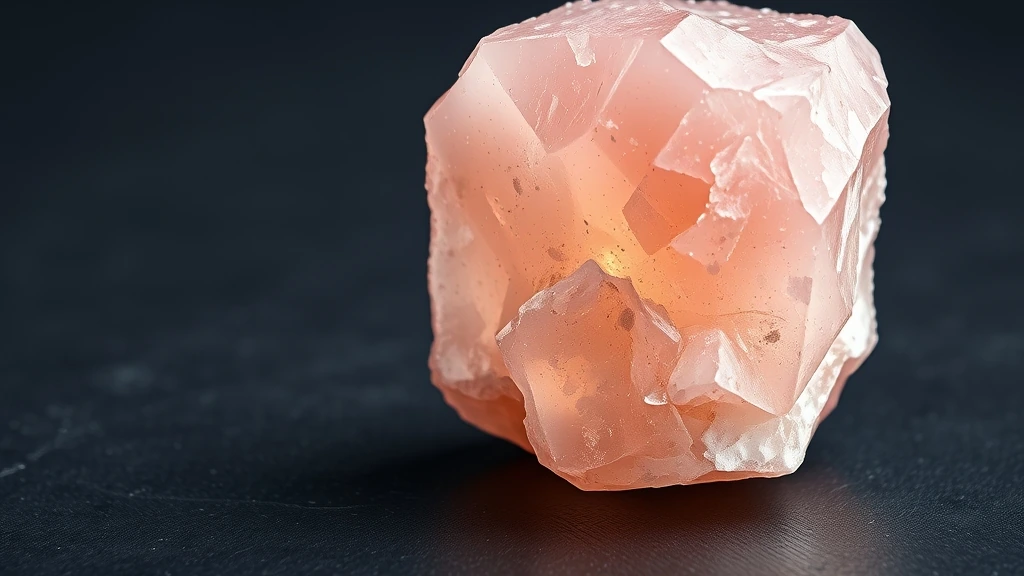
Morganite belongs to the beryl family, a natural mineral group characterized by a hexagonal‑type framework that crystallizes in the trigonal system. Formed in pegmatitic veins under high‑temperature, low‑pressure conditions, its crystals grow as elongated prisms with basal terminations. The stone’s pastel pink to salmon colors arise from trace manganese (Mn²⁺) substituting for beryllium, while its density (2.71–2.74 g/cm³) and refractive index (1.624–1.652) reflect a tightly packed silicate lattice.
What is Morganite Gemstone? Geological Overview & Definition
Morganite is the pink‑to‑peach member of the beryl series, distinguished from emerald and aquamarine by its unique chromophore. It forms in granitic pegmatites where beryllium‑rich fluids interact with manganese‑bearing host rocks, producing the characteristic pastel hue.
The gemstone is prized for its emotional resonance in metaphysical circles, often linked to the heart chakra and the zodiac signs Taurus, Virgo, and Libra. Its clarity and relatively low inclusions make it a popular choice for fine jewelry, while its hardness ensures resistance to everyday wear.
Morganite Gemstone Chemical Composition & Crystallographic Properties
Morganite’s ideal formula is Be₃Al₂(Si₆O₁₈), a cyclosilicate where six SiO₄ tetrahedra form a ring structure. This trigonal lattice belongs to the space group *R3̅m*, producing elongated prismatic crystals with a distinct basal pinacoid.
Manganese ions (Mn²⁺) substitute for a small fraction of the beryllium sites, creating color centers that absorb specific wavelengths and yield the stone’s pink to salmon spectrum. The substitution is limited; higher Mn content can shift the hue toward rose or even red.
Morganite is chemically stable in neutral environments but can be attacked by hydrofluoric acid, which dissolves the silicate framework. It is resistant to most common acids, making it suitable for everyday wear.
Thermally, Morganite expands modestly with temperature, displaying a coefficient of thermal expansion typical of beryl (~5.5 × 10⁻⁶ K⁻¹). Heating above 600 °C can cause decoloration as Mn²⁺ ions migrate, while rapid cooling may induce micro‑fracturing if internal stresses are present.
| Property | Specification |
|---|---|
| Mineral Group | Natural Mineral / Crystal |
| Chemical Formula | Be₃ Al₂ (Si₆ O₁₈ ) |
| Mohs Hardness | 7.5 to 8 |
| Crystal System | Trigonal |
| Specific Gravity (Density) | 2.71 – 2.74 |
| Refractive Index | 1.624 – 1.652 |
| Color & Optical Properties | Natural Morganite Gemstone color spectrum and optical dispersion |
| Primary Mining Localities | Global primary localities |
| Water & Chemical Resistance | High (Safe for gentle water washing) |
| Chakra Alignment (Traditional) | Heart Chakra |
| Zodiac Affinity (Traditional) | Taurus, Virgo, Libra |
| Symbolic Meaning (Traditional) | Unconditional love, emotional healing, and inner peace |
Morganite Gemstone Varieties & Color Spectrum
Morganite is the pink to peach variety of beryl, distinguished by trace amounts of manganese within its crystal lattice. Unlike emerald, which owes its green hue to chromium, this gemstone’s coloration is entirely dependent on manganese substitution. The intensity ranges from pale pastel shades to vibrant salmon pinks, making it a sought-after alternative to pink sapphire.
Classic Peach Morganite
This variety exhibits a soft, warm peach tone that is highly valued in the jewelry market. It typically forms in large, clean crystals with minimal internal inclusions, allowing for high clarity grades. The refractive index of 1.624 to 1.652 enhances its brilliance, making it visually striking even in smaller cuts.
Deep Salmon Morganite
Characterized by a richer, more saturated pink hue, this morph is rarer and commands a premium price. The color intensity is often attributed to higher concentrations of manganese ions during the pegmatite formation process. Collectors prize these stones for their vivid appearance and potential for significant color enhancement.
Pale Blush Morganite
These stones display a very light, almost white-pink coloration that appeals to those preferring subtle elegance. They are often found in larger sizes, making them ideal for center stones in engagement rings. The Mohs hardness of 7.5 to 8 ensures durability, though its pale color may require careful setting to maximize visual impact.
Brazilian Pink Morganite
Sourced primarily from Minas Gerais, this regional variety is known for its consistent color and excellent clarity. The geological environment in Brazil provides optimal conditions for the growth of large, high-quality beryl crystals. These stones often exhibit a trigonal crystal system structure that facilitates precise cutting and polishing.
African Peach Morganite
Found in countries like Madagascar and Mozambique, this variety often displays warmer, more orange-leaning tones. The deposits here are frequently associated with complex pegmatite bodies that contain diverse mineral assemblages. The density of 2.71 to 2.74 g/cm³ helps distinguish it from synthetic imitations during gemological testing.
Treated Morganite Varieties
While natural color is preferred, some pale stones undergo heat or irradiation treatment to deepen their hue. Ethical gemologists emphasize transparency regarding such treatments to maintain market integrity and consumer trust. Understanding the chemical formula Be3Al2(Si6O18) helps experts identify potential stability issues in treated specimens.
Where is Morganite Gemstone Found? Geological Mining & Extraction
Morganite forms exclusively within pegmatite deposits, which are coarse-grained igneous rocks resulting from the final stages of magma crystallization. These geological formations often contain large crystals of beryl, feldspar, and quartz, creating ideal conditions for gemstone growth. The slow cooling rate allows for the development of the large, clean crystals prized by lapidaries.
Primary mining regions include Brazil, Madagascar, and Afghanistan, each offering distinct color profiles and crystal sizes. In Brazil, the Minas Gerais region remains a prolific source of high-quality peach and pink morganite. Meanwhile, Madagascar has emerged as a key supplier of larger, more saturated stones in recent decades.
Historical Significance & Cultural Lore of Morganite Gemstone
Although beryl has been known since ancient times, morganite was not formally described until 1911 by George F. Kunz. It was named in honor of J.P. Morgan, a prominent financier and gem collector who owned a significant collection of beryl specimens. This naming highlights the stone’s connection to early 20th-century gemological exploration and elite patronage.
In modern esoteric traditions, morganite is associated with the Heart Chakra, symbolizing unconditional love and emotional healing. While it lacks the deep historical artifacts of diamonds or rubies, its contemporary lore emphasizes inner peace and spiritual connection. This modern narrative has significantly boosted its popularity in alternative jewelry markets.
Modern Uses & Jewelry Applications of Morganite Gemstone
Lapidaries favor morganite for its pleochroism, which allows cutters to orient the stone to maximize its soft pink to peach hues. The gem’s moderate hardness makes it suitable for both faceted cuts and smooth cabochons, offering versatility in design. Its gentle color palette pairs beautifully with white gold, platinum, and rose gold settings.
- Engagement Rings: Popular as a romantic alternative to traditional diamonds or sapphires.
- Earrings and Pendants: Ideal for showcasing the stone’s delicate refractive index and brilliance.
- Cabochon Carvings: Used in intaglio work where the stone’s translucency is highlighted.
- Beads and Bracelets: Polished into smooth spheres for casual yet elegant jewelry pieces.
Carat, Quality Grades & Value Factors of Morganite Gemstone
The value of morganite is primarily driven by color saturation, with deep, vivid pinks commanding the highest prices. Stones with a chromium impurity often exhibit richer tones compared to those tinted by manganese. Clarity is also critical, as eye-clean specimens are rare and significantly more valuable than those with visible inclusions.
Cut quality determines how well the stone reflects light, enhancing its perceived color and brilliance. A well-proportioned cut maximizes the refractive index range of 1.624 to 1.652, creating superior fire and sparkle. Carat weight influences price exponentially, as larger, high-quality morganites are increasingly scarce in the global market.
Zodiac and Astrological Lore of Morganite Gemstone
Morganite is traditionally aligned with Taurus, Virgo, and Libra, signs that value stability, harmony, and beauty. In astrological practice, this beryl variety is believed to amplify the wearer’s natural affinity for balance and aesthetic appreciation. Its soft energy is thought to support emotional equilibrium during periods of change.
The stone is strongly associated with the Heart Chakra, promoting feelings of unconditional love and emotional healing. Cultural heritage views morganite as a stone of compassion, helping individuals open their hearts to vulnerability. It is often recommended for those seeking inner peace and deeper emotional connections.
How to Identify Real vs. Fake Morganite Gemstone
Distinguishing genuine morganite from imitations requires attention to subtle physical properties and optical behaviors. Common fakes include dyed white beryl, synthetic glass, and cubic zirconia, which may mimic the stone’s color but lack its natural character. Understanding these differences is crucial for ensuring authenticity and value.
Practical At-Home Authenticity Tests
- Temperature Test (Thermal Feel): Genuine morganite feels cool to the touch initially due to its thermal conductivity. Glass imitations often warm up faster and feel less cool upon prolonged contact with skin.
- Specific Gravity & Weight Test: Real morganite has a density of 2.71 – 2.74 g/cm³. It should feel slightly heavier than a similarly sized piece of glass or plastic, which typically have lower densities.
- Scratch & Hardness Test (Mohs Comparison): With a Mohs hardness of 7.5 to 8, morganite can scratch glass and quartz. However, it will not scratch sapphire or diamond, helping to distinguish it from harder synthetic alternatives.
- Microscopic & Loupe Inspection (Internal Inclusions): Use a 10x loupe to look for natural inclusions like silk or feathers. Perfectly clear stones without any internal features may indicate synthetic glass or lab-grown material.
Morganite Gemstone Valuation Factors, Grading & Pricing
The primary driver of value is Color Saturation, which determines the stone’s visual appeal. Experts assess the intensity of the pink hue alongside tone uniformity across the entire gem. High-grade specimens exhibit exceptional optical clarity and a vibrant, glassy luster that enhances their brilliance.
Carat Weight significantly impacts pricing, as larger, high-quality stones are increasingly rare in the market. Precise facet symmetry is crucial for maximizing light performance and overall aesthetic appeal. Furthermore, the presence of visible matrix or internal inclusions can drastically reduce the gemstone’s commercial value.
Geographical Provenance Premium often elevates the price of stones from renowned mines like Brazil or Madagascar. Current wholesale and retail trends show a steady increase in demand for medium to large stones. Collectors frequently pay a premium for certified origin documentation that verifies the stone’s source.
How to Clean and Care for Morganite Gemstone
To maintain the stone’s integrity, always use warm soapy water and a soft, lint-free cloth for cleaning. Gently wipe the surface to remove oils and dust without applying excessive pressure. This method effectively restores the gem’s natural luster while ensuring its physical safety.
You must strictly avoid ultrasonic cleaners as they can cause structural fractures in the crystal lattice. The Mohs hardness of 7.5 to 8 makes morganite durable, yet it remains susceptible to shock. Regular gentle care is the safest approach to preserving the stone’s long-term beauty.
Cleansing and Recharging Morganite Gemstone (Energetic Care)
For energetic maintenance, place the gemstone on a selenite plate to absorb negative energies naturally. This dry method respects the mineral’s physical structure while aligning with its Heart Chakra associations. Ensure the stone is completely dry before storing it in a safe location.
Alternatively, expose the morganite to moonlight or use smoke smudging for spiritual cleansing. These techniques avoid direct water contact, adhering to safe handling guidelines for this beryl variety. Such practices support the stone’s reputation for promoting unconditional love and emotional healing.
Frequently Asked Questions About Morganite Gemstone
What is the chemical composition of morganite?
Morganite is a beryllium‑aluminium cyclosilicate. Its formula is Be₃Al₂(Si₆O₁₈), placing it in the beryl family alongside emerald and aquamarine. The crystal lattice consists of six‑membered silica rings that give the stone its characteristic pink to peach hue.
How hard is morganite on the Mohs scale?
Morganite rates 7.5 – 8 on the Mohs hardness scale. This makes it suitable for everyday jewelry such as rings and pendants, though it can still be scratched by harder minerals like topaz or diamond. Regular care, like avoiding hard impacts, will preserve its brilliance.
Can I wear morganite while swimming or washing my hands?
Yes, morganite is highly water‑resistant and safe for gentle water washing. A quick rinse with warm, soapy water and a soft cloth will remove residues without harming the stone. Avoid harsh chemicals or prolonged soaking to maintain its surface luster.
Should I clean morganite with an ultrasonic cleaner?
No, avoid ultrasonic cleaners for morganite. Use warm, mildly soapy water and a soft cloth to gently wipe the gem; ultrasonic vibrations can cause micro‑fractures in the crystal structure. Proper manual cleaning keeps the stone intact and sparkling.
Which zodiac signs are associated with morganite?
Morganite aligns with Taurus, Virgo, and Libra. These earth‑ and air‑signs are said to benefit from the stone’s soothing energy, enhancing balance and emotional steadiness. Wearing morganite may reinforce the traits traditionally linked to these signs.
Which chakra does morganite activate?
Morganite resonates with the Heart Chakra. This energy center governs love, compassion, and emotional healing; the stone’s gentle pink tones are believed to amplify unconditional love and inner peace. Meditating with morganite can help open and balance this chakra.
How do I assess the quality of a morganite gemstone?
Look for vivid, evenly distributed pink to peach color and good clarity. High‑quality stones exhibit minimal inclusions and a strong, uniform hue. Cut and polish should maximize brilliance while preserving as much weight as possible for optimal value.
Is morganite a good choice for an engagement ring?
Morganite is an increasingly popular alternative for engagement rings. Its romantic pink shade symbolizes love, and its hardness (7.5‑8) offers reasonable durability. Pair it with a protective setting and routine gentle cleaning to keep the ring looking radiant.