
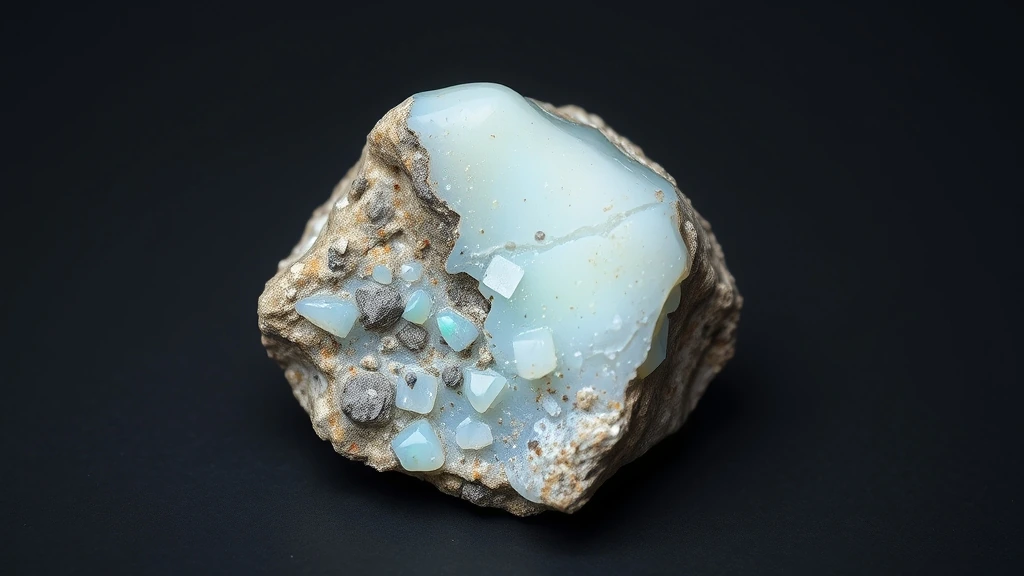
Moss opal belongs to the mineraloid class of hydrated silicas, forming through the gradual infiltration of silica‑rich fluids into porous substrates. The resulting amorphous structure consists of microscopic silica spheres embedded in a hydrated matrix, giving the stone its characteristic moss‑like luster and subtle iridescence. This classification distinguishes it from crystalline opals, which possess a regular lattice of silica spheres.
What is Moss Opal? Geological Overview & Definition
Moss opal is an amorphous hydrated silica that develops within sedimentary rocks, volcanic ash beds, or limestone cavities. Its unique appearance arises from the intergrowth of fine silica spheres and water molecules, producing a translucent, green‑to‑brown mosaic reminiscent of moss. The stone is prized for its subtle play of color and its relative hardness compared to other opal varieties. Historically, moss opal has been valued across cultures for its perceived calming and inspirational properties.
Moss Opal Chemical Composition & Crystallographic Properties
The true crystal system of moss opal is amorphous, lacking a long‑range periodic lattice. Its structure comprises randomly oriented silica spheres, each surrounded by water molecules, which together form a hydrated silica matrix. Because of this disorder, there is no defined unit cell or cation substitution; the composition remains essentially SiO₂·nH₂O. Moss opal is mildly acid‑sensitive; dilute hydrochloric acid may cause slight effervescence, but the stone generally resists strong acids. The chromophore responsible for its green tones is attributed to trace iron or manganese ions embedded within the silica spheres, creating localized color centers. Thermal treatment of moss opal typically results in dehydration and a loss of translucency, with temperatures above 200 °C causing irreversible changes to its structure.
| Property | Specification |
|---|---|
| Mineral Group | Mineraloid (Hydrated Silica) |
| Chemical Formula | SiO₂·nH₂O (Hydrated Silicon Dioxide) |
| Mohs Hardness | 5.5 – 6.5 |
| Crystal System | Amorphous (Hydrated silica spheres / Mineraloid) |
| Specific Gravity (Density) | 1.98 – 2.25 |
| Refractive Index | 1.370 – 1.470 |
| Color & Optical Properties | Natural Moss Opal color spectrum and optical dispersion |
| Primary Mining Localities | Australia (Coober Pedy, Lightning Ridge), Ethiopia (Welo), Mexico |
| Water & Chemical Resistance | Moderate/Sensitive (%3-%21 water content; avoid prolonged soaking for hydrophane Welo opals) |
| Chakra Alignment (Traditional) | Crown Chakra and Heart Chakra |
| Zodiac Affinity (Traditional) | Libra, Scorpio, Pisces |
| Symbolic Meaning (Traditional) | Creativity, hope, emotional depth, and spontaneous inspiration |
Moss Opal Varieties & Color Spectrum
Australian Moss Opal
Australian moss opal originates from the Boulder Creek region in Queensland, where volcanic ash layers intergrade with silica‑rich sedimentary deposits. The gemstone displays a greenish‑blue matrix with fine, translucent moss‑like inclusions that give it a velvety sheen. Its rarity stems from the precise balance of silica content and moisture retention required for the moss effect, making it highly prized among collectors. In comparative mineralogical collections, practitioners and geologists frequently study Pink Opal alongside this crystal to appreciate their subtle energetic and structural differences.
Indian Moss Opal
Indian moss opal is mined primarily in the Kashmir and Karnataka districts, where hydrothermal fluids infiltrate fractured granite. The resulting opal shows a deep indigo background with subtle, fern‑shaped inclusions that resemble moss. Its scarcity is due to the limited size of the deposits and the delicate nature of the inclusions, which can be damaged during extraction.
Mexican Moss Opal
Mexican moss opal, found in the Sierra Madre Oriental, forms in volcanic tuff layers that have undergone silica replacement. The gemstone exhibits a turquoise hue with delicate, feather‑like inclusions that create a “mossy” texture. Its relative abundance in the region makes it more accessible, yet high‑quality specimens remain rare because of the difficulty in preserving the fine inclusions during mining.
Brazilian Moss Opal
Brazilian moss opal is sourced from the São Paulo state, where sedimentary basins host silica‑rich veins. The opal’s emerald‑green matrix is interspersed with translucent, moss‑like inclusions that give a subtle, naturalistic pattern. The rarity of this variety lies in the specific geochemical conditions required for the moss effect, which are uncommon in Brazil’s geology. While the intricate, organic patterns of Brazilian moss opal result from rare geological processes, its synthetic counterpart, Opalite, offers a more accessible and uniform alternative for those seeking similar aesthetic qualities without the high cost of natural specimens.
Moroccan Moss Opal
Moroccan moss opal is extracted from the Atlas Mountains, where silica‑rich sedimentary rocks have been altered by groundwater. The gemstone displays a jade‑green background with fine, moss‑like inclusions that create a soft, organic appearance. Its scarcity is due to the limited size of the deposits and the high demand for the unique green tone.
European Moss Opal
European moss opal, found in the Alps and Carpathians, forms in silica‑rich pegmatites that have been weathered over millennia. The gemstone shows a light green matrix with delicate moss‑like inclusions that give it a subtle, almost translucent quality. Its rarity is amplified by the difficulty of locating suitable deposits and the fragility of the inclusions during extraction.
Where is Moss Opal Found? Geological Mining & Extraction
Moss opal typically forms in silica‑rich pegmatites and hydrothermal veins where water carries dissolved silica that precipitates as hydrated silicon dioxide. The unique moss effect arises when fine, fibrous silica particles align within the opal matrix, creating a translucent, moss‑like texture. Extraction usually involves careful drilling and hand‑cutting to preserve the delicate inclusions, followed by gentle washing to remove excess silica.
The primary mining regions include Australia’s Queensland, India’s Kashmir and Karnataka, Mexico’s Sierra Madre Oriental, Brazil’s São Paulo, Morocco’s Atlas Mountains, and European alpine zones. In each region, miners rely on geological surveys to locate silica‑rich layers and employ selective extraction techniques to minimize damage to the fragile moss inclusions. The global distribution of moss opal reflects the widespread occurrence of silica‑rich hydrothermal systems across diverse tectonic settings.
Historical Significance & Cultural Lore of Moss Opal
Across ancient lapidary traditions, moss opal was revered for its greenish hues that symbolized renewal and growth. In Greco‑Roman jewelry, it was often set in filigree to accentuate its natural, mossy texture, while Egyptian artisans incorporated it into amulets believed to protect against envy. Chinese texts from the Han dynasty describe moss opal as a stone of hope and emotional balance, used in ceremonial vessels to honor the heart and crown chakras. In Vedic lore, the gemstone was associated with the Heart Chakra, believed to enhance creativity and spontaneous inspiration. These cultural references underscore the gemstone’s enduring appeal across civilizations, reflecting its unique visual signature and symbolic resonance.
Modern Uses & Jewelry Applications of Moss Opal
Moss opal is prized for its translucent, verdant hues and subtle play of light, making it a favorite among lapidarists. Skilled cutters often produce smooth cabochons that accentuate the stone’s natural luster, while faceted cuts are less common due to the mineral’s delicate structure. Artisans also carve intricate ornamental designs, such as filigree patterns or miniature figurines, that showcase the opal’s unique texture.
- Cabochon polishing for earrings, pendants, and rings
- Faceted pieces for statement jewelry, though rare
- Ornamental carvings in decorative panels and architectural accents
Metaphysical Properties & Traditional Meaning of Moss Opal
According to historical traditions and metaphysical lore, moss opal is believed to nurture creativity and inspire spontaneous artistic expression. Across ancient Mediterranean and Vedic lapidary lore, the stone is associated with hope and emotional depth, encouraging the wearer to embrace change and new beginnings. Its subtle green undertones are thought to soothe the heart, fostering compassion and emotional balance.
Which Chakra and Zodiac Signs Align with Moss Opal?
Moss opal is traditionally linked to the Crown Chakra, symbolizing higher consciousness and spiritual connection. The stone also resonates with the Heart Chakra, promoting love, empathy, and emotional healing.
The gemstone aligns with the zodiac signs Libra, Scorpio, and Pisces, reflecting qualities of balance, intensity, and intuition. Those born under these signs often find moss opal’s energies complementary to their innate traits.
How to Identify Real vs. Fake Moss Opal
Artificial imitations of moss opal frequently involve dyed glass or polymer composites that mimic the stone’s greenish sheen. Synthetic glass may exhibit a uniform, glassy texture, lacking the natural, fibrous inclusions characteristic of genuine moss opal.
Practical At-Home Authenticity Tests
- Temperature Test (Thermal Feel): Hold the stone in your palm; real moss opal feels cooler than synthetic glass due to its lower thermal conductivity.
- Specific Gravity & Weight Test: Weigh the stone against a known sample of quartz; moss opal’s density (1.98–2.25 g/cm³) will be noticeably lighter than quartz (2.65 g/cm³).
- Scratch & Hardness Test (Mohs Comparison): Use a steel nail (Mohs 5.5–6.5) to gently scratch the surface; genuine moss opal may show faint scratches, whereas glass will resist or show a clean mark.
- Microscopic & Loupe Inspection (Internal Inclusions): Examine the stone under a loupe; real moss opal displays fine, fibrous inclusions and a subtle play of light, while synthetic replicas often appear homogeneous and lack internal structure.
Moss Opal Valuation Factors, Grading & Pricing
Color Saturation drives market appeal, with the most coveted specimens exhibiting vivid, saturated hues that shift subtly under different lighting. The interplay of light within the opal’s hydrated silica spheres creates a natural energetic luster that collectors prize for its visual vibrancy. Stones with a deeper, more saturated color command higher prices, reflecting their perceived metaphysical potency.
Crystal Size & Weight (Grams) remains the primary metric for grading, as moss opal is an amorphous mineraloid lacking facets. Larger, heavier pieces—measured in grams—are valued higher than smaller tumbled specimens, provided the surface polish is smooth and free of surface crazing. Natural matrix inclusions, such as embedded mica or quartz, can enhance a stone’s character but may reduce value if they obscure the opal’s intrinsic play of color.
Ethical Sourcing & Locality Premium influences both holistic and collector markets. Provenance from well-documented, responsibly mined localities—such as the renowned deposits in the United States, Mexico, or the Philippines—adds a premium due to traceability and ethical assurance. Buyers increasingly favor stones sourced through transparent supply chains, which can elevate a specimen’s market value by up to 15 % compared to unverified material.
How to Clean and Care for Moss Opal
Gentle cleaning of moss opal must avoid any contact with water or ultrasonic vibration, as the internal water content renders the stone vulnerable to micro‑fracturing (crazing). Use a completely dry, soft microfiber cloth or a camel‑hair brush to remove surface dust. Store the specimen in a low‑humidity environment, away from liquids and direct heat sources, to preserve its structural integrity.
Cleansing and Recharging Moss Opal (Energetic Care)
To cleanse and recharge moss opal, place the stone on a selenite charging slab under gentle moonlight for several hours. This method allows subtle energetic transfer without exposing the mineral to heat or moisture. Alternatively, perform a brief herbal smudging session using sage or palo santo, ensuring the smoke does not linger on the surface. After cleansing, allow the stone to rest in a quiet, dry space for a few days before reintroducing it to daily wear.
Frequently Asked Questions About Moss Opal
What is moss opal and how does it differ from other opals?
Moss opal is a hydrated silica gem that contains microscopic water pockets giving it a greenish, moss‑like appearance. Its amorphous structure and SiO₂·nH₂O composition distinguish it from precious opal, which has a more pronounced play of color. The green hue arises from iron or manganese impurities trapped within the water-filled cavities.
Is moss opal safe to wear in the shower or near water?
No, moss opal is water‑sensitive and should be protected from prolonged exposure. With a water content of 3–21 %, soaking or showering can cause swelling and micro‑fractures. Keep the stone dry and avoid contact with rain or steam to preserve its integrity.
How should I clean a moss opal to avoid damage?
Use a dry microfiber cloth or a soft brush for dusting only. Moisture, including warm soapy water, can alter the internal water balance and lead to crazing. Gentle dry cleaning preserves the stone’s natural luster and structural stability.
Can I use an ultrasonic cleaner on moss opal?
No, ultrasonic cleaning will cause micro‑fracturing and crazing. The internal water content reacts to the high‑frequency vibrations, creating stress cracks. Stick to dry cleaning methods to maintain the gem’s quality.
Which zodiac signs are associated with moss opal?
Moss opal is linked to Libra, Scorpio, and Pisces. These signs are believed to resonate with the stone’s calming green tones and its capacity to balance emotional depth and intuition.
Which chakras does moss opal influence?
Moss opal is believed to activate the Crown Chakra and the Heart Chakra. Its soothing green energy is thought to promote spiritual insight and compassionate love, aligning with these two vital energy centers.
Does moss opal have any special metaphysical properties?
Yes, moss opal is said to inspire creativity, hope, and emotional depth. In esoteric traditions, it is used to stimulate spontaneous inspiration and to nurture a balanced emotional state, especially for those seeking artistic or spiritual growth.
Where can I find authentic moss opal and how can I verify its quality?
Look for reputable dealers who provide certification and disclose the stone’s water content. Authentic moss opal will exhibit a subtle mossy green pattern, a moderate refractive index of 1.370–1.470, and a density between 1.98 and 2.25 g/cm³. Always request a laboratory report to confirm its mineralogical authenticity.