
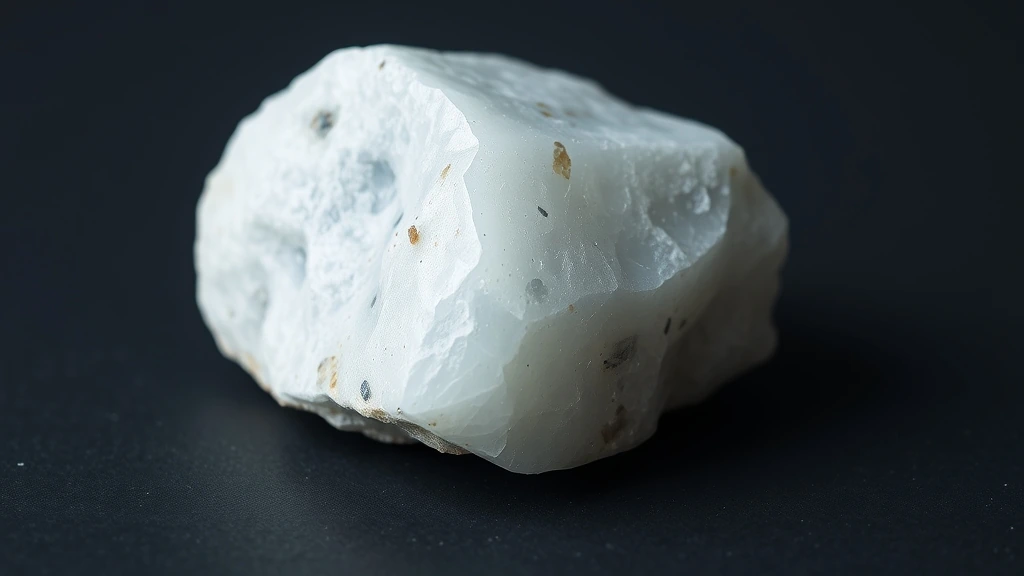
Opalite belongs to the broader family of hydrated silica mineraloids, lacking a true crystal lattice and forming as microscopic spheres that fuse into a glass‑like mass. It is not a distinct mineral but an amorphous aggregate of silica particles, often produced synthetically or derived from natural opal that has been heat‑treated. This mineraloid classification emphasizes its amorphous structure and its origin in silica‑rich sedimentary environments where silica precipitates from groundwater.
What is Opalite? Geological Overview & Definition
Opalite is defined as a mineraloid composed of hydrated silicon dioxide that exhibits a characteristic milky translucency and occasional play of color reminiscent of true opal. Unlike crystalline opal, it lacks a periodic atomic arrangement, resulting in a uniform, glass‑like appearance rather than the distinct diffraction pattern of precious opal. While opalite mimics the soft glow of natural stones, enthusiasts seeking a more organic aesthetic often turn to Wood Opal, which preserves the intricate cellular structure of ancient timber within a translucent silica matrix.
Historically, the term “opalite” has been applied to both natural and lab‑grown glassy substances that mimic the aesthetic of opal without possessing its internal structure. Across ancient lapidary traditions, such materials were prized for their soothing visual effect, though they were never classified as true gemstones by early mineralogists. Modern interpretations of this aesthetic lineage often extend to the Aurora Borealis Crystal, which shares the same iridescent, glassy allure that historically defined the appeal of opalite-like materials.
Opalite Chemical Composition & Crystallographic Properties
The chemical makeup of opalite is best described as SiO₂·nH₂O, indicating silica with variable water content bound within an amorphous matrix. Because it lacks a repeating unit cell, there is no true lattice; instead, the material consists of interlocking silica spheres that create a continuous, non‑crystalline network.
Cation substitution is minimal in opalite; trace amounts of iron, magnesium, or calcium may be present, subtly influencing its hue but never forming ordered sites within a crystal lattice. This amorphous nature also makes opalite sensitive to strong acids, which can dissolve the silica framework and release trapped water molecules.
Color in opalite arises from chromophore color centers generated during formation or heat treatment, where electron traps scatter light to produce the familiar blue‑white sheen. These centers are not tied to specific impurity ions but to structural irregularities within the glassy matrix.
Thermally, opalite behaves like other hydrated silicas: heating drives off water, potentially causing a slight densification and a shift toward a clearer, more quartz‑like appearance. Rapid temperature changes can induce micro‑cracking, underscoring the need for careful handling in jewelry settings.
| Property | Specification |
|---|---|
| Mineral Group | Mineraloid (Hydrated Silica) |
| Chemical Formula | SiO₂·nH₂O (Hydrated Silicon Dioxide) |
| Mohs Hardness | 5.5 – 6.5 |
| Crystal System | Amorphous (Hydrated silica spheres / Mineraloid) |
| Specific Gravity (Density) | 1.98 – 2.25 |
| Refractive Index | 1.370 – 1.470 |
| Color & Optical Properties | Natural Opalite color spectrum and optical dispersion |
| Primary Mining Localities | Australia (Coober Pedy, Lightning Ridge), Ethiopia (Welo), Mexico |
| Water & Chemical Resistance | Moderate/Sensitive (%3-%21 water content; avoid prolonged soaking for hydrophane Welo opals) |
| Chakra Alignment (Traditional) | Crown Chakra and Heart Chakra |
| Zodiac Affinity (Traditional) | Libra, Scorpio, Pisces |
| Symbolic Meaning (Traditional) | Creativity, hope, emotional depth, and spontaneous inspiration |
Opalite Varieties & Color Spectrum
Opalite is primarily a synthetic mineraloid created in laboratories, distinct from natural opal. It is formed by mixing powdered silica with water and a small amount of borax. This process results in a material that mimics the play-of-color seen in precious opals.
Standard Synthetic Opalite
This variety is the most common form found in the global gemstone market. It typically exhibits a uniform, milky white base with scattered flashes of iridescence. The color spectrum often includes soft pinks, blues, and greens. Its amorphous structure lacks the distinct silica spheres found in natural opals.
Blue Opalite
Blue opalite features a dominant cool-toned refractive index response. The hue ranges from pale sky blue to deep indigo. This variety is often used in jewelry for its calming aesthetic. It is produced by adjusting the particle size of the silica during synthesis.
Pink Opalite
Pink opalite displays a warm, rose-colored play-of-color. The base material remains translucent to semi-opaque. This variety is highly sought after for its association with emotional healing. The intensity of the pink depends on the borax concentration used in manufacturing.
Green Opalite
Green opalite showcases vibrant emerald and forest green flashes. The silica spheres within the matrix scatter light to create this effect. It is often confused with natural Australian opals. However, its density is slightly lower than that of natural stone.
Multi-Color Opalite
This variety exhibits a broad spectrum of iridescent colors simultaneously. It includes reds, oranges, yellows, and purples. The visual effect is often described as a rainbow. This is achieved by varying the diameter of the silica particles.
Where is Opalite Found? Geological Mining & Extraction
Opalite is not mined from geological deposits but is synthetically manufactured in industrial facilities. It is produced in countries with advanced silica processing capabilities. The raw materials are sourced from abundant quartzite and sand deposits.
The production process involves heating the mixture to form a glass-like solid. This material is then cut and polished into gemstones. There are no natural pegmatite or volcanic deposits of opalite. It is entirely a human-made mineraloid product.
Historical Significance & Cultural Lore of Opalite
While opalite itself is a modern invention, its aesthetic mimics natural precious opal. Ancient civilizations revered natural opals for their play-of-color. The Egyptians used opals in jewelry to symbolize hope. The Romans associated opals with good fortune and love.
In Vedic traditions, opals were linked to the Crown Chakra. They were believed to enhance spiritual awareness and emotional depth. Archaeological records show opal artifacts in Mesoamerican cultures. These stones were valued for their translucent quality and vibrant hues.
Modern Uses & Jewelry Applications of Opalite
Opalite is prized for its translucent, milky appearance, making it a favorite for lapidary artisans who cut it into smooth cabochons or delicate facets that enhance its subtle play of light. Jewelers often set opalite in rings, pendants, and earrings, pairing it with metals such as sterling silver or rose gold to accent its gentle glow. The stone is also carved into ornamental pieces—vases, figurines, and decorative panels—where its soft translucency creates a dreamlike aesthetic.
- Cabochon: Polished, rounded surfaces that showcase opalite’s milky luster.
- Faceted: Small facets accentuate internal scattering, ideal for earrings and pendants.
- Carving: Sculpted into figurines or architectural ornaments, emphasizing its gentle translucence.
Metaphysical Properties & Traditional Meaning of Opalite
According to historical traditions and metaphysical lore, opalite is believed to be a stone of hope and emotional clarity. Across ancient Mediterranean and Vedic lapidary traditions, it is associated with the Crown Chakra, symbolizing spiritual insight, and the Heart Chakra, representing compassion and emotional balance. Practitioners claim that wearing opalite encourages spontaneous inspiration, fostering creative expression while soothing emotional turbulence.
Which Chakra and Zodiac Signs Align with Opalite?
Opalite’s energetic profile is closely linked to the Crown Chakra, the seat of higher consciousness, and the Heart Chakra, the center of love and compassion. These chakras are said to harmonize the mind, body, and spirit, allowing the wearer to access deeper levels of intuition and emotional healing.
The stone is traditionally aligned with the zodiac signs Libra, Scorpio, and Pisces. Those born under these signs are believed to resonate with opalite’s gentle energy, finding balance between emotional depth and intellectual clarity.
How to Identify Real vs. Fake Opalite
Artificial imitations of opalite are often made from dyed glass or polymer composites that mimic its milky appearance. Synthetic glass may have a higher refractive index and a different density, while dyed replicas can be distinguished by their uniform coloration and lack of natural inclusions.
Practical At-Home Authenticity Tests
- Temperature Test (Thermal Feel): Real opalite feels cool to the touch, cooling more slowly than synthetic glass, which tends to feel warmer due to higher thermal conductivity.
- Specific Gravity & Weight Test: Weigh the stone against a known mass; real opalite has a specific gravity of 1.98–2.25, lighter than glass of similar size.
- Scratch & Hardness Test (Mohs Comparison): Use a steel file or a quartz crystal; opalite’s hardness of 5.5–6.5 will scratch glass but not steel, whereas synthetic glass may show different scratch patterns.
- Microscopic & Loupe Inspection (Internal Inclusions): Under magnification, real opalite displays tiny, irregular inclusions and a cloudy matrix, whereas dyed glass shows uniform, smooth interiors.
Opalite Valuation Factors, Grading & Pricing
Color Saturation remains the foremost determinant of opalite value. Stones exhibiting a vivid, evenly distributed hue—whether soft blue, gentle green, or translucent white—command higher prices due to their visual vibrancy and perceived energetic luster. The degree of saturation directly influences how the light refracts within the hydrated silica matrix, creating the characteristic “opal glow” that collectors prize. Market buyers often compare specimens side‑by‑side, favoring those with the richest, most consistent coloration.
Crystal Size & Weight (Grams) is the next critical metric. Larger opalite pieces, measured in grams, provide a more substantial visual presence and are therefore more desirable. Raw, unpolished specimens are valued for their natural matrix inclusions and the authenticity of their form, while tumbled or lightly polished stones offer a smoother surface and enhanced sparkle. Because opalite lacks facets, grading focuses on overall dimensions, weight, and the quality of the surface finish rather than carat or tumbled polish and natural crystal geometry.
Ethical Sourcing & Locality Premium plays an increasingly important role in both holistic and collector markets. Opalite sourced from responsibly managed quarries, with transparent supply chains, often carries a premium. Provenance from well‑documented localities—such as the historically rich deposits in Australia, Ethiopia, or Mexico—adds cultural and historical value, appealing to buyers who prioritize ethical stewardship and geological heritage.
How to Clean and Care for Opalite
To preserve opalite’s delicate structure, avoid prolonged soaking or exposure to hot water; brief cleaning with a lightly damp soft cloth is safe. Gently dust the stone with a completely dry, soft microfiber cloth or a camel‑hair brush; this removes surface debris without risking internal moisture expansion. Store the specimen in a low‑humidity environment, away from direct sunlight and temperature fluctuations, to prevent micro‑cracking or crazing that can arise from moisture absorption.
Cleansing and Recharging Opalite (Energetic Care)
For energetic cleansing, place the opalite on a selenite charging slab under gentle moonlight for several hours; the subtle lunar energy recharges the stone without exposing it to heat. Alternatively, a brief herbal smudging session—using sage or cedar—can clear residual energies while keeping the opalite dry. These practices respect the mineral’s sensitivity, ensuring that its natural vibrancy and metaphysical properties remain intact.
Frequently Asked Questions About Opalite
Opalite displays distinct mineralogical characteristics across its geological varieties and structural habits. Gemologists evaluate these natural varieties based on crystal habit, trace chromophore concentrations, and visual luster.
Primary Natural Opalite
The benchmark natural variety exhibiting diagnostic color saturation, though it lacks true crystallographic symmetry because it is an amorphous mineraloid.
Distinct Geological Morphs of Opalite
Secondary regional and structural varieties formed under localized geological temperature and pressure conditions.
Is opalite safe to wear in the shower?
Opalite is water-sensitive and should not be exposed to prolonged soaking. As a hydrated silica mineraloid, it contains 3% to 21% water within its structure. Extended immersion in hot water or steam can cause internal stress, leading to surface crazing or structural instability. Remove jewelry before bathing to preserve its integrity.
Can I use an ultrasonic cleaner on opalite?
No, ultrasonic cleaners and steam cleaning are strictly prohibited for opalite. The high-frequency vibrations can shatter the delicate internal sphere structure, causing permanent micro-fracturing known as crazing. This damage is irreversible and significantly diminishes the stone’s optical play-of-color and overall aesthetic value.
What is the chemical composition of opalite?
Opalite is composed of hydrated silicon dioxide, represented by the formula SiO₂·nH₂O. Unlike crystalline quartz, it exists as an amorphous mineraloid made of tightly packed silica spheres. This unique arrangement scatters light, creating the characteristic iridescent flash and soft, milky appearance associated with the gemstone.
Which zodiac signs are aligned with opalite?
Opalite is traditionally associated with Libra, Scorpio, and Pisces. These water and air signs resonate with the stone’s themes of emotional depth and creativity. Wearing opalite is believed to enhance intuitive connections and foster a sense of hope and spontaneous inspiration for these specific astrological profiles.
Which chakras does opalite activate?
Opalite primarily activates the Crown Chakra and the Heart Chakra. This dual alignment bridges spiritual awareness with emotional healing, promoting creativity and spontaneous inspiration. Practitioners use the stone to balance the upper and lower energy centers, facilitating a harmonious flow between intellect and feeling.
How should I clean my opalite jewelry?
Clean opalite using only a dry, soft microfiber cloth. Because the stone is porous and water-sensitive, avoid submerging it in liquid or using chemical cleaners. Gently dust the surface to remove oils and debris, ensuring the hydrated silica structure remains undisturbed and free from potential moisture damage.
What is the Mohs hardness of opalite?
Opalite ranks between 5.5 and 6.5 on the Mohs scale. This moderate hardness means it is susceptible to scratching by harder minerals like quartz or topaz. Store opalite separately from other gemstones to prevent abrasion, and handle it with care to maintain its polished surface finish over time.
Is opalite a natural or synthetic?
Opalite is a naturally occurring mineraloid, not a synthetic material. It forms through the deposition of silica spheres in ancient marine environments. While it resembles glass, its amorphous crystal system and organic origin distinguish it from man-made materials, making it a genuine geological specimen with unique optical properties.