
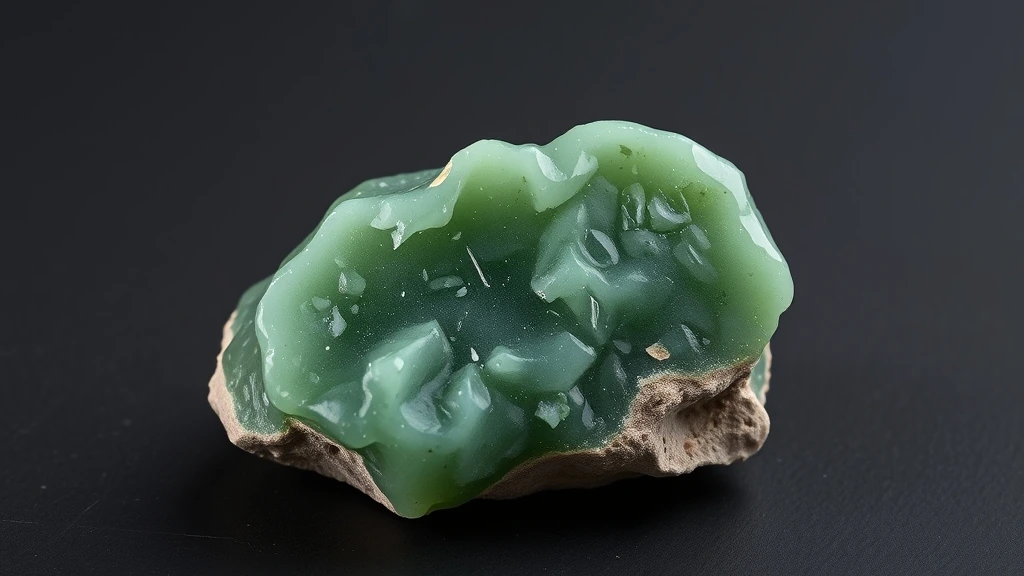
Nephrite belongs to the amphibole subgroup of silicate minerals and is classified as a natural mineral/crystal rather than an aggregate rock. Formed in metamorphic environments where serpentinized peridotite interacts with silica‑rich fluids, it crystallizes in the monoclinic system, producing interlocking fibrous aggregates that give the stone its characteristic toughness and smooth polish.
What is Nephrite Jade Gemstone? Geological Overview & Definition
Nephrite jade is a fibrous amphibole that occurs as massive, interwoven bundles rather than discrete crystals, giving it a compact, waxy texture. It is most commonly found in metamorphic belts of China, New Zealand, and Canada, where tectonic pressure transforms ultramafic rocks into the jade‑bearing assemblage.
The stone’s name derives from the Greek *nephros* (“kidney”) because early specimens resembled the organ’s shape and color. In gemology, nephrite is distinguished from jadeite by its monoclinic symmetry, lower specific gravity, and broader color palette ranging from ivory to jade‑green.
Nephrite Jade Gemstone Chemical Composition & Crystallographic Properties
The idealized chemical formula Ca₂(Mg,Fe)₅Si₈O₂₂(OH)₂ reflects a solid‑solution series where magnesium and iron substitute freely within the octahedral sites, influencing both density (2.90–2.95 g/cm³) and hue. Higher Fe content deepens the green tone, while Mg‑rich material appears lighter or even white.
Nephrite crystallizes in the monoclinic crystal system, specifically the space group C2/m, forming elongated, parallel fibers that interlock at the microscopic level. This fibrous lattice imparts exceptional toughness, allowing the stone to withstand impact without fracturing—a key reason for its historic use in tools and ceremonial objects.
The mineral is acid‑sensitive; dilute hydrochloric acid can leach calcium from the structure, gradually dulling the surface. However, its silicate framework remains stable under normal atmospheric conditions, and the hydroxyl groups confer limited resistance to weathering.
Color in nephrite arises from chromophore centers where Fe²⁺ and Fe³⁺ replace Mg²⁺, absorbing specific wavelengths of light. Thermal treatment above 600 °C can oxidize Fe²⁺ to Fe³⁺, subtly shifting the color toward a more vivid green, but excessive heating may cause dehydroxylation and structural breakdown.
| Property | Specification |
|---|---|
| Mineral Group | Natural Mineral / Crystal |
| Chemical Formula | Ca₂(Mg,Fe)₅Si₈O₂₂(OH)₂ |
| Mohs Hardness | 6.0 – 6.5 |
| Crystal System | Monoclinic |
| Specific Gravity (Density) | 2.90 – 2.95 |
| Refractive Index | 1.60 – 1.63 |
| Color & Optical Properties | Natural Nephrite Jade Gemstone color spectrum and optical dispersion |
| Primary Mining Localities | Global primary localities |
| Water & Chemical Resistance | High (Safe for gentle water washing) |
| Chakra Alignment (Traditional) | Heart Chakra |
| Zodiac Affinity (Traditional) | Taurus, Libra, Cancer |
| Symbolic Meaning (Traditional) | Emotional balance, harmony, and protection |
Jade Varieties & Comprehensive Sub‑Types
Jadeite
Jadeite forms in high‑pressure, low‑temperature metamorphic belts where sodium‑rich pyroxene crystallizes from sub‑alkaline granitic melts. Inclusions of rutile, zoisite, or spinel create the classic “moss” or “cat’s‑eye” banding morphology prized by collectors. Its vivid imperial‑green hue is caused by trace Cr³⁺, while lavender and red varieties owe color to Mn³⁺ and Fe²⁺. With a Mohs hardness of 6.5‑7.0, jadeite commands the highest market price and dominates the fine‑carving trade in Myanmar and Guatemala.
Nephrite
Nephrite is an aggregate of tremolite‑actinolite amphibole fibers that interlock to give extraordinary fracture toughness and a silky, oily luster. It typically occurs in metasomatic serpentinite veins, where silicate‑rich fluids replace ultramafic rocks, producing a characteristic spinach‑green to mutton‑fat white palette. The mineral’s monoclinic structure yields a fibrous texture that resists chipping, making it the preferred material for large ceremonial axes and traditional Chinese carvings. Trade values are moderate; nephrite is abundant in China, New Zealand, and Russia, yet high‑grade material remains highly sought after for ornamental sculpture.
Omphacite Jade
Omphacite jade forms in the deep mantle under high‑pressure, high‑temperature conditions, bridging the compositional gap between jadeite and diopside‑rich pyroxenes. It displays a dense, fine‑grained matrix with occasional glassy inclusions of chromite or magnetite that enhance its deep dark‑green appearance. The mineral’s crystal habit produces a subtle, uniform banding that is less pronounced than jadeite’s but more consistent than nephrite’s fibrous pattern. Though rarer than the other two, omphacite is prized by master lapidaries for intricate cabochons and high‑relief relief work, especially from deposits in the Pamir and Tibetan regions.
Comparative Summary – Gemologists differentiate these jade varieties by combining refractive index, hardness, and microscopic fiber orientation: jadeite shows a granular, high‑index (1.66‑1.68) structure; nephrite exhibits a lower index (1.60‑1.63) with parallel amphibole fibers; omphacite falls between, with a slightly higher index and mixed pyroxene‑jadeite chemistry. These diagnostic traits guide cutting, polishing, and authentication decisions in the lapidary studio.
Where is Nephrite Jade Gemstone Found? Geological Mining & Extraction
Nephrite occurs chiefly in serpentinite‑derived metamorphic belts, where ultramafic host rocks have been altered by silica‑rich fluids. In China’s Xinjiang and Liaoning provinces, large nephrite lenses are mined from weathered serpentinite ridges, often using hand‑picked techniques to avoid fracturing the fibrous matrix.
Significant deposits also exist in New Zealand’s South Island (the “Pounamu” region), British Columbia’s Coast Mountains, and the Russian Urals. Modern extraction combines small‑scale open‑pit mining with selective underground tunnels, followed by water‑based washing to separate nephrite nodules from host rock debris.
Historical Significance & Cultural Lore of Nephrite Jade Gemstone
Nephrite has been venerated since the Neolithic, with the Mesoamerican Olmec and Chinese Neolithic cultures carving ritual axes, beads, and burial ornaments from the stone. Archaeological finds such as the “Mutton‑Fat” jade burial suits of the Han dynasty illustrate its role as a status symbol and protective talisman.
In Māori tradition, Pounamu is believed to embody the spirit of ancestors, granting emotional balance and protection to its wearer; legends recount that warriors received carved pendants to ensure safe return from battle. Across Eurasia, nephrite was traded along the Silk Road, linking distant societies through a shared reverence for its harmony‑inducing qualities.
Modern Uses & Jewelry Applications of Nephrite Jade Gemstone
Nephrite jade is prized for its toughness and buttery luster, making it ideal for both delicate cabochons and robust ornamental pieces. Lapidary artisans often employ a wet‑saw to shape the stone, then polish it to a high‑gloss finish that showcases its subtle green hues. The material’s resistance to chipping allows designers to experiment with faceted cuts, while traditional cultures favor smooth, rounded cabochons for pendants, rings, and bangles.
- Cabochon pendants and beads for necklaces and bracelets
- Faceted rings and earrings that highlight light play
- Large ornamental carvings such as prayer beads, figurines, and ceremonial swords
Metaphysical Properties & Traditional Meaning of Nephrite Jade Gemstone
According to historical traditions and metaphysical lore, nephrite jade embodies emotional balance and a deep sense of harmony that soothes the heart. Ancient Chinese texts describe it as a protective talisman that guards the wearer from negative energies while encouraging compassion and generosity. In contemporary practice, the stone is believed to nurture inner peace, allowing the mind to release stress and cultivate a steady, loving presence.
Which Chakra and Zodiac Signs Align with Nephrite Jade Gemstone?
Nephrite jade resonates most strongly with the Heart Chakra, where it is thought to open the channel for unconditional love and forgiveness. Practitioners claim that placing the stone on the chest area amplifies feelings of empathy, helping the wearer connect more authentically with others.
The stone’s astrological affinity is limited to Taurus, Libra, and Cancer. These signs are said to benefit from nephrite’s stabilizing energy, which reinforces Taurus’s grounded nature, Libra’s quest for balance, and Cancer’s nurturing instincts. No other zodiac signs are traditionally associated with this jade.
How to Identify Real vs. Fake Nephrite Jade Gemstone
Artificial imitations of nephrite jade include synthetic glass, polymer resins, and dyed serpentine that mimic its color but lack its characteristic density and toughness. Some manufacturers also apply surface coatings or use high‑pressure polymerization to create a glossy finish that can deceive the casual observer. Recognizing these fakes requires a combination of visual inspection and simple physical tests.
Practical At-Home Authenticity Tests
- Temperature Test (Thermal Feel): Real nephrite feels cool to the touch and retains that coolness longer than glass or plastic, which quickly warm up in the hand.
- Specific Gravity & Weight Test: Nephrite’s density (2.90‑2.95 g/cm³) makes it noticeably heavier than most imitations of the same size; a simple water‑displacement test can confirm this.
- Scratch & Hardness Test (Mohs Comparison): With a Mohs hardness of 6.0‑6.5, nephrite can scratch a steel nail but will not be scratched by a quartz point; use a known reference mineral to gauge resistance.
- Microscopic & Loupe Inspection (Internal Inclusions): Under 10× magnification, authentic nephrite shows fine, interlocking fibrous textures and occasional tiny mineral inclusions, whereas glass or dyed stones appear uniformly smooth and glassy.
Nephrite Jade Gemstone Valuation Factors, Grading & Pricing
Color Saturation is the foremost driver of price. Deep, vivid greens that are evenly distributed across the stone command the highest premiums, while pale or mottled hues are discounted. A uniform tone enhances perceived optical clarity and gives the jade a polished, glassy luster that collectors prize.
Carat Weight influences value but only when paired with excellent cutting. Larger stones above 30 carats are rare and fetch higher bids, yet uneven facet symmetry can diminish their appeal. The presence of a fine matrix or visible inclusions, especially dark mineral streaks, reduces clarity and thus market price.
Geographical Provenance Premium adds a notable surcharge for jade from historic sources such as Myanmar or New Zealand. Provenance certificates verify origin and often boost resale value by 15‑30 %. Market trends show wholesale prices stabilizing, while retail premiums rise during periods of heightened demand for luxury jade jewelry.
How to Clean and Care for Nephrite Jade Gemstone
Use warm soapy water and a soft cloth to gently remove surface grime; this method respects the stone’s high water resistance while preserving its natural sheen. Rinse the cloth in clean water and pat the jade dry, avoiding any abrasive pads that could scratch the surface. Never place nephrite in an ultrasonic cleaner, as the vibrations can cause micro‑fractures in its monoclinic lattice. Store the gemstone in a padded pouch away from hard metals to prevent accidental impacts.
Cleansing and Recharging Nephrite Jade Gemstone (Energetic Care)
For energetic renewal, hold the jade in the smoke of sage or cedar and allow the gentle vapor to cleanse lingering negative imprints; the stone’s low solubility ensures it remains unaffected by the smoke. Alternatively, place the jade on a selenite charging plate for several hours; the pure crystal energy clears and amplifies its natural harmonizing properties.
Expose the stone to moonlight during a full moon, laying it on a soft cloth outdoors or on a windowsill. The lunar photons subtly recharge the jade’s emotional balance without any risk of moisture penetration, keeping the gemstone ready for daily wear.
Frequently Asked Questions About Nephrite Jade Gemstone
Is nephrite jade safe to wear in the shower?
Yes, nephrite jade is highly water-resistant and safe for gentle exposure. The stone’s dense monoclinic crystal structure prevents rapid absorption of moisture during daily activities. However, avoid harsh soaps or sudden temperature changes that might stress the mineral lattice.
Can I clean nephrite jade in an ultrasonic cleaner?
No, you must avoid ultrasonic cleaners to prevent structural fractures. The intense vibrations can exploit natural fissures within the stone, causing permanent damage. Instead, use warm soapy water and a soft cloth for safe, effective maintenance.
What is the chemical composition of nephrite jade?
Nephrite is a calcium magnesium iron silicate with the formula Ca₂(Mg,Fe)₅Si₈O₂₂(OH)₂. This specific chemical formula defines its identity as a pyroxene mineral. The ratio of magnesium to iron directly influences the stone’s final color and density.
How hard is nephrite jade on the Mohs scale?
Nephrite jade measures between 6.0 and 6.5 on the Mohs hardness scale. This makes it durable enough for everyday jewelry but softer than quartz or sapphire. Be mindful of abrasive contact with harder materials to prevent surface scratching.
Which zodiac signs are aligned with nephrite jade?
Nephrite jade is traditionally associated with Taurus, Libra, and Cancer. These earth and water signs resonate with the stone’s grounding energy. Wearing this gemstone is believed to enhance emotional balance and harmony for these individuals.
Which chakra does nephrite jade correspond to?
Nephrite jade is exclusively aligned with the Heart Chakra. This connection supports themes of love, compassion, and emotional stability. It is not associated with other chakras, ensuring a focused energetic alignment for meditation and healing.
What is the refractive index of nephrite jade?
The refractive index of nephrite jade ranges from 1.60 to 1.63. This optical property contributes to its characteristic waxy luster rather than a glassy shine. Gemologists use this value alongside density to distinguish nephrite from other jade varieties.
How does nephrite differ from jadeite jade?
Nephrite is generally tougher and more durable than jadeite. While both are called jade, nephrite has a higher tensile strength, making it resistant to breaking. Jadeite, however, often displays more vibrant colors and higher market value due to rarity.