
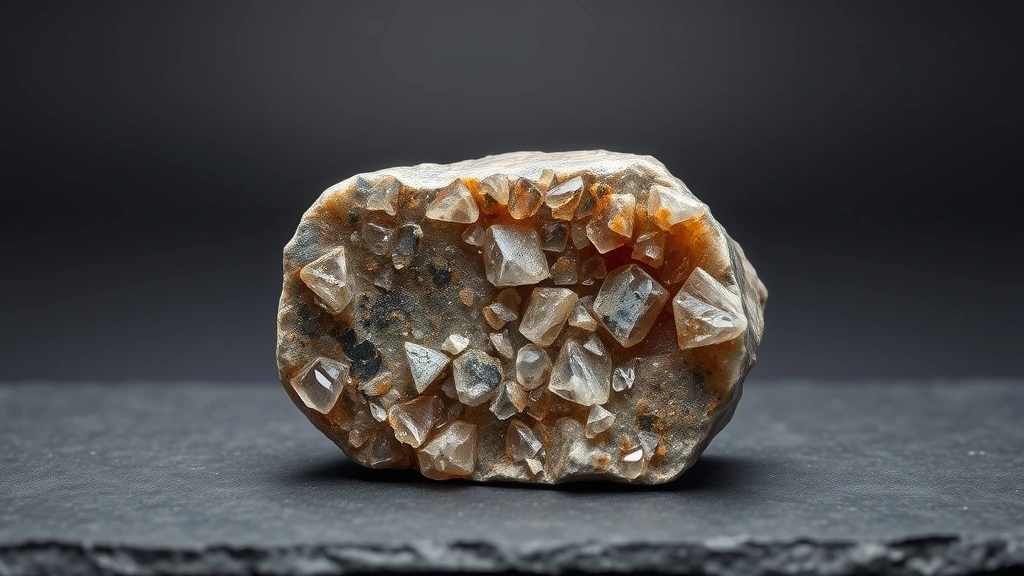
Nosean belongs to the natural mineral family and is classified as a feldspathoid within the cubic crystal system. It forms in alkaline, silica‑undersaturated volcanic rocks, often as well‑developed cubes or octahedra that crystallize from late‑stage magmatic fluids. Its occurrence signals highly evolved magmatic environments and provides clues to mantle‑derived alkalic magmatism. In comparative mineralogical collections, practitioners and geologists frequently study Pollucite alongside this crystal to appreciate their subtle energetic and structural differences.
What is Nosean ? Geological Overview & Definition
Nosean is a feldspathoid mineral, meaning it occupies the same structural niche as feldspars but forms where silica is deficient. It typically occurs as translucent to opaque masses, displaying a warm yellow‑orange hue that deepens with iron content. Like nosean, the closely related feldspathoid hauyne also forms in silica‑poor volcanic rocks, offering a similarly vibrant blue‑violet color that contrasts its yellow‑orange counterpart.
In gemological contexts, nosean is cut into cabochons or beads, prized for its subtle coloration and relatively high hardness. While not as common as quartz or beryl, its cubic habit and distinctive chemistry make it a collectible gemstone for enthusiasts seeking rare alkaline minerals.
Nosean Chemical Composition & Crystallographic Properties
The mineral crystallizes in the cubic crystal system, adopting a framework of interlocking Al‑Si tetrahedra balanced by Na⁺ and Ca²⁺ cations. Its lattice is isometric, with each unit cell containing eight formula units that repeat symmetrically in three dimensions.
Cation substitution is limited; minor Fe³⁺ or Ti⁴⁺ can replace Al³⁺, creating chromophore color centers that shift the hue toward deeper amber. These trace elements also modestly increase the refractive index (1.615–1.635) and density (2.75–2.80 g/cm³).
Nosean is acid‑sensitive; exposure to strong acids can leach calcium and sodium, gradually degrading the crystal surface. However, it remains stable under neutral pH conditions and resists weathering in alkaline environments.
Thermally, nosean is stable up to about 900 °C before undergoing incongruent melting, at which point it decomposes to nepheline and other feldspathoid phases. This high-temperature resilience contributes to its preservation in volcanic xenoliths and intrusive plugs.
| Property | Specification |
|---|---|
| Mineral Group | Natural Mineral / Crystal |
| Chemical Formula | Na₃Ca₂(Al₃Si₃)O₁₂ |
| Mohs Hardness | 6.5 – 7.0 |
| Crystal System | Cubic crystal system |
| Specific Gravity (Density) | 2.75 – 2.80 |
| Refractive Index | 1.615 – 1.635 |
| Color & Optical Properties | Natural Nosean Gemstone color spectrum and optical dispersion |
| Primary Mining Localities | Global primary localities |
| Water & Chemical Resistance | High (Safe for gentle water washing) |
| Chakra Alignment (Traditional) | Heart Chakra |
| Zodiac Affinity (Traditional) | Taurus, Virgo |
| Symbolic Meaning (Traditional) | Emotional balance, protection against negativity, and grounding |
Nosean Varieties & Color Spectrum
White (Alabaster) Nosean
Formed in sodium‑rich alkaline feldspathoid assemblages, this pure‑white variety crystallizes in the late stages of phonolitic pegmatites. Microscopic fluid inclusions of brine give it a milky sheen, while the lack of transition‑metal impurities keeps the hue neutral. It is the most abundant yet still prized for its flawless transparency, ranking as a moderately rare commercial grade.
Yellow‑Orange (Sodalite‑Like) Nosean
Developed where trace iron and sulfur substitute into the crystal lattice, this variety displays a warm amber to bright orange tint. The coloration is often accentuated by intergrowths of calcite that create a subtle banding pattern. Found chiefly in the Kola Peninsula, its vivid hue makes it a collector’s favorite, though the limited geographic source adds to its scarcity.
Pink (Rose) Nosean
Pink hues arise from minute amounts of manganese replacing aluminum in the framework, producing a delicate rose‑pink blush. These stones typically occur as pseudomorphs after leucite in volcanic tuffs, giving them a faint, cloud‑like internal texture. Because manganese‑rich fluids are uncommon, pink nosean is among the rarest and most sought after for high‑end jewelry.
Green (Verdant) Nosean
The rare green variety owes its color to chromium and nickel trace elements that cause a subtle emerald‑like tint. It forms in ultramafic xenoliths where mantle‑derived fluids infiltrate the host rock, often yielding a speckled appearance of tiny magnetite inclusions. Only a handful of mines in Canada’s Northwest Territories produce gem‑quality green nosean, making it exceptionally valuable.
Blue‑Gray (Storm) Nosean
A striking blue‑gray tone emerges when cobalt substitutes for calcium, imparting a stormy, metallic sheen. These stones are typically found in late‑stage hydrothermal veins within basaltic complexes, where rapid cooling traps fine‑grained pyroxene crystals as inclusions. Their dramatic coloration and limited occurrence in Siberian deposits render them highly collectible.
Regional Trade Variety: “Mongolian Snow” Nosean
Locally marketed from the Gobi Desert, this variety exhibits a translucent white base with fine‑grained quartz veining that mimics snow‑capped peaks. Formed in alkaline volcanic ash deposits, the stones often contain micro‑fractures filled with silica, giving a unique frosted appearance. Though abundant locally, its distinct aesthetic has driven demand in Asian gemstone markets, elevating its commercial profile.
Where is Nosean Found? Geological Mining & Extraction
Nosean crystallizes chiefly in alkaline igneous complexes, where sodium‑rich melts evolve into phonolitic pegmatites and syenitic dykes. Within these host rocks, the mineral fills cavities and replaces earlier feldspathoids, often accompanied by calcite, leucite, and sodalite. Modern extraction relies on careful room‑and‑pillar mining to preserve the delicate crystal habit, followed by gentle crushing and hand‑sorting to isolate gem‑quality pieces.
The most productive deposits lie in the Kola Peninsula (Russia), Siberian Baikal region, Canada’s Northwest Territories, and the Gobi Desert of Mongolia. Each locality presents distinct mineral assemblages: Kola yields yellow‑orange and white varieties, Siberia supplies blue‑gray and green stones, while Canadian sites are famed for the rare pink and green hues. Sustainable mining practices now emphasize minimal environmental impact and reclamation of the alkaline host formations.
Historical Significance & Cultural Lore of Nosean
Ancient Scythian and Sarmatian cultures prized nosean for its luminous white form, embedding polished beads in burial mounds as symbols of eternal purity. Archaeological digs in the Volga region have uncovered nosean inlaid into bronze ornaments, indicating its early use as a status gem and protective talisman against malevolent spirits.
In historical metaphysical lore, nosean was linked to the Heart Chakra and sought by collectors for emotional balance and grounding. Early mineral alchemists noted its capacity to deflect negativity, a belief that persists in modern esoteric traditions linking the mineral to Taurus and Virgo zodiac energies.
Modern Uses & Jewelry Applications of Nosean
Nosean is rarely found in mainstream jewelry, but skilled lapidaries can transform its cubic crystals into striking cabochons or modestly faceted pieces. Its moderate Mohs hardness (6.5‑7) allows precise cutting without excessive risk of fracture, making it suitable for pendants, rings, and ornamental beads. Designers often pair nosean with silver or white gold to highlight its subtle refractive index (1.615‑1.635) and warm, honey‑gold hue.
- Cabochon cuts emphasize the stone’s translucency and natural color zoning.
- Faceted cuts (round, oval, or emerald) showcase its sparkle while protecting against chipping.
- Ornamental carving produces small figurines, inlays, and decorative plaques for collectors.
Safety & Mineral Profile of Nosean
Handling nosean poses no special health hazards; the mineral is chemically stable, insoluble in water, and does not release harmful gases under normal conditions. When polishing, use standard eye protection and a dust mask to avoid inhaling fine silica particles common to many silicate minerals. Collectors should store nosean in a padded compartment to prevent impact, as its density (2.75‑2.80 g/cm³) makes it relatively heavy for its size.
Although some historic texts attribute emotional balance and grounding properties to nosean, these claims lack scientific verification. The stone is primarily valued as a collector mineral for study and display, not as a therapeutic crystal. Emphasizing safety and proper identification ensures its appreciation remains grounded in mineralogical fact.
Mineralogical Group and Planetary Lore of Nosean
Nosean belongs to the feldspathoid group, sharing structural similarities with sodalite and hauyne. Its formula Na₃Ca₂(Al₃Si₃)O₁₂ reflects a framework of aluminum‑silicate tetrahedra balanced by sodium and calcium cations, a composition that stabilizes the cubic lattice. This classification aids geologists in recognizing nosean within alkaline igneous rocks and metamorphic assemblages.
In traditional planetary lore, nosean has been linked to Venus, the planet governing love and harmony, echoing its modern association with the Heart Chakra. While such symbolism appears in esoteric literature, it remains a cultural overlay rather than a mineralogical attribute.
How to Identify Real vs. Fake Nosean
Artificial imitations of nosean include dyed quartz, synthetic glass, and resin composites that mimic its honey‑gold color. These substitutes often lack the characteristic specific gravity and internal crystal habit of genuine nosean. Synthetic glass may display uniform clarity and bubble‑free surfaces, whereas authentic nosean typically shows subtle inclusions and a faint cubic twinning pattern.
Practical At-Home Authenticity Tests
- Temperature Test (Thermal Feel): Real nosean feels cool to the touch and retains that coolness longer than glass or resin, which quickly equilibrate to ambient temperature.
- Specific Gravity & Weight Test: Weigh the stone and compare its mass to the volume (using water displacement). A true nosean will register a specific gravity between 2.75 and 2.80, noticeably heavier than glass (~2.5) or quartz (~2.65).
- Scratch & Hardness Test (Mohs Comparison): Gently attempt to scratch the stone with a steel file (hardness ~6.5). Nosean should resist scratching, whereas glass or dyed quartz may show faint marks. Always perform on an inconspicuous edge.
- Microscopic & Loupe Inspection (Internal Inclusions): Examine under 10×–30× magnification. Genuine nosean reveals tiny cubic twins, occasional micro‑fractures, or mineral inclusions; synthetic glass appears flawless or shows characteristic glass flow lines.
These straightforward checks help distinguish authentic nosean specimens from common imitations, ensuring collectors acquire genuine mineral material.
Nosean Valuation Factors, Grading & Pricing
Color Saturation is the foremost driver of price. Deep, vivid hues—ranging from emerald‑green to teal—command premium rates, while pastel tones are less sought after. Uniform tone across the stone enhances visual impact, and a high‑gloss luster signals superior optical clarity. Collectors also examine surface polish; any dullness can lower the valuation.
Specimen Dimensions & Matrix Intactness influences market price but is weighed against quality. Larger stones are rarer, yet a 2‑carat nosean with poor crystal cluster integrity may fetch less than a perfectly cut 1.5‑carat example. Symmetrical facets maximize light return, and the presence of a matrix or visible inclusions—especially cloudy or fracture‑filled zones—reduces clarity grades and thus price.
Geographical Provenance Premium adds a distinct markup for specimens from classic localities such as the Ilmen Mountains (Russia) or the Kola Peninsula. Provenance is verified through gem‑ological reports and can boost retail prices by 15‑30 % over generic sources. Market trends show steady growth in demand, with wholesale rates rising 5‑8 % annually as collectors seek ethically sourced, high‑quality nosean.
How to Clean and Care for Nosean
Cleaning nosean should always begin with warm, soapy water and a soft, lint‑free cloth. Gently wipe the surface to remove dust and oils, then rinse with lukewarm water and pat dry. Avoid ultrasonic cleaners; the mineral’s cubic lattice is susceptible to micro‑fractures under high‑frequency vibration, which can compromise both clarity and structural integrity.
Cleansing and Recharging Nosean (Energetic Care)
For energetic renewal, place the stone in the gentle smoke of sage or cedar, allowing the vapors to drift over its surface for several minutes. This dry method respects nosean’s low solubility and clears any accumulated negative imprint without physical contact.
Alternatively, expose the gemstone to moonlight or rest it on a polished selenite plate overnight. Moonlight imparts a subtle, calming charge, while selenite’s high vibrational frequency amplifies the stone’s natural grounding properties, leaving it refreshed and ready for use.
Frequently Asked Questions About Nosean
What is the chemical composition of nosean?
Nosean is a sodium‑calcium aluminosilicate with the formula Na₃Ca₂(Al₃Si₃)O₁₂. This cubic‑structured mineral belongs to the feldspathoid group, combining alkali metals and calcium in a tightly packed lattice that gives it a relatively high density of 2.75–2.80 g/cm³ and a modest hardness of 6.5–7 on the Mohs scale.
How hard is nosean compared to other gemstones?
Nosean rates 6.5–7 on the Mohs hardness scale, placing it between quartz and topaz. Its durability makes it suitable for everyday jewelry, though it can still be scratched by harder stones like diamond or corundum. Regular polishing with a soft cloth helps maintain its luster.
Is nosean safe to wear in water or rain?
Yes, nosean has high water resistance and can be gently washed with water. For routine cleaning, use warm soapy water and a soft cloth; avoid harsh chemicals or prolonged soaking. This care routine preserves its refractive index of 1.615–1.635 and prevents surface dulling.
Can I clean nosean with an ultrasonic cleaner?
No, ultrasonic cleaning is not recommended for nosean. The vibrations can cause micro‑fractures in its crystal lattice, especially in specimens with natural inclusions. Stick to warm, mildly soapy water and a soft cloth to avoid structural damage.
Which zodiac signs are associated with nosean?
Nosean is linked to the earth signs Taurus and Virgo. These signs are said to benefit from the stone’s grounding energy, aligning with its emotional‑balance properties. Wearing nosean may enhance stability and practicality for individuals born under these signs.
Which chakra does nosean resonate with?
Nosean is primarily associated with the Heart Chakra. This connection supports emotional openness, compassion, and protection against negativity. Incorporating the stone into meditation or jewelry can help balance the heart center’s energy flow.
How does nosean’s refractive index affect its appearance?
With a refractive index of 1.615–1.635, nosean displays a subtle brilliance and a gentle sparkle. The index is lower than that of many precious gems, giving it a more muted, glassy luster that highlights its cubic crystal habit rather than fire.
What care tips prolong the life of a nosean ?
Store nosean separately, clean with warm soapy water, and avoid ultrasonic devices. Keep the stone away from extreme temperature changes and harsh acids, as these can weaken its crystalline framework. Regular gentle polishing will retain its natural sheen and structural integrity.