
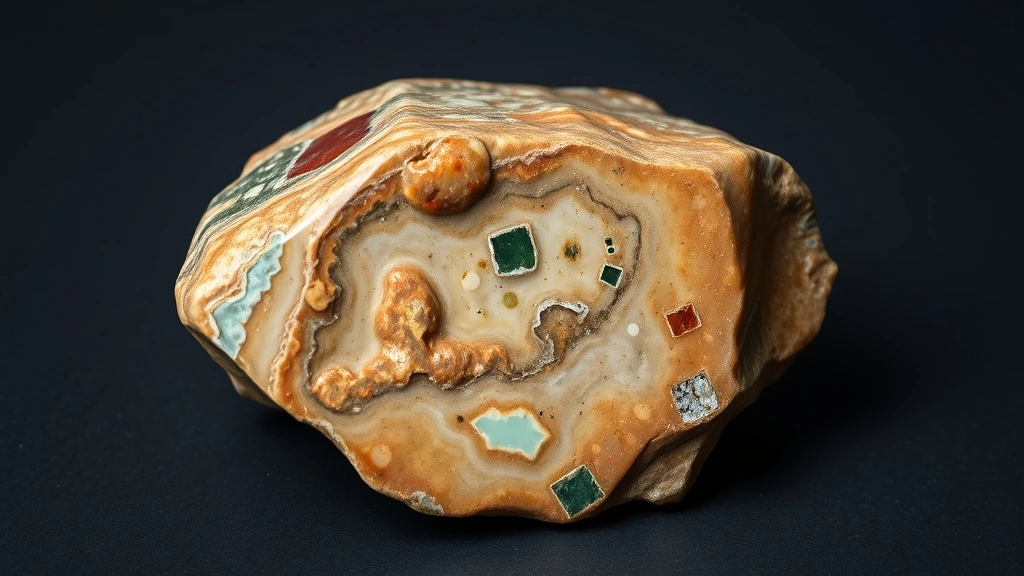
Ocean Jasper is classified as a natural mineral aggregate, specifically a variety of chalcedony. It belongs to the broader quartz group, which consists of microcrystalline silicon dioxide. Unlike macrocrystalline quartz, this stone forms through the precipitation of silica in volcanic environments. Its unique banding patterns result from complex geological processes involving mineral impurities.
What is Ocean Jasper ? Geological Overview & Definition
Ocean Jasper is a cryptocrystalline form of quartz found exclusively in the Mafic volcanic rocks of Madagascar. It is not a single mineral species but a rock aggregate composed of interlocking microcrystals. This stone forms within basaltic lava flows where silica-rich fluids infiltrate fractures. The resulting texture is dense, fine-grained, and highly durable.
The gemstone is distinguished by its intricate, organic patterns resembling ocean waves or coral reefs. These designs are created by the differential precipitation of various mineral inclusions. Chalcedony serves as the primary matrix, hosting these colorful mineral deposits. This unique formation process gives the stone its characteristic aesthetic appeal.
Ocean Jasper Chemical Composition & Crystallographic Properties
The fundamental building block is silicon dioxide (SiO₂), arranged in a Trigonal crystal system. While the macroscopic stone appears amorphous, its microscopic structure follows trigonal symmetry. The lattice consists of tetrahedral silica units linked by shared oxygen atoms. This arrangement provides the stone with its characteristic refractive index of 1.530 to 1.544. In comparative mineralogical collections, practitioners and geologists frequently study Lava Stone Basalt alongside this crystal to appreciate their subtle energetic and structural differences.
Color variations arise from trace chromophore elements and mineral inclusions rather than the pure silica matrix. Iron oxides typically produce the warm orange and red tones observed in the stone. Blue and green hues often result from microscopic inclusions of other minerals. These impurities do not significantly alter the base chemical formula of the silica.
The stone exhibits high acid sensitivity only if surface treatments or impurities are present. Pure chalcedony is chemically inert to most weak acids, ensuring long-term stability. Thermal behavior is stable, as the stone withstands moderate heat without structural degradation. However, extreme temperature changes may cause fracturing in the aggregate structure.
| Property | Specification |
|---|---|
| Mineral Group | Natural Mineral / Crystal |
| Chemical Formula | SiO₂ |
| Mohs Hardness | 6.5 – 7.0 |
| Crystal System | Trigonal |
| Specific Gravity (Density) | 2.60 – 2.65 |
| Refractive Index | 1.530 – 1.544 |
| Color & Optical Properties | Natural Ocean Jasper Gemstone color spectrum and optical dispersion |
| Primary Mining Localities | Global primary localities |
| Water & Chemical Resistance | High (Safe for gentle water washing) |
| Chakra Alignment (Traditional) | Heart Chakra, Throat Chakra |
| Zodiac Affinity (Traditional) | Pisces, Cancer |
| Symbolic Meaning (Traditional) | Emotional healing, connection to the ocean, peace, and serenity |
Ocean Jasper Varieties & Color Spectrum
Ocean Jasper presents a complex chromatic palette derived from its unique volcanic origin, distinguishing it sharply from other jasper types. The stone’s visual identity relies heavily on the interplay between its base matrix and intricate mineral inclusions.
Classic Ocean Jasper
This primary variety features a deep blue to teal base matrix punctuated by white and green dendritic patterns. These branching inclusions result from the oxidation of iron-rich fluids trapped during rapid volcanic cooling. The high contrast between the blue chalcedony background and the lighter dendrites creates the signature “ocean wave” aesthetic.
Green Ocean Jasper
Characterized by a dominant emerald to forest green hue, this morph showcases a higher concentration of chlorite or other green iron silicates. The green tones often appear in swirling, cloud-like formations rather than sharp dendritic lines. This variation is generally less common than the blue-based types, adding to its desirability among collectors.
Red and Orange Ocean Jasper
These warmer-toned specimens display vivid rust, orange, or brick-red coloration within the matrix. The intense hues stem from high concentrations of hematite and other iron oxides precipitating within the volcanic glass. While rarer than blue or green variants, these stones offer a striking alternative for jewelry design.
Multi-Color Ocean Jasper
This rare morph combines blue, green, red, and white in a single specimen, creating a complex, painterly effect. The co-occurrence of multiple oxidation states indicates fluctuating chemical conditions during the original volcanic eruption. Such stones are highly prized for their polychromatic beauty and geological complexity.
Where is Ocean Jasper Found? Geological Mining & Extraction
Ocean Jasper is exclusively sourced from the Bantimurung Formation in South Sulawesi, Indonesia, a region rich in volcanic activity. The stone forms within specific layers of volcanic ash and tuff that underwent rapid hydrothermal alteration. This geographic restriction ensures that all genuine Ocean Jasper shares a consistent geological pedigree.
Extraction occurs through open-pit mining methods, where miners carefully separate the jasper-bearing layers from the surrounding host rock. The process requires precision to avoid fracturing the delicate dendritic inclusions that define the stone’s value. Post-extraction, the raw material is cut and polished to reveal the intricate internal patterns.
Historical Significance & Cultural Lore of Ocean Jasper
Despite its modern popularity, Ocean Jasper lacks a documented history in ancient civilizations due to its recent commercial discovery. Unlike agate or carnelian, it does not appear in archaeological records from Egypt, Rome, or the Indus Valley. Its absence from historical artifacts reflects the limited global awareness of this specific Indonesian volcanic deposit prior to the twenty-first century.
Contemporary lore often associates the stone with oceanic energy and emotional balance, drawing parallels to its visual resemblance to sea waves. These modern metaphysical attributes have driven its rapid adoption in the wellness and alternative healing markets. The stone’s cultural significance remains primarily tied to its aesthetic appeal and recent gemological recognition.
Where is Ocean Jasper Found? Geological Mining & Extraction
Ocean Jasper occurs in silicified rhyolite dykes that intruded the volcanic plateau of north‑western Madagascar during the Cretaceous. The host rock is heavily fractured, allowing silica‑rich hydrothermal fluids to permeate and replace the original basaltic material, creating the characteristic orbicular textures. Modern extraction relies on careful hand‑mining to preserve the delicate concentric patterns, followed by washing and hand‑sorting on site.
The primary mining districts are near Anjajavy and the Antsiranana region, where small cooperatives employ traditional tools to chip out slabs. After extraction, the raw blocks are transported to processing centers in Antananarivo, where they are cut, polished, and graded before export to global gem markets.
Historical Significance & Cultural Lore of Ocean Jasper
Ancient Malagasy communities valued Ocean Jasper for its protective and healing properties, embedding polished cabochons in ceremonial necklaces and amulets. Archaeological digs at coastal burial sites have uncovered Ocean Jasper beads dating to the 12th‑14th centuries, suggesting the stone was traded along Indian Ocean routes to Arab and Southeast Asian merchants.
In contemporary metaphysical practice, Ocean Jasper is linked to the heart and throat chakras, believed to foster emotional balance, communication, and a deep connection to the sea. Folklore recounts that the stone’s “eyes” are the gazes of ocean spirits, offering peace and serenity to those who carry it.
Modern Uses & Jewelry Applications of Ocean Jasper
Ocean Jasper is prized for its intricate, multicolored banding, which lends itself to both classic and contemporary designs. Lapidary artisans typically cut the stone into smooth cabochons to showcase its natural patterns, while skilled faceters can produce subtle facets that catch light without overwhelming the texture. In addition to rings and pendants, the stone is often carved into ornamental beads, figurines, and decorative inlays for furniture or wall art.
- Cabochon pendants that highlight the stone’s “oceanic” swirls
- Faceted earrings that balance sparkle with pattern visibility
- Carved beads for mala strands and spiritual jewelry
- Decorative tiles or small sculptures for interior design
Metaphysical Properties & Traditional Meaning of Ocean Jasper
According to historical traditions and metaphysical lore, Ocean Jasper is regarded as a bridge to emotional healing, encouraging calmness and inner peace. Its soothing energy is said to dissolve stress, fostering a sense of serenity that mirrors the gentle rhythm of the sea. Practitioners also attribute to it the ability to enhance communication, allowing the wearer to express feelings more openly and authentically.
Which Chakra and Zodiac Signs Align with Ocean Jasper ?
Ocean Jasper resonates most strongly with the Heart Chakra, where it is believed to open pathways for unconditional love and compassion. It also vibrates with the Throat Chakra, supporting clear self‑expression and the release of suppressed emotions.
In astrology, the stone is specifically aligned with the zodiac signs Pisces and Cancer, both water signs that value emotional depth and nurturing connections. Wearing Ocean Jasper during these periods is thought to amplify intuitive insight and reinforce the protective, caring qualities of these signs.
How to Identify Real vs. Fake Ocean Jasper
Artificial imitations of Ocean Jasper include dyed quartz, synthetic glass, and resin composites that mimic its characteristic banded appearance. These substitutes often lack the stone’s natural density, subtle color variations, and internal inclusions that genuine Ocean Jasper exhibits. Recognizing the differences requires a combination of visual inspection and simple physical tests.
Practical At-Home Authenticity Tests
- Temperature Test (Thermal Feel): Real Ocean Jasper feels cool to the touch and retains that coolness longer than glass or plastic replicas, which quickly warm to skin temperature.
- Specific Gravity & Weight Test: With a density of 2.60‑2.65 g/cm³, authentic Ocean Jasper feels noticeably heavier than dyed quartz of similar size; a simple water displacement test can confirm the specific gravity range.
- Scratch & Hardness Test (Mohs Comparison): Using a steel nail (hardness ~5.5) or a quartz point (hardness 7), genuine Ocean Jasper (hardness 6.5‑7) will resist scratching, whereas softer imitations will show visible marks.
- Microscopic & Loupe Inspection (Internal Inclusions): Under 10×‑30× magnification, natural Ocean Jasper reveals fine, irregular mineral inclusions and micro‑fractures; synthetic glass appears uniformly clear or shows bubble patterns, lacking the organic texture.
Ocean Jasper Valuation Factors, Grading & Pricing
Color Saturation is the foremost driver of value. Deep, vivid blues, greens, and reds that bleed into one another signal a high‑grade stone, while washed‑out hues lower the price. Uniform tone across the matrix enhances visual impact, and a polished luster that reflects light without cloudiness adds premium appeal.
Specimen Size & Weight influences price but only when paired with excellent cut quality. Larger specimens that retain a balanced tumbled polish and natural geometry showcase the stone’s natural patterns without distortion. Visible matrix or mineral inclusions are acceptable, yet a clean, well‑distributed network is preferred; heavy fracturing or large cracks can dramatically reduce market value.
Geographical Provenance Premium rewards stones sourced from the historic Madan Plateau in Madagascar, where the unique hydrothermal environment creates the characteristic “oceanic” patterns. Collectors pay a premium for documented origin, driving wholesale prices upward. Retail trends show a steady 8‑12 % annual increase as demand for ethically sourced, aesthetically striking Ocean Jasper grows.
How to Clean and Care for Ocean Jasper
Physical cleaning should follow the canonical guideline: gently immerse the stone in warm soapy water, then wipe with a soft cloth to remove surface grime. Rinse briefly with lukewarm water and pat dry with a lint‑free towel. Avoid ultrasonic cleaners entirely, as the rapid vibrations can cause micro‑fractures in the trigonal quartz structure. Store the gem in a padded pouch or a fabric-lined box to protect it from knocks and scratches.
Cleansing and Recharging Ocean Jasper (Energetic Care)
Because Ocean Jasper is a silica‑based mineral, it is insoluble in water and safe for dry energetic cleansing. Pass the stone through smoke smudging using sage or palo santo, allowing the gentle vapor to clear lingering negative energies without physical contact.
For a lunar recharge, place the gemstone on a selenite plate or directly on a windowsill under full moonlight for several hours. The cool, neutral energy of moonlight harmonizes the stone’s emotional‑healing properties, restoring its serene vibration for continued use.
Frequently Asked Questions About Ocean Jasper
What is the primary chemical composition of Ocean Jasper?
Ocean Jasper is composed entirely of silicon dioxide (SiO₂), making it a variety of chalcedony. This crystalline structure ensures chemical stability and resistance to environmental degradation. Its trigonal crystal system contributes to the unique, fluid-like patterns found in each stone.
Is Ocean Jasper safe to wear in water or the shower?
Yes, Ocean Jasper is safe for gentle water washing and showering. Its high water resistance allows it to withstand moisture without dissolving or degrading. However, avoid prolonged exposure to harsh chemicals or very hot water to maintain the stone’s integrity and vibrant surface luster.
Can I clean Ocean Jasper in an ultrasonic cleaner?
No, you should strictly avoid ultrasonic cleaners for this gemstone. The vibrations can cause structural fractures within the delicate matrix of the stone. Instead, use warm soapy water and a soft cloth for safe, effective cleaning that preserves the intricate patterns.
What is the Mohs hardness of Ocean Jasper?
Ocean Jasper rates between 6.5 and 7.0 on the Mohs hardness scale. This makes it durable enough for everyday jewelry like rings and bracelets. It is harder than calcite but softer than topaz, requiring care against sharp impacts or abrasive surfaces.
Which zodiac signs are aligned with Ocean Jasper?
The primary zodiac signs associated with this stone are Pisces and Cancer. These water signs resonate with the gem’s fluid, oceanic energy and emotional depth. Wearing Ocean Jasper is believed to enhance the natural intuitive and empathetic qualities of these individuals.
Which chakras does Ocean Jasper activate?
Ocean Jasper primarily aligns with the Heart Chakra and Throat Chakra. It promotes emotional healing and clear communication by balancing these energy centers. This dual alignment supports both deep emotional connection and the ability to express feelings authentically.
What is the refractive index of Ocean Jasper?
The refractive index of Ocean Jasper ranges from 1.530 to 1.544. This optical property determines how light bends within the stone, creating its characteristic soft sheen. It is slightly lower than pure quartz, contributing to its unique, matte-to-satin visual appearance.
How should I store Ocean Jasper to prevent damage?
Store Ocean Jasper in a soft pouch or separate jewelry compartment. Although hard, the stone can suffer structural fractures if struck by harder minerals. Keeping it away from direct sunlight and extreme temperatures helps preserve its density and vibrant coloration over time.