
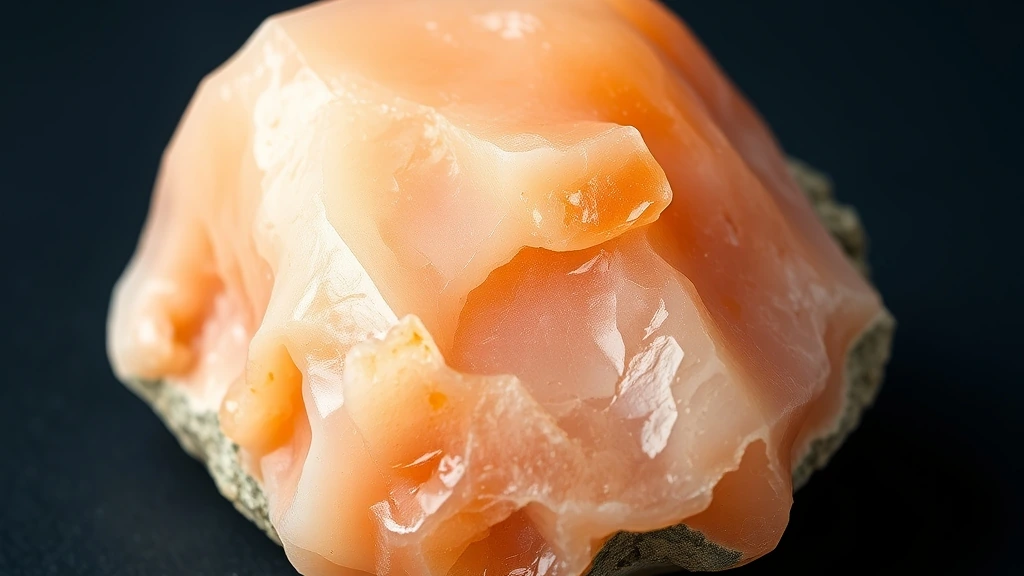
Orange Moonstone belongs to the Silicates supergroup, specifically within the Tectosilicates subclass. It is a member of the Feldspar Group, which constitutes the most abundant mineral family in Earth’s crust. This stone forms through the intergrowth of different feldspar phases, creating its distinctive optical properties. Its geological origin is tied to igneous and metamorphic processes that facilitate the separation of these crystalline structures.
What is Orange Moonstone (peach Moonstone)? Geological Overview & Definition
Orange Moonstone is a rare variety of labradorite or orthoclase feldspar. It is characterized by a unique optical phenomenon known as adularescence. This effect appears as a shimmering, peach-colored light floating beneath the stone’s surface. The color distinguishes it from the more common blue or white moonstones. In comparative mineralogical collections, practitioners and geologists frequently study Peach Moonstone alongside this crystal to appreciate their subtle energetic and structural differences.
The stone forms when perthitic intergrowths of different feldspar phases separate during cooling. This lamellar structure scatters light to produce the characteristic glow. Geologists classify it under the monoclinic system due to its crystal symmetry. Its rarity stems from specific thermal conditions required for this optical development.
Orange Moonstone (peach Moonstone) Chemical Composition & Crystallographic Properties
The primary chemical composition is KAlSi₃O₈, representing the orthoclase end-member. However, the stone often contains minor albite inclusions. This mixture creates the necessary density variations for light scattering. The monoclinic crystal system governs its fundamental lattice geometry.
The internal structure features perthitic lamellar intergrowths of potassium and sodium feldspar. These microscopic layers are responsible for the adularescence effect. The cation substitution of sodium for potassium alters the refractive index slightly. This structural complexity defines its unique gemological identity.
The stone exhibits moderate acid sensitivity, as feldspars can etch in strong acids. It is generally stable under normal jewelry conditions. Thermal behavior shows no significant phase changes at standard temperatures. The refractive index ranges from 1.518 to 1.526, confirming its feldspar origin.
| Property | Specification |
|---|---|
| Mineral Group | Silicates (Tectosilicates / Feldspar Group) |
| Chemical Formula | KAlSi₃O₈ (Orthoclase / Albite feldspar) |
| Mohs Hardness | 6.0 – 6.5 |
| Crystal System | Monoclinic (Orthoclase / Albite perthitic lamellar) |
| Specific Gravity (Density) | 2.56 – 2.60 |
| Refractive Index | 1.518 – 1.526 |
| Color & Optical Properties | Natural Orange Moonstone (peach Moonstone) color spectrum and optical dispersion |
| Primary Mining Localities | Sri Lanka, India, Madagascar, Myanmar, Brazil |
| Water & Chemical Resistance | Moderate (Safe for brief lukewarm washing; avoid acids and thermal shocks) |
| Chakra Alignment (Traditional) | Crown Chakra and Third Eye Chakra |
| Zodiac Affinity (Traditional) | Cancer, Libra, Scorpio |
| Symbolic Meaning (Traditional) | Feminine intuition, inner harmony, new beginnings, and emotional balance |
Orange Moonstone (peach Moonstone) Varieties & Color Spectrum
Classic Peach Moonstone
Formed in perthitic feldspar where orthoclase lamellae intergrow with albite, this variety displays a soft, pastel peach hue that deepens under diffused light. Microscopic exsolution twins create the characteristic adularescent glow, while occasional iron‑oxide specks add subtle sparkle. Found primarily in Sri Lanka, it is the most commercially abundant yet still prized for its uniform color.
Sunset Orange Moonstone
Developed in high‑temperature pegmatites of Brazil, Sunset Orange Moonstone exhibits a richer, amber‑orange tone with a pronounced blue‑white sheen on the underside of the stone. The presence of microscopic hematite inclusions intensifies the warmth, and the stone often shows a faint chatoyancy when cut en cabochon. Its limited occurrence makes it a collector’s favorite, especially in larger carat sizes.
Himalayan Peach Moonstone
Harvested from the metamorphic schists of the Himalayas, this variety combines a delicate peach base with occasional rainbow‑like flashes of violet and green caused by strain‑induced lattice distortions. Thin mica flakes trapped during formation produce a subtle iridescence that differs from classic adularescence. The remote mining locations and fragile host rock contribute to its rarity and higher market value.
Madagascar “Fire” Moonstone
Originating in the alkaline granitic complexes of Madagascar, the “Fire” Moonstone shows a vivid, almost vermilion orange that can shift to a golden hue under direct sunlight. Its high iron content yields a stronger internal glow, while occasional fluid inclusions appear as tiny bubbles in polished stones. The variety is newly emerging on the trade market, prized for its bold coloration.
Tanzanian Sunset Pearl Moonstone
Extracted from the late‑Cretaceous pegmatites of Tanzania, this stone blends a soft peach core with a pearl‑like luster along its edges, caused by fine‑grained calcite intergrowths. The mineral often contains tiny zircon crystals that add a subtle sparkle, distinguishing it from other orange moonstones. Its limited production and distinctive finish make it a niche choice for high‑end jewelry.
Australian Outback Moonstone
Discovered in the granitic terrains of Western Australia, this variety presents a muted orange‑tan background overlaid with a milky adularescence that appears more diffuse than in other types. The stone frequently includes tiny quartz veining, giving it a speckled appearance reminiscent of desert sand. Its remote extraction sites and modest supply keep it relatively uncommon in global markets.
Where is Orange Moonstone (peach Moonstone) Found? Geological Mining & Extraction
Orange Moonstone occurs chiefly within perthitic feldspar zones of granitic pegmatites, where slow cooling allows orthoclase and albite to exsolve into lamellar intergrowths. These pegmatites are typically hosted by metamorphic basement rocks, providing the pressure and temperature conditions necessary for the stone’s characteristic adularescence.
Major extraction centers include the Sri Lankan gem fields of Ratnapura, the Brazilian Minas Gerais pegmatite belts, and the Himalayan schist complexes of Nepal and India. Smaller but notable sources are found in Madagascar’s alkaline granites, Tanzania’s late‑Cretaceous pegmatites, and Western Australia’s granitic outcrops, each contributing distinct color nuances to the global supply.
Historical Significance & Cultural Lore of Orange Moonstone (peach Moonstone)
Ancient traders prized peach‑colored moonstone for its alleged ability to enhance intuition and protect travelers, a belief documented in early Sanskrit texts and Roman lapidary manuals. Archaeological finds from the Indus Valley and Roman Britain reveal polished cabochons set in amulets, indicating the stone’s long‑standing role in personal adornment and spiritual practice.
In Eastern mysticism, the stone is linked to the Crown and Third Eye Chakras, where it is said to balance feminine energy and foster new beginnings. Classical Persian and Near Eastern lore describes peach moonstone as a luminous talisman of lunar vitality, honoring it for emotional harmony and gentle inner guidance in contemporary crystal healing circles.
Modern Uses & Jewelry Applications of Orange Moonstone (peach Moonstone)
The warm, adularescent glow of orange moonstone makes it a favored choice for both contemporary and classic designs. Lapidaries often cut the stone as a cabochon to showcase its silky sheen, while skilled faceting can produce subtle fire without sacrificing the characteristic glow. Artisans also carve ornamental pendants, beads, and small sculptures, allowing the stone’s peach hue to complement mixed‑metal settings.
- Cabochon pendants and earrings highlighting the stone’s moon‑like sheen
- Faceted rings that balance brilliance with adularescence
- Carved beads, brooches, and decorative inlays for luxury accessories
Metaphysical Properties & Traditional Meaning of Orange Moonstone (peach Moonstone)
According to historical traditions and metaphysical lore, orange moonstone is revered as a conduit for feminine intuition and emotional equilibrium. It is said to nurture inner harmony, encouraging new beginnings while soothing turbulent feelings. Practitioners believe the stone amplifies creative insight, aligning the wearer with the subtle currents of the subconscious mind.
Which Chakra and Zodiac Signs Align with Orange Moonstone (peach Moonstone)?
The stone resonates strongly with the Crown Chakra, supporting spiritual connection and higher‑level awareness. Simultaneously, it activates the Third Eye Chakra, sharpening intuition and inner vision. Together, these energy centers foster a balanced flow of insight and transcendence, making the gem popular in meditation and holistic practices.
In astrology, orange moonstone is specifically linked to the signs Cancer, Libra, and Scorpio. Those born under these constellations are thought to benefit from the stone’s ability to harmonize emotional tides, promote diplomatic clarity, and deepen transformative experiences, respectively. No other zodiac affiliations are traditionally recognized for this variety.
How to Identify Real vs. Fake Orange Moonstone (peach Moonstone)
Artificial imitations of orange moonstone include colored glass, resin, and dyed quartz, which often lack the stone’s characteristic adularescent sheen. Synthetic versions may mimic color but typically fail under close inspection, revealing uniform clarity or a glassy luster. Awareness of these differences helps collectors avoid costly misidentifications.
Practical At-Home Authenticity Tests
- Temperature Test (Thermal Feel): Natural moonstone feels cool to the touch initially and warms slowly, whereas glass or plastic warms quickly in the hand.
- Specific Gravity & Weight Test: Real orange moonstone has a density of 2.56‑2.60 g/cm³; a simple water displacement test will show it is heavier than most glass substitutes.
- Scratch & Hardness Test (Mohs Comparison): With a hardness of 6.0‑6.5, the stone resists scratching by a steel file but will be marked by a quartz point; glass typically scratches more easily.
- Microscopic & Loupe Inspection (Internal Inclusions): Under 10× magnification, authentic moonstone displays fine, parallel lamellae (perthitic twinning) and occasional tiny inclusions, while synthetic glass appears uniformly clear with no internal structure.
Orange Moonstone (peach Moonstone) Valuation Factors, Grading & Pricing
The market places the highest premium on color saturation; a vivid peach‑orange hue with a strong adularescent glow signals superior quality. Stones that display uniform, deep coloration without gray overtones command higher prices, as collectors associate visual vibrancy with rarity. The natural energetic luster, often described as a soft inner glow, further enhances perceived value in metaphysical circles.
Crystal size & weight (grams) is the next decisive metric, with larger, heavier specimens fetching a premium when they retain a clean, tumbled polish. Raw blocks that exhibit minimal matrix inclusions and a smooth surface are prized for cabochon work, while heavily cleaved pieces may be discounted despite their size. Consistent polish quality, free of scratches, signals careful handling and adds to market desirability.
Ethical sourcing & locality premium increasingly influences pricing, especially among holistic practitioners and serious collectors. Moonstones mined from regions with transparent labor practices and minimal environmental impact often carry a modest surcharge. Proven provenance from historic feldspar belts, coupled with responsible extraction, reassures buyers that the stone’s metaphysical reputation is backed by sustainable stewardship.
How to Clean and Care for Orange Moonstone (peach Moonstone)
Cleaning should be gentle to respect the stone’s cleavage planes; use lukewarm water mixed with a mild, pH‑neutral soap and softly swish the piece for a few seconds. Rinse briefly with clean lukewarm water, pat dry with a soft, lint‑free microfiber cloth, and avoid any sudden temperature changes or acidic solutions. Ultrasonic cleaners are unsafe because the vibration can split the lamellar structure, so manual cleaning remains the only reliable method.
Cleansing and Recharging Orange Moonstone (peach Moonstone) (Energetic Care)
For energetic renewal, place the stone on a clean selenite slab for several hours, allowing the neutral selenite to absorb and release lingering vibrations without exposing the mineral to heat. Alternatively, a brief session of herbal smudging with sage or cedar, performed at a safe distance, can clear stagnant energy while preserving the stone’s crystal lattice.
Moonlight exposure is also beneficial; set the stone on a windowsill during a clear night and let the gentle lunar rays bathe it for an hour or two. This method revitalizes the stone’s inner glow without subjecting it to intense sunlight or thermal stress, ensuring both its physical integrity and metaphysical potency remain intact.
Frequently Asked Questions About Orange Moonstone (peach Moonstone)
What is the chemical composition of peach moonstone?
Peach moonstone consists primarily of KAlSi₃O₈, representing the orthoclase and albite feldspar varieties. This specific perthitic lamellar structure creates the distinctive optical interference known as adularescence. The intergrowth of these two feldspar types is responsible for the gem’s unique peachy-orange body color and shimmering light effect.
Is orange moonstone safe to wear in the shower?
Moderate water resistance allows for brief exposure to lukewarm water during gentle washing. However, you must avoid prolonged submersion, hot thermal shocks, or acidic soaps that could damage the surface. Always remove the stone before using harsh chemicals or engaging in activities that expose it to extreme temperature fluctuations.
Can I use an ultrasonic cleaner on this?
No, you should strictly avoid ultrasonic cleaning due to the stone’s prone cleavage splitting nature. The internal lamellar structure is susceptible to vibration-induced fractures that can permanently ruin the gem’s integrity. Instead, clean it gently with warm soapy water and a soft brush to preserve its structural stability and optical clarity.
Which zodiac signs are aligned with peach moonstone?
This gemstone is traditionally associated with Cancer, Libra, and Scorpio in astrological practices. These water and air signs resonate with the stone’s emotional balancing properties and intuitive energy. Wearing peach moonstone is believed to enhance the natural traits of these signs, promoting harmony and deeper self-awareness.
Which chakras does orange moonstone activate?
Peach moonstone specifically activates the Crown Chakra and Third Eye Chakra. These upper energy centers are linked to higher consciousness, spiritual insight, and intuitive perception. The stone’s soft peach hues support meditation practices aimed at opening these channels for enhanced mental clarity and spiritual connection.
How hard is peach moonstone on the Mohs scale?
The gemstone rates between 6.0 and 6.5 on the Mohs hardness scale. While durable enough for daily jewelry, it is softer than quartz and susceptible to scratching by harder minerals. Proper storage in a fabric-lined box is essential to prevent surface abrasion and maintain the stone’s polished luster over time.
What is the refractive index of this feldspar?
Peach moonstone exhibits a refractive index ranging from 1.518 to 1.526. This optical property contributes to its gentle, pearly luster rather than the high brilliance seen in diamonds. The specific RI helps gemologists distinguish it from similar-looking stones like labradorite or white sapphire during identification processes.
What is the specific gravity of peach moonstone?
The mineral has a density of 2.56 to 2.60, which is relatively low for a gemstone. This lighter weight makes it comfortable for large pendants or earrings without excessive strain on the setting. Accurate density measurement is a standard laboratory method for confirming the stone’s identity as a feldspar variety.