
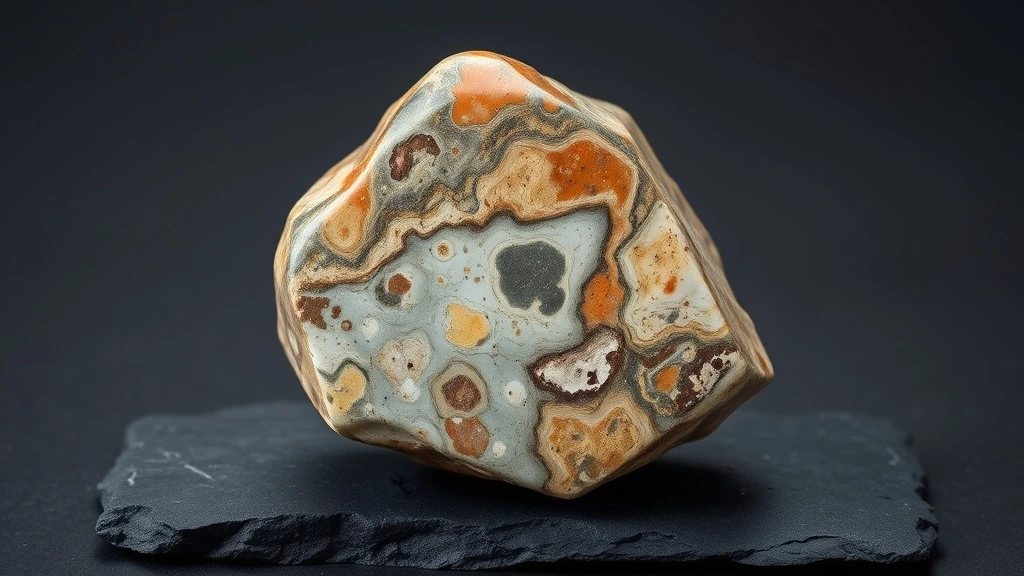
Picture Jasper belongs to the Natural Mineral / Crystal group, specifically within the quartz family. It forms as a cryptocrystalline aggregate where microscopic silica crystals interlock tightly. This structure distinguishes it from macrocrystalline quartz varieties. The stone develops through the slow precipitation of silica-rich fluids in volcanic or sedimentary environments. Its formation process allows for the intricate layering of minerals that create its unique visual patterns.
What is Picture Jasper? Geological Overview & Definition
Picture Jasper is a banded chalcedony known for its landscape-like patterns. These designs result from the sequential deposition of iron oxides and other trace minerals. The stone typically forms in hydrothermal veins or as nodules within basaltic lava flows. This geological setting provides the necessary chemical gradients for complex image formation. While Picture Jasper’s intricate landscapes arise from layered iron oxide deposits, its mineralogical cousin Blue Chalcedony achieves its serene hue through trace amounts of cobalt, offering a striking contrast in color despite their shared chalcedony structure.
The term “Jasper” derives from the Greek word for a red stone. Picture Jasper specifically refers to specimens displaying recognizable figurative patterns. These images often resemble landscapes, animals, or abstract shapes. The polished surface reveals these hidden geological narratives with striking clarity.
Picture Jasper Chemical Composition & Crystallographic Properties
The primary constituent is silicon dioxide (SiO₂) in a trigonal crystal system. The structure consists of a silica tetrahedra lattice with minor impurities. This cryptocrystalline arrangement lacks the large, visible crystals of macrocrystalline quartz. The trigonal symmetry governs the fundamental atomic arrangement of the silica framework.
Color variations stem from chromophore inclusions, primarily iron oxides like hematite and goethite. These cation substitutions and impurities create the earthy reds, browns, and greens. The stone exhibits high chemical stability and resistance to most acids. However, prolonged exposure to strong alkalis can degrade the silica matrix.
Thermal behavior remains stable under normal jewelry conditions. The refractive index ranges from 1.544 to 1.553, providing a vitreous luster. Density measures between 2.60 and 2.65 g/cm³. These physical properties confirm its identity as a robust quartz variety.
| Property | Specification |
|---|---|
| Mineral Group | Natural Mineral / Crystal |
| Chemical Formula | SiO₂ (Quartz/Chalcedony matrix with Fe-oxide inclusions) |
| Mohs Hardness | 6.5 – 7.0 |
| Crystal System | Trigonal |
| Specific Gravity (Density) | 2.60 – 2.65 |
| Refractive Index | 1.544 – 1.553 |
| Color & Optical Properties | Natural Picture Jasper color spectrum and optical dispersion |
| Primary Mining Localities | Global primary localities |
| Water & Chemical Resistance | High (Safe for gentle water washing) |
| Chakra Alignment (Traditional) | Root Chakra, Sacral Chakra |
| Zodiac Affinity (Traditional) | Taurus, Virgo, Capricorn |
| Symbolic Meaning (Traditional) | Grounding, emotional stability, and connection to nature |
Picture Jasper Varieties & Color Spectrum
Mexican Picture Jasper
Originating primarily from the Guanajuato region, this variety features distinct iron oxide inclusions that form swirling, landscape-like patterns. The stone typically displays a warm, earthy background ranging from deep brown to reddish-orange. These vivid internal structures result from the slow cooling of silica-rich fluids within volcanic rock.
Brazilian Picture Jasper
Found extensively in Minas Gerais, this type is characterized by its chalcedony matrix and intricate, detailed imagery. The colors often include shades of green, blue, and white, creating a more subdued yet complex visual aesthetic. Its high clarity and fine-grained texture make it highly prized for detailed carving and tumbled stones.
Australian Picture Jasper
Sourced from the Northern Territory, this variety is renowned for its striking banded patterns and vibrant color contrasts. The stone frequently exhibits sharp, geometric designs that resemble abstract art or topographical maps. Its unique formation in ancient sedimentary basins contributes to its exceptional durability and visual appeal.
South African Picture Jasper
This rare variety from the Northern Cape province displays a distinctive pyrite inclusion pattern that adds metallic sparkle to the stone. The background is often a deep, chocolate brown, providing strong contrast to the bright, golden flecks. Such metallic inclusions are geologically significant, indicating specific hydrothermal activity during formation.
Indian Picture Jasper
Emerging from the Karnataka region, this type features soft, pastel hues of pink, cream, and light green. The silica deposition occurs in layered sequences, creating gentle, flowing bands that mimic watercolor paintings. Its delicate appearance makes it a popular choice for jewelry designers seeking softer aesthetic tones.
Andean Picture Jasper
Harvested from the high-altitude regions of Peru and Bolivia, this variety is known for its intense, saturated reds and oranges. The hematite content is particularly high, giving the stone a rich, fiery appearance. Extreme altitude and pressure during formation contribute to its exceptional hardness and vivid coloration.
Where is Picture Jasper Found? Geological Mining & Extraction
Picture Jasper forms within volcanic tuff and igneous rocks, where silica-rich fluids infiltrate porous host materials. The precipitation of iron oxides and other minerals occurs over millions of years, creating the characteristic pictorial patterns. This geological process requires specific conditions of temperature and pressure to produce the detailed imagery seen in high-quality specimens.
Primary extraction occurs in open-pit mines across Mexico, Brazil, and Australia, where large deposits are accessible. Mechanical extraction methods are commonly used to remove blocks of raw stone from the earth. These blocks are then transported to processing facilities for cutting, polishing, and sorting based on visual quality and pattern clarity.
Historical Significance & Cultural Lore of Picture Jasper
Ancient civilizations, including the Aztecs and Mayans, valued Picture Jasper for its protective properties and spiritual significance. Archaeological evidence reveals its use in ceremonial objects, amulets, and ornamental carvings dating back thousands of years. The stone was often associated with earth elements and believed to enhance physical strength and vitality.
In modern times, Picture Jasper has gained popularity in metaphysical practices for its grounding qualities and emotional stabilizing effects. Practitioners often associate the stone with the root and sacral chakras, using it to foster a deeper connection to nature. Its enduring appeal lies in the unique, one-of-a-kind patterns found in each individual piece, making it a cherished gemstone for collectors and healers alike.
Modern Uses & Jewelry Applications of Picture Jasper
Lapidaries primarily cut Picture Jasper into cabochons to preserve the integrity of its intricate internal imagery, as faceting would disrupt the natural landscape patterns. This opaque variety of chalcedony is also carved into ornamental boxes, inlays, and architectural elements, showcasing its unique silica matrix and iron-oxide pigments.
- Cabochon Cutting: Polished domes highlight the “picture” without refractive distortion, ideal for rings and pendants.
- Ornamental Carving: Skilled artisans sculpt the stone into decorative objects, leveraging its Mohs hardness of 6.5–7.0 for durability.
- Inlay Work: Thin slices are embedded in wood or metal for high-end jewelry and decorative panels.
Metaphysical Properties & Traditional Meaning of Picture Jasper
According to historical traditions and metaphysical lore, Picture Jasper is revered as a powerful grounding stone that fosters deep emotional stability. Practitioners believe its earthy tones connect the wearer to the natural world, promoting a sense of emotional resilience during turbulent times.
This gemstone is often associated with spiritual connection and inner peace, helping individuals feel anchored and secure. Its visual complexity is thought to stimulate creativity while maintaining a steady, rooted energy that supports personal growth.
Which Chakra and Zodiac Signs Align with Picture Jasper?
In chakra theory, Picture Jasper resonates most strongly with the Root Chakra, enhancing feelings of safety and physical presence. It also influences the Sacral Chakra, supporting creative expression and emotional balance through its earthy, stabilizing properties.
Astrologically, this stone is canonically aligned with Taurus, Virgo, and Capricorn. These earth signs share the gemstone’s affinity for stability, practicality, and a deep connection to the physical realm, making it a harmonious companion for their energy.
How to Identify Real vs. Fake Picture Jasper
Artificial imitations of Picture Jasper often involve dyed quartz, synthetic glass, or plastic composites designed to mimic natural iron-oxide inclusions. These fakes may lack the subtle color variations and organic layering found in genuine specimens, appearing overly uniform or artificially vibrant.
Practical At-Home Authenticity Tests
- Temperature Test (Thermal Feel): Genuine Picture Jasper feels cool to the touch initially and warms slowly, whereas plastic or glass may feel warmer or change temperature more rapidly.
- Specific Gravity & Weight Test: Real jasper has a density of 2.60–2.65 g/cm³, making it feel heavier than similarly sized glass or plastic imitations.
- Scratch & Hardness Test (Mohs Comparison): With a Mohs hardness of 6.5–7.0, authentic jasper will not be scratched by a steel knife (hardness 5.5), while softer fakes may show marks.
- Microscopic & Loupe Inspection (Internal Inclusions): Use a 10x loupe to check for natural chalcedony banding and irregular iron-oxide patterns; synthetic glass often contains circular bubbles or perfectly uniform color distribution.
Picture Jasper Valuation Factors, Grading & Pricing
The market first gauges color saturation, rewarding stones that display vivid reds, oranges, and deep earth tones without artificial dye. A lively, natural hue combined with a subtle internal sheen signals high visual vibrancy, which collectors equate with premium pricing. Even slight variations in tone can shift a piece from ordinary to sought‑after.
Next, crystal size & weight (grams) dominate pricing, with larger, heavier specimens commanding higher values. Raw blocks retain a rustic appeal, while tumbled pieces with a smooth polish fetch a premium for their ready‑to‑wear finish. Inclusions of the quartz‑chalcedony matrix are assessed for aesthetic harmony; a balanced pattern enhances desirability, whereas disruptive fractures lower the price.
Finally, ethical sourcing & locality premium influences both holistic and collector markets. Stones extracted from responsibly managed mines in Brazil or the United States attract a surcharge for their traceable provenance. Buyers increasingly favor jasper that supports fair labor practices and environmental stewardship, adding a moral dimension to the monetary valuation.
How to Clean and Care for Picture Jasper
Cleaning Picture Jasper is straightforward: immerse the stone in warm soapy water, gently rub with a soft cloth, then rinse and pat dry with a lint‑free microfiber towel. This method removes surface grime without compromising the quartz‑chalcedony matrix or the delicate iron‑oxide inclusions. Avoid ultrasonic cleaners, as the rapid vibrations can create micro‑fractures that diminish the stone’s structural integrity.
Cleansing and Recharging Picture Jasper (Energetic Care)
For energetic maintenance, place the jasper on a clean selenite slab and allow the natural charge of the moonlight to bathe it for a few hours, preferably during a waning phase. The gentle lunar energy is believed to clear lingering vibrations while preserving the mineral’s crystal lattice.
Alternatively, pass a lightly smoldering bundle of sage or cedar over the stone, ensuring the smoke never contacts the surface directly. This dry herbal smudging method is thought to refresh the stone’s grounding properties without introducing moisture or heat that could damage the jasper.
Frequently Asked Questions About Picture Jasper
Is Picture Jasper safe to wear in the shower?
Yes, it tolerates gentle water exposure. Picture Jasper’s quartz‑based matrix is water‑resistant, so routine showering won’t damage the stone, though prolonged soaking should be avoided. A quick rinse with warm, soapy water and a soft cloth keeps it bright without risking fracture.
How should I clean a Picture Jasper necklace?
Use warm soapy water and a soft cloth, never an ultrasonic bath. The stone’s Fe‑oxide inclusions can loosen under high‑frequency vibrations, so hand‑washing preserves its integrity. Gently rub the surface, rinse, and pat dry with a lint‑free microfiber towel.
Can ultrasonic cleaners be used on Picture Jasper?
No, ultrasonic cleaners should be avoided. The rapid cavitation can create micro‑cracks in the chalcedony matrix, leading to eventual breakage. Stick to manual cleaning methods to maintain the stone’s structural stability over time.
What is the typical hardness of Picture Jasper?
It rates between 6.5 and 7 on the Mohs scale. This hardness reflects its silica (SiO₂) composition, making it suitable for daily wear but still vulnerable to scratches from harder materials like diamonds or corundum. Store it separately from tougher gems.
Which zodiac signs are most compatible with Picture Jasper?
Taurus, Virgo, and Capricorn are the aligned signs. These earth‑signs appreciate the stone’s grounding energy, reinforcing emotional stability and a practical outlook. Wearing Picture Jasper can accentuate the innate traits of these signs in personal or professional settings.
Which chakras does Picture Jasper activate?
Root Chakra and Sacral Chakra are the primary centers. Activation of the Root promotes security and connection to the physical world, while the Sacral enhances creativity and emotional flow. Meditative focus on these chakras can deepen the stone’s earth‑based influence.
Is Picture Jasper suitable for setting in rings?
Yes, it can be set in rings with proper protection. Its trigonal crystal system offers good durability, but because it is slightly softer than many gemstones, a bezel or protective setting is recommended to shield the inclusions from impact.
Does Picture Jasper have any known metaphysical benefits?
It is associated with grounding, emotional stability, and a connection to nature. Practitioners claim the stone helps anchor energetic fluctuations, fostering a calm mindset and reinforcing ties to the earth element, which aligns with its traditional esoteric uses.