
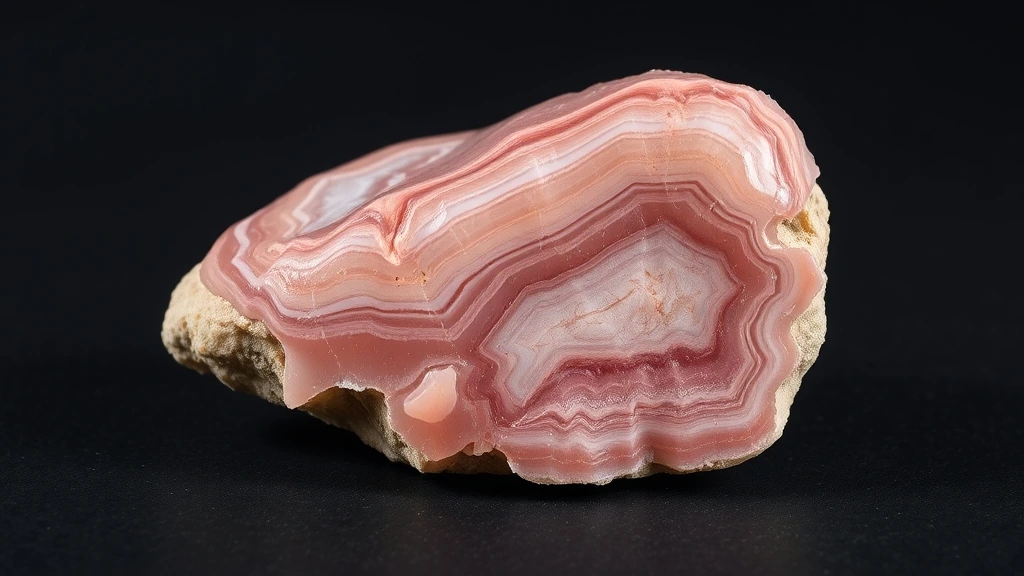
Pink banded onyx belongs to the silicate family, specifically the chalcedony subgroup of the quartz group. It forms as an aggregate of interlocking microfibers that crystallize in the trigonal system, producing the characteristic parallel banding that distinguishes it from other onyx varieties. Its formation requires silica‑rich solutions in low‑temperature hydrothermal environments, where subtle variations in trace elements generate the delicate pink hues prized by lapidaries worldwide.
What is Pink Banded Onyx? Geological Overview & Definition
Pink banded onyx is an aggregate of microcrystalline chalcedony, not a single crystal, and its banded appearance results from rhythmic changes in impurity concentration during growth. The bands are typically 0.5–2 mm thick and run parallel to the fibrous fabric of the chalcedony, giving the stone a striped, ornamental texture. While pink banded onyx displays fine, parallel stripes from rhythmic impurity shifts, its geological cousin Wood Jasper often exhibits coarser, concentric banding that mimics the growth rings of ancient timber.
Historically, this variety has been valued across ancient lapidary traditions for its subtle coloration and ease of carving. Across early archaeological records, artisans fashioned beads, intaglios, and cameos from pink banded onyx, exploiting its ability to hold fine detail while maintaining a resilient surface. While pink banded onyx was prized for its delicate hues, its more dramatic counterpart, Volcano Agate, was often selected by these same artisans for its striking contrast and robust structural integrity.
Pink Banded Onyx Chemical Composition & Crystallographic Properties
The stone consists of silica (SiO₂) organized as a microcrystalline aggregate of chalcedony, with each fiber adhering to the trigonal crystal system. Although no single lattice parameter can be assigned to the whole rock, the constituent fibers share the same hexagonal‑close‑packed silica framework typical of quartz, but with a slight distortion that yields trigonal symmetry.
Coloration arises from trace manganese (Mn²⁺) and iron (Fe³⁺) substituting for silicon in the silica lattice, creating chromophore centers that absorb specific wavelengths and produce the pink banding. These substitutions are minor, preserving the overall density of 2.60–2.65 g/cm³ and the refractive index range of 1.544–1.553.
Pink banded onyx is acid‑sensitive; exposure to strong acids can dissolve the silica framework, leading to surface pitting. However, it remains stable under neutral pH conditions and resists weathering in typical terrestrial environments.
Thermally, the aggregate behaves like quartz: heating above 573 °C triggers the α‑β quartz transition, potentially altering the banding pattern if the stone is subjected to rapid temperature changes. Controlled annealing can relieve internal stresses, improving clarity without compromising the characteristic pink hues.
| Property | Specification |
|---|---|
| Mineral Group | Silicates (Chalcedony / Quartz Group) |
| Chemical Formula | SiO₂ (Microcrystalline Chalcedony with parallel banding) |
| Mohs Hardness | 6.5 – 7.0 |
| Crystal System | Trigonal (Microcrystalline fibrous Chalcedony) |
| Specific Gravity (Density) | 2.60 – 2.65 |
| Refractive Index | 1.544 – 1.553 |
| Color & Optical Properties | Natural Pink Banded Onyx color spectrum and optical dispersion |
| Primary Mining Localities | Brazil, India, Madagascar, Uruguay, Germany |
| Water & Chemical Resistance | High (Safe in warm soapy water) |
| Chakra Alignment (Traditional) | Root Chakra (Muladhara) |
| Zodiac Affinity (Traditional) | Leo, Capricorn, Scorpio |
| Symbolic Meaning (Traditional) | Willpower, emotional discipline, grounding protection, and stamina |
Pink Banded Onyx Varieties & Color Spectrum
Pink Banded Onyx displays distinct mineralogical characteristics across its geological varieties and structural habits. Gemologists evaluate these natural varieties based on crystal habit, trace chromophore concentrations, and visual luster.
Primary Natural Pink Banded Onyx
The benchmark natural variety exhibiting diagnostic color saturation and classic crystallographic symmetry.
Distinct Geological Morphs of Pink Banded Onyx
Secondary regional and structural varieties formed under localized geological temperature and pressure conditions.
Pink Banded Onyx (Chalcedony)
This classic variety displays fine, parallel bands of pink and white, produced by cyclical silica precipitation in quartz veins. The bands are typically 0.5–1 mm wide, giving the stone a delicate, lace‑like appearance. It is prized for its subtle elegance and is widely used in jewelry and ornamental carvings. Microcrystalline chalcedony ensures a smooth, translucent finish that enhances its visual appeal.
Rose‑Band Onyx
Rose‑band onyx features a more pronounced pink hue, often tinged with faint salmon or blush tones. The bands are thicker, ranging from 1–2 mm, and may contain minor iron‑oxide inclusions that give a subtle sheen. This variety is rarer than the classic pink banded form and is frequently sourced from the Appalachian region of the United States. Its distinctive coloration makes it a favorite for high‑end decorative pieces. Iron‑oxide inclusions contribute to its unique luster.
Pink‑Banded Agate
Although technically an agate, pink‑banded agate shares the same fibrous chalcedony structure but exhibits more irregular, concentric banding. The pink bands are often interspersed with darker brown or gray rings, creating a striking contrast. This variety is commonly found in volcanic ash deposits in the Philippines and Indonesia. Its complex patterning makes it highly sought after by collectors. Concentric banding distinguishes it from linear banded onyx.
Pink‑Banded Jasper
Pink‑banded jasper is a non‑transparent, opaque form of chalcedony that shows broad, irregular pink swirls rather than fine bands. The coloration results from iron and manganese impurities, giving the stone a warm, earthy tone. This variety is typically mined in Brazil and parts of Africa. Its robust texture and vivid color make it ideal for sculptural work. Iron and manganese impurities are key to its hue.
Pink‑Banded Agate (Mosaic)
A mosaic‑style pink‑banded agate displays a patchwork of pink, white, and gray fragments fused together. The irregular pattern arises from rapid silica deposition in hydrothermal veins. This variety is often sourced from the Carpathian Mountains in Eastern Europe. Its unique mosaic appearance is prized by designers seeking unconventional textures. Rapid silica deposition creates its distinctive mosaic.
Pink‑Banded Onyx (Southeast Asian)
This regional variant is characterized by a deeper, richer pink tone with subtle gray veining. The bands are thicker and more pronounced, often exceeding 2 mm, and may contain tiny quartz inclusions that sparkle under light. It is predominantly found in the limestone formations of Thailand and Myanmar. Its rarity and vivid color make it a coveted choice for luxury jewelry. Quartz inclusions add to its brilliance.
Where is Pink Banded Onyx Found? Geological Mining & Extraction
Pink banded onyx is typically hosted in silica‑rich pegmatites and quartz veins that form within metamorphic and intrusive igneous rocks. The cyclic precipitation of silica during hydrothermal activity creates the characteristic parallel bands. Major mining regions include the Appalachian Basin in the United States, the Carpathian Mountains in Eastern Europe, and limestone formations in Southeast Asia. Extraction often involves careful quarrying of vein deposits, followed by hand‑cutting to preserve the delicate banding.
Historical Significance & Cultural Lore of Pink Banded Onyx
Across ancient lapidary traditions, pink banded onyx was valued for its gentle beauty and symbolic associations with the root chakra (Muladhara), representing grounding and emotional stability. In Greco‑Roman jewelry, it appeared in cameo portraits and ornamental filigree, while Egyptian artisans incorporated it into amulets believed to protect against negative energies. Chinese texts from the Han dynasty reference the stone’s use in ceremonial vessels, attributing it with the power to enhance willpower and emotional discipline. These enduring traditions underscore the stone’s lasting appeal in both decorative and metaphysical contexts.
Modern Uses & Jewelry Applications of Pink Banded Onyx
Pink Banded Onyx is prized for its subtle banding and gentle hue, making it ideal for both classic and contemporary adornments. Skilled lapidaries cut the stone into smooth cabochons or delicate facets, preserving the natural parallel layers while enhancing brilliance. The gemstone’s moderate hardness (6.5–7.0 on the Mohs scale) allows for intricate ornamental carving, often seen in pendants, brooches, and carved figurines.
- Cabochon earrings and pendants that showcase the natural banded pattern
- Faceted rounds and ovals for a subtle sparkle in rings and bracelets
- Carved ornamental pieces such as cameos, seals, and small statuettes
Metaphysical Properties & Traditional Meaning of Pink Banded Onyx
According to historical traditions and metaphysical lore, Pink Banded Onyx is believed to embody grounding and emotional balance. Across ancient Mediterranean and Vedic lapidary lore, the stone is associated with the Root Chakra (Muladhara), fostering a sense of stability and inner strength. Its gentle pink tones are thought to soothe the heart, encouraging emotional discipline while protecting against negative energies. In general metaphysical circles, the gem is also linked to willpower and stamina, supporting perseverance in challenging endeavors.
Which Chakra and Zodiac Signs Align with Pink Banded Onyx?
The Root Chakra (Muladhara) is the primary energetic center associated with Pink Banded Onyx, anchoring the wearer to the earth and promoting a grounded sense of self. This chakra governs feelings of safety, security, and basic survival instincts, which the stone is said to reinforce.
The canonical zodiac signs that resonate with Pink Banded Onyx are Leo, Capricorn, and Scorpio. Individuals born under these signs are believed to benefit from the stone’s grounding qualities and its capacity to enhance emotional resilience.
How to Identify Real vs. Fake Pink Banded Onyx
Artificial imitations of Pink Banded Onyx often appear as dyed glass, synthetic quartz, or low‑quality stone with artificial banding. Genuine specimens exhibit a natural, subtle banded pattern and a characteristic silica composition (SiO₂). Synthetic glass typically shows a uniform color and lacks the microcrystalline texture seen in authentic onyx.
Practical At-Home Authenticity Tests
- Temperature Test (Thermal Feel): Hold the stone in your palm; real onyx feels cool to the touch for a few seconds, whereas glass warms quickly.
- Specific Gravity & Weight Test: Compare the weight of a similarly sized sample to a known quartz; onyx should feel slightly heavier due to its higher density (2.60–2.65 g/cm³).
- Scratch & Hardness Test (Mohs Comparison): Use a standard Mohs kit; onyx should scratch glass (6.0) but be scratched by a steel file (7.0).
- Microscopic & Loupe Inspection (Internal Inclusions): Under magnification, real onyx shows fine fibrous inclusions and parallel banding; glass displays uniform, often artificial patterns.
Pink Banded Onyx Valuation Factors, Grading & Pricing
Color Saturation remains the foremost determinant of market value, as the depth and uniformity of the pink bands directly influence visual vibrancy and perceived energetic luster. Stones exhibiting a rich, even blush that extends through the entire cross‑section command premium prices, while lighter or irregular banding reduces desirability. Collectors often equate higher saturation with stronger metaphysical potency, further elevating the stone’s worth.
Crystal Size & Weight (Grams) governs both raw and finished product pricing, with larger specimens offering greater surface area for display and carving. A tumbled polish enhances the stone’s tactile appeal, yet the presence of natural matrix inclusions can either add character or detract from value, depending on their visibility and distribution. Market analysts typically price by gram, favoring well‑polished, defect‑free samples that showcase the banded pattern.
Ethical Sourcing & Locality Premium plays an increasingly critical role in holistic and collector markets. Provenance from responsibly managed quarries, especially those with transparent supply chains, commands a premium, while stones sourced from regions with historical significance or unique geological formations may receive additional value. Buyers are willing to pay more for ethically sourced material that aligns with sustainable and fair‑trade principles.
How to Clean and Care for Pink Banded Onyx
To preserve the integrity of pink banded onyx, gently clean the surface with warm soapy water and a soft cloth. Avoid abrasive materials or harsh chemicals that could dull the natural luster. After washing, rinse with clean water and pat dry with a lint‑free towel, ensuring no moisture remains trapped in the stone’s microcrystalline structure.
Cleansing and Recharging Pink Banded Onyx (Energetic Care)
For energetic renewal, place the onyx under gentle moonlight for a few hours, allowing the soft lunar energy to recharge its subtle vibrations. Alternatively, resting the stone on a selenite charging slab can facilitate a harmonious transfer of positive frequencies, enhancing its grounding properties. Herbal smudging with sage or palo santo may also cleanse residual energies, but avoid direct contact with the stone’s surface to prevent surface abrasion.
End.
Frequently Asked Questions About Pink Banded Onyx
Pink Banded Onyx displays distinct mineralogical characteristics across its geological varieties and structural habits. Gemologists evaluate these natural varieties based on crystal habit, trace chromophore concentrations, and visual luster.
Primary Natural Pink Banded Onyx
The benchmark natural variety exhibiting diagnostic color saturation and classic crystallographic symmetry.
Distinct Geological Morphs of Pink Banded Onyx
Secondary regional and structural varieties formed under localized geological temperature and pressure conditions.
Is pink banded onyx safe to wear in the shower?
Yes, it is safe to wear in the shower due to its high water resistance. As a form of microcrystalline chalcedony, the stone is chemically stable and does not dissolve or degrade when exposed to water. However, frequent exposure to hot steam and harsh soaps may gradually dull the surface luster over time.
How should I clean my pink banded onyx jewelry?
Clean it with warm soapy water and a soft cloth for optimal results. Avoid abrasive materials that could scratch the surface, as the Mohs hardness of 6.5 to 7.0 makes it durable but not impervious to damage. Rinse thoroughly to remove any soap residue that might accumulate in the banding patterns.
Can I use an ultrasonic cleaner on this?
Ultrasonic cleaners should generally be avoided or used with extreme caution, as high-frequency vibrations can cause microscopic fissures. The intense vibrations can potentially loosen settings or damage artificial color enhancements. For the safest maintenance, stick to gentle manual cleaning with a soft microfiber cloth and mild soap to preserve the stone’s integrity.
What zodiac signs are aligned with pink banded onyx?
The stone is traditionally associated with Leo, Capricorn, and Scorpio. In esoteric traditions, these signs are believed to benefit from the stone’s grounding properties. This alignment supports emotional discipline and stability, helping individuals maintain focus and resilience during challenging life transitions or periods of high stress.
Which chakra does pink banded onyx correspond to?
It is primarily linked to the Root Chakra, also known as Muladhara. This energy center governs feelings of safety, security, and physical vitality. The stone’s earthy tones and banded structure are thought to enhance grounding protection, helping to anchor the wearer’s energy to the physical plane effectively.
What is the chemical composition of pink banded onyx?
The primary chemical formula is SiO₂, representing silicon dioxide in a microcrystalline form. The distinctive pink hues often result from trace impurities or natural inclusions within the chalcedony matrix. This composition gives the stone its characteristic translucency and smooth, waxy luster when polished to a high finish.
How hard is pink banded onyx on the Mohs scale?
It rates between 6.5 and 7.0 on the Mohs hardness scale. This level of durability makes it suitable for everyday jewelry wear, such as rings and bracelets. While resistant to scratches from common materials, it can still be damaged by harder minerals like topaz or diamond, so proper storage is recommended.
Does pink banded onyx have any historical significance?
Ancient civilizations valued this stone for its protective and grounding qualities. In historical lapidary lore, it was often used in amulets to ward off negative influences. The parallel banding was interpreted as a symbol of order and stability, making it a popular choice for ceremonial and personal adornment across cultures.