
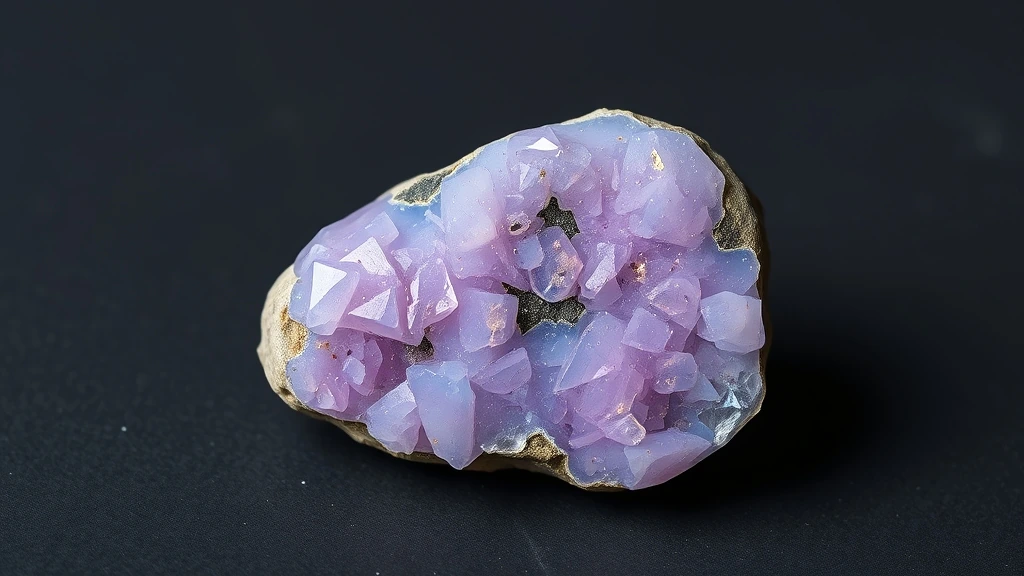
Opal Morado belongs to the mineraloid category, distinguishing it from true crystalline minerals due to its lack of long-range atomic order. It forms through the precipitation of silica gel in porous host rocks, creating a disordered network of hydrated silica spheres. This geological process results in a material that mimics crystal aesthetics while retaining an amorphous internal structure. Consequently, it is classified under the broader hydrated silica group rather than a specific mineral species.
What is Purple Opal Morado Opal? Geological Overview & Definition
Purple Opal Morado is a rare variety of common opal, characterized by its deep violet to purple body color. Unlike precious opal, which displays vibrant play-of-color, Morado opal typically exhibits a uniform hue with subtle internal luster. Its formation occurs in sedimentary basins where silica-rich solutions fill voids in volcanic tuff or sandstone. The specific purple tint is attributed to trace impurities and structural variations within the silica matrix.
The stone’s geological provenance is primarily linked to regions with significant volcanic activity, such as Mexico and Brazil. These areas provide the necessary porous host rocks for silica gel deposition over millions of years. The resulting material is a cryptocrystalline aggregate, meaning it consists of microscopic crystals too small to be individually resolved. This structural composition contributes to its unique optical properties and moderate durability. Similarly, the vibrant pink hues of Strawberry Opal are also formed in volcanic terrains where silica‑rich fluids infiltrate porous host rocks, creating a comparable cryptocrystalline structure.
Purple Opal Morado Opal Chemical Composition & Crystallographic Properties
The fundamental chemical identity of Purple Opal Morado is hydrated silicon dioxide, represented by the formula SiO₂·nH₂O. The variable water content (nH₂O) ranges significantly, influencing the stone’s density and stability. Unlike crystalline minerals, opal lacks a repeating unit cell, classifying it as an amorphous mineraloid. This disordered structure consists of tightly packed, sub-micron silica spheres arranged in a random yet dense packing. If you’re exploring the mineralogical nuances of opal, you might also appreciate how the iron‑rich inclusions that give Red Tiger Eye its striking chatoyancy illustrate a contrasting crystalline order within a similarly hydrated silica framework.
The amorphous lattice prevents the formation of distinct crystal faces, resulting in a conchoidal fracture pattern. Cation substitution is minimal, as the silica tetrahedra form a continuous network without significant metallic ion integration. The purple coloration stems from chromophore centers and light scattering effects within the silica sphere arrangement. These structural nuances create the stone’s characteristic ethereal glow without relying on traditional crystallographic symmetry.
Thermal behavior is critical for opal stability, as dehydration can cause crazing or cracking. Heating above 150°C may lead to irreversible loss of structural water, altering the refractive index and surface integrity. Acid sensitivity is low for pure silica, but impurities in the host rock may react to strong acids. Proper handling requires avoiding extreme temperature fluctuations to preserve the hydrated silica matrix and maintain optical clarity.
| Property | Specification |
|---|---|
| Mineral Group | Mineraloid (Hydrated Silica) |
| Chemical Formula | SiO₂·nH₂O (Hydrated Silicon Dioxide) |
| Mohs Hardness | 5.5 – 6.5 |
| Crystal System | Amorphous (Hydrated silica spheres / Mineraloid) |
| Specific Gravity (Density) | 1.98 – 2.25 |
| Refractive Index | 1.370 – 1.470 |
| Color & Optical Properties | Natural Purple Opal Morado Opal color spectrum and optical dispersion |
| Primary Mining Localities | Australia (Coober Pedy, Lightning Ridge), Ethiopia (Welo), Mexico |
| Water & Chemical Resistance | Moderate/Sensitive (%3-%21 water content; avoid prolonged soaking for hydrophane Welo opals) |
| Chakra Alignment (Traditional) | Crown Chakra and Heart Chakra |
| Zodiac Affinity (Traditional) | Libra, Scorpio, Pisces |
| Symbolic Meaning (Traditional) | Creativity, hope, emotional depth, and spontaneous inspiration |
Purple Opal Morado Opal Varieties & Color Spectrum
Purple Opal Morado Opal displays distinct mineralogical characteristics across its geological varieties and structural habits. Gemologists evaluate these natural varieties based on crystal habit, trace chromophore concentrations, and visual luster.
Primary Natural Purple Opal Morado Opal
The benchmark natural variety exhibiting diagnostic color saturation and classic crystallographic symmetry.
Distinct Geological Morphs of Purple Opal Morado Opal
Secondary regional and structural varieties formed under localized geological temperature and pressure conditions.
Australian Lavender Morado
Formed in silica‑rich sandstones of the Great Artesian Basin, this variety displays a lavender‑blue diffraction that shifts to deep violet under angled light. Microscopic silica spheres are tightly packed, creating a uniform play‑of‑color with minimal inclusions. Its rarity stems from the limited extent of the host sandstone lenses, making high‑quality stones prized by collectors.
Mexican Charcoal Morado
Developed within volcanic tuff deposits of the Sierra Madre, Mexican Charcoal Morado contains fine carbonaceous inclusions that mute the background, enhancing the opal’s dark purple hue. The opal’s hydrated silica matrix exhibits a strong fire effect, flashing magenta and indigo tones. Because mining is confined to small, family‑run shafts, gem‑quality material is scarce.
Ethiopian Violet Morado
Found in the Rift Valley’s basaltic lava flows, Ethiopian Violet Morado forms in secondary silica veins that fill fissures after volcanic activity. The opal’s high water content (up to 10 % by weight) produces a vivid, almost neon violet that intensifies after gentle heating. Limited exposure of the veins and strict export controls keep this variety among the most exclusive.
Brazilian Midnight Morado
Embedded in the quartz‑rich pegmatites of Minas Gerais, Brazilian Midnight Morado shows a deep midnight‑purple background punctuated by bright white fire flashes. Inclusions of micro‑crystalline quartz create a subtle sparkle that distinguishes it from lighter morado stones. The region’s extensive mining infrastructure yields more material, yet top‑grade stones remain limited due to stringent quality grading.
Canadian Arctic Morado
Originating in the permafrost‑preserved glacial till of the Northwest Territories, this variety exhibits a cool, icy violet with a faint blue‑white sheen. The opal’s formation involves slow precipitation of silica from meltwater, resulting in exceptionally uniform spheres and low impurity levels. Accessibility challenges and environmental regulations render high‑quality specimens exceptionally rare.
Slovakian Alpine Morado
Developed in the karstic limestone of the High Tatras, Slovakian Alpine Morado is characterized by layered banding of purple and pale pink hues, a result of alternating silica‑rich and calcite‑rich depositional phases. Thin calcite inclusions create a subtle iridescence that enhances the opal’s depth. Limited quarrying operations and the mountain’s protected status keep this variety scarce on the market.
Where is Purple Opal Morado Opal Found? Geological Mining & Extraction
The primary host rocks for morado opal are silica‑saturated sandstones, volcanic tuffs, and basaltic lava flows, where groundwater leaches silica and redeposits it as hydrated spheres. In many deposits, the opal fills fracture fillings and voids within these rocks, creating the characteristic play‑of‑color that defines the gemstone.
Major extraction zones include the Great Artesian Basin of Australia, the Sierra Madre of Mexico, and the Ethiopian Rift Valley, each employing a mix of open‑pit and underground mining. Smaller but notable sources occur in Brazil’s Minas Gerais pegmatites, Canada’s Arctic permafrost, and Slovakia’s High Tatras, where artisanal miners carefully chip away surrounding matrix to preserve the delicate opal structures.
Historical Significance & Cultural Lore of Purple Opal Morado Opal
Across ancient lapidary traditions, purple opal was treasured for its royal hue and perceived metaphysical powers. In Greco‑Roman texts, the stone was linked to Venus, symbolizing creativity and hope, while Egyptian tomb inventories list opal amulets intended to protect the heart and crown chakras of the deceased.
In early Chinese jade workshops, morado opal was inlaid into ceremonial vessels, believed to channel emotional depth and inspire spontaneous artistic insight. Vedic literature references a “*purplish stone of the heavens*” used in royal regalia to invoke balance between the Crown and Heart Chakras, underscoring its enduring cross‑cultural reverence.
Modern Uses & Jewelry Applications of Purple Opal Morado Opal
Lapidaries primarily cut Purple Opal into cabochons to maximize its play-of-color and soft pastel hues. The stone’s moderate Mohs hardness of 5.5 to 6.5 requires careful setting to prevent chipping during daily wear. Designers often pair it with silver or white gold to enhance its ethereal, dreamlike aesthetic.
- Cabochon Cutting: Dominant style for showcasing the amorphous silica sphere structure and color flashes.
- Ring and Pendant Settings: Bezel or prong settings that protect the stone’s edges from impact.
- Ornamental Carvings: Rarely carved due to fragility, but used in decorative inlays for artistic jewelry pieces.
- Earring Designs: Lightweight cuts to ensure comfort while displaying the stone’s unique refractive index variations.
Metaphysical Properties & Traditional Meaning of Purple Opal Morado Opal
According to historical traditions and metaphysical lore, this variety is revered for its ability to stimulate creative inspiration and emotional healing. Ancient Mediterranean lapidaries associated purple hues with royal spirituality and deep introspective power. The stone is believed to bridge the gap between the physical body and higher consciousness.
In Vedic and universal esoteric practices, Purple Opal symbolizes emotional depth and the restoration of hope during turbulent times. It is considered a powerful tool for balancing the mind and spirit, fostering spontaneous artistic expression. Practitioners often use it to release suppressed feelings and encourage intuitive clarity.
Which Chakra and Zodiac Signs Align with Purple Opal Morado Opal?
This gemstone is canonically aligned with the Crown Chakra and the Heart Chakra. The Crown connection supports spiritual awakening and higher intuition, while the Heart alignment promotes emotional balance and compassion. This dual resonance makes it ideal for meditation practices focused on holistic well-being.
Astrologically, Purple Opal is the primary stone for Libra, Scorpio, and Pisces. These water and air signs benefit from its calming influence and capacity to enhance emotional sensitivity. It is not traditionally associated with other zodiac signs in standard gemological astrology.
How to Identify Real vs. Fake Purple Opal Morado Opal
Artificial imitations of Purple Opal often include synthetic glass, dyed chalcedony, or plastic replicas designed to mimic the stone’s unique color play. These fakes lack the natural hydrated silicon dioxide structure and often exhibit uniform, unnatural color distribution. Understanding the subtle differences in texture and optical behavior is crucial for buyers.
Practical At-Home Authenticity Tests
- Temperature Test (Thermal Feel): Genuine opal feels cool to the touch and warms slowly, whereas plastic imitations warm up almost instantly due to low thermal conductivity.
- Specific Gravity & Weight Test: Real opal has a density of 1.98 – 2.25, making it feel heavier than plastic or lightweight glass substitutes of the same size.
- Scratch & Hardness Test (Mohs Comparison): With a hardness of 5.5-6.5, genuine opal will not be scratched by a steel knife (hardness 5.5), while softer fakes may show marks.
- Microscopic & Loupe Inspection (Internal Inclusions): Use a 10x loupe to check for natural silica sphere patterns; glass imitations often contain circular air bubbles or swirls not found in natural stone.
Purple Opal Morado Opal Valuation Factors, Grading & Pricing
The market value of a Purple Opal Morado Opal is first and foremost driven by Color Saturation. Stones that display a deep, vivid violet with a natural energetic luster command higher prices, as collectors prize the visual vibrancy that reflects the stone’s metaphysical potency.
Second, Crystal Size & Weight (Grams) plays a decisive role. Larger specimens with a smooth, tumbled polish and minimal natural matrix inclusions fetch premium prices, while smaller, raw pieces are valued primarily by their gram weight and overall shape. The absence of tumbled polish and natural crystal geometry or carat measurements underscores the amorphous nature of this mineraloid.
Finally, Ethical Sourcing & Locality Premium influences both holistic and collector markets. Stones sourced from responsibly managed deposits with transparent supply chains command a premium, as do specimens originating from renowned localities that carry historical lapidary significance.
How to Clean and Care for Purple Opal Morado Opal
Because Purple Opal Morado Opal contains a significant internal water content, ultrasonic cleaners and steam will cause micro‑fracturing (crazing). Strictly avoid any form of wet cleaning, including warm soapy water, damp cloths, or prolonged soaking. Instead, gently dust the specimen with a completely dry, soft microfiber cloth or a camel‑hair brush. Store the stone in a low‑humidity environment, away from liquids and direct heat sources, to preserve its structural integrity.
Cleansing and Recharging Purple Opal Morado Opal (Energetic Care)
For energetic renewal, place the opal under gentle moonlight for a few hours, allowing the subtle lunar energy to recharge its vibrational field. Alternatively, resting the stone on a selenite charging slab can facilitate a subtle, non‑thermal energy transfer that revitalizes its metaphysical properties. Herbal smudging with sage or cedar, performed with a dry, controlled flame, can cleanse residual energies without exposing the opal to heat that might damage its delicate lattice.
These dry, low‑heat methods respect the mineral’s sensitivity while supporting its energetic balance.
Frequently Asked Questions About Purple Opal Morado Opal
Purple Opal Morado Opal displays distinct mineralogical characteristics across its geological varieties and structural habits. Gemologists evaluate these natural varieties based on crystal habit, trace chromophore concentrations, and visual luster.
Primary Natural Purple Opal Morado Opal
The benchmark natural variety exhibiting diagnostic color saturation and classic crystallographic symmetry.
Distinct Geological Morphs of Purple Opal Morado Opal
Secondary regional and structural varieties formed under localized geological temperature and pressure conditions.
What is the chemical composition of purple opal?
It is hydrated silicon dioxide, SiO₂·nH₂O. This mineraloid consists of microscopic silica spheres that diffract light, producing the characteristic violet play‑of‑color. The water molecules trapped within the structure give the stone its modest density of 1.98–2.25 g/cm³ and contribute to its sensitivity to prolonged moisture exposure.
How hard is Morado opal compared with other gemstones?
Its Mohs hardness ranges from 5.5 to 6.5. This places it between quartz and feldspar, making it suitable for earrings and pendants but vulnerable to scratches from harder materials. Careful handling and protective settings help preserve its delicate play‑of‑color over time.
Can I wear purple opal in the shower or while swimming?
No, avoid prolonged soaking or direct water exposure. Morado opal contains 3‑21 % water and is moderately water‑sensitive, especially hydrophane “Welo” varieties that can absorb moisture and develop surface crazing. Quick exposure to rain is acceptable, but extended immersion should be avoided.
What is the safest way to clean a Morado opal piece?
Use a dry, soft microfiber cloth or a gentle brush to remove dust. Because the stone’s internal water makes it prone to micro‑fracturing, ultrasonic cleaners, steam, or any liquid cleaning agents can cause irreversible damage. Regular dusting maintains its brilliance without risk.
Does ultrasonic cleaning damage purple opal?
Yes, ultrasonic cleaning should be strictly avoided. The high‑frequency vibrations generate heat and pressure that can create micro‑fractures (crazing) within the hydrated silica matrix. Even brief exposure can compromise the stone’s structural integrity and diminish its visual effect.
Which zodiac signs are associated with Morado opal?
Libra, Scorpio, and Pisces are the aligned zodiac signs. In astrological tradition, these signs are believed to resonate with the stone’s creative and emotional energies, enhancing intuition and artistic expression for those born under these constellations.
Which chakras does purple opal balance?
It is linked to the Crown Chakra and the Heart Chakra. Activation of these energy centers is said to promote spiritual insight, emotional depth, and compassionate creativity, aligning the wearer’s higher consciousness with heartfelt inspiration.
How does the refractive index affect the stone’s appearance?
The refractive index varies between 1.370 and 1.470. This relatively low range, combined with the internal silica sphere structure, creates the soft, ethereal violet hues that shift with viewing angle. The modest index also contributes to the stone’s gentle sparkle rather than high‑intensity brilliance.