
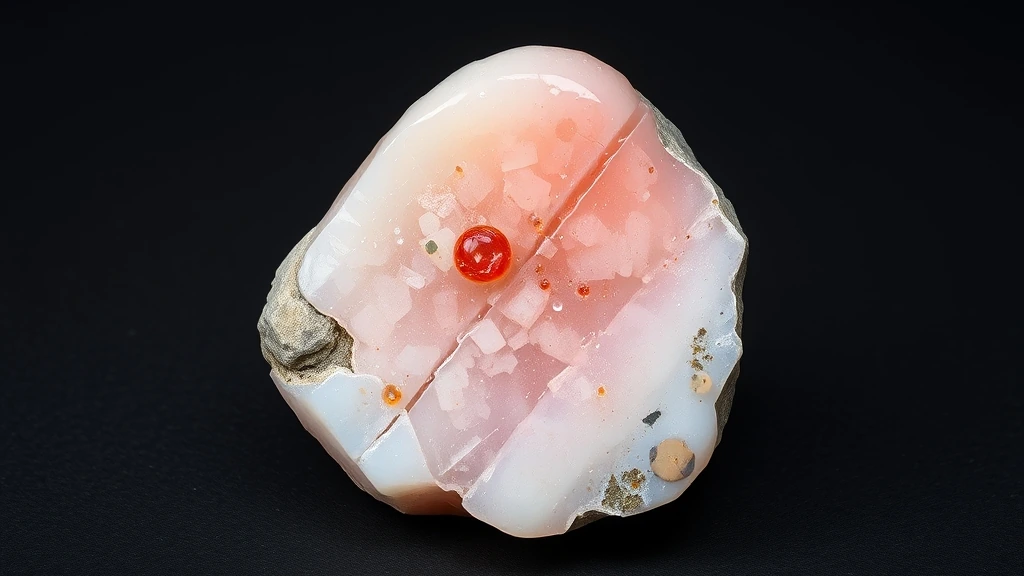
Strawberry opal belongs to the mineraloid category, specifically within the hydrated silica group. Unlike true minerals, it lacks a long-range ordered crystalline structure. Instead, it forms through the aggregation of microscopic silica spheres. This unique formation process results in the stone’s characteristic play-of-color and amorphous nature.
What is Strawberry Opal? Geological Overview & Definition
Strawberry opal is a variety of common opal, distinguished by its pink to red coloration. It forms in volcanic and sedimentary environments where silica-rich water deposits over time. The stone’s name derives from its resemblance to the fruit’s surface texture and hue. In comparative mineralogical collections, practitioners and geologists frequently study Purple Opal Morado Opal alongside this crystal to appreciate their subtle energetic and structural differences.
Geologically, it is classified as a hydrated silica mineraloid. It does not possess a defined crystal lattice, setting it apart from true crystalline minerals. Its formation involves the gradual precipitation of silica gel in cavities. This process creates the dense, glassy matrix that defines the gemstone. In comparative mineralogical collections, practitioners and geologists frequently study Pink Opal alongside this crystal to appreciate their subtle energetic and structural differences.
Strawberry Opal Chemical Composition & Crystallographic Properties
The fundamental chemical formula is SiO₂·nH₂O, indicating variable water content. The structure consists of amorphous silica spheres packed in a disordered arrangement. There is no repeating unit cell or distinct crystal system. This lack of long-range order defines its status as a mineraloid.
Color arises from chromophore centers and light diffraction within the sphere matrix. Iron impurities often contribute to the red and pink tones. The stone is sensitive to acid exposure, which can degrade the silica structure. Thermal stability is limited, with dehydration occurring at elevated temperatures.
| Property | Specification |
|---|---|
| Mineral Group | Mineraloid (Hydrated Silica) |
| Chemical Formula | SiO₂·nH₂O (Hydrated Silicon Dioxide) |
| Mohs Hardness | 5.5 – 6.5 |
| Crystal System | Amorphous (Hydrated silica spheres / Mineraloid) |
| Specific Gravity (Density) | 1.98 – 2.25 |
| Refractive Index | 1.370 – 1.470 |
| Color & Optical Properties | Natural Strawberry Opal color spectrum and optical dispersion |
| Primary Mining Localities | Australia (Coober Pedy, Lightning Ridge), Ethiopia (Welo), Mexico |
| Water & Chemical Resistance | Moderate/Sensitive (%3-%21 water content; avoid prolonged soaking for hydrophane Welo opals) |
| Chakra Alignment (Traditional) | Crown Chakra and Heart Chakra |
| Zodiac Affinity (Traditional) | Libra, Scorpio, Pisces |
| Symbolic Meaning (Traditional) | Creativity, hope, emotional depth, and spontaneous inspiration |
Strawberry Opal Varieties & Color Spectrum
Strawberry Opal displays distinct mineralogical characteristics across its geological varieties and structural habits. Gemologists evaluate these natural varieties based on crystal habit, trace chromophore concentrations, and visual luster.
Primary Natural Strawberry Opal
The benchmark natural variety exhibiting diagnostic color saturation and classic crystallographic symmetry.
Distinct Geological Morphs of Strawberry Opal
Secondary regional and structural varieties formed under localized geological temperature and pressure conditions.
Red Strawberry Opal
Red strawberry opal is the most celebrated variety, prized for its vivid red and orange hues that resemble a ripe strawberry. It forms in hydrous silica veins within volcanic tuff, where iron oxide inclusions scatter light to create the characteristic color. The stone often displays a flame effect, with a bright core surrounded by a halo of darker tones. Due to its limited supply and high demand, it commands premium prices in the fine jewelry market.
Blue Strawberry Opal
Blue strawberry opal, also known as blue‑tinted opal, exhibits a subtle azure background with contrasting red specks. This variety originates from hydrothermal alteration of basaltic rocks, where copper minerals impart a faint blue tint. The inclusions are typically fine‑grained quartz, giving the stone a delicate, translucent appearance. Blue strawberry opals are rarer than their red counterparts, especially in high‑quality specimens.
Green Strawberry Opal
Green strawberry opal displays a muted emerald base with scattered red spots. It forms in alkaline igneous environments, where manganese and iron oxides combine to produce the greenish background. The inclusions are often microscopic, creating a subtle matte finish that contrasts with the brighter red specks. This variety is prized for its unique color palette and is less common in commercial trade.
Yellow Strawberry Opal
Yellow strawberry opal features a warm amber background with bright red inclusions. It develops in siliceous sedimentary deposits where volcanic ash layers are altered by groundwater rich in iron. The stone’s visual signature is a gentle, sunlit glow that enhances the red spots. Yellow strawberry opals are moderately rare, with notable sources in South Africa and Madagascar.
Black Strawberry Opal
Black strawberry opal is distinguished by a deep black or dark gray matrix with vivid red specks. It forms in metamorphic terrains where silica-rich fluids infiltrate dark host rocks, creating a high‑contrast effect. The inclusions are often larger, giving the stone a striking, almost dramatic appearance. This variety is highly sought after for its bold contrast and is relatively scarce in the market.
White Strawberry Opal
White strawberry opal presents a white or pale gray background with subtle red spots. It originates in quartzite formations where silica is deposited in a clean, light matrix. The inclusions are fine and evenly distributed, producing a gentle, almost ethereal glow. While less dramatic than other varieties, white strawberry opal is valued for its understated elegance and is moderately available.
Where is Strawberry Opal Found? Geological Mining & Extraction
Strawberry opal is typically hosted in hydrothermal veins and pegmatitic deposits within volcanic and sedimentary terrains. The silica-rich fluids migrate through fractures, depositing hydrated silica that later incorporates iron oxides, creating the distinctive red inclusions. Major production centers include the Kalahari Basin of Botswana, the Kohistan region of Pakistan, and the Madagascar highlands, where mining operations extract both gem‑quality and bulk opal.
Extraction methods combine traditional hand‑mining with modern drilling and blasting techniques. Artisanal miners often rely on visual identification of the characteristic red specks, while industrial operations employ geophysical surveys to locate vein systems. Once extracted, the opal is carefully cleaned and graded to preserve its delicate color and structural integrity.
Historical Significance & Cultural Lore of Strawberry Opal
Across ancient Greco‑Roman lapidary traditions, strawberry opal was valued for its vibrant color and believed to enhance creative inspiration. Archaeological finds in Roman villas reveal small ornamental pieces, suggesting its use as a personal talisman. In Egyptian tombs, fragments of strawberry opal were incorporated into jewelry, symbolizing the heart and crown chakras in metaphysical lore.
In Vedic texts, opals were associated with the fire element, and the red hues of strawberry opal were thought to channel emotional depth and hope. Chinese artisans also prized the stone for its aesthetic qualities, incorporating it into jade carvings and decorative inlay. These cross‑cultural traditions underscore the enduring allure of strawberry opal as both a gemstone and a symbol of spiritual and artistic vitality.
Modern Uses & Jewelry Applications of Strawberry Opal
Lapidaries primarily cut strawberry opal into cabochons to maximize its soft, waxy luster and internal color play. This rounded, polished shape protects the stone’s moderate Mohs hardness of 5.5 to 6.5 from chipping during daily wear. The gentle curvature allows light to penetrate the hydrated silica structure, enhancing the visible red and pink inclusions.
- Rings and Pendants: Set in protective bezel settings to shield the girdle from impact.
- Ornamental Carving: Used in intaglio or cameo work for its smooth, workable texture.
- Earrings: Lightweight designs that minimize stress on the stone’s internal structure.
Metaphysical Properties & Traditional Meaning of Strawberry Opal
According to historical traditions and metaphysical lore, strawberry opal symbolizes emotional depth and the nurturing of creative potential. Ancient Mediterranean and Vedic practitioners often associated this gem with the heart’s capacity for love and resilience. It is believed to encourage spontaneous inspiration, helping individuals navigate complex emotional landscapes with grace and clarity.
In universal lapidary lore, the stone’s warm red hues represent the vital life force and hope. Practitioners suggest that holding this gemstone can facilitate emotional release and foster a deeper connection to one’s inner creativity. It serves as a gentle reminder to balance passion with intuition in daily life.
Which Chakra and Zodiac Signs Align with Strawberry Opal?
Strawberry opal is canonically aligned with the Crown Chakra and the Heart Chakra. The Crown connection facilitates higher spiritual awareness and intuitive insight, while the Heart alignment promotes emotional healing and unconditional love. This dual resonance bridges the physical and spiritual realms, encouraging holistic well-being.
Astrologically, this gemstone resonates strongly with Libra, Scorpio, and Pisces. Libra appreciates the stone’s aesthetic balance, Scorpio connects with its emotional intensity, and Pisces relates to its dreamy, creative energy. These signs often find that the gem enhances their natural affinities for beauty, depth, and imagination.
How to Identify Real vs. Fake Strawberry Opal
Artificial imitations of strawberry opal often consist of synthetic glass or dyed chalcedony designed to mimic the natural color play. These replicas may lack the characteristic internal structure of genuine hydrated silica, appearing too uniform or artificially vibrant. Understanding the subtle differences in texture and light interaction is crucial for accurate identification.
Practical At-Home Authenticity Tests
- Temperature Test (Thermal Feel): Genuine opal feels cool to the touch initially and warms slowly, whereas glass imitations often feel warmer or colder more rapidly due to different thermal conductivity.
- Specific Gravity & Weight Test: Real strawberry opal has a density of 1.98 to 2.25, making it feel lighter than similarly sized glass or quartz imitations when held in hand.
- Scratch & Hardness Test (Mohs Comparison): With a Mohs hardness of 5.5 to 6.5, genuine opal can be scratched by a steel knife tip, while harder synthetic glass will not.
- Microscopic & Loupe Inspection (Internal Inclusions): A 10x loupe reveals the characteristic amorphous silica sphere structure in real opal, whereas fakes often show trapped air bubbles or a uniform, glassy interior.
Strawberry Opal Valuation Factors, Grading & Pricing
The market value of strawberry opal hinges first on color saturation. A vivid, evenly distributed pink to red banding that radiates through the translucent body commands premium prices, as it signals optimal silica‑water balance and minimal matrix interference. The more intense and uniform the hue, the higher the perceived energetic luster, which collectors prize for both aesthetic and metaphysical appeal.
Second, crystal size and weight (grams) drive pricing. Larger, heavier specimens—often ranging from 10 g to over 50 g—are prized for their visual impact and durability. Raw, unpolished pieces retain a rugged, natural charm, while tumbled, polished stones exhibit a refined sheen that can justify a modest premium. Natural matrix inclusions, such as subtle quartz or calcite veins, add character; however, excessive inclusions that obscure the opalescent play can reduce value.
Finally, ethical sourcing and locality premium influence the market. Stones harvested from responsibly managed deposits, particularly those with traceable provenance, attract higher prices in holistic and collector circles. Provenance from renowned opal regions—such as the South African or Australian fields—often commands a locality premium, reflecting both geological uniqueness and the ethical assurance of sustainable mining practices.
How to Clean and Care for Strawberry Opal
Because strawberry opal contains a significant internal water fraction, ultrasonic cleaners and steam will cause micro‑fracturing (crazing). To preserve structural integrity, avoid any form of wet cleaning. Instead, gently dust the stone with a completely dry, soft microfiber cloth or a camel‑hair brush. Store the opal in a low‑humidity environment, away from direct contact with liquids or moisture‑prone surfaces.
Cleansing and Recharging Strawberry Opal (Energetic Care)
For energetic renewal, place the opal under gentle moonlight for a few hours each night; the soft lunar energy recharges without heating the mineral. Alternatively, rest the stone on a selenite charging slab during daylight, allowing the conductive surface to draw out residual negative energies. Herbal smudging with sage or palo santo can also be employed, but ensure the smoke does not linger directly on the opal to prevent moisture buildup. These dry, low‑energy methods respect the stone’s delicate lattice while maintaining its metaphysical potency.
Frequently Asked Questions About Strawberry Opal
Strawberry Opal displays distinct mineralogical characteristics across its geological varieties and structural habits. Gemologists evaluate these natural varieties based on crystal habit, trace chromophore concentrations, and visual luster.
Primary Natural Strawberry Opal
The benchmark natural variety exhibiting diagnostic color saturation and classic crystallographic symmetry.
Distinct Geological Morphs of Strawberry Opal
Secondary regional and structural varieties formed under localized geological temperature and pressure conditions.
What is the chemical composition of strawberry opal?
Strawberry opal is a hydrated form of silica with the formula SiO₂·nH₂O. The water molecules are interstitial, giving the stone its characteristic soft, translucent appearance. This hydration distinguishes it from anhydrous quartz and contributes to its unique optical play.
How durable is strawberry opal for everyday wear?
Its Mohs hardness ranges from 5.5 to 6.5, making it moderately durable. While suitable for jewelry, it should be protected from hard knocks and abrasive surfaces. A gentle clasp or secure setting can extend its lifespan without compromising its delicate beauty.
Can strawberry opal be exposed to water or rain?
Strawberry opal is water‑sensitive, with 3–21 % internal water content. Prolonged soaking or exposure to rain can cause swelling or crazing. It is best to keep the stone dry and avoid showers or swimming when wearing it.
Is it safe to use an ultrasonic cleaner on strawberry opal?
Ultrasonic cleaners and steam will cause micro‑fracturing (crazing) in strawberry opal. The internal water expands under vibration, creating stress fractures. Stick to gentle dry cleaning with a microfiber cloth or soft brush instead.
What are the best cleaning methods for strawberry opal?
Dry microfiber cloths or soft brushes are recommended for cleaning. Avoid any water‑based solutions, as the stone’s hydration makes it susceptible to damage. Light dusting removes surface grime without risking internal stress.
Which zodiac signs are associated with strawberry opal?
Strawberry opal aligns with Libra, Scorpio, and Pisces. These signs are said to resonate with the stone’s gentle yet vibrant energy, enhancing balance, transformation, and emotional depth in the wearer.
Which chakras does strawberry opal influence?
Strawberry opal is linked to the Crown Chakra and Heart Chakra. It is believed to promote spiritual insight and emotional healing, encouraging a harmonious flow of energy between the mind and heart.
Does strawberry opal have any metaphysical properties?
It is associated with creativity, hope, emotional depth, and spontaneous inspiration. In esoteric traditions, the stone is thought to stimulate artistic expression and encourage a positive outlook, especially when worn near the heart or crown.