
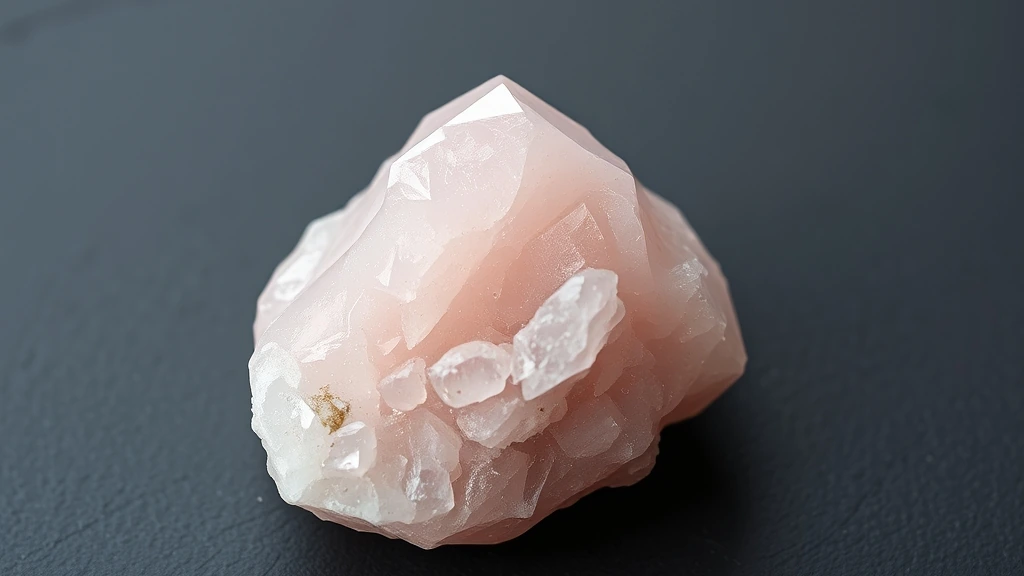
Rose Aura Quartz belongs to the Tectosilicate subclass within the broader Silicate mineral family. This classification reflects its framework structure of corner-sharing silicon-oxygen tetrahedra. As a member of the Quartz Group, it shares fundamental lattice mechanics with common varieties like amethyst and citrine. The stone’s unique aesthetic arises from surface treatments rather than internal crystalline defects.
What is Rose Aura Quartz? Geological Overview & Definition
Rose Aura Quartz is not a naturally occurring mineral variety but a treated gemstone. It consists of high-quality clear or smoky quartz that has undergone specific surface modification. This process creates a thin, metallic film that produces the characteristic rose-gold iridescence. The underlying crystal remains structurally identical to standard alpha-quartz.
The term “Aura” refers to the optical phenomenon of thin-film interference caused by the coating. This layer typically contains titanium dioxide or similar metal oxides. The resulting color shifts from pink to purple depending on the angle of light. Geologically, the stone is identical to untreated quartz, differing only in its surface chemistry. While the pink and purple hues of Rose Aura Quartz are often achieved through titanium dioxide coatings, the specific application of a metallic titanium layer produces the distinct silvery shee characteristic of Titanium Aura Quartz.
Rose Aura Quartz Chemical Composition & Crystallographic Properties
The crystallographic foundation of Rose Aura Quartz is the Trigonal system, specifically exhibiting Rhombohedral or Trapezohedral symmetry. Its lattice structure consists of a helical arrangement of SiO₄ tetrahedra linked by shared oxygen atoms. This open framework allows for minor cation substitution without disrupting the primary silicon-oxygen backbone. The stoichiometric formula remains strictly SiO₂, with no significant internal dopants in the base crystal. While the trigonal lattice of Rose Aura Quartz relies on a helical arrangement of SiO₄ tetrahedra, the cubic framework of Mystic Topaz demonstrates how different crystal systems can host similar metallic vapor depositions to create iridescent surface phenomena.
Optical properties are governed by a refractive index ranging from 1.544 to 1.553. The chromophore responsible for the aura is not an internal color center but an external metallic oxide layer. This coating interacts with incident light to create interference colors. The base quartz may contain trace iron impurities that influence the underlying smoky or clear tone.
Thermal behavior indicates stability up to approximately 573°C, where alpha-quartz transforms to beta-quartz. However, the surface coating may degrade at significantly lower temperatures due to oxidation or delamination. Acid sensitivity is low for the quartz substrate, which resists most mineral acids. The metallic aura layer, however, may react with strong alkaline solutions or abrasive polishing compounds.
| Property | Specification |
|---|---|
| Mineral Group | Silicates (Tectosilicates / Quartz Group) |
| Chemical Formula | SiO₂ (Silicon Dioxide) |
| Mohs Hardness | 7.0 |
| Crystal System | Trigonal (Rhombohedral / Trapezohedral) |
| Specific Gravity (Density) | 2.65 |
| Refractive Index | 1.544 – 1.553 |
| Color & Optical Properties | Natural Rose Aura Quartz color spectrum and optical dispersion |
| Primary Mining Localities | Brazil, Madagascar, USA (Arkansas), Swiss Alps |
| Water & Chemical Resistance | High (Fully resistant to water and moisture) |
| Chakra Alignment (Traditional) | All Chakras (Universal Harmonizer) |
| Zodiac Affinity (Traditional) | All Zodiac Signs (Especially Leo and Aries) |
| Symbolic Meaning (Traditional) | Master energy amplifier, clarity, purification, and focus |
Rose Aura Quartz Varieties & Color Spectrum
Rose Aura Quartz displays distinct mineralogical characteristics across its geological varieties and structural habits. Gemologists evaluate these natural varieties based on crystal habit, trace chromophore concentrations, and visual luster.
Primary Natural Rose Aura Quartz
The benchmark natural variety exhibiting diagnostic color saturation and classic crystallographic symmetry.
Distinct Geological Morphs of Rose Aura Quartz
Secondary regional and structural varieties formed under localized geological temperature and pressure conditions.
Classic Pink Aura Quartz
Formed when clear quartz is treated with a thin metallic coating, classic pink aura quartz displays a luminous rose‑pink sheen that deepens under angled light. The coating adheres to micro‑fractures created during natural crystal growth, giving a subtle iridescent glow. Though produced worldwide, high‑quality specimens from Brazil are prized for their uniform hue and minimal surface blemishes, making them moderately rare in the market.
Lavender‑Blushed Aura Quartz
This variety exhibits a delicate lavender‑pink overlay, resulting from a combination of titanium vapor deposition and controlled heat treatment. The titanium‑induced fluorescence produces a soft violet undertone that shifts to pink when viewed through the stone’s natural trigonal lattice. Primary sources include Madagascar and the United States, where the process yields a consistently vibrant color, though true lavender‑blush remains a collector’s specialty.
Sunset‑Rose Aura Quartz
Characterized by a gradient that moves from deep rose at the base to a warm amber near the apex, sunset‑rose aura quartz forms when iron oxide particles are introduced during the coating stage. The iron inclusions scatter light, creating a sunset‑like chromatic transition unique to each crystal. South‑African mines supply the most vivid specimens, and their limited output contributes to a higher market value.
Frosted Pink Aura Quartz
Frosted pink aura quartz displays a milky, opalescent surface over a gentle pink base, achieved by applying a fine silica dust before the metallic coating. The silica veil diffuses light, giving the stone a soft, ethereal glow that mimics early morning frost. This treatment is most common in Chinese workshops, yet authentic frosted pink stones with minimal surface wear are comparatively scarce.
Aurora‑Flare Pink Quartz
A rare hybrid, aurora‑flare pink quartz combines a pink aura coating with embedded thin layers of gold‑colored iridescence, producing a dynamic flare effect when rotated. The effect arises from alternating layers of gold vapor deposition and quartz, creating interference patterns visible at specific angles. Limited production runs in Brazil and Namibia make aurora‑flare pieces highly sought after by high‑end designers.
Rose‑Sheen Vein Quartz
Occurring naturally, rose‑sheen vein quartz contains thin, pink‑tinged calcite veins that run parallel to the crystal’s c‑axis. These calcite inclusions impart a subtle blush without any artificial coating, offering a genuine geological pink hue. Found primarily in the pegmatites of the United States’ Arkansas region, the variety is prized for its authenticity and is relatively uncommon compared to treated counterparts.
Where is Rose Aura Quartz Found? Geological Mining & Extraction
Rose aura quartz is not a primary mineral deposit but a post‑mining treatment applied to clear quartz harvested from pegmatitic host rocks rich in silica. The raw quartz crystals are extracted from deep‑seated granitic intrusions where slow cooling allows large, well‑formed trigonal prisms to develop, providing the ideal substrate for the aura coating process.
Major extraction zones include the Brazilian Minas Gerais pegmatite fields, the Madagascar Ankaratra complex, and the South African Bushveld belt, where abundant clear quartz is mined and subsequently shipped to specialized coating facilities. In each region, careful hand‑sorting ensures that only crystals with minimal inclusions receive the aura treatment, preserving the stone’s optical clarity and commercial grade.
Historical Significance & Cultural Lore of Rose Aura Quartz
Across ancient lapidary traditions, pink quartz was revered for its gentle yet potent energy, often associated with the heart and feminine virtues. In Vedic texts, rose‑hued quartz (known as “Mohan‑Mani”) was employed in meditation to amplify clarity and promote emotional balance, while Egyptian tomb inventories list pink quartz amulets intended to safeguard the soul in the afterlife.
During the Greco‑Roman era, rose quartz was carved into intaglios and cameos, symbolizing love and marital fidelity; writers such as Pliny the Elder noted its “softening” influence on the wearer’s temperament. In Chinese Daoist alchemy, pink quartz was ground into powders believed to harmonize the five elements, reinforcing its reputation as a universal harmonizer across all chakras.
Modern Uses & Jewelry Applications of Rose Aura Quartz
Rose Aura Quartz is prized for its soft pink hue and subtle translucency, making it ideal for lapidary cutting that accentuates its natural glow. Artisans frequently shape the stone into elegant cabochons for rings, pendants, and earrings, or carve it into intricate ornamental pieces for decorative panels and architectural accents. The gemstone’s durability (Mohs 7) allows for both polished faceted cuts and smooth, rounded surfaces that enhance its gentle aesthetic.
- Cabochon rings and pendants
- Faceted earrings and brooches
- Ornamental carvings for interior décor
- Decorative panels in architectural settings
Metaphysical Properties & Traditional Meaning of Rose Aura Quartz
According to historical traditions and metaphysical lore, Rose Aura Quartz is celebrated as a master energy amplifier that promotes emotional healing and spiritual clarity. Across ancient Mediterranean and Vedic lapidary lore, the stone is believed to soothe the heart, encouraging compassion and unconditional love. Its gentle vibration is said to cleanse negative energies, fostering a sense of inner peace and focus. In general metaphysical circles, the quartz is revered for its ability to harmonize the body’s energetic field, supporting both physical and emotional well‑being.
Which Chakra and Zodiac Signs Align with Rose Aura Quartz?
The stone is traditionally associated with all chakras, functioning as a universal harmonizer that balances the entire energetic system. Its influence is considered to extend across the entire spectrum of chakras, from the root to the crown, facilitating a holistic sense of equilibrium.
The gemstone aligns with all zodiac signs, with particular emphasis on Leo and Aries. In astrological practice, it is thought to enhance the fiery, dynamic qualities of these signs while also providing grounding support for the entire zodiac wheel.
How to Identify Real vs. Fake Rose Aura Quartz
Artificial imitations of Rose Aura Quartz often appear as dyed glass or synthetic crystals that lack the stone’s natural inclusions and subtle color variations. Genuine quartz exhibits a characteristic silica composition (SiO₂) and a refractive index between 1.544 and 1.553, whereas synthetic glass typically shows a higher index and a more uniform appearance.
Practical At-Home Authenticity Tests
- Temperature Test (Thermal Feel): Hold the stone in your hand; real quartz feels cool to the touch for a few seconds before warming, whereas glass warms quickly.
- Specific Gravity & Weight Test: Weigh the stone and compare its density to the known 2.65 g/cm³ of quartz; a lighter weight may indicate a glass imitation.
- Scratch & Hardness Test (Mohs Comparison): Use a reference mineral of known hardness (e.g., a steel nail for 5.5 or a quartz sample for 7); real quartz will scratch or be scratched according to its true hardness.
- Microscopic & Loupe Inspection (Internal Inclusions): Examine the stone under a loupe; authentic quartz often shows natural inclusions or subtle clouding, while dyed glass tends to be uniformly clear.
Rose Aura Quartz Valuation Factors, Grading & Pricing
Market value hinges primarily on Color Saturation, where deeper, more vibrant pink hues command higher premiums. Collectors prize specimens exhibiting a uniform, intense rose tone over pale or washed-out varieties. The visual impact is further enhanced by a natural, glassy luster that reflects light without artificial enhancement.
Pricing is determined by Crystal Size & Weight (Grams), with larger, unfractured pieces fetching significant sums in the raw market. Tumbled stones are graded by their polish quality, favoring smooth, blemish-free surfaces over rough or pitted textures. Natural matrix inclusions may add character but typically reduce the overall commercial value of the specimen.
Ethical Sourcing & Locality Premium significantly influences pricing within holistic and collector communities. Buyers increasingly demand transparent supply chains that ensure fair labor practices and environmental stewardship during extraction. Specimens from renowned, historically significant localities often carry a premium due to their provenance and rarity.
How to Clean and Care for Rose Aura Quartz
Rose Aura Quartz possesses a Mohs hardness of 7.0, making it highly durable against physical abrasion and daily wear. The mineral is fully resistant to water and moisture, allowing for safe immersion without risk of structural degradation. This stability ensures that the stone retains its integrity even after repeated exposure to liquids.
For routine maintenance, easily clean the specimen with warm water and mild soap to remove surface oils and dust. Rinse thoroughly under running water and dry immediately with a soft, lint-free cloth to prevent water spots. The stone is suitable for ultrasonic cleaning unless it is heavily fractured, as the vibrations may propagate existing internal cracks.
Cleansing and Recharging Rose Aura Quartz (Energetic Care)
Holistic practitioners often employ herbal smudging with sage or palo santo to clear perceived energetic stagnation from the stone. This dry method involves gently wafting the smoke over the crystal without direct flame contact, ensuring no thermal shock occurs. The process is considered safe for the mineral structure while addressing metaphysical intentions within traditional practices.
Alternatively, placing the quartz on a selenite charging slab allows for passive energy renewal through resonance. Gentle exposure to moonlight overnight is another popular technique, avoiding the intense heat of direct sunlight that could potentially stress the lattice. These methods maintain the stone’s physical stability while aligning with universal metaphysical traditions.
Frequently Asked Questions About Rose Aura Quartz
Rose Aura Quartz displays distinct mineralogical characteristics across its geological varieties and structural habits. Gemologists evaluate these natural varieties based on crystal habit, trace chromophore concentrations, and visual luster.
Primary Natural Rose Aura Quartz
The benchmark natural variety exhibiting diagnostic color saturation and classic crystallographic symmetry.
Distinct Geological Morphs of Rose Aura Quartz
Secondary regional and structural varieties formed under localized geological temperature and pressure conditions.
What is the chemical composition of Rose Aura Quartz?
Rose Aura Quartz is a form of silicon dioxide (SiO₂). This mineral belongs to the quartz family, crystallizing in a trigonal system. Its structure gives it a hardness of 7 on the Mohs scale and a density of 2.65 g/cm³, making it durable for everyday wear.
Is Rose Aura Quartz safe to wear in the shower or around water?
Yes, Rose Aura Quartz is fully resistant to water and moisture. Its crystalline lattice does not absorb water, so it can be worn in showers, baths, or exposed to rain without risk of damage. This property makes it ideal for daily use.
How should I clean my Rose Aura Quartz jewelry?
Use warm water and mild soap, or an ultrasonic cleaner if the stone is not heavily fractured. Gentle cleaning removes surface oils and grime. Avoid harsh chemicals that could dull the stone’s subtle pink sheen.
Can I use an ultrasonic cleaner on Rose Aura Quartz?
Yes, it is suitable for ultrasonic cleaning unless the stone has significant fractures. The ultrasonic waves help dislodge dirt from fine crevices, but heavily cracked pieces may crack further under vibration.
Which zodiac signs are most associated with Rose Aura Quartz?
All Zodiac Signs are compatible, especially Leo and Aries. The stone’s gentle energy resonates with the fire signs’ vitality, while its universal harmony benefits every sign’s astrological profile.
Which chakras does Rose Aura Quartz influence?
It harmonizes all chakras, acting as a universal energizer. The stone’s subtle pink hue supports emotional balance, while its crystal structure aligns the body’s energy centers for overall clarity.
Does Rose Aura Quartz have any special metaphysical properties?
It amplifies master energy, promotes clarity, purification, and focus. In metaphysical lore, the stone is believed to soothe emotional wounds and enhance self‑confidence, making it a popular choice for meditation and healing practices.
Can Rose Aura Quartz be used in jewelry that will be exposed to high temperatures?
Yes, it is heat resistant up to moderate temperatures. Quartz can withstand typical jewelry‑making heat without deforming, but extreme heat (above 500 °C) should be avoided to preserve its color and structural integrity.