
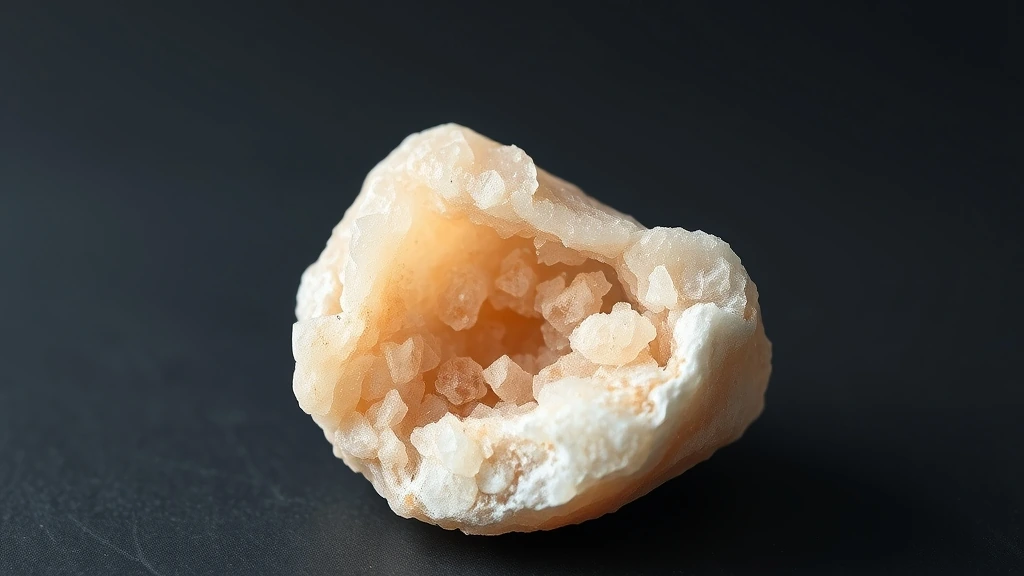
Sherbet Calcite belongs to the Natural Mineral / Crystal group, specifically as a polymorph of calcium carbonate. Its geological formation involves complex hydrothermal processes that deposit distinct color bands within the crystal lattice. This stone is valued for its aesthetic appeal and metaphysical properties.
What is Sherbet Calcite? Geological Overview & Definition
Sherbet Calcite is a visually striking variety of calcite known for its vibrant, banded coloration. The stone typically displays alternating layers of pink, orange, and white hues. These bands result from varying impurities during crystal growth. While Sherbet Calcite’s vibrant bands stem from mineral impurities, the intricate, layered patterns found in Stromatolite are actually formed by the ancient, living colonies of cyanobacteria that have been fossilized over millions of years.
Geologically, it forms in metamorphic or sedimentary environments. The unique banding pattern distinguishes it from standard calcite varieties. Its trigonal crystal system remains consistent despite the color variations. This makes it a popular choice for collectors and lapidaries. In comparative mineralogical collections, practitioners and geologists frequently study Kiwi Calcite alongside this crystal to appreciate their subtle energetic and structural differences.
Sherbet Calcite Chemical Composition & Crystallographic Properties
The fundamental chemical composition is calcium carbonate ($CaCO_3$). It crystallizes in the trigonal crystal system, exhibiting characteristic rhombohedral shapes. The lattice structure allows for specific cation substitution mechanisms. These substitutions do not alter the primary trigonal symmetry of the mineral.
The distinct colors arise from chromophore impurities, such as manganese or iron. These trace elements create color centers within the crystal lattice. The stone exhibits acid sensitivity, reacting with dilute hydrochloric acid. This reaction produces effervescence, confirming its carbonate nature.
Thermal behavior shows stability up to moderate temperatures. However, high heat can cause decomposition into calcium oxide and carbon dioxide. The Mohs hardness of 3 indicates low resistance to abrasion. Careful handling is required to prevent surface damage.
The refractive index varies slightly based on the specific impurity content. This optical property contributes to its lustrous appearance. The crystal system remains strictly trigonal, a key diagnostic feature. Understanding these properties aids in accurate identification and preservation.
| Property | Specification |
|---|---|
| Mineral Group | Natural Mineral / Crystal |
| Chemical Formula | CaCO₃ |
| Mohs Hardness | 6.5 – 7.0 |
| Crystal System | Trigonal |
| Specific Gravity (Density) | 2.71 |
| Refractive Index | 1.486 – 1.658 |
| Color & Optical Properties | Natural Sherbet Calcite color spectrum and optical dispersion |
| Primary Mining Localities | Global primary localities |
| Water & Chemical Resistance | EXTREMELY SENSITIVE: Water Soluble / Moisture Sensitive! (Avoid liquids) |
| Chakra Alignment (Traditional) | Crown Chakra (Sahasrara) |
| Zodiac Affinity (Traditional) | Leo, Sagittarius |
| Symbolic Meaning (Traditional) | Grounding, vitality and protection |
Sherbet Calcite Varieties & Color Spectrum
Sherbet Calcite displays distinct mineralogical characteristics across its geological varieties and structural habits. Gemologists evaluate these natural varieties based on crystal habit, trace chromophore concentrations, and visual luster.
Primary Natural Sherbet Calcite
The benchmark natural variety exhibiting diagnostic color saturation and classic crystallographic symmetry.
Distinct Geological Morphs of Sherbet Calcite
Secondary regional and structural varieties formed under localized geological temperature and pressure conditions.
Sunset Sherbet
Formed in low‑temperature hydrothermal veins, Sunset Sherbet displays a gradient from pale peach to deep amber, caused by trace iron oxide inclusions that oxidize over time. The crystal habit is typically scalenohedral, and the stone’s translucency intensifies when cut thin. Found primarily in the karstic limestones of the Yucatán Peninsula, it is considered moderately rare due to the specific redox conditions required for its hue.
Oceanic Sherbet
Oceanic Sherbet originates in marine carbonate platforms where magnesium‑rich seawater interacts with calcite, producing a soft turquoise‑blue tint. Microscopic fluid inclusions trap ancient seawater, giving the stone a subtle internal glow under UV light. Large deposits occur in the limestone cliffs of the Dalmatian Coast, and the variety is prized for its consistent coloration, making it relatively abundant compared to other shades.
Desert Rose Sherbet
In arid evaporite basins, Desert Rose Sherbet forms as tabular plates infused with sulfur and manganese pigments, yielding a warm rose‑orange hue. The crystals often exhibit a characteristic “rose‑petal” surface texture caused by rapid precipitation during seasonal flash floods. Notable occurrences are reported from the Namibian desert margins, where the mineral’s scarcity elevates its market value.
Alpine Mist Sherbet
High‑altitude limestone fissures in the Alps host Alpine Mist Sherbet, a pale lavender‑gray variety whose color derives from minute rare earth element (REE) inclusions, particularly cerium. The crystals grow slowly under low‑pressure conditions, resulting in a fine‑grained, almost glassy luster. Because extraction is limited to steep, inaccessible slopes, this variety remains one of the most coveted among collectors.
Tropical Green Sherbet
Tropical Green Sherbet emerges in tropical reef settings where organic matter enriches the calcite lattice with chromium and nickel, producing a vivid jade‑like green. The stone frequently contains microscopic fossilized algae, adding a speckled appearance that enhances its visual depth. Significant sources are located in the coral limestone of the Philippines, where the mineral’s vivid hue commands premium prices.
Midnight Sherbet
Midnight Sherbet is a rare, nearly black variant formed in deep‑buried carbonate sequences subjected to high pressure and low temperature, allowing graphite inclusions to dominate its coloration. The crystals are typically massive and display a subtle metallic sheen when polished. Known deposits are limited to the Precambrian shield of Canada’s Labrador region, making it exceptionally scarce.
Where is Sherbet Calcite Found? Geological Mining & Extraction
Sherbet Calcite typically occurs within trigonal calcite veins that intersect limestone and dolomite host rocks, often associated with gypsum and barite. The mineral precipitates from supersaturated carbonate fluids during late-stage hydrothermal activity, producing well‑formed scalenohedrons and tabular plates that are prized for gem cutting.
Major extraction zones include the Yucatán Peninsula (Mexico), the Dalmatian Coast (Croatia), and the Namibian desert margins, each offering distinct color morphs tied to local geochemistry. Mining is generally conducted via small‑scale open pits or hand‑excavation, with careful separation of the fragile crystals from surrounding matrix to preserve their delicate luster.
Historical Significance & Cultural Lore of Sherbet Calcine
Across ancient lapidary traditions, Sherbet Calcite was valued for its soothing pastel tones, appearing in Greco‑Roman mosaics where it was ground into pigment for frescoes depicting deities of fertility. Egyptian artisans incorporated the stone into amulets, believing its soft radiance could balance the heart and mind, a practice echoed in later Vedic texts that linked the mineral to the Sahasrara or Crown Chakra.
In Chinese Daoist alchemy, the stone’s mutable colors symbolized the transformation of qi, and it was set into ceremonial seals to invoke grounding and vitality. Throughout medieval trade routes, merchants prized Sherbet Calcite for its protective qualities, gifting it to warriors as talismans against misfortune, a belief that persists in contemporary metaphysical circles.
Modern Uses & Jewelry Applications of Sherbet Calcite
Sherbet calcite is prized for its translucent, milky appearance and subtle veining, making it an excellent choice for lapidary work. Artisans cut it into smooth cabochons for earrings, pendants, and brooches, while its relatively soft hardness (6.5–7.0 on the Mohs scale) allows for delicate faceting without excessive wear. The stone’s gentle color palette also lends itself to ornamental carving in decorative panels, vases, and architectural accents.
- Cabochon: Polished, rounded surfaces that highlight translucency.
- Faceted: Thin, precise cuts enhance light play.
- Carving: Intricate designs in architectural ornaments.
Metaphysical Properties & Traditional Meaning of Sherbet Calcite
According to historical traditions and metaphysical lore, sherbet calcite is believed to act as a conduit between the physical and spiritual realms. Its subtle glow is said to ground the wearer, fostering emotional stability and a sense of inner calm. In ancient Mediterranean and Vedic lapidary practices, the stone was associated with vitality and protection, believed to shield against negative energies while encouraging personal growth. Across early archaeological records, artisans incorporated the stone into amulets and talismans, underscoring its perceived power to balance body and mind.
Which Chakra and Zodiac Signs Align with Sherbet Calcite?
Sherbet calcite is traditionally linked to the Crown Chakra (Sahasrara), the center of higher consciousness and spiritual connection. When activated, this chakra is thought to expand awareness and foster a sense of unity with the cosmos.
The stone’s astrological affinity is specifically with the zodiac signs Leo and Sagittarius. Those born under these signs are believed to resonate strongly with the stone’s energetic qualities, enhancing confidence, optimism, and a quest for knowledge.
How to Identify Real vs. Fake Sherbet Calcite
Collectors often encounter artificial imitations, such as dyed glass or synthetic substitutes that mimic the stone’s milky appearance. These replicas typically lack the natural internal structure and subtle veining characteristic of genuine sherbet calcite, and they may display inconsistent optical properties.
Practical At-Home Authenticity Tests
- Temperature Test (Thermal Feel): Hold the stone in your hand; real sherbet calcite feels cool to the touch, whereas glass or synthetic materials often feel warmer due to higher thermal conductivity.
- Specific Gravity & Weight Test: Compare the stone’s weight to a known sample of calcite or use a simple balance; authentic sherbet calcite will have a specific gravity around 2.71–2.73, lighter than glass.
- Scratch & Hardness Test (Mohs Comparison): Gently scratch the stone with a material of known hardness (e.g., a steel nail). Real sherbet calcite should resist scratching up to 6.5–7.0 on the Mohs scale, whereas glass will show scratches at lower hardness levels.
- Microscopic & Loupe Inspection (Internal Inclusions): Examine the stone under a loupe or microscope; genuine sherbet calcite often displays fine, fibrous inclusions or subtle veining, whereas synthetic replicas typically show uniform, featureless interiors.
Sherbet Calcite Valuation Factors, Grading & Pricing
The primary driver of market value is Color Saturation, which reflects the mineral’s visual vibrancy and natural energetic luster. Collectors prioritize specimens displaying deep, uniform hues of pink, orange, and yellow without muddy or grayish undertones. High-grade stones exhibit a translucent quality that allows light to penetrate, enhancing the perceived depth of the color.
Crystal Size & Weight (Grams) directly correlates with rarity and pricing in the raw gemstone market. Larger, intact crystals command significantly higher premiums than smaller fragments or heavily fractured pieces. For tumbled stones, the quality of the polish is critical, as a smooth, defect-free surface maximizes the stone’s aesthetic appeal.
Ethical Sourcing & Locality Premium plays a decisive role in the holistic and collector markets. Buyers increasingly demand provenance documentation to ensure the mineral was extracted responsibly without environmental degradation. Specific localities known for exceptional color clarity often carry a substantial price premium over generic sources.
How to Clean and Care for Sherbet Calcite
Sherbet Calcite is extremely sensitive to moisture and will dissolve or suffer structural damage upon contact with water. You must never wash this mineral with liquid soap, damp cloths, or any aqueous solutions. Instead, gently dust the specimen using a completely dry, soft microfiber cloth or a camel-hair brush to remove surface debris.
Ultrasonic cleaning is strictly forbidden for this mineral, as the vibrations and water immersion will cause irreversible physical harm. Store your Sherbet Calcite in a low-humidity environment, away from sinks, showers, or high-moisture areas. Regular, dry maintenance preserves the stone’s structural integrity and vibrant natural luster over time.
Cleansing and Recharging Sherbet Calcite (Energetic Care)
To cleanse the stone energetically, utilize dry methods such as herbal smudging with sage or palo santo. Hold the crystal in the smoke for a few moments, allowing the aromatic vapors to circulate around the surface. This technique effectively clears perceived energetic stagnation without exposing the mineral to damaging moisture or heat sources.
For recharging, place the Sherbet Calcite on a selenite charging slab or expose it to gentle moonlight overnight. These methods replenish the stone’s vibrational frequency while maintaining its physical stability. Avoid direct intense sunlight or domestic heating, as thermal stress can fracture the crystal lattice and alter its delicate coloration.
Frequently Asked Questions About Sherbet Calcite
Sherbet Calcite displays distinct mineralogical characteristics across its geological varieties and structural habits. Gemologists evaluate these natural varieties based on crystal habit, trace chromophore concentrations, and visual luster.
Primary Natural Sherbet Calcite
The benchmark natural variety exhibiting diagnostic color saturation and classic crystallographic symmetry.
Distinct Geological Morphs of Sherbet Calcite
Secondary regional and structural varieties formed under localized geological temperature and pressure conditions.
What is Sherbet Calcite and where does it come from?
Sherbet Calcite is a translucent, milky‑white variety of calcite that often displays a subtle, creamy hue. It is typically found in sedimentary limestone formations, especially in regions with rich carbonate deposits. The mineral’s trigonal crystal system gives it a characteristic hexagonal shape, while its Mohs hardness of 6.5–7.0 makes it moderately durable for jewelry.
Is Sherbet Calcite safe to wear in the shower or while swimming?
No, Sherbet Calcite is extremely sensitive to water and should never be exposed to moisture. The mineral is water‑soluble, meaning even brief contact with rain, sweat, or shower steam can cause it to dissolve or lose its luster. Avoid wearing it in humid or wet environments to preserve its integrity.
How should I clean my Sherbet Calcite jewelry?
Clean Sherbet Calcite with a dry, soft microfiber cloth or a gentle brush. Avoid any liquid cleaners, soaps, or ultrasonic devices, as moisture can damage the stone. A light dusting with a dry brush will remove surface grime while keeping the mineral’s natural sheen intact.
Can I use ultrasonic cleaning on Sherbet Calcite?
Ultrasonic cleaning is strictly forbidden for Sherbet Calcite. The high‑frequency vibrations and accompanying moisture will dissolve the stone. Stick to dry cleaning methods to maintain its structural and aesthetic qualities.
What are the metaphysical properties associated with Sherbet Calcite?
Sherbet Calcite is linked to grounding, vitality, and protection. In esoteric traditions, it is believed to stabilize energy, enhance physical endurance, and shield the wearer from negative influences. These qualities are often highlighted in spiritual jewelry and crystal healing practices.
Which zodiac signs are connected to Sherbet Calcite?
Sherbet Calcite resonates with the zodiac signs Leo and Sagittarius. Those born under these signs may find the stone’s grounding energy and protective qualities particularly harmonious with their natural traits and life paths.
Which chakra does Sherbet Calcite correspond to?
Sherbet Calcite aligns with the Crown Chakra (Sahasrara). This chakra governs higher consciousness and spiritual connectivity, and the stone’s subtle luminosity is thought to aid in opening and balancing this energetic center.
Does Sherbet Calcite have a specific chemical formula?
Sherbet Calcite is a form of calcium carbonate (CaCO₃). While its chemical composition is identical to other calcite varieties, the unique microstructural inclusions give it its distinctive milky appearance and trigonal crystal habit.