
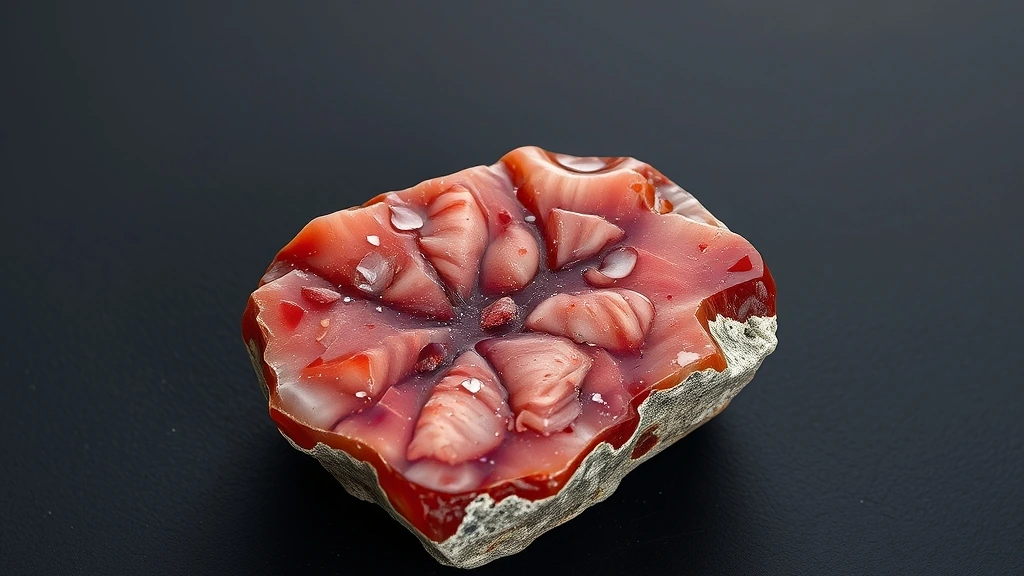
Strawberry Onyx belongs to the silicate class, specifically the chalcedony subgroup of quartz. This microcrystalline aggregate forms through the slow precipitation of silica in cavities or fractures, producing fine fibrous textures that give the stone its characteristic banding. The resulting mineral is prized for its visual contrast and relative durability.
What is Strawberry Onyx? Geological Overview & Definition
Strawberry Onyx is a fibrous microcrystalline variant of chalcedony, itself a member of the quartz group. It is distinguished by concentric or parallel bands of red or pink iron‑oxide inclusions within a dark matrix, creating a “strawberry” appearance. The stone is typically found in volcanic or sedimentary host rocks where silica‑rich fluids have infiltrated fissures. Its aesthetic appeal has made it a popular choice for ornamental carvings and jewelry.
Strawberry Onyx Chemical Composition & Crystallographic Properties
The fundamental chemical formula of Strawberry Onyx is SiO₂, identical to other chalcedony varieties. However, its trigonal crystal system—specifically a microcrystalline fibrous arrangement—differs from the more common hexagonal quartz lattice. In this system, the silica chains align along the c‑axis, producing a fibrous texture that is key to the stone’s banding. This distinctive fibrous microstructure is also a defining characteristic of Timor Agate, which shares the same chalcedony lineage but exhibits unique banding patterns resulting from similar silica deposition processes.
Cation substitution is minimal; the primary chromophore responsible for the red bands is iron (Fe³⁺) incorporated as trace impurities. These iron ions create color centers that absorb green and blue wavelengths, leaving a vivid pink or red hue. The stone’s acid sensitivity is low; dilute hydrochloric acid has little effect on its silica framework, though prolonged exposure can cause surface etching. In comparative mineralogical collections, practitioners and geologists frequently study Iris Agate alongside this crystal to appreciate their subtle energetic and structural differences.
Thermally, Strawberry Onyx behaves like other chalcedony: it resists moderate heating but will begin to soften and lose structural integrity above 500 °C. Its fibrous microstructure can crack if subjected to rapid temperature changes, so it is best handled at ambient conditions. The combination of its trigonal lattice, iron‑induced coloration, and robust silica matrix defines its unique identity within the quartz family.
| Property | Specification |
|---|---|
| Mineral Group | Silicates (Chalcedony / Quartz Group) |
| Chemical Formula | SiO₂ (Microcrystalline Chalcedony with parallel banding) |
| Mohs Hardness | 6.5 – 7.0 |
| Crystal System | Trigonal (Microcrystalline fibrous Chalcedony) |
| Specific Gravity (Density) | 2.60 – 2.65 |
| Refractive Index | 1.544 – 1.553 |
| Color & Optical Properties | Natural Strawberry Onyx color spectrum and optical dispersion |
| Primary Mining Localities | Brazil, India, Madagascar, Uruguay, Germany |
| Water & Chemical Resistance | High (Safe in warm soapy water) |
| Chakra Alignment (Traditional) | Root Chakra (Muladhara) |
| Zodiac Affinity (Traditional) | Leo, Capricorn, Scorpio |
| Symbolic Meaning (Traditional) | Willpower, emotional discipline, grounding protection, and stamina |
Strawberry Onyx Varieties & Color Spectrum
Strawberry onyx exhibits a diverse range of color morphs driven by trace element impurities within the microcrystalline chalcedony matrix. The most common variety features a soft, translucent pink hue resulting from minute iron oxide inclusions. This specific coloration is often referred to as rose chalcedony in gemological trade standards. The stone typically displays subtle, parallel banding that enhances its visual depth.
Classic Rose Chalcedony
This primary variety is characterized by a uniform, pale pink to salmon coloration without distinct banding. It forms through the slow precipitation of silica gel in cavities of volcanic rock. The lack of heavy impurities allows for high translucency and a smooth, waxy luster. It is the most widely available form in the global gemstone market.
Banded Strawberry Onyx
Distinct from the uniform rose variety, this type features alternating layers of pink and white or cream. The banding results from periodic changes in silica saturation and impurity concentration during deposition. These parallel bands create a striped visual effect that is highly sought after for carvings. The contrast between the bands defines its unique aesthetic appeal.
Deep Coral Onyx
This rarer morph displays a richer, more saturated orange-pink tone resembling dried coral. The intense coloration is attributed to higher concentrations of iron oxide traces within the silica structure. It often appears more opaque than its lighter counterparts due to denser microcrystalline fibers. This variety commands a premium price in the lapidary trade.
Mottled Strawberry Onyx
Characterized by irregular, cloud-like patches of pink against a white or gray background, this variety lacks linear banding. The chaotic pattern forms when silica deposits interact with varying host rock minerals. It offers a unique, organic appearance that differs from structured banded stones. Lapidaries often select these pieces for freeform jewelry designs.
Translucent Pale Pink Onyx
This delicate variety features a very light, almost pastel pink shade with high clarity. It is prized for its ability to transmit light through the fibrous chalcedony structure. The stone often appears ethereal and soft to the naked eye. Its subtle hue makes it popular for minimalist and contemporary jewelry settings.
Where is Strawberry Onyx Found? Geological Mining & Extraction
Strawberry onyx primarily forms in hydrothermal veins and cavities within volcanic and metamorphic host rocks. These deposits are typically found in regions with significant geological activity, such as Brazil, India, and Indonesia. The silica-rich fluids cool slowly, allowing the microcrystalline fibers to align and create the characteristic banding. Extraction involves careful blasting or drilling to preserve the integrity of the stone.
Major commercial sources include the Minas Gerais region in Brazil and the Chikmagalur district in India. Brazilian deposits often yield larger, higher-quality slabs suitable for carving and cabochons. Indian stones are known for their consistent coloration and moderate hardness. Mining operations focus on open-pit methods to access the shallow-lying ore bodies efficiently.
Historical Significance & Cultural Lore of Strawberry Onyx
Ancient Greco-Roman civilizations valued pink chalcedony varieties for their perceived ability to calm the mind and enhance emotional stability. Roman artisans frequently carved these stones into cameos and intaglios depicting deities and mythological scenes. The soft pink hue was associated with Aphrodite, the goddess of love and beauty. Archaeological findings in Pompeii reveal numerous such artifacts used as personal amulets.
In Vedic traditions, similar pinkish chalcedonies were incorporated into meditative practices to promote grounding and emotional discipline. Ancient Chinese lapidaries also utilized banded stones for decorative and ritualistic purposes, symbolizing harmony and balance. These cross-cultural uses highlight the stone’s enduring appeal as a tool for spiritual and aesthetic expression. The historical record confirms its widespread adoption across diverse ancient societies.
Modern Uses & Jewelry Applications of Strawberry Onyx
Strawberry Onyx is prized for its vivid pink‑red banding, making it a favorite for cabochon settings that showcase its smooth, lustrous surface. Artisans also facet the stone to create sparkling pieces, though the banded pattern is most striking in polished domes. Ornamental carving—such as beads, pendants, and small figurines—leverages its relatively easy workability while preserving its natural coloration.
- Cabochon pendants and earrings emphasizing the stone’s layered hues
- Faceted rings that combine durability with visual depth
- Carved cameos, beads, and decorative inlays for luxury accessories
Metaphysical Properties & Traditional Meaning of Strawberry Onyx
According to historical traditions and metaphysical lore, Strawberry Onyx is associated with willpower and grounding energy, helping the wearer maintain emotional discipline during turbulent times. Across ancient Mediterranean and Vedic lapidary records, the stone is believed to protect against negative influences while enhancing stamina for physical and mental tasks. Its warm coloration resonates with the heart’s desire for stability, encouraging a balanced flow of protective earth energy.
Which Chakra and Zodiac Signs Align with Strawberry Onyx?
In universal chakra systems, Strawberry Onyx is linked to the Root Chakra (Muladhara), reinforcing a sense of security and connection to the physical world. The stone’s grounding qualities are thought to anchor the wearer’s energy, fostering confidence and resilience in daily life.
Astrologically, the stone aligns with the fire‑sign Leo, the earth‑sign Capricorn, and the water‑sign Scorpio. These three signs are said to benefit from its stabilizing influence, which supports leadership, ambition, and transformative depth respectively.
How to Identify Real vs. Fake Strawberry Onyx
Artificial imitations of Strawberry Onyx include dyed quartz, colored glass, and synthetic resins that mimic its banded appearance but lack the mineral’s true silica composition. These substitutes often display uniform coloration or a glassy luster that differs from the natural stone’s subtle translucency. Careful observation of weight, surface feel, and internal structure can reveal the distinction between authentic onyx and its replicas.
Practical At-Home Authenticity Tests
- Temperature Test (Thermal Feel): Natural onyx feels cool to the touch and retains that coolness longer than glass, which quickly warms in the hand.
- Specific Gravity & Weight Test: Real Strawberry Onyx has a density of 2.60‑2.65 g/cm³, making it noticeably heavier than most synthetic glass of similar size.
- Scratch & Hardness Test (Mohs Comparison): With a hardness of 6.5‑7, the stone resists scratching by a steel file but will be marked by a quartz point; glass typically scratches more easily.
- Microscopic & Loupe Inspection (Internal Inclusions): Under 10× magnification, authentic onyx shows fine, parallel banding and micro‑crystalline texture, whereas imitations reveal bubbles, uniform color, or a lack of natural growth patterns.
Strawberry Onyx Valuation Factors, Grading & Pricing
Color saturation is the foremost driver of market value. Stones that display a vivid, uniform ruby‑red hue with minimal brown or gray streaks command premium prices, as collectors prize visual vibrancy that mimics fresh strawberries. A natural, glossy luster further enhances perceived quality, distinguishing high‑grade pieces from dull or unevenly colored material.
Crystal size and weight, expressed in grams, directly influence price brackets. Larger, well‑proportioned specimens that weigh several grams fetch higher rates, especially when the surface is expertly tumbled to a mirror‑like polish. Conversely, raw blocks with visible matrix inclusions are priced lower, reflecting the additional labor required to achieve a refined finish.
Ethical sourcing and locality premium increasingly shape collector demand. Stones harvested from responsibly managed quarries, with documented provenance and minimal environmental impact, attract a sustainability premium. Buyers in holistic markets also value pieces linked to traditional mining regions, where cultural heritage adds intangible worth beyond the physical attributes.
How to Clean and Care for Strawberry Onyx
Clean the gemstone using warm soapy water and a soft, lint‑free cloth, gently wiping the surface to remove dust and oils. Rinse briefly with clean water and pat dry with a microfiber towel, ensuring no residue remains. Ultrasonic cleaners may be employed safely provided the stone has not been artificially dyed, as the process will not damage the microcrystalline chalcedony structure.
Cleansing and Recharging Strawberry Onyx (Energetic Care)
For energetic maintenance, place the stone in the soft glow of moonlight for several hours, allowing lunar energy to gently refresh its vibrational field without exposing it to heat. Alternatively, a brief session of herbal smudging with sage or cedar can clear stagnant energies, provided the smoke is directed away from the surface to avoid residue buildup.
Resting the onyx on a clean selenite slab offers a non‑thermal method of recharging, as selenite’s high vibrational frequency can subtly amplify the stone’s grounding properties. Ensure the slab is dry and free of dust before contact, and limit exposure to a few minutes to maintain the crystal’s structural integrity.
Frequently Asked Questions About Strawberry Onyx
Strawberry Onyx displays distinct mineralogical characteristics across its geological varieties and structural habits. Gemologists evaluate these natural varieties based on crystal habit, trace chromophore concentrations, and visual luster.
Primary Natural Strawberry Onyx
The benchmark natural variety exhibiting diagnostic color saturation and classic crystallographic symmetry.
Distinct Geological Morphs of Strawberry Onyx
Secondary regional and structural varieties formed under localized geological temperature and pressure conditions.
Is strawberry onyx safe to wear in the shower?
Yes, it is safe in warm, soapy water. Strawberry onyx, a micro‑crystalline chalcedony, has a density of 2.60–2.65 g/cm³ and a hardness of 6.5–7.0, making it resistant to routine water exposure. Warm, mild soap and a soft cloth will not damage its parallel banding or color.
How should I clean strawberry onyx jewelry?
Clean with warm soapy water and a soft cloth; ultrasonic cleaners are safe unless the stone is dyed. The quartz‑based structure tolerates gentle agitation, but excessive heat or harsh chemicals can leach dyes. Rinse thoroughly and pat dry to preserve the stone’s vibrant red‑pink layers.
Can strawberry onyx be used in everyday rings?
Absolutely, its hardness of 6.5–7.0 makes it suitable for daily wear. While not as hard as corundum, it resists scratches from common activities. Regular cleaning with warm soapy water will keep the microcrystalline surface bright without compromising durability.
What zodiac signs are associated with strawberry onyx?
Leo, Capricorn, and Scorpio are the aligned zodiac signs. In astrological tradition, these signs are thought to benefit from the stone’s grounding energy, which complements the willpower and emotional discipline attributed to strawberry onyx.
Which chakra does strawberry onyx balance?
It is linked to the Root Chakra (Muladhara). This chakra governs stability and grounding, and the stone’s earthy quartz composition is believed to reinforce physical stamina and protective grounding for the wearer.
Does strawberry onyx have any known metaphysical properties?
It is said to enhance willpower, emotional discipline, and grounding protection. Practitioners claim the stone channels stamina and resilience, helping individuals stay centered during stressful situations while maintaining a calm, grounded presence.
Is strawberry onyx a true onyx?
No, it is a form of chalcedony, not true onyx. The name derives from its layered appearance, but chemically it is SiO₂, a microcrystalline quartz with parallel banding that mimics the visual effect of true onyx.
Can strawberry onyx be dyed, and does dye affect care?
Yes, some stones are artificially colored, and dye requires special care. While undyed strawberry onyx tolerates ultrasonic cleaning, dyed pieces may lose color if exposed to prolonged ultrasonic action or harsh detergents. Use gentle hand cleaning and avoid extended ultrasonic cycles to protect the dyed surface.