
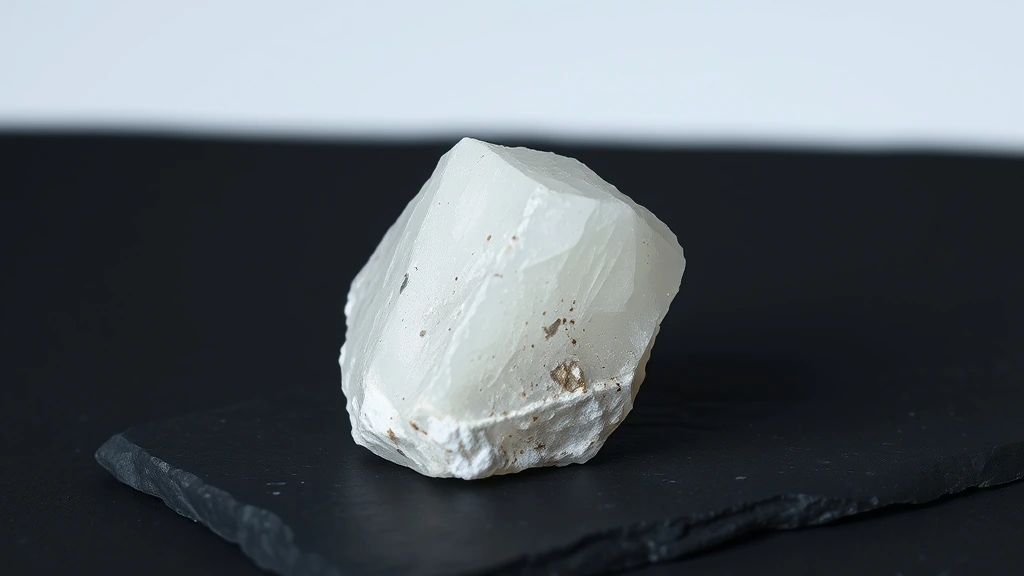
White aventurine belongs to the quartz family, a natural mineral that crystallizes in the trigonal system. It forms as a granular aggregate of micro‑inclusions that scatter light, giving the stone its characteristic shimmering appearance. Though often marketed as a single gemstone, it is an aggregate of silica crystals intergrown with minute mineral inclusions that produce its distinctive visual effect.
What is White Aventurine? Geological Overview & Definition
White aventurine is a silica‑based quartz variety whose milky translucency results from fine, uniformly distributed inclusions of mica, hematite, or other light‑scattering phases. These inclusions are typically less than a micron in size, creating a subtle adularescence that differentiates it from clear quartz.
In geological terms, white aventurine is an aggregate rock rather than a single mineral species; it comprises a host of quartz crystals bound together by silica cement. Its formation occurs in hydrothermal veins and pegmatitic bodies where slow cooling allows the growth of well‑ordered trigonal crystals interspersed with the reflective inclusions.
White Aventurine Chemical Composition & Crystallographic Properties
The primary chemical constituent of white aventurine is silicon dioxide (SiO₂), the same formula that defines all quartz varieties. Because it is an aggregate, the overall composition may include trace amounts of Fe, Al, or Ti that substitute into the quartz lattice, subtly influencing its optical properties. Zimbabwe Aventurine, for instance, often exhibits a distinct greenish hue due to specific iron inclusions that interact with the underlying silicon dioxide matrix.
White aventurine crystallizes in the trigonal crystal system, adopting the typical hexagonal‑like lattice of quartz with space group P3₁21 or P3₂21. The unit cell parameters (a ≈ 4.91 Å, c ≈ 5.40 Å) reflect the three‑fold rotational symmetry that governs its growth habit and cleavage. While white aventurine exhibits this specific trigonal lattice, its color variant, Yellow Aventurine, shares the same underlying quartz structure but incorporates iron-oxide inclusions that alter its optical properties without changing its fundamental crystallographic symmetry.
Acid sensitivity mirrors that of pure quartz: dilute hydrochloric acid produces no visible reaction, confirming the stability of the Si–O framework. However, prolonged exposure to strong acids can leach minor cationic impurities, potentially altering the stone’s surface luster.
Color in white aventurine arises from light‑scattering inclusions rather than transition‑metal chromophores; the inclusions act as microscopic reflectors that diffuse incident light, yielding a soft, opalescent sheen. Thermal treatment above 500 °C can cause the inclusions to recrystallize, sometimes enhancing the stone’s brilliance but also risking loss of the characteristic milky appearance.
| Property | Specification |
|---|---|
| Mineral Group | Natural Mineral / Crystal |
| Chemical Formula | SiO₂ |
| Mohs Hardness | 6.5 – 7.0 |
| Crystal System | Trigonal |
| Color & Optical Properties | Natural White Aventurine color spectrum and optical dispersion |
| Primary Mining Localities | Global primary localities |
| Water & Chemical Resistance | High (Safe for gentle water washing) |
| Chakra Alignment (Traditional) | Crown Chakra (Sahasrara) |
| Zodiac Affinity (Traditional) | Gemini, Virgo |
| Symbolic Meaning (Traditional) | Grounding, vitality and protection |
White Aventurine Varieties & Color Spectrum
White aventurine is not a single mineral species but a distinct variety of quartz characterized by its unique internal structure. Its defining feature is the presence of microscopic inclusions that create a shimmering, star-like effect known as aventurescence. This optical phenomenon distinguishes it from standard milky quartz, which lacks these reflective platelets.
Classic White Aventurine
This primary variety features a translucent to opaque white base with a dense field of tiny, silvery mica flakes. The inclusions are typically phlogopite or biotite, which scatter light to produce a soft, glittering luster. It is the most commercially available form, often sourced from Brazil and Madagascar.
Snow White Aventurine
Snow white aventurine exhibits a brighter, more crystalline appearance with fewer dark inclusions than the classic type. The high reflectivity of its internal quartz crystals gives it a frosty, icy aesthetic. This morph is highly sought after for its clean, luminous visual signature in jewelry design.
Milky White Aventurine
This variety displays a softer, cloud-like opacity due to higher concentrations of suspended silica particles within the quartz matrix. The resulting haze diffuses light gently, creating a dreamy, ethereal quality rather than a sharp sparkle. It is often confused with standard milky quartz but retains subtle aventurescent flecks.
Green-White Aventurine
While primarily white, this transitional morph contains trace amounts of chlorite or epidote inclusions. These greenish specks add a subtle, earthy undertone to the dominant white background. It is less common than pure white varieties and commands a premium in the gem market.
Blue-White Aventurine
Blue-white aventurine features a cool-toned white base with faint blue-grey mica inclusions. The coloration arises from the specific mineral composition of the reflective platelets. This variety is rare and often mistaken for pale blue quartz by untrained observers.
Where is White Aventurine Found? Geological Mining & Extraction
White aventurine typically forms within pegmatite deposits, where slow-cooling magma allows for the growth of large quartz crystals. These inclusions develop as the quartz crystallizes around pre-existing mica or other mineral fragments. The geological process is crucial for creating the distinct aventurescent effect seen in the gemstone.
Primary mining regions include Brazil, Madagascar, and the United States, particularly in states like California and North Carolina. Extraction involves open-pit mining or underground quarrying, followed by careful cutting to maximize the shimmering effect. The stone is then polished to reveal its internal beauty and structural integrity.
Historical Significance & Cultural Lore of White Aventurine
In ancient Greco-Roman traditions, quartz varieties were associated with purity and the divine realm of the gods. White stones were often used in rituals to invoke clarity and spiritual protection. Archaeological findings suggest these gems were valued for their perceived ability to channel positive energy.
Throughout Vedic and Chinese historical records, white quartz was linked to the crown chakra and mental clarity. It was believed to enhance meditation and connect the wearer to higher consciousness. This enduring legacy continues to influence modern metaphysical practices and gemological appreciation.
Modern Uses & Jewelry Applications of White Aventrine
White aventurine is most often fashioned into smooth cabochons that showcase its subtle shimmer, though skilled lapidaries also produce faceted cuts for rings and pendants. The stone’s relatively high Mohs hardness (6.5‑7) allows it to endure daily wear while retaining a gentle luster. Artisans also carve ornamental beads, small figurines, and decorative inlays for luxury watch faces and high‑end accessories.
- Cabochon pendants for meditation necklaces
- Faceted rings and earrings emphasizing light play
- Carved beads for rosaries and mala strands
- Inlaid motifs in watch dials and luxury pens
Metaphysical Properties & Traditional Meaning of White Aventurine
According to historical traditions and metaphysical lore, white aventurine is regarded as a stone of grounding that channels subtle vitality while offering protective energy. Across ancient Mediterranean and Vedic lapidary records, the stone is linked to mental clarity, encouraging rational thought and balanced decision‑making. Its cool, milky hue is said to soothe emotional turbulence, fostering inner peace and a sense of renewal during periods of change.
Which Chakra and Zodiac Signs Align with White Aventurine?
In universal esoteric systems, white aventurine resonates most strongly with the Crown Chakra (Sahasrara), supporting spiritual insight and the integration of higher consciousness. Practitioners place the stone on the crown during meditation to amplify intuitive guidance and connect with universal wisdom.
The stone’s energetic profile is traditionally matched to the zodiac signs Gemini and Virgo. Gemini benefits from its ability to clarify communication and mental agility, while Virgo finds reinforcement of analytical precision and practical grounding.
How to Identify Real vs. Fake White Aventurine
Artificial imitations of white aventurine often consist of dyed quartz, synthetic glass, or resin composites that mimic its milky appearance but lack the characteristic internal shimmer of natural mineral inclusions. These substitutes may feel lighter, display uniform coloration, or exhibit a glassy surface that differs from genuine stone.
Practical At-Home Authenticity Tests
- Temperature Test (Thermal Feel): Hold the stone against the skin; natural aventurine feels cool and gradually warms, whereas glass or plastic warms quickly.
- Specific Gravity & Weight Test: Compare the stone’s heft to a known quartz of similar size; genuine aventurine is slightly heavier due to its higher density.
- Scratch & Hardness Test (Mohs Comparison): Use a steel file (Mohs ~5.5); white aventurine should resist scratching, while glass or dyed quartz may show surface marks.
- Microscopic & Loupe Inspection (Internal Inclusions): Examine under 10× magnification; natural aventurine reveals fine, glittering mineral platelets, whereas fakes appear uniformly clear or display bubbles.
White Aventurine Valuation Factors, Grading & Pricing
The market value of white aventurine is primarily driven by color saturation. Stones with a deep, evenly distributed greenish sheen and a subtle sparkle command higher prices, as the visual vibrancy signals a well‑formed crystal lattice and minimal matrix interference. Collectors also prize specimens that exhibit a natural energetic luster, often described as a “soft glow” that enhances the stone’s metaphysical appeal.
Crystal size and weight (grams) are the next decisive criteria. Larger, heavier pieces—especially those that retain their raw, unpolished surface—are prized for their authenticity and heft. Tumbled polish quality can increase value, but only when the finish preserves the stone’s natural texture and does not obscure internal inclusions. In the absence of carat or tumbled polish and natural crystal geometry, the overall mass and dimensions remain the key metrics for grading.
Ethical sourcing and locality premium influence both holistic and collector markets. Stones mined from responsibly managed deposits, such as those in the United States or Brazil, carry a premium due to traceability and environmental stewardship. Provenance from renowned localities, coupled with transparent supply chains, can add significant value for discerning buyers who prioritize ethical considerations.
How to Clean and Care for White Aventurine
White aventurine is water‑resistant and can be safely cleaned with warm soapy water and a soft cloth. Gently wipe the surface to remove dust and fingerprints, ensuring the cloth is damp but not soaking wet. Avoid ultrasonic cleaners, as the vibration can induce micro‑fractures in the crystal structure, compromising its integrity.
Cleansing and Recharging White Aventurine (Energetic Care)
For energetic cleansing, place the stone on a selenite slab under gentle moonlight for several hours; the subtle lunar energy recharges without exposing the crystal to heat. Alternatively, a brief herbal smudging session—using sage or cedar—can clear residual energies while keeping the stone dry and protected from moisture. These methods respect the mineral’s structural stability while honoring its metaphysical properties.
Frequently Asked Questions About White Aventurine
White Aventurine displays distinct mineralogical characteristics across its geological varieties and structural habits. Gemologists evaluate these natural varieties based on crystal habit, trace chromophore concentrations, and visual luster.
Primary Natural White Aventurine
The benchmark natural variety exhibiting diagnostic color saturation and classic crystallographic symmetry.
Distinct Geological Morphs of White Aventurine
Secondary regional and structural varieties formed under localized geological temperature and pressure conditions.
What is the chemical composition of white aventurine?
White aventurine is a form of quartz with the chemical formula SiO₂. The mineral belongs to the trigonal crystal system and typically exhibits a hardness of 6.5 to 7 on the Mohs scale, making it durable for everyday wear. Its structure allows for the inclusion of mica or other mineral fragments, giving the stone its characteristic sparkling effect.
Is white aventurine safe to wear in the shower or during swimming?
Yes, white aventurine is water-resistant and can be gently washed in water. It can withstand normal exposure to moisture, but prolonged soaking or high-pressure jets may cause surface abrasion. For routine cleaning, a mild soapy solution and a soft cloth are recommended, avoiding harsh chemicals that could dull its luster.
How should I clean white aventurine to avoid damage?
Use warm soapy water and a soft cloth, and avoid ultrasonic cleaners. The stone’s internal structure can fracture under ultrasonic vibration, so gentle hand washing is safest. After cleaning, pat the surface dry with a microfiber cloth to preserve its natural sheen and prevent water spots.
Does white aventurine have any metaphysical associations with chakras?
White aventurine is associated with the Crown Chakra (Sahasrara). In many spiritual traditions, it is believed to enhance spiritual awareness, promote clarity of thought, and support a connection to higher consciousness. Its calming energy is thought to balance the mind and foster a sense of inner peace.
Which zodiac signs are traditionally linked to white aventurine?
The gemstones are traditionally linked to Gemini and Virgo. In astrological lore, these signs are thought to benefit from the stone’s grounding and protective qualities, helping to stabilize energy and encourage balanced communication and analytical thinking.
Can I use white aventurine in jewelry that is exposed to everyday wear and tear?
Yes, white aventurine is suitable for everyday jewelry. Its hardness and resistance to scratching make it a practical choice for rings, pendants, and bracelets. However, it should still be protected from harsh abrasives and heavy impacts that could chip or fracture the stone.
Is white aventurine suitable for children or people with sensitive skin?
White aventurine is generally safe for children and sensitive skin. The stone does not contain heavy metals or allergens, and its smooth surface is unlikely to cause irritation. Nonetheless, it is advisable to keep the jewelry out of reach of very young children to prevent accidental ingestion or injury.
What are the best storage practices for white aventurine jewelry?
Store white aventurine in a dry, soft-lined pouch or compartment. Avoid stacking heavy items on top of the stone to prevent scratches, and keep it away from direct sunlight to preserve its color. Regularly dust with a dry microfiber cloth to maintain its natural brilliance and protect against environmental pollutants.