
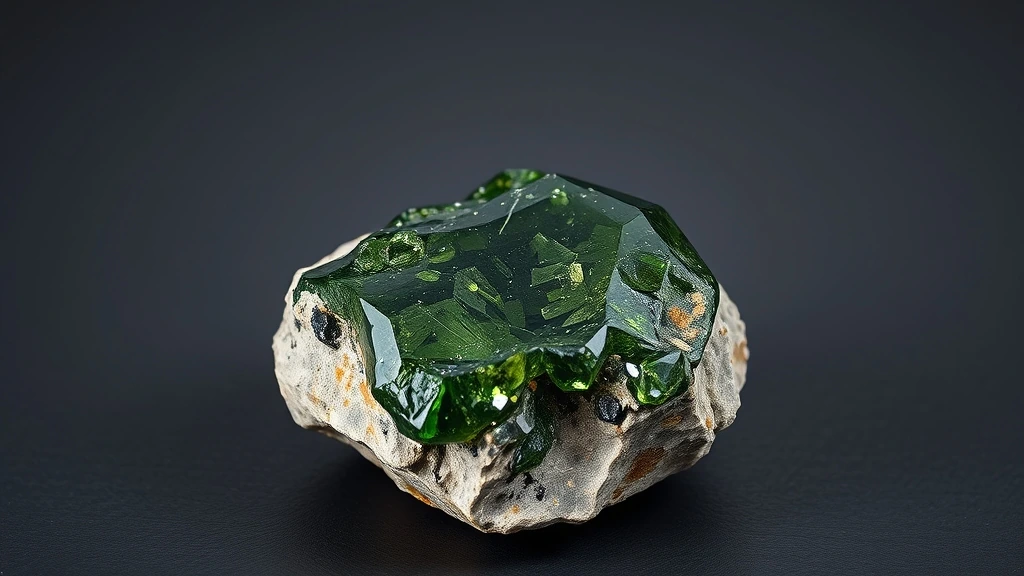
Demantoid garnet represents a specific variety of the garnet group, a major class of nesosilicate minerals. These silicates feature isolated tetrahedral silicon-oxygen units linked by metal cations, forming a robust structural framework. As a member of the garnet supergroup, it shares fundamental crystallographic traits with other species like almandine and pyrope. Its geological origin is tightly linked to metamorphic schists and serpentinites, where high-pressure conditions facilitate its formation.
What is Demantoid Garnet Gemstone? Geological Overview & Definition
Demantoid is distinguished by its high refractive index, which rivals that of diamond. This property grants the stone its characteristic “fire” and scintillation, often described as demantoid-like. It typically forms in small, well-developed crystals within host rocks such as talc-schist or chlorite-schist.
The name derives from the diamond-like appearance of its polished facets. Unlike other green garnets, such as tsavorite, demantoid often contains inclusions of chrysotile or chlorite. These internal features can affect clarity but also serve as diagnostic indicators of its specific geological environment.
Demantoid Garnet Gemstone Chemical Composition & Crystallographic Properties
Demantoid crystallizes in the isometric system, commonly forming dodecahedral or trapezohedral crystals. Its unit cell is cubic, reflecting the high symmetry inherent to the garnet group. The lattice structure consists of interpenetrating frameworks of silicon-oxygen tetrahedra and metal-oxygen polyhedra. This arrangement ensures structural stability under the high-pressure conditions of its formation.
The chemical formula is generally expressed as Ca3Fe2Si3O12, with significant cation substitution occurring. Iron replaces calcium in the dodecahedral sites, while chromium or vanadium may substitute for iron. These substitutions are critical for determining the stone’s specific gravity and optical dispersion.
The primary chromophore responsible for the green color is chromium, present in trace amounts. This transition metal creates specific energy levels within the crystal lattice, absorbing red and blue light. The resulting transmission of green wavelengths produces the stone’s vivid hue.
Demantoid is resistant to dilute acids, a property consistent with most silicate minerals. Thermally, it remains stable under standard jewelry conditions but may exhibit slight changes in color under intense heat. Its thermal conductivity is moderate, allowing for efficient heat dissipation during polishing.
| Property | Specification |
|---|---|
| Mineral Group | Silicates (Nesosilicates / Garnet Group) |
| Chemical Formula | X₃Y₂(SiO₄)₃ (Complex Silicate / Nesosilicate Group) |
| Mohs Hardness | 6.5 – 7.5 |
| Crystal System | Isometric / Cubic (Dodecahedral or trapezohedral crystals) |
| Specific Gravity (Density) | 3.50 – 4.30 |
| Refractive Index | 1.714 – 1.888 |
| Color & Optical Properties | Natural Demantoid Garnet Gemstone color spectrum and optical dispersion |
| Primary Mining Localities | India, Madagascar, Sri Lanka, Mozambique, USA |
| Water & Chemical Resistance | High (Water-resistant; safe for gentle warm water washing) |
| Chakra Alignment (Traditional) | Root Chakra (Muladhara) and Sacral Chakra |
| Zodiac Affinity (Traditional) | Capricorn, Aquarius, Aries |
| Symbolic Meaning (Traditional) | Grounding, passion, loyalty, physical vitality, and steadfast courage |
Garnet Varieties & Comprehensive Sub-Types
Almandine
Almandine represents the most abundant member of the garnet family, characterized by its iron-aluminum silicate composition. This variety typically exhibits a deep red to brownish-red hue, with a hardness ranging from Mohs 7.5 to 8.5. Geologically, it forms in metamorphic schists and gneisses, often displaying distinct zonal banding patterns.
In the gem trade, almandine is valued for its durability and consistent color saturation. While less rare than other varieties, high-quality stones command significant interest in jewelry markets. Its robust crystal structure makes it ideal for everyday wear in rings and pendants.
Pyrope
Pyrope is a magnesium-rich garnet celebrated for its intense ruby-red to blood-red coloration. Historically associated with Bohemia, this variety is prized for its fiery vitality and passionate aesthetic appeal. It typically forms in high-pressure metamorphic environments, often within eclogite facies rocks.
Lapidaries appreciate pyrope for its excellent clarity and vibrant luster, which rivals that of fine rubies. The stone’s chemical purity often results in minimal inclusions, enhancing its brilliance. Trade status remains stable, with collectors seeking large, eye-clean specimens from historic European mines.
Spessartine
Spessartine is a manganese-rich garnet distinguished by its electric fiery orange to mandarin hues. This variety is highly coveted by collectors due to its exceptional brilliance and rare color intensity. It commonly occurs in hydrothermal veins and skarn deposits, where manganese impurities create its signature warmth.
The gemological market places a premium on spessartine with vivid, unadulterated orange tones. High-quality specimens from Brazil and Namibia often exhibit superior transparency and fire. Its unique color range sets it apart from other orange gemstones in professional appraisal.
Demantoid
Demantoid is a rare emerald-green variety of andradite garnet, renowned for its diamond-like fire and brilliance. Its defining characteristic is the presence of horsetail inclusions, which are bundles of serpentine fibers. These inclusions serve as a natural identifier, distinguishing demantoid from other green garnets.
Geologically, demantoid forms in serpentinite rocks, often associated with tectonic plate boundaries. Its scarcity and exceptional refractive index make it a top-tier collector’s gem. Trade volumes are low, with high-value stones frequently appearing in auction houses rather than retail markets.
Tsavorite
Tsavorite is a vibrant chrome-green grossular garnet, primarily sourced from Kenya and Tanzania. Its intense green hue rivals that of the finest emeralds, making it a sought-after alternative. The color is driven by chromium substitution within the crystal lattice, ensuring exceptional saturation.
This variety is relatively young in the gem market, discovered in the 1960s. Its clarity and brilliance often exceed those of emeralds, which frequently contain visible inclusions. Lapidaries value tsavorite for its durability and vivid, unclouded green appearance in cut stones.
Rhodolite
Rhodolite is a natural pyrope-almandine solid solution series, exhibiting purplish-red to raspberry pink tones. This intermediate variety bridges the gap between pyrope and almandine in both composition and color. It typically forms in metamorphic terrains, sharing geological origins with its parent varieties.
The gem trade recognizes rhodolite for its unique, soft pinkish-red hue, distinct from standard garnets. Its balanced composition provides excellent hardness and durability for jewelry applications. Collectors prize stones with a clear, raspberry tone and minimal internal fractures.
Hessonite (Cinnamon Stone)
Hessonite is a grossular garnet variety characterized by its cinnamon-orange to honey-brown coloration. It often contains treacle-like swirl inclusions, which are distinctive and aid in identification. These inclusions result from fluid trapped during the crystal’s formation in metamorphic rocks.
While less valuable than other garnets, hessonite is popular in traditional jewelry and spiritual practices. Its warm, earthy tones appeal to those seeking affordable, durable gemstones. Lapidaries work with hessonite to optimize its luster, often cutting it to enhance its natural glow.
Gemologists differentiate these varieties primarily through spectroscopic analysis and visual inspection of inclusions. Each sub-type possesses unique chemical signatures and optical properties that guide precise identification. This systematic approach ensures accurate grading and valuation in the global gemstone market.
Where is Demantoid Garnet Gemstone Found? Geological Mining & Extraction
Demantoid garnet forms exclusively within serpentinite rocks, which are metamorphic formations derived from ultramafic oceanic crust. These deposits are typically located in tectonically active zones where intense pressure and heat transform the host rock. The gem crystals grow in cavities or along fracture planes within this specific geological matrix.
Primary extraction regions include the Ural Mountains in Russia, which historically produced the finest specimens. More recently, significant deposits have been identified in Afghanistan, Pakistan, and the United States. Mining operations focus on carefully extracting these fragile crystals from the surrounding serpentine matrix to preserve their integrity.
Historical Significance & Cultural Lore of Demantoid Garnet Gemstone
Demantoid garnet was first discovered in the Ural Mountains of Russia in 1868, leading to its naming after the diamond due to its brilliance. It quickly gained fame among European aristocracy, who prized its exceptional fire and rarity. Unlike older garnet varieties, demantoid was a modern discovery that captivated the 19th-century gemological community.
Its cultural lore is deeply tied to Russian imperial history, where it symbolized power and refined taste. Archaeological evidence of its use is limited to the post-1868 period, reflecting its relatively recent entry into the gem trade. Today, it remains a symbol of elite status and exceptional gemological quality.
Modern Uses & Jewelry Applications of Demantoid Garnet Gemstone
Demantoid garnet is prized for its exceptional brilliance and high refractive index, making it a favorite for faceted gemstones. Lapidaries often cut these stones to maximize their fiery dispersion, which rivals that of diamond. Due to their relative rarity, high-quality specimens are frequently set in gold or platinum rings, pendants, and earrings.
- Faceted Cuts: Round, oval, and emerald cuts are common to highlight the stone’s fire and clarity.
- Cabochons: Rarely used due to the stone’s transparency, but occasionally seen in antique pieces.
- Ornamental Carving: Small, high-clarity stones may be carved into intricate beads or small sculptural elements for luxury accessories.
Carat, Quality Grades & Value Factors of Demantoid Garnet
According to historical traditions and metaphysical lore, demantoid garnet is believed to stimulate personal power and ambition. Practitioners suggest that this stone helps the wearer overcome fear and fosters a sense of grounded confidence. It is often associated with transformation, encouraging individuals to shed old habits and embrace new beginnings.
The stone’s deep green color is thought to resonate with the heart chakra, promoting emotional balance and compassion. Many believe that wearing demantoid garnet can enhance intuition and spiritual awareness. Its energy is described as protective, helping to shield the wearer from negative influences while promoting inner peace.
Which Chakra and Zodiac Signs Align with Demantoid Garnet Gemstone?
In metaphysical practice, demantoid garnet is primarily aligned with the Root Chakra (Muladhara). This connection is believed to ground the wearer, providing stability and a strong sense of security. The stone is also said to influence the Sacral Chakra, enhancing creativity, passion, and emotional flow.
Astrologically, this gemstone is considered particularly beneficial for Capricorn, Aquarius, and Aries. For Capricorns, it is thought to enhance discipline and achievement. Aquarians may find it aids in innovation and social connection, while Aries are believed to gain increased courage and drive.
How to Identify Real vs. Fake Demantoid Garnet Gemstone
Identifying genuine demantoid garnet requires attention to its unique optical properties and internal characteristics. Common imitations include synthetic glass, dyed quartz, and other green garnet varieties like tsavorite. Glass imitations often lack the natural inclusions found in real stones and may exhibit different refractive indices.
Practical At-Home Authenticity Tests
- Temperature Test (Thermal Feel): Real demantoid garnet feels cool to the touch initially and warms up slowly. Glass imitations tend to warm up more quickly due to their lower thermal conductivity.
- Specific Gravity & Weight Test: Demantoid garnet has a specific gravity of approximately 3.9. It should feel noticeably heavier than a similarly sized glass or quartz stone when held in the hand.
- Scratch & Hardness Test (Mohs Comparison): With a Mohs hardness of 6.5 to 7, demantoid garnet will scratch glass (hardness 5.5) but will not scratch quartz (hardness 7). Be cautious, as this test can damage the stone.
- Microscopic & Loupe Inspection (Internal Inclusions): Use a 10x loupe to look for natural inclusions such as “horsetail” fibers or small bubbles. Glass imitations often contain circular bubbles, while natural stones may have irregular fluid inclusions.
Demantoid Garnet Gemstone Valuation Factors, Grading & Pricing
Color Saturation is the primary driver of value, with intense green hues commanding the highest premiums. Uniform tone across the stone ensures visual consistency, while high optical clarity enhances brilliance. A strong vitreous luster further distinguishes top-tier specimens from lower-grade material in the market.
Carat Weight significantly impacts pricing, as large, eye-clean demantoids are exceedingly rare and exponentially more valuable. Precise facet symmetry maximizes light return, creating the characteristic diamond-like fire that collectors seek. The presence of matrix inclusions can either detract from value or add unique geological interest.
Geographical Provenance Premium often elevates prices for stones from renowned locales like Russia or India. Wholesale values fluctuate based on supply, but retail prices remain stable due to limited availability. Understanding these trends helps buyers assess fair market value accurately.
How to Clean and Care for Demantoid Garnet Gemstone
To maintain optimal clarity, clean your gemstone with warm soapy water and a soft cloth. This gentle method effectively removes oils and dust without risking surface damage. Rinse thoroughly and dry with a lint-free cloth to prevent water spots.
Ultrasonic cleaners are generally safe for untreated garnets, but always verify the stone’s stability first. Avoid harsh chemicals or abrasive materials that could compromise the polish. Regular, gentle maintenance preserves the stone’s natural beauty and structural integrity over time.
Cleansing and Recharging Demantoid Garnet Gemstone (Energetic Care)
For energetic cleansing, use smoke smudging with sage or palo santo to clear stagnant energy. This dry method avoids moisture exposure, ensuring the mineral remains chemically stable. Allow the smoke to pass over the stone for a few minutes.
Place the gemstone on a selenite plate under moonlight for overnight recharging. This passive technique restores vibrational balance without physical contact or liquid immersion. Ensure the stone is dry before storage to maintain its luster.
Frequently Asked Questions About Demantoid Garnet Gemstone
What is demantoid garnet and how does it differ from other garnets?
Demantoid is a green, transparent variety of the andradite garnet group. It stands out for its exceptional dispersion (fire), often exceeding that of diamond, and its vivid emerald‑like hue, which results from trace chromium. Unlike the more common red pyrope, demantoid’s rarity and brilliance command premium prices.
How durable is demantoid for everyday jewelry?
Demantoid rates 6.5–7 on the Mohs hardness scale, making it fairly hard but slightly softer than quartz. It tolerates daily wear when set securely, yet its natural inclusions can create internal stress, so avoiding hard impacts is wise. Regular inspections help prevent chipping in high‑impact settings.
Is demantoid water‑resistant and safe to clean with warm water?
Yes, demantoid is highly water‑resistant and can be gently washed in warm, soapy water. Use a soft cloth to wipe the stone after cleaning; avoid harsh chemicals that could affect any surface treatments. This routine keeps its sparkle without compromising the crystal lattice.
Can I use an ultrasonic cleaner on demantoid garnet?
Ultrasonic cleaning is generally safe for untreated demantoid. Warm soapy water combined with a soft brush removes most residues, and a brief ultrasonic cycle (no more than 30 seconds) will not damage the stone’s internal structure. Always ensure the piece is securely mounted before cleaning.
Which zodiac signs are associated with demantoid garnet?
Demantoid aligns with Capricorn, Aquarius, and Aries. Enthusiasts believe the stone amplifies the ambition of Capricorn, the innovative spirit of Aquarius, and the courage of Aries. Wearing demantoid during key astrological periods is thought to enhance personal confidence and focus.
Which chakras does demantoid resonate with?
The gemstone is linked to the Root Chakra (Muladhara) and the Sacral Chakra. It is said to ground energy, fostering stability, while also stimulating creativity and emotional flow. Practitioners often place demantoid on the lower abdomen during meditation to balance these centers.
Where are the most prized demantoid deposits found?
Russia’s Ural Mountains, particularly the Zlatoust region, produce the finest demantoid specimens. These stones often exhibit the coveted “horsetail” inclusions—silicate needles that create a shimmering effect. Significant finds also occur in Namibia, Madagascar, and Pakistan, though they are typically less vivid.
How can I tell if a demantoid has been treated or enhanced?
Untreated demantoid displays natural inclusions and a uniform green hue without artificial colorants. Laboratory testing (e.g., spectroscopy) can detect heat treatment or surface coatings. If the stone appears overly bright or uniformly saturated, it may have undergone heat enhancement to improve its color.