
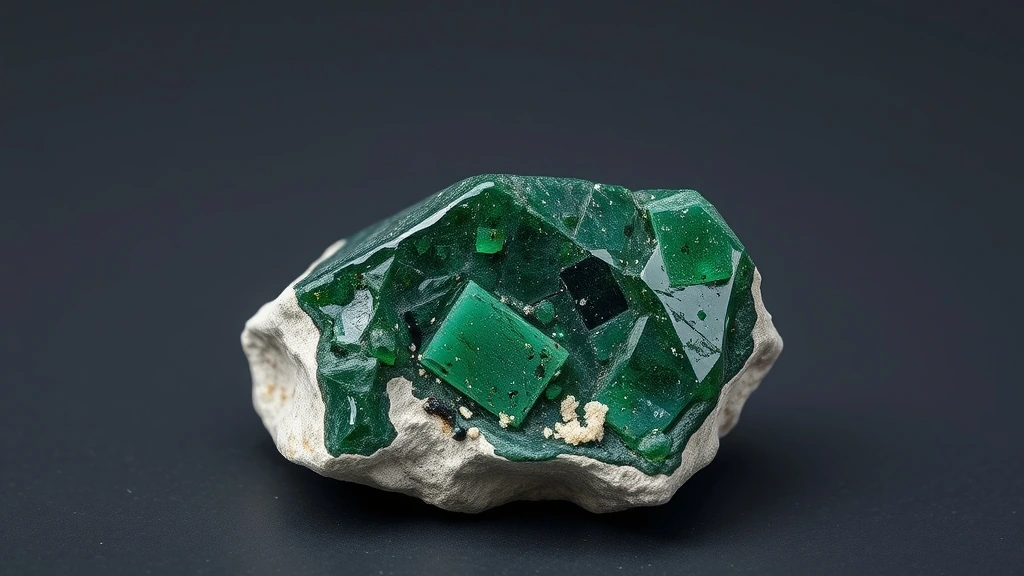
Tsavorite belongs to the garnet group of nesosilicates, a subclass of silicate minerals characterized by isolated SiO₄ tetrahedra. Formed in high‑grade metamorphic rocks such as schist and marble, it crystallizes in the isometric (cubic) system, typically as dodecahedral or trapezohedral crystals. The gemstone’s vivid green hue is imparted by trace vanadium and chromium substituting into the crystal lattice, a process that also influences its optical and physical properties.
What is Tsavorite Garnet? Geological Overview & Definition
Tsavorite is a green grossular garnet, first discovered in the 1960s in Tanzania’s Umba River valley. Unlike the more common red garnets, its coloration derives from vanadium and chromium, giving it a distinctive emerald‑like brilliance prized by gem collectors worldwide. In comparative mineralogical collections, practitioners and geologists frequently study Demantoid Garnet alongside this crystal to appreciate their subtle energetic and structural differences.
In mineralogical terms, Tsavorite is an isometric nesosilicate that forms in metamorphic environments where calcium‑rich rocks interact with vanadium‑bearing fluids. Its occurrence is relatively rare, limited to a few locales in Tanzania, Kenya, and Pakistan, which enhances its market value and collector appeal. In comparative mineralogical collections, practitioners and geologists frequently study Almandine Garnet alongside this crystal to appreciate their subtle energetic and structural differences.
Tsavorite Garnet Chemical Composition & Crystallographic Properties
The idealized formula X₃Y₂(SiO₄)₃ reflects a solid‑solution series where calcium occupies the X sites and vanadium or chromium substitute for the Y sites. This cation substitution not only creates the vivid green color but also subtly modifies the lattice parameters within the cubic framework.
Tsavorite crystallizes in the isometric (cubic) system, most often as well‑formed dodecahedra or trapezohedra. The crystal structure consists of isolated SiO₄ tetrahedra linked by calcium and transition‑metal cations, producing a highly symmetrical and densely packed lattice that contributes to its high specific gravity (3.50–4.30).
The gemstone’s refractive index (1.714–1.888) and moderate dispersion arise from the electronic transitions of vanadium and chromium ions, which act as chromophore centers. These ions absorb specific wavelengths of light, yielding the characteristic green hue while maintaining excellent brilliance.
Thermally, Tsavorite is stable up to about 800 °C; heating can cause color alteration if vanadium oxidizes, but the structure remains intact due to its robust cubic lattice. Its resistance to acid is moderate; dilute hydrochloric acid may etch the surface over prolonged exposure, reflecting the general chemical resilience of garnet minerals.
| Property | Specification |
|---|---|
| Mineral Group | Silicates (Nesosilicates / Garnet Group) |
| Chemical Formula | X₃Y₂(SiO₄)₃ (Complex Silicate / Nesosilicate Group) |
| Mohs Hardness | 6.5 – 7.5 |
| Crystal System | Isometric / Cubic (Dodecahedral or trapezohedral crystals) |
| Specific Gravity (Density) | 3.50 – 4.30 |
| Refractive Index | 1.714 – 1.888 |
| Color & Optical Properties | Natural Tsavorite Garnet color spectrum and optical dispersion |
| Primary Mining Localities | India, Madagascar, Sri Lanka, Mozambique, USA |
| Water & Chemical Resistance | High (Water-resistant; safe for gentle warm water washing) |
| Chakra Alignment (Traditional) | Root Chakra (Muladhara) and Sacral Chakra |
| Zodiac Affinity (Traditional) | Capricorn, Aquarius, Aries |
| Symbolic Meaning (Traditional) | Grounding, passion, loyalty, physical vitality, and steadfast courage |
Tsavorite Garnet Varieties & Color Spectrum
Tanzanian Tsavorite
Formed in granulitic metamorphic zones of the Merelani Hills, Tanzanian tsavorite crystallizes within mica‑rich schists under high‑temperature, low‑pressure conditions. The stones often display fine invisible inclusions of rutile and spinel that enhance their brilliance. Its vivid emerald‑green hue, caused by trace vanadium, is the most sought after, making this variety exceptionally rare and valuable.
Kenyan Tsavorite
Kenyan deposits occur in the Kakamega greenstone belt, where tsavorite grows in pegmatitic veins intersecting basaltic host rocks. These gems frequently exhibit a slightly bluish‑green tint and characteristic fracture‑filled fluid inclusions that give a watery depth to the stone. Compared with Tanzanian material, Kenyan tsavorite is less abundant but prized for its unique chromatic nuance.
Canadian Tsavorite (Ontario)
Discovered in the Bancroft region of Ontario, Canadian tsavorite forms in alkaline granitic pegmatites that cooled slowly, allowing large, well‑developed crystals. The stones are noted for a yellow‑green to olive coloration, often with subtle chlorite inclusions that impart a matte sheen. Their limited production and remote mining locations contribute to a niche market among collectors.
Russian Tsavorite (Ural)
Ural tsavorite originates from high‑grade metamorphic complexes where garnet replaces feldspar in mica‑schist matrices. The gems display a deep forest‑green tone with occasional rutile needle inclusions that create a star‑like effect under magnification. Though historically mined in modest quantities, Russian tsavorite remains a coveted specimen for its distinctive depth of color.
Australian Tsavorite (Western Australia)
Found in the Yilgarn Craton’s greenstone belts, Australian tsavorite grows in pegmatitic pockets within ancient basaltic flows. These stones often possess a bright, almost neon green hue, enriched by higher vanadium concentrations, and may contain microscopic quartz veils that enhance sparkle. Their recent discovery has sparked interest, yet the limited output keeps them relatively scarce.
Synthetic/Enhanced Tsavorite (Laboratory)
While not a natural variety, laboratory‑grown tsavorite replicates the X₃Y₂(SiO₄)₃ garnet structure using the Czochralski method. These gems can be engineered to display a uniform emerald‑green color with minimal inclusions, offering an affordable alternative for designers. Despite their visual similarity, synthetic tsavorite is clearly distinguished by its growth‑sector patterns under gemological microscopy.
Where is Tsavorite Garnet Found? Geological Mining & Extraction
Tsavorite is primarily extracted from metamorphic pegmatite veins that intersect mica‑schist and granitic host rocks, where high temperatures facilitate vanadium incorporation into the garnet lattice. Mining operations employ selective hand‑sorting and low‑impact blasting to preserve the delicate crystal habit, followed by careful washing to remove silicate matrix and reveal the stone’s brilliance.
The most productive regions include Tanzania’s Merelani Hills, Kenya’s Kakamega belt, and Canada’s Bancroft area, each offering distinct geological settings that influence color and clarity. Smaller but notable deposits exist in Russia’s Ural Mountains and Western Australia’s Yilgarn Craton, where remote extraction logistics add to the gems’ rarity and market value.
Historical Significance & Cultural Lore of Tsavorite Garnet
First documented by Western gemologists in the 1960s, tsavorite quickly entered high‑society jewelry, symbolizing grounding and steadfast courage in modern esoteric traditions. Ancient trade routes through East Africa suggest that early Swahili merchants may have exchanged tsavorite for ivory and gold, though no definitive archaeological artifacts have been recovered.
In contemporary folklore, tsavorite is associated with the Root and Sacral Chakras, believed to bolster physical vitality and passion. Its vibrant green hue has linked the stone to the zodiac signs Capricorn, Aquarius, and Aries, reinforcing themes of perseverance, innovation, and dynamic energy across cultures.
Modern Uses & Jewelry Applications of Tsavorite Garnet
Tsavorite garnet is primarily cut into brilliant, oval, and pear shapes to maximize its vivid green fire and dispersion. Lapidaries often employ mixed cut styles to enhance the stone’s natural brilliance while preserving carat weight.
- Faceted Jewelry: Ideal for engagement rings, earrings, and pendants due to its high refractive index.
- Cabochon Polishing: Rarely used, but applied to high-clarity stones for a smooth, glassy appearance.
- Ornamental Carving: Occasionally carved into beads or small figurines for high-end bespoke collections.
Carat, Quality Grades & Value Factors of Tsavorite Garnet
The primary determinant of tsavorite value is color, with a deep, vivid green being the most desirable. Stones exhibiting a slight bluish or yellowish undertone are generally less valuable than those with a pure, saturated green hue. The 4Cs framework remains the industry standard, where color saturation and tone outweigh other factors in pricing.
Clarity is the second critical factor, as eye-clean stones command significant premiums over those with visible inclusions. Carat weight impacts value exponentially, as larger, high-quality tsavorites are exceedingly rare in the global market. Cut quality must optimize light return to prevent the stone from appearing dull or muddy.
Durability is a key consideration for jewelry design, given tsavorite’s Mohs hardness of 6.5 to 7.5. While suitable for rings, the stone is more susceptible to chipping than diamond or sapphire. Lapidary grading standards emphasize avoiding sharp edges in prong settings to protect the stone’s structural integrity.
Zodiac and Astrological Lore of Tsavorite Garnet
In traditional gemology, tsavorite is aligned with the Root Chakra (Muladhara) and the Sacral Chakra. These alignments suggest the stone promotes grounding, physical vitality, and creative passion for the wearer.
Astrologically, tsavorite is considered a powerful stone for Capricorn, Aquarius, and Aries. Individuals born under these signs are believed to benefit from its steadfast courage and loyalty.
How to Identify Real vs. Fake Tsavorite Garnet
Common imitations include synthetic glass, dyed quartz, and other green garnet varieties like demantoid. Glass imitations often contain bubbles and lack the natural inclusions found in genuine tsavorite. Dyed stones may show color concentration along crystal boundaries or fractures.
Practical At-Home Authenticity Tests
- Temperature Test (Thermal Feel): Genuine tsavorite feels cool to the touch initially and warms slowly. Glass imitations warm up much faster due to lower thermal conductivity.
- Specific Gravity & Weight Test: Tsavorite has a specific gravity of 3.50 to 4.30. It feels significantly heavier than glass or quartz of the same size.
- Scratch & Hardness Test (Mohs Comparison): Tsavorite (Mohs 6.5-7.5) will not be scratched by a steel knife (Mohs 5.5). Glass (Mohs 5.0-5.5) may show minor scratches.
- Microscopic & Loupe Inspection (Internal Inclusions): Use a 10x loupe to look for natural inclusions like tiny crystals. Glass often reveals bubbles or swirls, while dyed stones show color bleeding in cracks.
Tsavorite Garnet Valuation Factors, Grading & Pricing
Market value is primarily driven by Color Saturation, where deep, vivid green hues command the highest premiums among collectors. Uniformity across the entire stone ensures visual consistency, while high optical clarity minimizes the impact of internal inclusions. A strong, vitreous luster further enhances the gem’s brilliance, making it visually distinct from lower-grade material.
Carat Weight significantly influences pricing, as large, high-quality tsavorites are exceptionally rare in the global gemstone market. Precise facet symmetry and optimal cut proportions maximize light return, adhering to rigorous lapidary standards. These technical attributes align with the 4Cs framework, ensuring that size and craftsmanship are accurately reflected in the final valuation.
Geographical Provenance Premium plays a critical role, with stones from the original Kenyan deposits often fetching higher prices due to historical significance. Certified gem market value trends show steady appreciation for documented, high-integrity specimens with verified origins. Buyers increasingly prioritize laboratory certification to confirm natural origin and assess potential treatment history.
How to Clean and Care for Tsavorite Garnet
Maintain the stone’s integrity by gently washing it in warm soapy water using a soft, lint-free cloth to remove surface oils. This method effectively cleans the facets without risking damage to the crystal structure or any potential internal fractures. Rinse thoroughly with lukewarm water to ensure no soap residue remains, which could dull the gem’s natural luster.
Ultrasonic cleaners are generally safe for untreated tsavorite garnets, providing a deep clean for intricate jewelry settings. However, always verify that the stone has no significant inclusions or fractures before using high-frequency vibration. Store the gem separately from harder materials to prevent scratches, leveraging its robust Mohs hardness of 6.5 to 7.5.
Cleansing and Recharging Tsavorite Garnet (Energetic Care)
For holistic maintenance, rest the stone on a selenite charging slab to absorb ambient energy without physical contact with liquids. This dry method respects the mineral’s physical stability while aligning with traditional practices for energetic renewal. Ensure the environment remains calm and free from direct, intense heat sources that could compromise the crystal lattice.
Alternatively, expose the tsavorite to gentle moonlight overnight to clear subtle energetic residues associated with its root chakra alignment. This passive approach avoids the risks of thermal shock or chemical alteration inherent in more aggressive cleansing techniques. Keep the stone in a secure, low-humidity location to preserve both its energetic and physical condition.
Frequently Asked Questions About Tsavorite Garnet
Is tsavorite garnet safe to wear in the shower?
Yes, tsavorite garnet is highly water-resistant and safe for gentle warm water exposure. The stone’s dense crystal structure prevents water absorption during daily activities like showering. However, always remove jewelry before using harsh chemical soaps or scrubbers. These substances can dull the polished surface over time.
How should I clean my tsavorite garnet jewelry?
Use warm soapy water with a soft cloth for routine maintenance. This method effectively removes oils and dirt without damaging the stone. Ultrasonic cleaners are generally safe for untreated garnets but should be avoided if the stone has fractures. Regular gentle cleaning preserves the gem’s vibrant green brilliance.
What is the Mohs hardness of tsavorite garnet?
Tsavorite garnet scores between 6.5 and 7.5 on the Mohs scale. This places it in the mid-range of hardness for gemstones, making it durable for daily wear. It resists scratches from common materials like steel or glass. Proper storage prevents contact with harder minerals like topaz or diamond.
Which zodiac signs are aligned with tsavorite garnet?
Capricorn, Aquarius, and Aries are the primary zodiac signs associated with this gem. These signs resonate with the stone’s energetic properties of strength and determination. Wearing tsavorite is believed to enhance personal traits linked to these astrological profiles. The connection supports grounding and physical vitality for these individuals.
What chakras does tsavorite garnet activate?
Tsavorite garnet primarily activates the Root Chakra (Muladhara) and Sacral Chakra. These energy centers govern stability, survival, and creative passion. The stone’s deep green hue supports physical vitality and emotional balance. Practitioners use it to foster a sense of steadfast courage and loyalty.
How can I distinguish tsavorite from emerald?
Tsavorite typically exhibits higher refractive index values compared to emerald. While both are green, tsavorite often shows stronger double refraction under magnification. Emeralds frequently contain visible inclusions known as “jardin,” whereas tsavorite is often cleaner. Professional gemological testing confirms the specific chemical composition of each stone.
Is tsavorite garnet a good investment?
Yes, tsavorite is a rare and increasingly valuable gemstone. Its limited global supply drives consistent price appreciation in the market. High-quality stones with vivid green color command premium prices. Investors should seek certified pieces from reputable laboratories to ensure authenticity and value retention.
Does tsavorite garnet require special care in heat?
Tsavorite garnet is stable in moderate heat but should avoid extreme temperatures. Sudden thermal shock can potentially cause internal stress or fractures. Avoid exposing the stone to open flames or high-heat environments. Standard jewelry care involves keeping it away from direct sunlight for prolonged periods to preserve color saturation.