
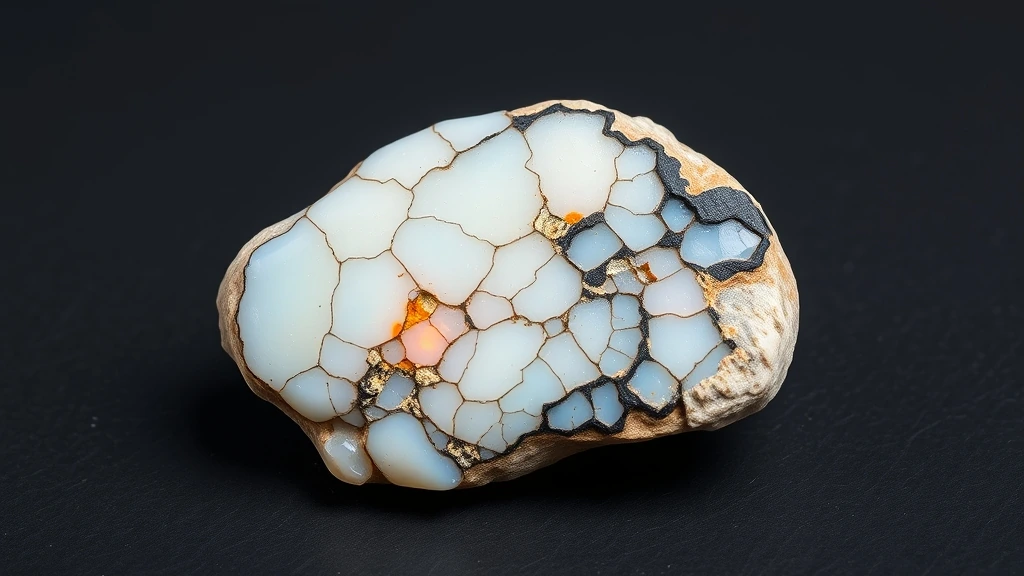
Dendritic Opal belongs to the Mineraloid (Hydrated Silica) parent group, distinguishing it from true crystalline minerals. Unlike quartz, it lacks a long-range atomic order, forming instead through the aggregation of microscopic silica spheres. This amorphous structure allows for the unique preservation of dendritic patterns within the stone. Consequently, it is classified as a colloidal silica deposit rather than a conventional gemstone crystal.
What is Dendritic Opal Gemstone? Geological Overview & Definition
Dendritic Opal forms when manganese or iron oxides precipitate along fissures in silica-rich environments. These metallic impurities create branching, fern-like patterns known as dendrites within the opal matrix. The host material is typically common opal, which provides the necessary structural stability for these inclusions.
The geological process involves the slow deposition of hydrated silica around existing mineral veins. This results in a stone that is visually striking yet structurally distinct from crystalline varieties. Understanding this formation is crucial for identifying natural specimens versus synthetic imitations. The dendritic pattern serves as a primary diagnostic feature for gemologists.
Dendritic Opal Gemstone Chemical Composition & Crystallographic Properties
The fundamental structure of Dendritic Opal is amorphous, composed of tightly packed hydrated silica spheres. It does not possess a defined crystal lattice or repeating unit cell, classifying it strictly as a mineraloid. This lack of long-range order differentiates it significantly from crystalline quartz or other silicate minerals.
Chemically, the base composition is SiO₂·nH₂O, where water content typically ranges from 3% to 20%. Cation substitution is minimal, as the silica framework remains largely pure. Any color in the dendrites arises from trace metallic oxides, not lattice defects. The chromophore centers are localized within these inclusions, not the silica host.
The stone exhibits moderate acid sensitivity, though pure silica is generally resistant to mild acids. However, the organic or metallic impurities in the dendrites may react differently under harsh conditions. Thermal behavior is critical, as rapid heating can cause dehydration and cracking. Proper handling ensures the preservation of the delicate hydrated silica structure.
| Property | Specification |
|---|---|
| Mineral Group | Mineraloid (Hydrated Silica) |
| Chemical Formula | SiO₂·nH₂O (Hydrated Silicon Dioxide) |
| Mohs Hardness | 5.5 – 6.5 |
| Crystal System | Amorphous (Hydrated silica spheres / Mineraloid) |
| Specific Gravity (Density) | 1.98 – 2.25 |
| Refractive Index | 1.370 – 1.470 |
| Color & Optical Properties | Natural Dendritic Opal Gemstone color spectrum and optical dispersion |
| Primary Mining Localities | Australia (Coober Pedy, Lightning Ridge), Ethiopia (Welo), Mexico |
| Water & Chemical Resistance | Moderate/Sensitive (%3-%21 water content; avoid prolonged soaking for hydrophane Welo opals) |
| Chakra Alignment (Traditional) | Crown Chakra and Heart Chakra |
| Zodiac Affinity (Traditional) | Libra, Scorpio, Pisces |
| Symbolic Meaning (Traditional) | Creativity, hope, emotional depth, and spontaneous inspiration |
Opal Varieties & Comprehensive Sub-Types
Black Opal
Formed in the silica‑rich, weathered sandstones of Lightning Ridge, Australia, black opal precipitates from groundwater under low‑temperature conditions. The dark body tone (N1‑N4) acts as a light‑absorbing canvas for vivid play‑of‑color bands that often display a “fireball” pattern. Inclusions are typically fine silica particles that enhance the contrast, while the banding is irregular, creating a “cactus‑skin” appearance. Because of its rarity and intense color contrast, black opal commands the highest market prices and is graded as the premier precious opal worldwide.
White / Light Opal
White or light opal develops in the same sedimentary basins as black opal but precipitates in zones with higher silica saturation, yielding a milky or white body tone. The opal’s play‑of‑color is softer, ranging from pastel blues to pinks, and appears as delicate flashes across a translucent matrix. Inclusions often consist of microscopic quartz crystals that scatter light, producing a subtle “milky” effect, while banding is generally uniform and less pronounced. Though less valuable than black opal, high‑grade white opal remains popular for jewelry due to its classic elegance and consistent color display.
Fire Opal
Mexican fire opal forms in volcanic rhyolite cavities where silica‑rich fluids cool rapidly, creating a translucent to transparent stone with warm hues of red, orange, or yellow. The vivid coloration is intrinsic to the silica lattice, not a surface coating, and the play‑of‑color is typically weak or absent, making the body color itself the focal point. Inclusions are often tiny gas bubbles that give a subtle sparkle, while the internal structure is relatively homogeneous, allowing the stone to be faceted like traditional gemstones. Fire opal is prized in the market for its fiery body tone and is frequently cut into cabochons or faceted gems for high‑end jewelry.
Boulder Opal
Boulder opal originates in the ironstone host rocks of Queensland, Australia, where silica‑rich solutions infiltrate cracks and replace the ironstone matrix. The opal remains bonded to its host, creating a striking contrast between the dark ironstone and the bright play‑of‑color seams that undulate like rivers of light. Inclusions include iron oxide minerals that reinforce the host‑stone bond, while the banding appears as narrow, wavy ribbons that follow the natural grain of the boulder. Because the opal cannot be separated from its host without damage, boulder opal is valued for its natural, sculptural aesthetic and commands premium prices in the collector market.
Ethiopian Welo Opal
Welo opal, a hydrophane volcanic opal from Ethiopia’s Wollo province, forms in silica‑rich volcanic ash layers that absorb water, causing the stone to swell and intensify its color. The opal displays a three‑dimensional honeycomb or patchwork of vivid play‑of‑color that changes with moisture content, making it uniquely dynamic. Inclusions are often microscopic voids that fill with water, enhancing the hydrophane effect, while the banding is irregular, forming a mosaic‑like pattern across the surface. Its rarity, striking visual change, and relatively low mining costs have propelled Welo opal into a fast‑growing segment of the gemstone market.
Dendritic Opal (Merlinite)
Dendritic opal, also known as merlinite, crystallizes in silica‑rich sediments where manganese and iron oxidize to form black, tree‑like dendrites within an opaque white to cream opal matrix. The characteristic branching dendrites create a natural “forest” pattern that is highly prized for metaphysical work and ornamental carving. Inclusions are primarily manganese oxides that produce the dark branches, while the surrounding opal lacks any play‑of‑color, giving the stone a uniform background. Though not as financially valuable as black or fire opal, dendritic opal enjoys steady demand for its distinctive aesthetic and use in spiritual jewelry.
Comparative Summary: Gemologists differentiate these opal varieties by examining body tone, presence and intensity of play‑of‑color, inclusion type, and host‑rock relationship. Black and white opals are identified by their dark or milky matrices and vivid color flashes, fire opal by its intrinsic warm body hue, boulder opal by its inseparable ironstone host, Welo opal by its hydrophane response, and dendritic opal by its characteristic manganese dendrite patterns.
Where is Dendritic Opal Gemstone Found? Geological Mining & Extraction
Dendritic opal is most commonly extracted from silica‑rich sedimentary deposits in the Great Artesian Basin of Queensland, Australia, where ancient river channels deposited fine sand and clay that later hosted opalization. Miners use open‑pit and underground techniques to expose the opal‑bearing layers, then employ careful hand‑splitting to preserve the delicate dendritic patterns within the host matrix.
In addition to Australia, smaller occurrences have been reported in the Mendoza Province of Argentina and the Sierra Madre region of Mexico, where similar hydrothermal conditions facilitated manganese oxidation. Extraction in these locales follows the same low‑impact methods, with emphasis on protecting the surrounding environment and maintaining the integrity of the fragile dendritic structures.
Historical Significance & Cultural Lore of Dendritic Opal Gemstone
Ancient Aboriginal peoples of Australia valued dendritic opal for its striking “tree‑like” designs, incorporating it into ceremonial pendants and trade items as early as 5,000 BP. Archaeological sites in the Boodjamulla region have yielded opal beads that suggest the stone was used as a status symbol and possibly as a talisman for protection during long journeys across the outback.
In the early 20th century, Western occultists embraced dendritic opal—renamed “Merlinite”—as a stone of duality and shadow work, believing the black branches represented the hidden self. This lore spread through the Theosophical Society and later into New Age practices, cementing the opal’s reputation as a conduit for spiritual transformation.
Modern Uses & Jewelry Applications of Dendritic Opal Gemstone
Lapidaries primarily cut dendritic opal as cabochons to fully showcase the intricate, fern-like patterns formed by manganese or iron oxide inclusions. While faceting is possible, it often obscures the delicate dendritic structures that define the stone’s unique aesthetic appeal. Consequently, most high-quality specimens are polished into smooth, domed shapes for rings, pendants, and earrings.
- Cabochon Polishing: The standard technique used to maximize the visibility of internal dendritic patterns.
- Intaglio Carving: Occasionally used for larger ornamental pieces where depth enhances the three-dimensional appearance of the branches.
- Inlay Work: Small polished pieces are set into silver or gold settings to create nature-inspired jewelry designs.
Metaphysical Properties & Traditional Meaning of Dendritic Opal Gemstone
According to historical traditions and metaphysical lore, dendritic opal is revered for its ability to foster emotional balance and spiritual clarity. Practitioners believe the fern-like patterns symbolize growth, renewal, and the interconnectedness of all living things within the natural world. This stone is often associated with healing stagnant energies and promoting a sense of calm during periods of transition.
The visual complexity of the dendritic structures is thought to stimulate intuitive insight and creative expression. Users frequently report feeling a deeper connection to their inner wisdom and a heightened sensitivity to subtle environmental cues. This resonance supports personal development by encouraging mindfulness and a harmonious relationship with one’s emotional landscape.
Which Chakra and Zodiac Signs Align with Dendritic Opal Gemstone?
Dendritic opal is canonically aligned with the Crown Chakra and the Heart Chakra, bridging higher consciousness with emotional compassion. The Crown Chakra connection supports spiritual expansion and universal awareness, while the Heart Chakra alignment fosters unconditional love and emotional healing. This dual alignment makes the stone particularly effective for balancing intellectual insight with heartfelt empathy.
In astrological practice, this gemstone resonates strongly with Libra, Scorpio, and Pisces. These signs benefit from the stone’s ability to harmonize their natural tendencies toward balance, depth, and intuition. Libra finds stability in its aesthetic harmony, Scorpio gains clarity in transformation, and Pisces enhances their empathic sensitivity.
How to Identify Real vs. Fake Dendritic Opal Gemstone
Artificial imitations of dendritic opal are increasingly common, often utilizing synthetic glass or dyed quartz to mimic the natural branching patterns. These replicas may feature uniform, overly perfect dendrites that lack the organic irregularity found in genuine specimens. Understanding the subtle differences in texture, color distribution, and internal structure is essential for accurate identification.
Practical At-Home Authenticity Tests
- Temperature Test (Thermal Feel): Genuine opal feels cool to the touch initially but warms up relatively quickly due to its low thermal conductivity, whereas glass imitations often remain cooler for a longer duration.
- Specific Gravity & Weight Test: Real dendritic opal has a specific gravity of approximately 2.1–2.2, making it feel lighter than similarly sized glass or quartz replicas, which are significantly denser.
- Scratch & Hardness Test (Mohs Comparison): With a Mohs hardness of 5.5–6.5, genuine opal can be scratched by steel, while many glass imitations are harder and will not scratch easily under the same conditions.
- Microscopic & Loupe Inspection (Internal Inclusions): Under a 10x loupe, natural dendrites appear irregular and three-dimensional, whereas synthetic versions often show trapped bubbles, swirl marks, or perfectly linear patterns indicative of manufacturing.
Dendritic Opal Gemstone Valuation Factors, Grading & Pricing
Market valuation hinges primarily on Color Saturation and the uniformity of the dendritic patterns. High-grade specimens display deep, contrasting blacks or greens against a vibrant opalescent background. Optical clarity is equally critical, as any haziness or internal fractures significantly diminishes the stone’s perceived luster and overall aesthetic appeal.
The Carat Weight of the gemstone directly influences its total market value, with larger pieces commanding exponential price increases. Facet symmetry ensures optimal light reflection, enhancing the play-of-color effect visible to the naked eye. Furthermore, the presence of a clean matrix without distracting inclusions is essential for achieving top-tier grading standards.
Geographical Provenance Premium plays a significant role, with Australian and Mexican sources often fetching higher prices due to established reputations. Wholesale values typically range from $50 to $500 per carat, while retail prices can exceed $1,000 for exceptional quality. Current market trends show steady appreciation for rare, large-diameter dendritic opals with vivid color displays.
How to Clean and Care for Dendritic Opal Gemstone
Due to its porous nature and internal water content, dendritic opal requires gentle, dry cleaning methods. Ultrasonic cleaners and steam will cause micro-fracturing (crazing) due to internal water content. STRICTLY AVOID these methods, as they can permanently damage the stone’s structural integrity and optical properties.
Instead, use a soft, lint-free cloth dampened with lukewarm water to gently wipe the surface. Avoid harsh chemicals, soaps, or abrasive materials that might strip the natural luster or clog the stone’s pores. Always allow the gemstone to air dry completely in a cool, shaded area before storing it.
Cleansing and Recharging Dendritic Opal Gemstone (Energetic Care)
For energetic cleansing, utilize dry methods that respect the mineral’s solubility and structural sensitivity. Smoke smudging with sage or palo santo is an effective technique, as it avoids direct moisture contact. Hold the opal near the smoke for a few minutes to clear any stagnant energy without risking physical damage.
Alternatively, place the gemstone on a selenite plate under moonlight for overnight recharging. This method leverages the crystal’s natural vibrational properties to restore balance and clarity. Ensure the environment is dry and stable to prevent any potential stress on the opal’s delicate lattice structure.
Frequently Asked Questions About Dendritic Opal Gemstone
How should I care for dendritic opal when it gets wet?
Avoid prolonged soaking; the stone contains 3‑21 % water and is only moderately water‑resistant. Extended exposure can cause the opal to swell, leading to surface crazing or loss of brilliance. Wipe it gently with a damp cloth and dry promptly, especially for hydrophane “Welo” varieties.
Can I clean dendritic opal with an ultrasonic cleaner?
No—ultrasonic or steam cleaning will likely cause micro‑fracturing (crazing). The internal water molecules vibrate under ultrasonic waves, creating stress cracks that are difficult to repair. Use a soft, lint‑free cloth and mild soap for routine cleaning instead.
Is dendritic opal suitable for everyday jewelry?
Yes, but treat it as a delicate gemstone. Its relatively low hardness (5.5–6 on the Mohs scale) makes it prone to scratches, and its water sensitivity demands careful handling. Store it separately, avoid impact, and remove it before strenuous activities.
Which zodiac signs are most compatible with dendritic opal?
Libra, Scorpio, and Pisces are traditionally aligned with this stone. These signs are said to benefit from the opal’s ability to amplify intuition and emotional depth, enhancing the natural traits associated with each sign’s astrological profile.
What chakras does dendritic opal activate?
The Crown Chakra and the Heart Chakra are the primary energy centers linked to dendritic opal. Activation of the Crown promotes spiritual insight, while the Heart encourages unconditional love and emotional healing, creating a balanced flow of subtle energy.
Does dendritic opal change color in different lighting?
Yes—its characteristic play‑of‑color, or “opalescence,” shifts with incident light. The dendritic inclusions scatter light, producing vivid flashes of green, blue, or amber that can appear more pronounced under natural daylight versus artificial illumination.
How can I tell if a dendritic opal is genuine?
Look for a milky matrix with branching, fern‑like inclusions and a subtle “fire” effect. Synthetic imitations often lack the irregular dendritic patterns and may display uniform color or excessive clarity. A professional gem‑lab test can confirm water content and authenticity.
What is the best way to store dendritic opal to prevent damage?
Store each piece in a soft, breathable pouch or a lined jewelry box away from hard minerals. Keeping it in a low‑humidity environment reduces the risk of moisture absorption, while cushioning prevents mechanical shocks that could trigger surface crazing.