
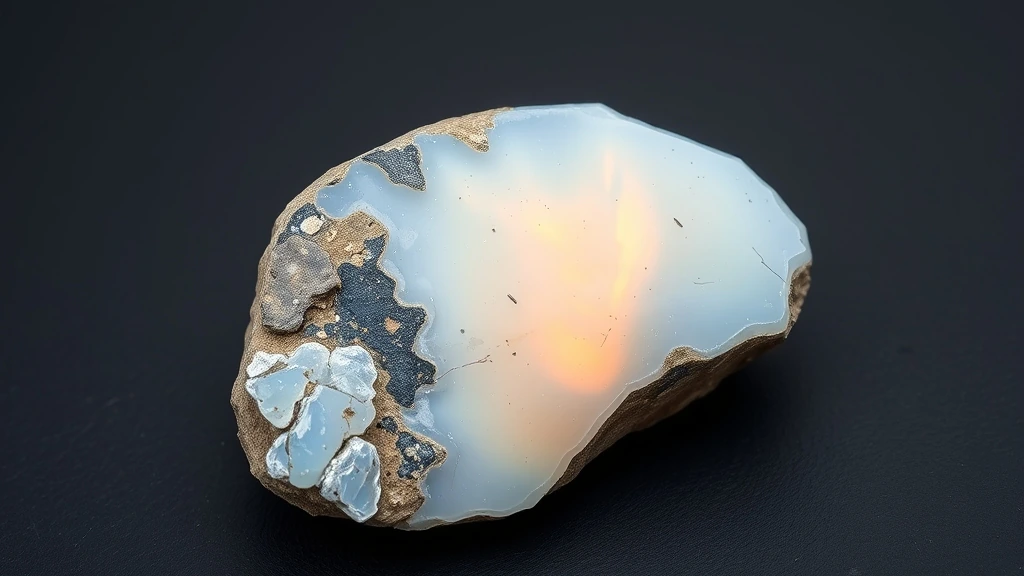
Hyalite opal is geologically classified as a mineraloid rather than a true crystalline mineral. It belongs to the broader hydrated silica group, sharing its fundamental chemical framework with common opal varieties. Unlike crystalline minerals, it lacks long-range atomic order, forming instead through the aggregation of microscopic silica spheres. This unique formation process distinguishes it from silicate minerals with defined lattice structures.
What is Hyalite Opal Gemstone? Geological Overview & Definition
Hyalite opal forms in hydrothermal veins and volcanic ash deposits, often associated with basaltic rocks. Its distinctive pale blue hue results from the Tyndall effect, where light scatters off the microscopic silica spheres. This optical phenomenon is identical to the blue color of the sky or opal’s play-of-color.
As a mineraloid, it lacks the periodic atomic arrangement required for mineral status. However, it is chemically stable enough to be cut and polished for gemological use. The stone typically occurs in nodular or massive aggregates within host rocks. Understanding its amorphous nature is critical for proper handling and identification.
Hyalite Opal Gemstone Chemical Composition & Crystallographic Properties
The fundamental building block is hydrated silica (SiO₂·nH₂O), where water molecules are integrated into the structure. It does not possess a defined crystal system, existing instead as an amorphous network of silica spheres. This lack of long-range order means it cannot be classified under standard crystallographic axes like cubic or hexagonal.
The internal structure consists of silica spheres packed in a disordered, random arrangement. There is no specific lattice structure or repeating unit cell to define its geometry. This amorphous packing allows for the unique light-scattering properties that define its visual appeal.
Coloration arises from chromophore impurities and structural scattering rather than specific cation substitution. Trace elements like iron or manganese may influence tone, but the primary blue comes from light scattering. The stone is sensitive to acid exposure, which can degrade the silica matrix over time.
Thermal behavior is limited by its hydration state, as excessive heat can cause dehydration. This process leads to shattering or cracking due to internal stress release. Consequently, hyalite opal must be protected from high temperatures and rapid temperature changes. Proper care ensures the preservation of its delicate amorphous structure.
| Property | Specification |
|---|---|
| Mineral Group | Mineraloid (Hydrated Silica) |
| Chemical Formula | SiO₂·nH₂O (Hydrated Silicon Dioxide) |
| Mohs Hardness | 5.5 – 6.5 |
| Crystal System | Amorphous (Hydrated silica spheres / Mineraloid) |
| Specific Gravity (Density) | 1.98 – 2.25 |
| Refractive Index | 1.370 – 1.470 |
| Color & Optical Properties | Natural Hyalite Opal Gemstone color spectrum and optical dispersion |
| Primary Mining Localities | Australia (Coober Pedy, Lightning Ridge), Ethiopia (Welo), Mexico |
| Water & Chemical Resistance | Moderate/Sensitive (%3-%21 water content; avoid prolonged soaking for hydrophane Welo opals) |
| Chakra Alignment (Traditional) | Crown Chakra and Heart Chakra |
| Zodiac Affinity (Traditional) | Libra, Scorpio, Pisces |
| Symbolic Meaning (Traditional) | Creativity, hope, emotional depth, and spontaneous inspiration |
Opal Varieties & Comprehensive Sub-Types
Black Opal
Black Opal forms in ancient riverbeds, primarily at Lightning Ridge, Australia, where dark body tone (N1-N4) creates a dramatic backdrop. This precious opal exhibits vivid play-of-color iridescence that contrasts sharply against its deep, charcoal base. The scarcity of high-quality specimens makes it the most valuable opal variety in the global gem trade.
White / Light Opal
White Opal features a light, milky, or transparent body tone that allows soft to bright color flashes to emerge. Formed in silica-rich sedimentary environments, it displays precious opal characteristics with a gentle, ethereal appearance. Its accessibility makes it a popular choice for jewelry, offering vibrant hues without the intensity of darker varieties.
Fire Opal
Fire Opal is a translucent to transparent variety found in volcanic rhyolite cavities, predominantly in Mexico. It exhibits warm red, orange, or yellow hues, often lacking the typical play-of-color seen in other opals. Gemologists frequently facet this stone like traditional colored gemstones to maximize its fiery brilliance and clarity.
Boulder Opal
Boulder Opal forms when precious opal naturally bonds to host ironstone rock, creating a unique geological composite. Originating from Queensland, Australia, it features rich colors confined to narrow, undulating seams within the matrix. This natural setting provides structural stability and a distinctive aesthetic that distinguishes it from loose opal stones.
Ethiopian Welo Opal
Ethiopian Welo Opal is a hydrophane volcanic opal from the Wollo province, known for its water-absorbing properties. When hydrated, it reveals vivid, three-dimensional play-of-color patterns resembling honeycombs or patchworks. This unique optical phenomenon arises from its specific silica sphere arrangement, making it a modern favorite in the gem market.
Dendritic Opal (Merlinite)
Dendritic Opal, also known as Merlinite, is a common opaque opal patterned with black manganese dendrites. These branching inclusions create intricate, fern-like designs on a white to cream background, symbolizing duality. It is prized in metaphysical circles for its association with shadow work and creative inspiration.
Gemologists differentiate these varieties by analyzing body tone, transparency, and the presence of play-of-color or specific inclusions. Lapidary practice requires distinct cutting techniques; for instance, Boulder Opal is carved to follow the matrix, while Fire Opal is faceted for brilliance. Understanding these structural nuances ensures accurate identification and valuation in the gemological trade.
Where is Hyalite Opal Gemstone Found? Geological Mining & Extraction
Hyalite opal typically forms in hydrothermal environments, often associated with basaltic lava flows or volcanic ash deposits. It is frequently found in sedimentary rock layers where silica-rich waters precipitated over millions of years. The primary extraction sites include regions with significant volcanic history, such as parts of the United States and Europe.
Mining operations focus on open-pit methods to access shallow deposits of this amorphous silica mineraloid. Geological surveys identify specific strata where hyalite is most abundant, guiding efficient extraction efforts. These deposits are often located near other volcanic minerals, providing context for their formation and distribution.
Historical Significance & Cultural Lore of Hyalite Opal Gemstone
Ancient civilizations valued opal for its mystical play-of-color, associating it with hope, purity, and emotional depth. Archaeological artifacts from Roman and Greek sites reveal opal use in jewelry and ceremonial objects. These early cultures believed the stone could enhance creativity and connect the wearer to higher spiritual realms.
In modern esoteric traditions, hyalite opal is linked to the Crown and Heart chakras, promoting spiritual growth and emotional balance. It is often recommended for individuals seeking spontaneous inspiration and creative breakthroughs. This enduring legacy underscores the stone’s significance across diverse cultural and spiritual contexts.
Modern Uses & Jewelry Applications of Hylittle Opal Gemstone
Hyalite opal is prized for its milky translucency and subtle play of color, making it a favorite in contemporary lapidary work. Artisans often cut the stone into smooth cabochons that showcase its inner glow, while skilled faceters can produce delicate facets that catch light without overwhelming the stone’s natural softness. In addition to wearable pieces, designers carve ornamental objects such as pendants, beads, and decorative inlays for high‑end interiors.
- Cabochon pendants that emphasize the stone’s ethereal sheen
- Faceted rings and earrings for a modern, sparkling look
- Carved beads and tassels for bohemian‑style necklaces
- Inlaid mosaics and decorative panels for luxury décor
Metaphysical Properties & Traditional Meaning of Hylittle Opal Gemstone
According to historical traditions and metaphysical lore, hyalite opal is regarded as a bridge between the physical and spiritual realms, fostering creativity and hope in its wearer. The stone is said to deepen emotional resonance, encouraging spontaneous inspiration and a gentle release of past hurts, thereby supporting inner healing and artistic expression.
Which Chakra and Zodiac Signs Align with Hylittle Opal Gemstone?
Hyalite opal resonates most strongly with the Crown Chakra, the energy center associated with higher consciousness, spiritual insight, and universal connection. When placed on the crown, the stone is believed to amplify meditation, enhance intuitive clarity, and open pathways to divine guidance.
In astrology, hyalite opal is aligned with the zodiac signs Libra, Scorpio, and Pisces. Libra benefits from the stone’s balancing influence, Scorpio draws upon its depth‑enhancing qualities, and Pisces experiences heightened emotional flow and creative imagination under its subtle glow.
How to Identify Real vs. Fake Hylittle Opal Gemstone
Artificial imitations of hyalite opal include low‑cost glass, synthetic opal, and dyed resin pieces that mimic the stone’s milky appearance but lack its genuine internal structure. These substitutes often feel heavier, display uniform color without the characteristic internal inclusions, and may exhibit a glassy surface rather than the natural, slightly frosted texture of true hyalite.
Practical At-Home Authenticity Tests
- Temperature Test (Thermal Feel): Genuine hyalite feels cool to the touch and retains that coolness longer than glass or plastic, which quickly warm to body temperature.
- Specific Gravity & Weight Test: Hyalite has a specific gravity of 2.0–2.2; it feels lighter than glass (≈2.5) when held, allowing a quick weight comparison using a simple balance or by feeling its heft in hand.
- Scratch & Hardness Test (Mohs Comparison): With a Mohs hardness of 5.5–6, hyalite can be lightly scratched by a steel file but not by a copper coin; glass (hardness ~5.5) may show a different scratch pattern, helping differentiate the materials.
- Microscopic & Loupe Inspection (Internal Inclusions): Under 10×–30× magnification, authentic hyalite reveals tiny fluid inclusions and a faint, irregular internal structure, whereas synthetic glass appears uniformly clear and free of such natural features.
Hyalite Opal Gemstone Valuation Factors, Grading & Pricing
Market valuation begins with assessing Color Saturation and tone uniformity across the stone’s surface. High-grade specimens display a consistent, milky-white or pale blue hue without muddy undertones. Optical clarity and a soft, waxy luster further enhance the gem’s visual appeal and desirability.
The second critical factor involves Carat Weight and precise facet symmetry during the cutting process. Larger stones with balanced proportions command significantly higher premiums in the luxury market. The absence of visible matrix or internal inclusions also contributes to a cleaner, more valuable final product.
Finally, Geographical Provenance Premium plays a decisive role in determining wholesale and retail pricing. Stones sourced from renowned deposits often fetch higher bids due to established market trust. Current trends show steady appreciation for high-quality hyalite opals from specific, verified origins.
How to Clean and Care for Hyalite Opal Gemstone
Due to its porous nature, hyalite opal requires gentle handling to preserve its structural integrity. You must STRICTLY AVOID ultrasonic cleaners and steam, as these methods cause micro-fracturing known as crazing. This damage occurs because the internal water content expands and contracts under heat or vibration.
For routine maintenance, use a soft, lint-free cloth dampened with lukewarm water to wipe the surface. Ensure the stone dries completely in a shaded, well-ventilated area before storage. Never submerge the gem in harsh chemicals or abrasive cleaning solutions that could strip its luster.
Cleansing and Recharging Hyalite Opal Gemstone (Energetic Care)
To energetically cleanse this sensitive stone, use dry methods that avoid direct moisture exposure. Smoke smudging with sage or palo santo is an effective, traditional technique for clearing stagnant energy. This process respects the mineral’s solubility while restoring its spiritual vibrancy and clarity.
For recharging, place the opal on a selenite plate or under natural moonlight overnight. These gentle, non-invasive methods align with the stone’s association with the Crown and Heart Chakras. Avoid direct sunlight, which can cause fading or thermal stress to the delicate structure.
Frequently Asked Questions About Hyalite Opal Gemstone
What is the typical water content of hyalite opal and how does it affect care?
Hyalite opal contains about 3 %–21 % water, making it moderately water‑sensitive. Because the stone is hydrophane, prolonged soaking can cause swelling or surface clouding; brief exposure to rain or splashes is usually harmless, but extended immersion should be avoided to preserve clarity.
Can I clean hyalite opal with an ultrasonic cleaner or steam?
No – ultrasonic cleaners and steam will likely cause micro‑fracturing (crazing). The internal water expands under heat and vibration, creating tiny cracks that dull the gemstone’s characteristic play of color. Hand‑wipe with a soft, damp cloth instead.
Is hyalite opal suitable for everyday jewelry like rings or bracelets?
It can be worn daily, but with caution due to its water sensitivity. Choose settings that protect the stone from direct impact and avoid activities that involve prolonged water exposure, such as swimming or heavy sweating, to prevent crazing or surface damage.
How does hyalite opal’s crystal structure influence its durability?
Hyalite opal is an amorphous silica gel with a glass‑like matrix. This structure lacks the strong lattice of quartz, making it softer (Mohs 5.5–6) and more prone to fracture when subjected to sudden temperature changes or mechanical shock.
Which zodiac signs are traditionally associated with hyalite opal?
Libra, Scorpio, and Pisces are the aligned zodiac signs. In astrological lore, the stone is believed to amplify the traits of these signs, offering creativity for Libra, emotional depth for Scorpio, and spiritual insight for Pisces.
Which chakras does hyalite opal resonate with?
The Crown Chakra and Heart Chakra are the primary energetic centers. When placed on these chakras, the opal is said to enhance spiritual connection and emotional healing, supporting meditation and heart‑centered intentions.
Does hyalite opal exhibit a play of color, and how is it described?
Yes, it displays a subtle play of color often described as milky or pastel flashes. Unlike fire opal, the effect is softer, showing gentle blues, greens, or pinks that shift with viewing angle, a result of diffraction within its hydrated silica matrix.
How should I store hyalite opal to maintain its appearance?
Store the gemstone in a padded, low‑humidity container away from direct sunlight. Keeping it separate from harder minerals prevents scratches, while a stable environment limits moisture loss that could lead to crazing or surface clouding over time.