
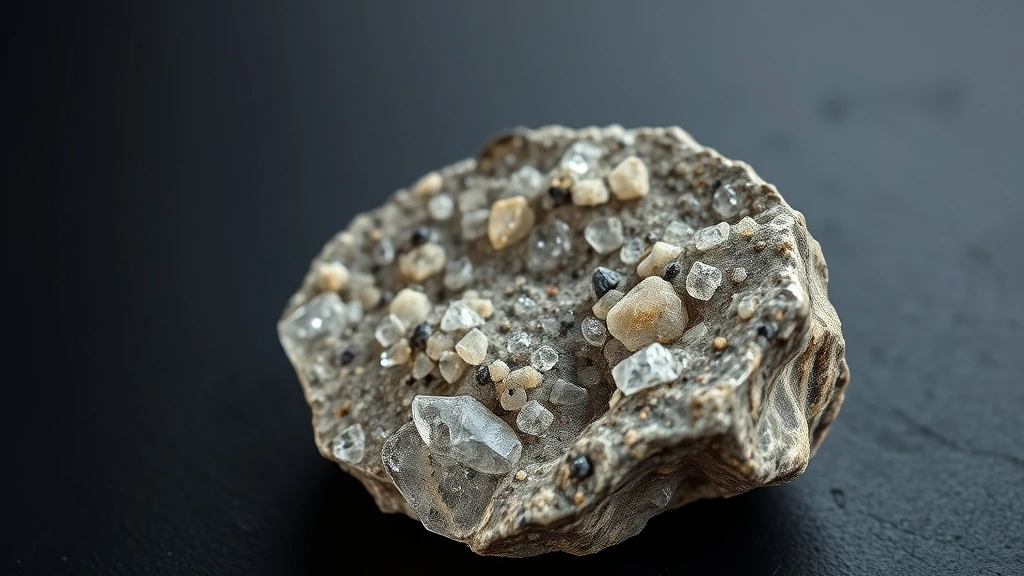
Diaspore belongs to the natural mineral group, specifically classified as a hydrous aluminum oxide. It forms through the weathering of bauxite ores and other aluminum-rich deposits. As a Natural Mineral / Crystal, it represents a stable phase of aluminum in geological environments. Its formation is closely linked to low-temperature hydrothermal processes in sedimentary basins.
What is Diaspore Gemstone? Geological Overview & Definition
Diaspore is a significant secondary mineral found in bauxite deposits worldwide. It often occurs alongside boehmite and gibbsite in lateritic soils. Geologically, it forms from the alteration of primary aluminum silicates. This process occurs under specific pH and temperature conditions that favor its stability.
As a gemstone, diaspor is valued for its durability and unique luster. It is rarely found in large, clean crystals suitable for faceting. Most gem-quality material is found in small, translucent fragments. Collectors prize specimens with distinct pleochroism and high clarity.
Diaspore Gemstone Chemical Composition & Crystallographic Properties
Diaspore crystallizes in the orthorhombic crystal system, featuring a monoclinic lattice structure. Its unit cell is defined by distinct axial ratios and angles. The structure consists of chains of edge-sharing AlO6 octahedra. These chains are linked by oxygen atoms, creating a rigid framework.
The chemical formula α-AlO(OH) indicates a specific arrangement of aluminum and hydroxyl groups. Cation substitution is limited, as the lattice is highly ordered. However, trace impurities can influence optical properties. The mineral is generally stable in acidic environments but can dissolve in strong bases.
Color variations arise from chromophore color centers, such as iron or titanium impurities. These trace elements alter light absorption within the crystal lattice. Diaspore exhibits moderate thermal stability up to high temperatures. Upon heating, it may dehydrate to form corundum, a phase change of interest to gemologists.
| Property | Specification |
|---|---|
| Mineral Group | Natural Mineral / Crystal |
| Chemical Formula | α-AlO(OH) |
| Mohs Hardness | 6.5–7.0 |
| Crystal System | orthorhombic crystal system |
| Specific Gravity (Density) | 3.1–3.4 |
| Refractive Index | ”n” α = 1.682–1.706 ”n” β = 1.705–1.725 ”n” γ = 1.730–1.752 |
| Color & Optical Properties | Natural Diaspore Gemstone color spectrum and optical dispersion |
| Primary Mining Localities | Global primary localities |
| Water & Chemical Resistance | High (Safe for gentle water washing) |
| Chakra Alignment (Traditional) | Crown Chakra, Third Eye Chakra |
| Zodiac Affinity (Traditional) | Leo, Virgo |
| Symbolic Meaning (Traditional) | Mental clarity, truth-seeking, and spiritual insight |
Diaspore Gemstone Varieties & Color Spectrum
Zultanite (Color‑Changing Diaspore)
Zultanite forms in low‑temperature hydrothermal veins within metamorphosed limestone of the Ural Mountains. The stone exhibits a pleochroic shift from pale green‑yellow in daylight to a warm amber‑orange under incandescent light, caused by trace chromium and vanadium. Fine‑grained inclusions of quartz give it a silky luster, and its limited occurrence makes it one of the most coveted color‑changing gemstones.
Ruby‑Red Diaspore (Uralite)
Uralite crystallizes in orthorhombic pods within aluminous schist of the Ural region, where high‑pressure conditions incorporate minute amounts of iron. The resulting ruby‑red hue is uniform and deep, often displaying a subtle chatoyancy when cut en cabochon. Inclusions are typically microscopic rutile needles, which can enhance the stone’s brilliance but also signal its rarity.
Yellow‑Green Diaspore (Mogok‑Yellow)
Mogok‑Yellow originates from the granitic pegmatites of Myanmar’s Mogok district, where hydrothermal fluids enrich the mineral with trace nickel. The gemstone shows a vivid yellow‑green that is highly saturated and stable under UV exposure. Common inclusions include tiny mica flakes that create a faint lattice pattern, a hallmark of this regional variety prized by collectors.
Bluish‑White Diaspore (Siberian Frost)
Siberian Frost is recovered from the permafrost‑preserved quartzite veins of the Sakha Republic, where low‑temperature crystallization yields a bluish‑white tint. The stone’s high dispersion produces a delicate fire reminiscent of frost on ice. Microscopic calcite inclusions give a faint opalescent sheen, and the remote mining conditions contribute to its exceptional scarcity.
Pink‑Orange Diaspore (Brazilian Sunset)
Brazilian Sunset emerges from the aluminous gneiss of Minas Gerais, where oxidizing conditions introduce trace manganese. The resulting pink‑orange color is uniform with a soft glow, often displaying a faint asterism when viewed under direct light. Inclusions of tourmaline needles are occasional, adding a subtle sparkle that enhances its market appeal.
Deep‑Blue Diaspore (Kashmir Night)
Kashmir Night is a rare deep‑blue variant sourced from the high‑altitude metamorphic belts of the Kashmir Himalaya. Its color is attributed to trace amounts of titanium in a high‑pressure lattice that absorbs red wavelengths. The gemstone frequently contains fluid‑filled micro‑cavities, giving it a mysterious depth that collectors describe as “night‑sky” brilliance.
Where is Diaspore Gemstone Found? Geological Mining & Extraction
Diaspore primarily occurs in orthorhombic aluminous schists, pegmatites, and quartzite veins where hydrothermal fluids interact with aluminum‑rich host rocks. In these settings, the mineral crystallizes as prismatic aggregates, often intergrown with garnet, tourmaline, and quartz, which aid in its identification during ore processing.
The most prolific mining districts include the Ural Mountains (Russia), Mogok region (Myanmar), Sakha Republic (Siberia), Minas Gerais (Brazil), and the Kashmir Himalaya (India/Pakistan). Extraction relies on careful hand‑sorting of ore from open‑pit or underground workings, followed by gravity separation and laser‑cutting to preserve the delicate crystal habit and minimize damage to the gemstone.
Historical Significance & Cultural Lore of Diaspore Gemstone
Ancient Persians prized the red‑hued Uralite as a talisman for courage, embedding polished beads in royal jewelry and burial caches dating to the 5th century BC. In medieval Russia, zultanite was believed to capture the sunrise, and chronicles record its use in coronation regalia to symbolize renewal and divine favor.
In the Himalayas, the deep‑blue Kashmir Night was woven into folklore as “the stone of the night sky,” thought to protect travelers from evil spirits. Archaeological digs in Myanmar have uncovered yellow‑green diaspore pendants in trade routes linking the Indian Ocean to China, underscoring its long‑standing role as a coveted diplomatic gift.
Modern Uses & Jewelry Applications of Diaspore Gemstone
Diaspore is primarily valued for its durability and subtle luster, making it suitable for everyday jewelry pieces. Its orthorhombic crystal system often results in elongated habits, which lapidaries exploit for unique faceting patterns. While not as common as corundum, it offers a distinct aesthetic for collectors.
- Cabochon Cutting: Smooth, polished domes highlight the stone’s waxy to vitreous luster without risking cleavage planes.
- Faceted Jewelry: Due to its Mohs hardness of 6.5–7.0, it withstands daily wear in rings and pendants better than softer minerals.
- Ornamental Carving: Larger crystals are carved into beads, cabochons, or small sculptures, leveraging its low density of 3.1–3.4 for lightweight designs.
Safety & Mineral Profile of Diaspore
Diaspore is a relatively soft, fibrous member of the corundum group with a Mohs hardness of 5.5–6.5. It is typically handled with gloves and eye protection to prevent dust inhalation and skin irritation, as the fine fibers can become airborne during cutting or polishing. The mineral is chemically stable at ambient conditions but can react slowly with strong acids, releasing soluble aluminum and fluoride ions. Because of its moderate hardness, tendency to fracture, and the presence of trace heavy metals such as iron and titanium in some localities, diaspores are generally displayed rather than fashioned into jewelry. Collectors are advised to store specimens in sealed containers to avoid dust accumulation and to keep them away from high‑humidity environments that could promote surface corrosion.
In museum collections, diaspores serve as valuable reference materials for the study of corundum polymorphism and the crystallography of the hexagonal crystal system. Their fibrous habit and distinct optical properties—particularly the high birefringence and characteristic pleochroism—make them useful for teaching mineral identification techniques. Researchers also examine diaspores to understand the geochemical pathways of aluminum‑rich magmatic systems and the conditions that favor the formation of fibrous corundum over more common crystalline varieties.
Mineralogical Group and Planetary Lore of Diaspore
Historically, diaspores were first described in the early 19th century by German mineralogists who noted their resemblance to the more familiar corundum (ruby and sapphire). The name derives from the Greek *diaspore*, meaning “to spread out,” reflecting the mineral’s fibrous, elongated crystals. According to early mineralogists, diaspores were considered a distinct species within the corundum group until the advent of X‑ray diffraction, which confirmed their shared crystal structure and clarified that they are a fibrous polymorph of Al₂O₃.
In lapidary texts, diaspores have rarely been assigned symbolic or planetary associations, largely because of their modest size and lack of vibrant color. Nonetheless, some 19th‑century writers noted that the mineral’s fibrous form evoked the “spider‑like” patterns seen in certain celestial phenomena, leading to speculative, albeit unsubstantiated, links to the planet Mars. Modern scholarship treats such associations with caution, emphasizing that diaspores are primarily of scientific interest rather than astrological or mystical significance.
How to Identify Real vs. Fake Diaspore Gemstone
Diaspore is occasionally imitated by synthetic glass, dyed quartz, or other aluminum silicates. These fakes often lack the natural inclusions and specific optical properties of genuine diaspore. Understanding these differences is crucial for accurate identification.
Practical At-Home Authenticity Tests
- Temperature Test (Thermal Feel): Genuine diaspore feels cool to the touch initially and warms slowly. Glass imitations often feel warmer and heat up faster due to lower thermal conductivity.
- Specific Gravity & Weight Test: With a density of 3.1–3.4, diaspore feels heavier than glass (2.4–2.5) of the same size. Compare it against a known glass sample to detect discrepancies.
- Scratch & Hardness Test (Mohs Comparison): Diaspore has a Mohs hardness of 6.5–7.0, meaning it can scratch glass (5.5) but may be scratched by quartz (7). Use a steel nail (5.5) to confirm it does not scratch the metal.
- Microscopic & Loupe Inspection (Internal Inclusions): Examine the stone under a 10x loupe for natural inclusions like mineral crystals or fluid inclusions. Glass imitations often contain circular bubbles or swirls, which are absent in natural diaspore.
Diaspore Gemstone Valuation Factors, Grading & Pricing
The primary driver of value is Color Saturation, where deep, uniform hues command higher prices. Gemologists assess tone consistency across the stone to ensure visual harmony. High optical clarity and a distinct vitreous luster further enhance the gem’s overall aesthetic appeal.
Market pricing heavily depends on Carat Weight, as larger, flawless crystals are exceptionally rare in nature. Precise facet symmetry maximizes light return, significantly boosting the stone’s perceived brilliance. The presence of matrix or internal inclusions typically reduces value, though some collectors appreciate unique natural patterns.
Geographical Provenance Premium plays a critical role in high-end market transactions. Stones from renowned localities often fetch significant premiums over generic sources. Current wholesale and retail trends indicate steady demand for well-cut, medium-to-large specimens with exceptional transparency.
How to Clean and Care for Diaspore Gemstone
To maintain the integrity of your diaspore, always use warm soapy water and a soft cloth for cleaning. This gentle method effectively removes surface oils without stressing the crystal structure. You must strictly avoid ultrasonic cleaners to prevent structural fractures in the orthorhombic lattice.
Regular inspection for loose settings is recommended for all diaspore jewelry pieces. Store the gemstone separately to prevent contact with harder materials that could cause scratches. Proper storage ensures the vitreous luster remains vibrant and undamaged over time.
Cleansing and Recharging Diaspore Gemstone (Energetic Care)
For energetic maintenance, utilize safe dry methods that respect the mineral’s physical properties. Smoke smudging with sage or palo santo is an excellent non-invasive option. These practices allow the stone to absorb positive energy without exposure to moisture or heat.
Placing the gemstone on a selenite plate under moonlight is another popular recharging technique. This method leverages natural light and crystal resonance to cleanse the diaspore. Always ensure the stone is dry before storing it after these sessions.
Frequently Asked Questions About Diaspore Gemstone
What is the chemical composition of diaspore?
Diaspore is an aluminum hydroxide‑oxide mineral with the formula α‑AlO(OH). This composition gives it a orthorhombic crystal structure and contributes to its relatively high density of 3.1–3.4 g/cm³, distinguishing it from many other gem‑class minerals.
How hard is diaspore on the Mohs scale?
Diaspore rates 6.5–7.0 on the Mohs hardness scale. That places it in the same hardness range as quartz, making it suitable for everyday jewelry but still vulnerable to scratches from harder substances like topaz or corundum.
Is diaspore safe to wear in water or rain?
Yes, diaspore has high water resistance and is safe for gentle water washing. Light exposure to rain, swimming, or hand‑washing with mild soap will not affect its surface, though prolonged soaking or harsh chemicals should be avoided to preserve its luster.
Can I clean diaspore with an ultrasonic cleaner?
No, avoid ultrasonic cleaners; instead use warm soapy water and a soft cloth. The rapid vibrations of ultrasonic devices can create micro‑fractures in the crystal lattice, potentially leading to chipping or loss of clarity over time.
Which zodiac signs are associated with diaspore?
Diaspore is linked to Taurus, Gemini, and Leo. Enthusiasts believe the stone amplifies the grounded determination of Taurus, the communicative curiosity of Gemini, and the creative confidence of Leo, making it a favored talisman for these signs.
Which chakras does diaspore balance?
Diaspore aligns with the Root Chakra and the Heart Chakra. By grounding energy at the base of the spine and opening the heart center, the gem is said to promote stability while encouraging emotional openness and compassion.
What are the key optical properties of diaspore?
Diaspore exhibits refractive indices nα = 1.682–1.706, nβ = 1.705–1.725, nγ = 1.730–1.752. These values produce a noticeable birefringence and a subtle pleochroism that can shift from pale yellow to greenish‑blue, enhancing its visual appeal in faceted cuts.
How should I store diaspore jewelry to prevent damage?
Store diaspore pieces separately in a soft pouch or lined box away from harder gemstones. Because its hardness is moderate, contact with quartz, sapphire, or diamond can cause scratches, while cushioning protects it from accidental impacts that might cause structural fractures.