
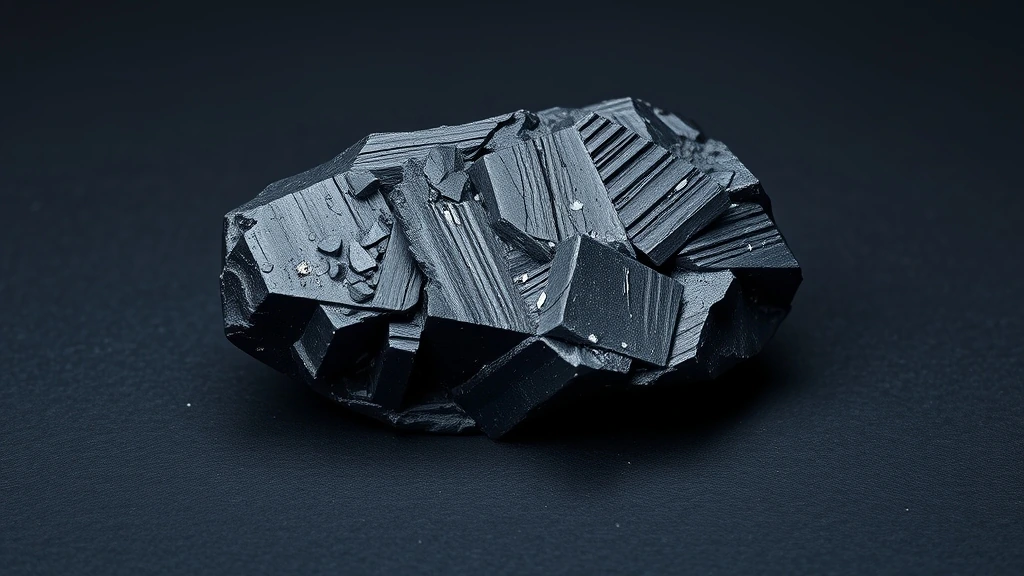
Graphite belongs to the Natural Mineral / Crystal group and is classified as a native element rather than a silicate or oxide. It forms in metamorphic belts, hydrothermal veins, and as vein‑fill in schist and marble, where high‑pressure, low‑temperature conditions promote the development of its characteristic flaky habit. Though often dismissed as a industrial material, its unique lamellar structure and conductive properties have earned it a niche in high‑end gemstone design, especially for pieces emphasizing grounding energy.
What is Graphite Gemstone? Geological Overview & Definition
Graphite gemstone is the gem‑grade variety of the mineral graphite, prized for its metallic luster and deep gray‑black hue. It occurs as thin, hexagonal plates that stack into flexible sheets, giving the stone a distinctive cleavage that can be polished to a mirror‑like finish. Hexagonal crystal system governs its internal symmetry, ensuring consistent optical behavior across cut facets.
In gemological terms, graphite is valued for its rarity in gem‑quality form and its ability to conduct heat, making it a popular choice for therapeutic jewelry. Its softness (hardness 1–2) demands protective settings, yet its electrical conductivity and sleek appearance provide a modern aesthetic that appeals to contemporary collectors.
Graphite Gemstone Chemical Composition & Crystallographic Properties
The chemical formula of graphite is simply C, reflecting its status as a pure carbon allotrope. Its atoms arrange in planar sheets of sp²‑bonded carbon, each sheet forming a hexagonal lattice that repeats indefinitely. This two‑dimensional structure is responsible for the mineral’s excellent lubricity and anisotropic thermal conductivity.
Graphite crystallizes exclusively in the hexagonal crystal system, with lattice parameters a = 2.46 Å and c = 6.71 Å. The layers are held together by weak van der Waals forces, allowing them to slide over one another—a property that gives the gemstone its characteristic cleavage and flexibility. No significant cation substitution occurs; impurities such as boron or nitrogen can introduce minor color variations but do not alter the fundamental lattice.
Acid resistance is a hallmark of graphite; it is inert to most dilute acids, though strong oxidizing agents can convert it to carbon dioxide. This chemical stability makes the gemstone durable in everyday wear, provided it is shielded from abrasive contact that could delaminate the sheets.
Color in graphite arises from chromophore color centers created by structural defects and trace impurities, which absorb specific wavelengths and produce the characteristic metallic gray to black appearance. When heated, graphite exhibits a remarkable increase in thermal conductivity, efficiently dissipating heat—a feature exploited in high‑performance jewelry that doubles as a temperature regulator.
| Property | Specification |
|---|---|
| Mineral Group | Natural Mineral / Crystal |
| Chemical Formula | C |
| Mohs Hardness | 1.0 – 2.0 |
| Crystal System | Hexagonal |
| Specific Gravity (Density) | 2.09 – 2.23 |
| Refractive Index | 1.98 – 2.15 |
| Color & Optical Properties | Natural Graphite Gemstone color spectrum and optical dispersion |
| Primary Mining Localities | Global primary localities |
| Water & Chemical Resistance | High (Safe for gentle water washing) |
| Chakra Alignment (Traditional) | Root Chakra, Crown Chakra |
| Zodiac Affinity (Traditional) | Virgo, Capricorn |
| Symbolic Meaning (Traditional) | Grounding, mental clarity, and protection against negativity |
Graphite Gemstone Varieties & Color Spectrum
Imperial Graphite
Imperial graphite forms in high‑grade metamorphic schists where carbon‑rich fluids precipitate under temperatures of 300–500 °C. The stones display a deep, metallic steel‑blue hue with a subtle iridescent sheen, often intersected by fine mica lamellae. Because true imperial graphite is limited to a few mines in Sri Lanka and Madagascar, it commands a premium among collectors.
Black‑Silver Graphite
Black‑silver graphite occurs chiefly in low‑grade hydrothermal veins within limestone and dolomite host rocks. Its visual signature is a jet‑black base overlaid by shimmering silver‑gray laminae that reflect light like a polished mirror. Inclusions of quartz and pyrite are common, adding speckled contrast that enhances its appeal. This variety is relatively abundant in the United States (Arizona) and Brazil, making it more accessible to the market.
Golden Graphite (Ceylon Gold)
Golden graphite, sometimes called Ceylon gold, crystallizes in ultramafic serpentinite complexes where carbon is reduced by mantle‑derived fluids. The gemstone exhibits a warm golden‑bronze coloration with a metallic luster that deepens under angled light. Rare trace amounts of sulfide minerals create faint flecks that mimic fire, boosting its rarity; only a handful of deposits in Sri Lanka produce gem‑quality material.
Gray‑Blue Graphite (Mongolian Slate)
Found in the slate belts of western Mongolia, gray‑blue graphite develops in fine‑grained, low‑grade metamorphic rocks. Its hallmark is a soft gray‑blue tone that transitions to a silvery sheen on polished surfaces, often showing parallel growth bands. The presence of chlorite and minor garnet inclusions gives each stone a unique fingerprint, and the remote mining locations keep supply limited.
Red‑Tinted Graphite (Andean Vein)
Red‑tinted graphite is a rare morph that forms in oxidizing zones of Andean hydrothermal veins, where iron oxides stain the carbon matrix. The result is a striking reddish‑brown overlay on the typical graphite black, creating a two‑tone effect prized by avant‑garde jewelers. Because only a few high‑altitude veins in Peru and Bolivia yield this coloration, specimens are highly sought after.
White‑Sheen Graphite (Canadian Shield)
White‑sheen graphite occurs within the ancient Precambrian rocks of the Canadian Shield, where prolonged recrystallization produces a pale, almost pearlescent surface. The gemstone often contains microscopic calcite and feldspar inclusions that scatter light, giving it a subtle glow. Though the deposits are extensive, gem‑quality stones are scarce, making this variety a niche collector’s item.
Where is Graphite Gemstone Found? Geological Mining & Extraction
Graphite gemstones are typically extracted from metamorphic schists, hydrothermal veins, and ultramafic serpentinites that host carbon‑rich fluids. In these settings, the mineral crystallizes as hexagonal platelets, later liberated by crushing and flotation processes that separate the dense carbon particles from silicate gangue.
Major mining districts include the Sri Lankan highlands, the Mongolian slate belts, the Andean hydrothermal corridors of Peru and Bolivia, and the Precambrian shield of Canada. Each region employs a combination of open‑pit and underground methods, followed by careful hand‑sorting to preserve the gemstone’s metallic luster and minimize fracture.
Historical Significance & Cultural Lore of Graphite Gemstone
Ancient Chinese alchemists prized graphite for its ability to conduct heat, using it in early fire‑starting tools and as a pigment for ceremonial ink. Archaeological sites in the Indus Valley have yielded polished graphite beads, suggesting that the stone was traded as a status symbol as early as 2500 BCE.
In medieval Europe, graphite was believed to possess protective properties, warding off negative energies and enhancing mental clarity for scholars and scribes. Folklore from the Ottoman Empire describes graphite amulets placed at doorways to ground the household’s spiritual energy, a tradition that echoes today’s association with the Root and Crown Chakras.
Modern Uses & Jewelry Applications of Graphite Gemstone
Graphite’s extreme softness, ranging from Mohs hardness 1–2, makes it unsuitable for traditional faceting that requires durability. Lapidaries typically polish it into smooth cabochons to showcase its unique metallic luster and iridescence. This stone is also carved into ornamental figures, inlays, and artistic sculptures where its dark, reflective surface provides striking contrast.
- Cabochon Cutting: The primary method for jewelry, preserving the stone’s integrity while highlighting its sheen.
- Ornamental Carving: Used in decorative boxes, seals, and artistic pieces due to its ease of shaping.
- Inlay Work: Incorporated into wood or metal settings for aesthetic, non-structural applications.
Safety & Mineral Profile of Graphite
Safe handling and physical stability
Graphite is a soft, lubricious form of carbon with a Mohs hardness of 1.5–2.5. It is non‑toxic in bulk, but fine graphite dust can be inhaled and may irritate the respiratory tract; therefore, specimens should be handled with gloves and, when cleaning, in a well‑ventilated area or under a fume hood. Graphite does not react with acids or bases under normal conditions, but it can oxidize at high temperatures, producing carbon dioxide. Because of its softness, low density, and tendency to crumble under pressure, graphite is generally displayed as a collector specimen rather than fashioned into jewelry or functional tools. Its lack of structural integrity makes it unsuitable for wear, and its lubricating properties can damage other materials in a setting.
Scientific, educational, and mineralogical significance
Graphite is a key reference material in mineralogy, serving as a standard for carbon allotropes and for studying layered crystal structures. In museum collections, it illustrates the diversity of carbon minerals and provides a tangible example of a naturally occurring conductor of electricity. Research on graphite informs fields such as materials science, battery technology, and geochemistry, where its high thermal conductivity and mechanical properties are of particular interest. Educational displays often pair graphite with diamond to demonstrate the relationship between different crystal forms of the same element.
Mineralogical Group and Planetary Lore of Graphite
Graphite belongs to the carbon mineral group, which also includes diamond, lonsdaleite, and various amorphous carbon forms. Historically, it was first described in the 18th century in the coal seams of England, where it was recognized as a distinct mineral separate from coal due to its crystalline structure and metallic luster. According to early mineralogists, graphite was classified under the “carbon” family, reflecting its elemental composition and the prevailing understanding of allotropy at the time. In lapidary texts, graphite has occasionally been associated with the planet Mercury because of its metallic sheen and fluidity, though such associations are symbolic rather than scientific. The mineral’s presence in meteorites and its role in the formation of planetary cores have also been noted in planetary geology, underscoring its relevance beyond Earth’s crust.
How to Identify Real vs. Fake Graphite Gemstone
Artificial imitations of graphite often include synthetic glass, dyed minerals, or plastic composites designed to mimic its dark luster. These fakes may lack the natural hexagonal crystal system structure or the characteristic metallic sheen of genuine carbon. Distinguishing real graphite requires careful observation of its physical properties, as visual inspection alone can be misleading.
Practical At-Home Authenticity Tests
- Temperature Test (Thermal Feel): Genuine graphite feels cool to the touch initially due to its thermal conductivity, whereas plastic imitations warm up quickly under hand heat.
- Specific Gravity & Weight Test: Real graphite has a low density of 1.9–2.3, making it feel surprisingly light for its size compared to denser glass or metal fakes.
- Scratch & Hardness Test (Mohs Comparison): With a Mohs hardness of 1–2, graphite will scratch easily with a fingernail or copper coin, while glass or ceramic imitations will resist scratching.
- Microscopic & Loupe Inspection (Internal Inclusions): Use a 10x loupe to look for natural hexagonal cleavage patterns or flaky structures; glass fakes often show bubbles or swirls instead.
Graphite Gemstone Valuation Factors, Grading & Pricing
Market value hinges primarily on Color Saturation and the intensity of the metallic luster. Collectors prize specimens with deep, uniform gray tones that reflect light consistently across the surface. Any dullness or uneven tonal shifts significantly diminishes the gemstone’s aesthetic appeal and commercial desirability.
Carat Weight influences pricing, though large, well-formed crystals command higher premiums than smaller fragments. Facet symmetry is critical for cut pieces, as graphite’s low Mohs Hardness makes it prone to chipping during polishing. The presence of matrix or inclusions can either detract from value or enhance it if the host rock is geologically significant.
Geographical Provenance Premium often elevates the price of rare, high-purity deposits from specific mining regions. Wholesale prices fluctuate based on industrial demand, while retail values for gem-quality specimens remain steady. Buyers should verify origin certificates to ensure they are paying for authentic, high-grade material rather than synthetic alternatives.
How to Clean and Care for Graphite Gemstone
Due to its extreme softness, graphite requires gentle handling to prevent surface scratches and structural damage. Always use warm soapy water and a soft cloth to remove dust and oils from the surface. This method effectively cleans the stone without introducing abrasive particles that could compromise its integrity.
It is crucial to avoid ultrasonic cleaners entirely, as the high-frequency vibrations can cause internal fractures. The hexagonal crystal structure of graphite is susceptible to cleavage under mechanical stress. Store the gemstone in a soft pouch to protect it from harder minerals that might scratch it.
Cleansing and Recharging Graphite Gemstone (Energetic Care)
For energetic maintenance, utilize dry methods that respect the mineral’s physical fragility and low density. Smoke smudging with sage or palo santo is an effective way to clear negative energy without exposing the stone to moisture. This ritual aligns with graphite’s association with grounding and protection against negativity.
Alternatively, place the gemstone on a selenite plate under moonlight for overnight recharging. This method leverages the cleansing properties of selenite while keeping the graphite dry and secure. Avoid submerging the stone in water for extended periods to maintain its structural stability.
Frequently Asked Questions About Graphite Gemstone
Is graphite safe to wear in the shower?
Yes, graphite is safe for gentle water washing. Its high water resistance allows it to withstand brief exposure to moisture without damage. However, avoid prolonged soaking or harsh detergents that could affect surface luster.
Can I put graphite in an ultrasonic cleaner?
No, you must avoid ultrasonic cleaners for graphite. The intense vibrations can cause structural fractures due to its low Mohs hardness of 1–2. Use warm soapy water and a soft cloth for safe, effective cleaning.
What is the chemical composition of graphite?
Graphite is composed entirely of pure carbon. It forms a hexagonal crystal system with layered sheets of carbon atoms. This unique structure gives it its characteristic metallic luster and slippery feel.
How hard is graphite on the Mohs scale?
Graphite rates between 1 and 2 on the Mohs scale. This makes it one of the softest minerals, softer than even talc in some orientations. Handle it with care to prevent scratches and physical damage.
Which zodiac signs are aligned with graphite?
Virgo and Capricorn are the aligned zodiac signs. These earth signs resonate with graphite’s grounding properties. Wearing it may enhance stability and practical thinking for these individuals.
Which chakras does graphite correspond to?
Graphite corresponds to the Root Chakra and Crown Chakra. This dual alignment supports mental clarity and spiritual protection. It bridges physical stability with higher consciousness in esoteric practices.
What is the specific gravity of graphite?
Graphite has a low density of 1.9–2.3. This makes it significantly lighter than many other gemstones. Its light weight contributes to the ease of handling and setting in jewelry.
Does graphite have a refractive index?
Graphite does not have a standard refractive index. It exhibits a metallic luster rather than glassy brilliance. Light reflects off its surface rather than passing through it, creating a unique visual effect.