
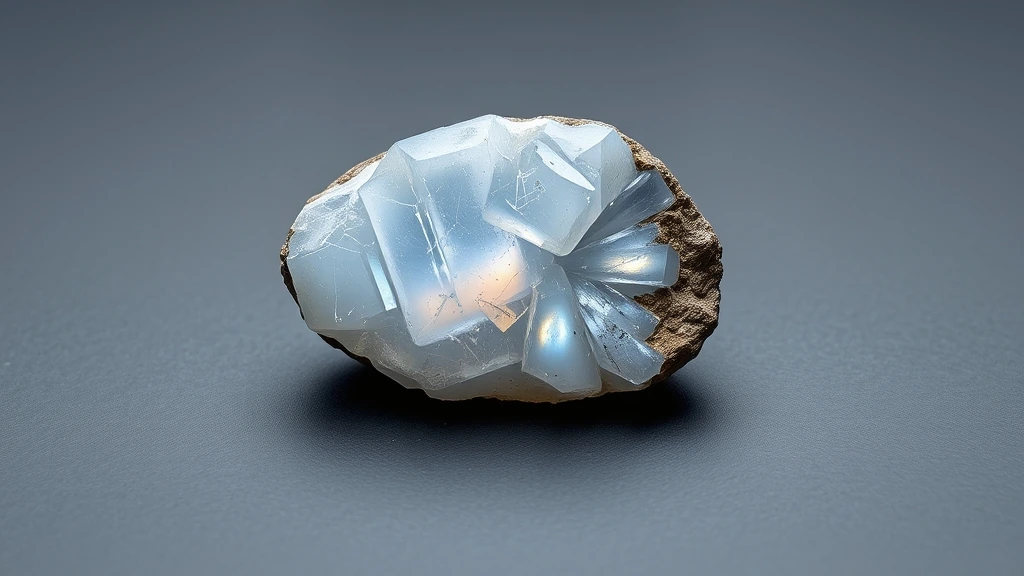
Rainbow Moonstone belongs to the tectosilicate feldspar group, a dominant component of continental crustal rocks such as granites and pegmatites. Its formation occurs in late‑stage magmatic fluids that allow potassium‑rich orthoclase to intergrow with albite, producing the characteristic lamellar perthite. The stone’s optical play arises from nanoscale intergrowths that diffract light, giving the famed “moon” effect prized by gem collectors worldwide.
What is Rainbow Moonstone Gemstone? Geological Overview & Definition
Rainbow Moonstone is a gem‑quality variety of feldspar in which orthoclase and albite separate into microscopic layers, a structure known as perthitic lamellae. This intergrowth creates the distinctive adularescent sheen that shifts from milky white to blue‑violet as the stone is moved under light.
In the field, the gem is harvested from pegmatitic veins and alluvial deposits, often alongside other feldspar species. Its monoclinic crystal symmetry distinguishes it from other moonstones, and the fine‑grained lamellae are responsible for the subtle play of color that defines the gemstone’s aesthetic and metaphysical appeal.
Rainbow Moonstone Gemstone Chemical Composition & Crystallographic Properties
Rainbow Moonstone’s chemistry is dominated by the solid‑solution series (K,Na)AlSi₃O₈, where potassium occupies the orthoclase sites and sodium the albite sites. Minor trace elements such as Fe²⁺, Ti⁴⁺, and Mn²⁺ can substitute into the lattice, influencing the intensity of the adularescent colors.
The gemstone crystallizes in the monoclinic system, specifically as orthoclase/albite perthitic lamellar aggregates. Its unit cell parameters reflect a slight distortion from the ideal feldspar lattice, producing the anisotropic optical properties that generate the characteristic “rainbow” effect.
Acidic environments readily attack the feldspar framework, especially where Na‑rich albite layers are exposed, leading to surface etching and loss of luster. Consequently, cleaning should be limited to neutral pH solutions and soft, lint‑free cloths to preserve the delicate lamellae.
Thermally, Rainbow Moonstone is stable up to about 600 °C, beyond which de‑perthitization can occur, altering the lamellar spacing and diminishing the adularescence. Controlled heating, however, is sometimes employed by gem cutters to enhance the play of color by subtly modifying the internal strain fields.
| Property | Specification |
|---|---|
| Mineral Group | Silicates (Tectosilicates / Feldspar Group) |
| Chemical Formula | KAlSi₃O₈ (Orthoclase / Albite feldspar) |
| Mohs Hardness | 6.0 – 6.5 |
| Crystal System | Monoclinic (Orthoclase / Albite perthitic lamellar) |
| Specific Gravity (Density) | 2.56 – 2.60 |
| Refractive Index | 1.518 – 1.526 |
| Color & Optical Properties | Natural Rainbow Moonstone Gemstone color spectrum and optical dispersion |
| Primary Mining Localities | Sri Lanka, India, Madagascar, Myanmar, Brazil |
| Water & Chemical Resistance | Moderate (Safe for brief lukewarm washing; avoid acids and thermal shocks) |
| Chakra Alignment (Traditional) | Crown Chakra and Third Eye Chakra |
| Zodiac Affinity (Traditional) | Cancer, Libra, Scorpio |
| Symbolic Meaning (Traditional) | Feminine intuition, inner harmony, new beginnings, and emotional balance |
Rainbow Moonstone Gemstone Varieties & Color Spectrum
**Adularescent White Moonstone**
Formed in granitic pegmatites where intergrowths of feldspar and albite create a microscopic lattice that diffracts light. The hallmark is a soft, billowy adularescence that shifts from milky white to a faint blue‑gray sheen. Found chiefly in Sri Lanka and India, this variety is relatively common but prized for its uniform glow.
**Blue‑Sheen Moonstone**
Develops in alkaline‑rich pegmatites where trace titanium and iron ions substitute into the crystal lattice, producing a vivid blue‑white adularescence. Inclusions of minute rutile needles can add a subtle asterism to the surface. The most coveted stones come from Madagascar, where the blue hue is both intense and rare.
**Rainbow‑Play (Multicolored) Moonstone**
A complex multiphase stone that exhibits simultaneous flashes of blue, green, and peach as the viewer moves. This effect arises from layered lamellar structures of orthoclase and albite, each with differing refractive indices. High‑quality specimens are sourced from the United States (California) and are among the most valuable due to their dramatic color play.
**Peach‑Blush Moonstone**
Originates in silicic pegmatites enriched with manganese, which imparts a warm, salmon‑pink undertone to the adularescence. The stone often contains microscopic fluid inclusions that scatter light, enhancing the blush effect. Rare finds from Brazil command premium prices because the pink hue is both delicate and fleeting.
**Black Moonstone**
A darker counterpart formed in mafic‑rich pegmatites where abundant magnetite and ilmenite inclusions absorb most wavelengths, leaving a deep gray‑black base. The residual adularescence appears as a faint, ghostly blue that seems to float beneath the surface. Limited deposits in Tanzania make this variety exceptionally scarce.
**Rainbow‑Fluorescent Moonstone**
Exhibits a vivid fluorescence under ultraviolet light due to trace uranium and rare‑earth elements within the crystal lattice. While the stone’s daytime appearance mirrors standard white moonstone, its UV‑induced colors range from electric green to violet. Only a handful of mines in Canada have produced this exotic variety, rendering it a collector’s curiosity.
Where is Rainbow Moonstone Gemstone Found? Geological Mining & Extraction
Rainbow moonstone is primarily hosted in granite‑derived pegmatite veins that crystallized from late‑stage magmatic fluids rich in silica, potassium, and aluminum. These pegmatites provide the low‑temperature, high‑pressure environment needed for the orderly intergrowth of orthoclase and albite that generates the stone’s signature adularescence.
Major extraction zones include the Kandy district of Sri Lanka, the Maharashtra region of India, Madagascar’s Antsiranana Province, and California’s Sierra Nevada foothills. In each locale, miners employ selective hand‑sorting and low‑impact blasting to preserve the delicate lamellar structures, followed by careful cleaning to remove mica and quartz matrix material.
Historical Significance & Cultural Lore of Rainbow Moonstone Gemstone
Ancient Romans called moonstone “Luna,” believing it was solidified moonlight and using it in signet rings to seal confidential messages. Archaeological digs in the Indus Valley have uncovered moonstone beads dating to 2500 BCE, indicating early trade routes that prized its mystical glow for adornment and amulets.
In Eastern traditions, the stone is linked to the Crown and Third Eye chakras, symbolizing feminine intuition, inner harmony, and new beginnings. Folklore from the Ottoman Empire held that moonstone could calm emotional turbulence, making it a favored talisman for diplomats seeking diplomatic balance and emotional steadiness.
Modern Uses & Jewelry Applications of Rainbow Moonstone Gemstone
Lapidaries primarily cut rainbow moonstone as cabochons to maximize its unique optical phenomenon, known as adularescence. This smooth, domed shape allows light to scatter within the stone’s internal layers, creating a floating blue or white sheen. Faceted cuts are less common but occasionally used for high-clarity specimens where brilliance is prioritized over the halo effect.
- Cabochon Rings: The most popular setting, showcasing the stone’s spectral glow prominently on the finger.
- Pendants and Necklaces: Ideal for displaying the full play of color, often set in silver or white gold.
- Ornamental Carvings: Historically used in intaglio carvings for seals and decorative objects in ancient cultures.
- Earrings: Small, polished cabochons that catch light dynamically with movement.
Metaphysical Properties & Traditional Meaning of Rainbow Moonstone Gemstone
According to historical traditions and metaphysical lore, rainbow moonstone is revered as a stone of feminine intuition and emotional healing. Practitioners believe it enhances inner harmony and supports individuals during periods of significant life transitions. The stone’s gentle energy is thought to soothe anxiety and promote a sense of calm stability.
This gemstone is also associated with new beginnings, encouraging wearers to embrace change with confidence and clarity. It is believed to strengthen the connection between the conscious mind and the subconscious, facilitating deeper self-awareness. Many users report feeling a renewed sense of purpose and emotional balance after prolonged meditation with the stone.
Which Chakra and Zodiac Signs Align with Rainbow Moonstone Gemstone?
In chakra theory, rainbow moonstone is strongly aligned with the Crown Chakra and the Third Eye Chakra. These energy centers govern spiritual connection, higher consciousness, and intuitive perception. By stimulating these areas, the stone is said to enhance clarity of thought and deepen one’s spiritual insight.
Astrologically, this gemstone resonates most profoundly with the signs of Cancer, Libra, and Scorpio. Cancer finds emotional security, Libra seeks balance and harmony, and Scorpio benefits from emotional depth. These signs are believed to amplify the stone’s nurturing and transformative properties effectively.
How to Identify Real vs. Fake Rainbow Moonstone Gemstone
Distinguishing genuine rainbow moonstone from artificial imitations requires careful observation of optical and physical properties. Common fakes include synthetic glass, which often lacks natural inclusions and displays overly uniform color. Dyed white quartz or lab-created feldspar may also mimic the stone’s appearance but fail under close inspection.
Practical At-Home Authenticity Tests
- Temperature Test (Thermal Feel): Genuine moonstone feels cool to the touch initially and warms slowly. Glass imitations tend to warm up much faster due to lower thermal conductivity.
- Specific Gravity & Weight Test: Real moonstone has a specific gravity of approximately 2.55 to 2.65. It should feel slightly heavier than similarly sized glass, which has a lower density.
- Scratch & Hardness Test (Mohs Comparison): Moonstone rates 6 to 6.5 on the Mohs hardness scale. It will not be scratched by a steel knife (5.5), but it may scratch glass (5.5) or quartz (7).
- Microscopic & Loupe Inspection (Internal Inclusions): Use a 10x loupe to check for natural inclusions like tiny bubbles or fluid-filled fractures. Synthetic glass often contains perfect, spherical bubbles, while natural stones show irregular, chaotic patterns.
Rainbow Moonstone Gemstone Valuation Factors, Grading & Pricing
The primary driver of value is Color Saturation, specifically the intensity of the blue or peach sheen known as adularescence. Graders assess the uniformity of this optical phenomenon across the stone’s surface. High-quality specimens exhibit a vibrant, sky-blue glow that remains consistent under varying light angles.
Carat Weight significantly impacts pricing, as larger, eye-clean stones are exponentially rarer than smaller pieces. Facet symmetry is critical for maximizing the play-of-light effect in cut gems. Additionally, the presence of matrix or visible inclusions can drastically reduce the stone’s commercial appeal and market value.
Geographical Provenance Premium often elevates the price of stones from renowned sources like Sri Lanka or Madagascar. Wholesale prices fluctuate based on supply chain stability and global demand trends. Retail prices typically include a substantial markup to cover certification, cutting, and dealer margins.
How to Clean and Care for Rainbow Moonstone Gemstone
Rainbow moonstone is Prone to cleavage splitting, making it vulnerable to mechanical shock and harsh chemical treatments. You must clean it gently using warm water and mild, pH-neutral soap to preserve its integrity. Avoid exposing the gem to sudden temperature changes, which can induce internal stress and fracture.
Ultrasonic cleaning is strictly prohibited for this gemstone due to its structural sensitivity. The high-frequency vibrations can exploit natural cleavage planes, causing irreversible damage or shattering. Always air-dry the stone with a soft, lint-free cloth after washing to prevent water spots.
Cleansing and Recharging Rainbow Moonstone Gemstone (Energetic Care)
For energetic maintenance, use smoke smudging with sage or palo santo to clear stagnant energy without physical contact. This dry method respects the mineral’s solubility and structural fragility while aligning with its esoteric properties. Ensure the smoke circulates freely around the stone for a few minutes.
Alternatively, place the gemstone on a selenite plate under direct moonlight for recharging. This passive technique leverages lunar energy to restore the stone’s vibrational frequency safely. Avoid submerging the stone in water during these rituals to maintain its physical stability.
Frequently Asked Questions About Rainbow Moonstone Gemstone
Is rainbow moonstone safe to wear in the shower?
Rainbow moonstone has moderate water resistance, making it safe for brief lukewarm washing. However, you should avoid prolonged exposure to hot water or harsh chemicals. Thermal shocks can cause internal stress, potentially leading to fractures. Always remove your jewelry before using strong soaps or acids.
Can I clean rainbow moonstone in an ultrasonic cleaner?
No, you must avoid ultrasonic cleaning for rainbow moonstone. This stone is prone to cleavage splitting due to its internal structure. The high-frequency vibrations can shatter the delicate layers responsible for its adularescence. Instead, clean it gently with warm soapy water and a soft cloth.
Which zodiac signs are compatible with rainbow moonstone?
Rainbow moonstone is traditionally aligned with Cancer, Libra, and Scorpio. These water and air signs resonate with the stone’s emotional balancing properties. Wearing this gemstone can enhance intuition and harmony for these individuals. It serves as a powerful talisman for emotional stability.
What chakras does rainbow moonstone activate?
This gemstone primarily activates the Crown Chakra and Third Eye Chakra. It facilitates spiritual connection and heightened intuition. By aligning these energy centers, the stone promotes mental clarity and inner peace. It is not associated with lower physical chakras.
Why does rainbow moonstone have a blue or white sheen?
The unique optical effect is called adularescence, caused by light scattering. Thin layers of albite and oligoclase feldspar create this phenomenon. As you move the stone, the light shifts between blue, white, and peach. This play of color distinguishes it from other feldspars.
How should I store rainbow moonstone to prevent damage?
Store your rainbow moonstone in a soft pouch or separate jewelry box. This prevents contact with harder gems like quartz or topaz. Physical abrasion can scratch the surface and dull the luster. Keep it away from direct sunlight to preserve its vibrant colors.
Is rainbow moonstone a good gift for new beginnings?
Yes, it is widely regarded as a stone of new beginnings. Its association with feminine intuition and emotional balance makes it ideal for transitions. It encourages inner harmony and fresh starts in life. Many people choose it for milestones like graduations or career changes.
How can I tell if my moonstone is genuine?
Genuine rainbow moonstone exhibits distinct adularescence and a glassy luster. Look for a floating blue or white glow beneath the surface. Synthetic imitations often lack this depth or appear too uniform. Consult a certified gemologist for high-value pieces to verify authenticity.