
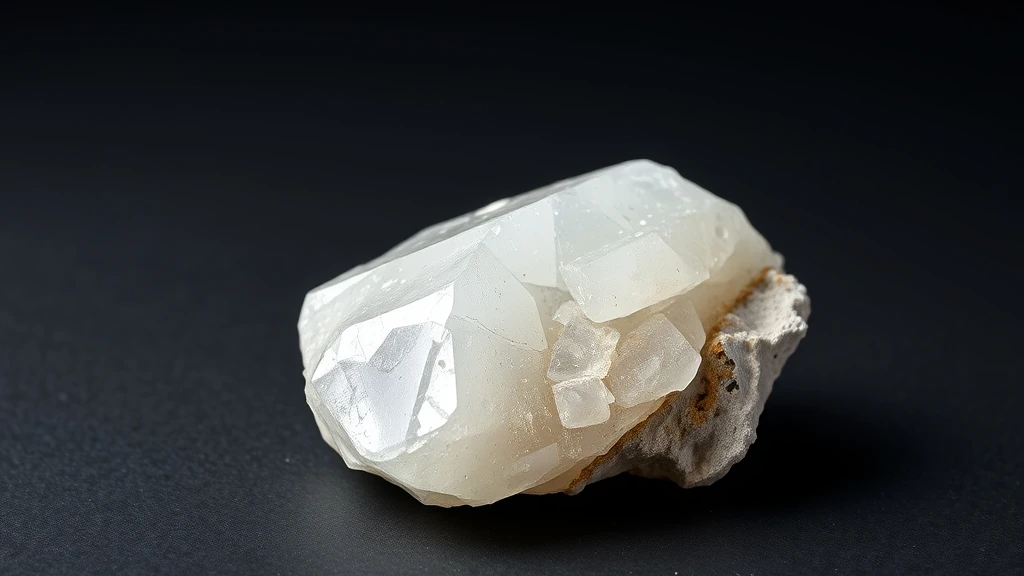
Apophyllite belongs to the vast category of Natural Mineral / Crystal species found in igneous and metamorphic rocks. It forms as a secondary mineral in cavities, often associated with feldspar and quartz. Its delicate structure makes it a favorite among collectors for its clarity. The mineral’s presence indicates specific geochemical conditions during rock formation. Understanding its origin helps identify potential gem-quality specimens.
What is Apophyllite Gemstone? Geological Overview & Definition
Apophyllite is a tetragonal mineral that frequently occurs in geodes and vugs within rhyolite or granite. Its formation is linked to the alteration of feldspar in hydrothermal environments. This process allows for the growth of large, well-formed crystals. Collectors prize specimens with high transparency and distinct geometric shapes.
The term “gemstone” applies to rare, high-clarity crystals suitable for cutting. Most apophyllite is too soft for daily jewelry use. However, exceptional pieces are carved into cabochons or ornamental objects. Its low density of 2.3–2.4 g/cm³ contributes to its light feel. Proper identification requires distinguishing it from similar silicates.
Apophyllite Gemstone Chemical Composition & Crystallographic Properties
The mineral crystallizes in the Tetragonal crystal system, featuring a distinct lattice structure. Its unit cell is defined by equal axes with a 90-degree angle. This symmetry results in square-based pyramidal crystal habits. The refractive index of 1.536 provides moderate brilliance.
Cation substitution occurs between potassium and sodium in the crystal lattice. This cation exchange influences the mineral’s physical properties slightly. Fluorine and hydroxyl ions occupy specific sites within the structure. These anions stabilize the hydrated framework. Impurities can cause subtle variations in color.
Color centers arise from trace elements or structural defects. Iron impurities often create pale yellow or brown hues. The mineral is sensitive to acids due to its silicate composition. Acid sensitivity means it can etch or dissolve in strong solutions. Careful handling is required to preserve surface integrity.
Thermal behavior shows that apophyllite loses water upon heating. This dehydration alters its chemical formula and stability. High temperatures can cause cracking or structural collapse. The hydrated nature of the mineral makes it vulnerable to heat. Cool, stable environments are essential for long-term preservation.
| Property | Specification |
|---|---|
| Mineral Group | Natural Mineral / Crystal |
| Chemical Formula | (K,Na)Ca₄ Si₈ O₂₀ (F,OH)·8H₂ O |
| Mohs Hardness | 4.5–5 |
| Crystal System | Tetragonal |
| Specific Gravity (Density) | 2.3–2.4 |
| Refractive Index | 1.536 |
| Color & Optical Properties | Natural Apophyllite Gemstone color spectrum and optical dispersion |
| Primary Mining Localities | Global primary localities |
| Water & Chemical Resistance | High (Safe for gentle water washing) |
| Chakra Alignment (Traditional) | Heart Chakra, Throat Chakra |
| Zodiac Affinity (Traditional) | Virgo, Libra |
| Symbolic Meaning (Traditional) | Emotional balance, spiritual growth, and communication |
Apophyllite Gemstone Varieties & Color Spectrum
White Apophyllite (Labradorite‑type)
Formed in late‑stage hydrothermal fluids within tetragonal pegmatites, this variety crystallizes as transparent to milky cubes. Minute fluid inclusions give a subtle opalescent sheen, while the lack of transition metals keeps the hue pure white. It is the most common commercial grade, yet high‑clarity stones are still prized for their glassy luster.
Yellow Apophyllite (Canary)
Yellow apophyllite develops where trace iron‑oxide and sulfur substitute into the lattice, imparting a sunny hue. Found chiefly in the Kalahari pegmatite fields of South Africa, the crystals often exhibit dendritic growth patterns. Fine‑grained micro‑inclusions of fluorite enhance the golden sparkle, making this color morph relatively rare in the market.
Green Apophyllite (Verdigris)
The green shade originates from chromium and nickel impurities incorporated during crystallization in alkaline volcanic tuffs. These stones are typically harvested from the Sierra Madre Occidental of Mexico, where they occur as well‑formed octahedra. Their vivid color is accentuated by internal fracture‑filled water pockets, a feature collectors seek for its rarity.
Blue Apophyllite (Azure)
Blue apophyllite is the least common, produced by trace copper ions within the crystal structure. It is exclusively reported from the Ural Mountains of Russia, where low‑temperature hydrothermal veins host the mineral. The deep azure tone is often masked by a thin surface film of calcite, requiring careful polishing to reveal its true brilliance.
Pink Apophyllite (Rosé)
Pink varieties arise from manganese substitution and occasional organic inclusions that lend a delicate blush. These gems are primarily sourced from Nevada’s Black Rock Desert pegmatites, where rapid cooling traps fine‑grained silica‑rich fluids. Their soft hue and limited occurrence make pink apophyllite a coveted specimen for high‑end jewelry.
Regional Trade Variety – “Mongolian Snow”
In Mongolia, a trade name “Moscow Snow” refers to exceptionally clear, water‑filled apophyllite crystals harvested from granite‑bound pegmatite dikes. The stones display a pristine, almost invisible matrix, allowing light to refract with a high refractive index of 1.536. Their scarcity and superior clarity command premium prices on the global market.
Where is Apophyllite Gemstone Found? Geological Mining & Extraction
Apophyllite is most frequently encountered in late‑stage hydrothermal pegmatites that intrude granitic host rocks. These environments provide the necessary fluorine‑rich fluids and low‑temperature conditions for the mineral to crystallize as well‑formed cubes or octahedra. Mining typically involves selective hand‑picking of crystal‑bearing veins, followed by gentle washing to preserve delicate surface inclusions.
Key extraction districts include the Kalahari region of South Africa, the Sierra Madre Occidental in Mexico, and the Ural Mountains of Russia. In each locale, miners exploit shallow, open‑pit deposits where apophyllite occurs alongside fluorite, calcite, and quartz, allowing for combined ore processing and minimal environmental disturbance.
Historical Significance & Cultural Lore of Apophyllite Gemstone
Ancient Mesoamerican cultures prized apophyllite for its purported ability to channel spiritual energy, embedding polished beads in ceremonial necklaces uncovered at the Teotihuacan site. Likewise, early Greek texts reference “transparent stones of the earth” that likely describe apophyllite, used as amulets to ward off illness and attract good fortune.
In modern folklore, apophyllite is called the “Stone of the Angels,” believed to amplify meditative clarity and protect against negative influences. This reputation stems from 19th‑century occultist writings that linked the mineral’s crystal lattice to celestial geometry, a belief that persists in contemporary crystal healing circles.
Modern Uses & Jewelry Applications of Apophyllite Gemstone
Apophyllite’s translucent, pale‑blue to green hues make it a favorite for delicate lapidary work, where artisans favor cabochon cuts that showcase its natural luster. Faceted pieces are also popular, though the stone’s modest Mohs hardness (4.5–5) demands careful polishing to avoid chipping. In addition to rings and pendants, the mineral is carved into ornamental beads, miniature sculptures, and decorative inlays for high‑end watch faces.
- Cabochon pendants and earrings highlighting the stone’s inner glow
- Faceted tumbled stones used as accent gems in multi‑stone settings
- Ornamental carvings such as tiny animal figures or crystal points for décor
Safety & Mineral Profile of Apophyllite
Safe handling and physical stability
Apophyllite is a soft, translucent mineral with a Mohs hardness of 2.5–3.0, making it prone to abrasion and surface damage during handling. The crystal habit is typically fibrous or columnar, and the material is highly porous; dust generated from cutting or polishing can become airborne and may cause respiratory irritation if inhaled. While apophyllite does not contain significant amounts of heavy metals, it can contain trace amounts of sulfur and fluorine, which may release volatile fluoride compounds when exposed to strong acids or high temperatures. Because of its softness, fragility, and potential for dust inhalation, apophyllite is best displayed as a collector specimen rather than fashioned into jewelry or functional items. Proper protective equipment—gloves, masks, and eye protection—is recommended when cutting or cleaning the mineral to mitigate physical injury and inhalation risks.
Scientific, educational, and mineralogical significance
Apophyllite is a rare member of the phyllosilicate group, notable for its unique columnar fibrous crystals and high water content. In museum collections it serves as a key example of hydrous silicate formation and provides insight into low‑temperature, evaporitic environments. Researchers study its crystal chemistry to understand the incorporation of fluorine and sulfur into silicate lattices, which has implications for the geochemical cycling of these elements. Additionally, apophyllite’s distinctive optical properties—such as its pronounced birefringence and pleochroism—make it an excellent teaching specimen for crystallography and mineral optics courses.
Mineralogical Group and Planetary Lore of Apophyllite
Historically, apophyllite was first described in the early 19th century from deposits in the Bavarian Alps and was named for its Greek roots meaning “to split apart,” reflecting its tendency to cleave into thin, fibrous sheets. According to early mineralogists, the mineral was classified within the phyllosilicate family, alongside mica and chlorite, due to its sheet‑like crystal structure. In lapidary texts of the 19th and early 20th centuries, apophyllite was occasionally associated with moonstone symbolism, attributed to its translucent, pearly appearance; however, modern mineralogists regard such associations as purely ornamental and not indicative of any planetary origin. The mineral’s occurrence in evaporitic, low‑temperature settings continues to inform contemporary studies of hydrothermal alteration and the stability of hydrated silicates in the Earth’s crust.
How to Identify Real vs. Fake Apophyllite Gemstone
Artificial imitations of apophyllite include dyed quartz, synthetic glass, and resin‑filled composites that mimic its pale coloration but lack the mineral’s true crystal structure. These substitutes often feel heavier or display a uniform, glassy surface that differs from natural apophyllite’s subtle internal fractures. Recognizing these differences helps collectors avoid costly misidentifications.
Practical At-Home Authenticity Tests
- Temperature Test (Thermal Feel): Natural apophyllite feels cool to the touch and retains that coolness longer than glass or plastic, which quickly warm to skin temperature.
- Specific Gravity & Weight Test: With a density of 2.3–2.4 g/cm³, genuine apophyllite is noticeably lighter than glass (≈2.5 g/cm³) of the same size; a simple water‑displacement test can confirm this.
- Scratch & Hardness Test (Mohs Comparison): Using a steel nail (hardness ~5.5) will leave a faint scratch on apophyllite, whereas glass (hardness ~5.5) may resist; a copper coin (hardness ~3) should not mark the stone.
- Microscopic & Loupe Inspection (Internal Inclusions): Under 10× magnification, authentic apophyllite shows fine, needle‑like inclusions and a subtle tetragonal fracture pattern, while synthetic glass appears uniformly clear with no internal features.
Apophyllite Gemstone Valuation Factors, Grading & Pricing
Color Saturation is the primary driver of value, with deep, uniform tones commanding higher premiums than pale specimens. Gemologists assess tone uniformity to ensure the stone lacks zoning or discoloration that detracts from its aesthetic appeal. High optical clarity and a distinct vitreous luster further enhance the gemstone’s overall visual impact and market desirability.
Carat Weight significantly influences pricing, as larger, inclusion-free crystals are increasingly rare in the global market. Precision in facet symmetry is critical for maximizing light return and brilliance in cut stones. The presence of matrix or internal inclusions typically reduces value, though some collectors appreciate unique mineral associations.
Geographical Provenance Premium elevates prices for specimens from renowned localities like the Ural Mountains or Germany. Wholesale values generally remain modest, but retail prices can double for certified, high-quality pieces. Market trends show steady demand for ethically sourced, well-documented apophyllite collections among serious mineralogists.
How to Clean and Care for Apophyllite Gemstone
Due to its moderate Mohs hardness of 4.5–5, apophyllite requires gentle handling to prevent surface scratches and damage. Always use warm soapy water and a soft cloth to remove dust and oils from the stone’s surface. This method effectively cleans the gem without exposing it to harsh chemicals or abrasive materials.
You must strictly avoid ultrasonic cleaners to prevent structural fractures within the crystal lattice. The high-frequency vibrations can exploit natural cleavage planes, causing irreversible damage to the gemstone. Regular, gentle maintenance ensures the stone retains its integrity and luster over time.
Cleansing and Recharging Apophyllite Gemstone (Energetic Care)
For energetic cleansing, use smoke smudging with sage or palo santo to clear negative energy without moisture exposure. This dry method respects the mineral’s sensitivity to water and prevents potential dissolution of surface structures. Ensure the stone is completely dry before storing it in a safe location.
Place the gemstone on a selenite plate under moonlight for gentle recharging and energy restoration. This passive technique avoids physical stress while aligning with the crystal’s natural tetragonal structure. Always store apophyllite separately from harder minerals to prevent accidental scratching or chipping.
Frequently Asked Questions About Apophyllite Gemstone
What is the chemical composition of apophyllite?
Apophyllite is a hydrated potassium‑sodium calcium silicate fluoride hydroxide. Its formula (K,Na)Ca₄Si₈O₂₀(F,OH)·8H₂O reflects a framework of tetragonal silica tetrahedra linked with water molecules, giving the stone its characteristic translucency and low density.
How hard is apophyllite on the Mohs scale?
Apophyllite rates between 4.5 and 5 on the Mohs hardness scale. This places it in the same range as fluorite, meaning it can be scratched by harder minerals like quartz but is resistant to everyday wear when set in protective jewelry settings.
Is apophyllite safe to wear in water or the shower?
Yes, apophyllite has high water resistance and is safe for gentle water washing. A brief rinse with warm, soapy water and a soft cloth will clean the stone without damage; however, prolonged soaking or harsh detergents should be avoided to preserve its surface luster.
Can I clean apophyllite with an ultrasonic cleaner?
No, ultrasonic cleaning is not recommended for apophyllite. The vibrations can cause micro‑fractures in its delicate crystal lattice. Instead, use warm soapy water and a soft cloth, gently wiping the surface to remove dirt while maintaining structural integrity.
Which zodiac signs are associated with apophyllite?
Apophyllite aligns with Taurus, Gemini, and Leo. Enthusiasts believe the stone amplifies the earthy stability of Taurus, the communicative energy of Gemini, and the creative fire of Leo, making it a popular talisman for those birth signs.
Which chakras does apophyllite balance?
Apophyllite is linked to the Root Chakra and the Heart Chakra. It is thought to ground physical energy while simultaneously opening the heart to compassion, creating a harmonious flow between stability and emotional openness during meditation or healing work.
How does apophyllite’s refractive index affect its appearance?
With a refractive index of 1.536, apophyllite displays a gentle brilliance. Light entering the crystal is modestly slowed, producing a soft glow rather than high sparkle, which enhances its pastel hues and makes it a favored stone for subtle, ethereal jewelry designs.
What is the typical density of apophyllite and why does it matter?
Apophyllite’s density ranges from 2.3 to 2.4 g/cm³, indicating a relatively light mineral. This low specific gravity contributes to its buoyancy in water and makes it comfortable to wear in larger cabochons, while also aiding gem cutters in achieving precise faceting without excessive weight.