
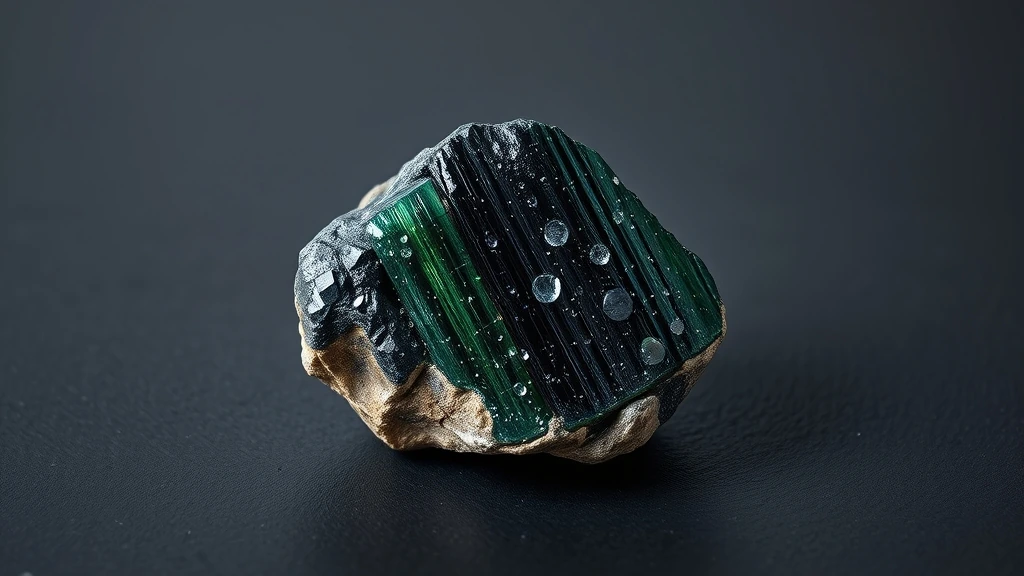
Chrome tourmaline belongs to the tourmaline super‑group, a natural mineral/crystal series that crystallizes in the trigonal system. It forms elongated prismatic crystals in pegmatitic veins and metamorphic schists, where high‑temperature fluids introduce the essential boron, aluminum, and transition‑metal cations that give the stone its characteristic hue.
What is Chrome Tourmaline Gemstone? Geological Overview & Definition
Chrome tourmaline is a chromium‑rich variety of the tourmaline series, distinguished by its intense emerald‑green to teal coloration. The presence of trace Cr³⁺ ions substitutes for Fe²⁺ in the octahedral sites, creating the vivid color that collectors prize.
In the field, the mineral occurs as well‑formed, striated prisms often associated with quartz, mica, and feldspar. Its formation requires boron‑rich, fluorine‑bearing fluids during late‑stage magmatic or high‑grade metamorphic processes, which promote the growth of large, transparent crystals suitable for faceting.
Chrome Tourmaline Gemstone Chemical Composition & Crystallographic Properties
The crystal lattice is trigonal (space group R3m), composed of six‑membered silicate rings linked to borate triangles and octahedrally coordinated cations. This arrangement yields a robust framework that resists cleavage, contributing to its respectable hardness of 7–7.5.
Cation substitution is central to its chemistry: Mg²⁺, Fe²⁺, and Cr³⁺ can occupy the octahedral sites, while Na occupies the large channel sites. Such variability explains the subtle shifts in hue from green to blue as the Cr/Fe ratio changes.
Chrome tourmaline is acid‑sensitive; exposure to strong acids can leach surface cations and dull the polish, so cleaning should be limited to mild, pH‑neutral solutions. Thermal treatment above 500 °C can cause irreversible color loss by reducing Cr³⁺ to color‑less Cr²⁺, underscoring the stone’s sensitivity to heat.
Overall, its trigonal symmetry, complex borosilicate chemistry, and chromophore-driven coloration make chrome tourmaline a uniquely valuable gemstone within the broader tourmaline family.
| Property | Specification |
|---|---|
| Mineral Group | Natural Mineral / Crystal |
| Chemical Formula | Na(Mg,Fe²⁺)₃Al₆(BO₃)₃Si₆O₁₈(OH)₄ |
| Mohs Hardness | 7.0 – 7.5 |
| Crystal System | Trigonal |
| Specific Gravity (Density) | 3.05 – 3.20 |
| Refractive Index | 1.620 – 1.650 |
| Color & Optical Properties | Natural Chrome Tourmaline Gemstone color spectrum and optical dispersion |
| Primary Mining Localities | Global primary localities |
| Water & Chemical Resistance | High (Safe for gentle water washing) |
| Chakra Alignment (Traditional) | Heart Chakra |
| Zodiac Affinity (Traditional) | Taurus, Virgo |
| Symbolic Meaning (Traditional) | Emotional balance, compassion, and spiritual growth |
Tourmaline Varieties & Comprehensive Sub‑Types
Black Tourmaline (Schorl)
Schorl forms in iron‑rich pegmatitic veins where high‑temperature fluids precipitate opaque, deep‑black crystals. Inclusions often consist of magnetite, hematite, and fluid‑filled cavities that produce characteristic parallel banding visible under magnification. Its dense, metallic luster and high specific gravity make it the premier ground‑ing and EMF‑shielding mineral in the trade, commanding steady demand among collectors and metaphysical markets.
Watermelon Tourmaline
Watermelon tourmaline crystallizes in lithium‑rich elbaite pegmatites, where fluctuating temperature gradients create concentric zones of pink and green. The inner pink core is enriched in Li‑bearing elbaite, while the outer ring incorporates chrome‑substituted iron, yielding vivid green‑chrome coloration. Because of its striking bi‑color zoning, it fetches premium prices, especially when the pink and green zones are sharply defined and free of fracture.
Paraiba Tourmaline
First discovered in Brazil’s Serra do Espinhaço range, Paraiba tourmaline grows in rare, copper‑ and manganese‑enriched pegmatites. Trace Cu²⁺ ions generate an intense neon‑cyan fluorescence, while Mn²⁺ adds subtle teal undertones, producing the hallmark electric blue hue. Owing to its scarcity and vivid color, Paraiba commands the highest market values, with specimens from Brazil and later Mozambique fetching record auction prices.
Rubellite
Rubellite develops in lithium‑rich, fluorine‑bearing pegmatites where chromium and vanadium are largely absent, allowing the Fe³⁺ chromophore to dominate and render a ruby‑red to magenta tone. The crystal often exhibits parallel growth striations and occasional needle‑like inclusions of rutile, which enhance its brilliance when cut en cabochon. Its stable color across lighting conditions makes rubellite a sought‑after gemstone for high‑end jewelry, ranking just below ruby in price per carat.
Indicolite
Indicolite originates in iron‑bearing elbaite pegmatites where Fe²⁺ substitutes for Mg, imparting a deep indigo to teal hue. The stone frequently displays fine, wavy banding and occasional black tourmaline inclusions that accentuate its depth of color. Because true indigolite is rare and often confused with synthetic analogues, natural specimens command premium prices, especially when the color is uniform and the crystal exhibits excellent clarity.
Comparative Summary – Gemologists differentiate these varieties by examining chemical chromophores (Fe, Cu, Mn, Li), zoning patterns, and inclusion types under a polarizing microscope. Refractive index and pleochroism measurements further separate black schorl from colored elbaites, while spectroscopic analysis confirms copper‑induced fluorescence in Paraiba and iron‑driven hues in indigolite. Precise cut orientation maximizes each stone’s unique optical character, guiding valuation and market placement.
Where is Chrome Tourmaline Gemstone Found? Geological Mining & Extraction
Chrome tourmaline occurs chiefly in chromium‑substituted elbaite pegmatites of the Central African Rift and the Brazilian Minas Gerais province. The host rocks are coarse‑grained granitic pegmatites rich in mica, feldspar, and beryl, where late‑stage hydrothermal fluids introduce Cr³⁺, producing the vivid green hue.
Extraction relies on selective hand‑picking of crystal fragments from open pits and underground workings, followed by careful washing to remove mica and quartz matrix. Because chrome tourmaline crystals are often intergrown with quartz and feldspar, miners employ gentle mechanical separation and hand‑sorting to preserve the delicate crystal faces essential for gem cutting.
Historical Significance & Cultural Lore of Chrome Tourmaline Gemstone
Ancient Mesoamerican cultures prized green tourmaline for its protective qualities, embedding polished beads in ceremonial necklaces and burial goods. Archaeological sites in the Yucatán reveal chrome‑green tourmaline pendants dating to the Classic Maya period, suggesting a trade network that linked Central America with South American pegmatite sources.
In Ottoman Turkey, chrome tourmaline was cut into cabochons for imperial jewelry, believed to balance the heart chakra and promote emotional harmony. Folklore across the Silk Road described the stone as a “guardian of the soul,” attributing to it the power to ward off negativity and enhance spiritual growth.
Modern Uses & Jewelry Applications of Chrome Tourmaline Gemstone
Lapidaries primarily cut chrome tourmaline into faceted gems to maximize its vivid green hue and brilliance. The stone’s Mohs hardness of 7.0-7.5 makes it durable enough for rings and bracelets, though cabochons are also popular for ornamental carvings.
- Faceted Cuts: Emerald and oval cuts are standard to enhance color saturation.
- Cabochons: Smooth, polished domes used in vintage-style jewelry settings.
- Ornamental Carving: Small figurines or beads for artisanal necklaces and pendants.
Carat, Quality Grades & Value Factors of Chrome Tourmaline
According to historical traditions and metaphysical lore, this stone is revered for promoting emotional balance and deep compassion. Practitioners believe it facilitates spiritual growth by helping individuals process complex feelings with clarity and grace.
It is often associated with healing the heart, encouraging open communication, and fostering genuine connections with others. This gemstone is thought to dissolve resentment and replace it with unconditional love and understanding.
Which Chakra and Zodiac Signs Align with Chrome Tourmaline Gemstone?
In esoteric practice, chrome tourmaline is specifically aligned with the Heart Chakra. This connection supports the flow of love and emotional equilibrium, helping to balance the heart’s energy center.
Astrologically, this gemstone resonates strongly with Taurus and Virgo. These earth signs benefit from its grounding nature, which enhances their innate stability and appreciation for beauty and harmony.
How to Identify Real vs. Fake Chrome Tourmaline Gemstone
Distinguishing genuine chrome tourmaline from imitations requires careful observation of physical properties. Common fakes include synthetic glass, which lacks natural inclusions, and dyed quartz or other tourmaline varieties that may show uneven color distribution.
Practical At-Home Authenticity Tests
- Temperature Test (Thermal Feel): Genuine tourmaline feels cool to the touch and warms slowly, whereas plastic imitations warm up almost instantly.
- Specific Gravity & Weight Test: Real chrome tourmaline has a density of 3.05 – 3.20, making it feel significantly heavier than glass or plastic of the same size.
- Scratch & Hardness Test (Mohs Comparison): With a Mohs hardness of 7.0 – 7.5, it can scratch glass but will not be scratched by a steel knife.
- Microscopic & Loupe Inspection (Internal Inclusions): Use a 10x loupe to look for natural inclusions or color zoning; synthetic glass is typically perfectly clear and bubble-free.
Chrome Tourmaline Gemstone Valuation Factors, Grading & Pricing
The primary driver of value is Color Saturation, specifically the intense, vivid green hue caused by chromium impurities. Experts assess the uniformity of this tone across the entire stone, as uneven distribution significantly reduces desirability. High optical clarity and a brilliant vitreous luster further enhance the gem’s visual appeal and market standing.
Carat Weight plays a crucial role, as large, high-quality chrome tourmalines are exceptionally rare in the global market. Facet symmetry must be precise to maximize light return, while any visible matrix or internal inclusions will lower the grade. Stones with minimal internal flaws command premium prices due to their exceptional transparency and structural integrity.
Geographical Provenance Premium often elevates value, with specimens from renowned mines like Mozambique fetching higher bids. Wholesale prices fluctuate based on supply constraints, but retail values remain stable due to consistent collector demand. Understanding these market trends helps buyers identify fair pricing for this sought-after variety of tourmaline.
How to Clean and Care for Chrome Tourmaline Gemstone
To maintain brilliance, immerse the stone in warm soapy water and gently scrub with a soft cloth. This method effectively removes oils and dust without damaging the surface or setting. Ensure the water is lukewarm, as extreme temperature changes can potentially stress the crystal structure over time.
Chrome tourmaline is safe for ultrasonic cleaning, making it an excellent option for removing stubborn residue from intricate facets. However, always inspect the setting first to ensure it is secure before using high-frequency vibrations. Regular professional inspections are recommended to check for any loose prongs or minor damage.
Cleansing and Recharging Chrome Tourmaline Gemstone (Energetic Care)
For energetic maintenance, place the stone on a selenite plate overnight to absorb negative energies. This dry method is safe because it avoids any contact with water or chemicals that might affect the stone. Selenite is known for its high vibrational frequency, which helps restore the gem’s natural energetic balance effectively.
Alternatively, you can perform smoke smudging using sage or palo santo to purify the stone’s aura. Hold the gem above the rising smoke for a few minutes, allowing the cleansing properties to permeate the crystal. This practice aligns with the stone’s association with the Heart Chakra, promoting emotional clarity and spiritual growth.
Frequently Asked Questions About Chrome Tourmaline Gemstone
What is the chemical composition of chrome tourmaline?
Chrome tourmaline is a sodium-magnesium-iron borosilicate mineral with the formula Na(Mg,Fe²⁺)₃Al₆(BO₃)₃Si₆O₁₈(OH)₄. The presence of chromium or vanadium impurities within the crystal lattice is responsible for its distinctive green coloration. This complex structure contributes to its unique optical properties and durability.
How hard is chrome tourmaline on the Mohs scale?
This gemstone rates between 7.0 and 7.5 on the Mohs hardness scale. This makes it durable enough for everyday jewelry, though it is slightly softer than quartz. Wearers should still avoid direct impacts with harder materials to prevent chipping.
Is chrome tourmaline safe to wear in water?
Yes, chrome tourmaline has high water resistance and is safe for gentle washing. It does not dissolve or degrade when exposed to rain or brief submersion. However, prolonged soaking is not recommended to maintain the setting’s integrity.
Can I clean chrome tourmaline in an ultrasonic cleaner?
Ultrasonic cleaning is generally safe for this durable gemstone. For routine maintenance, use warm soapy water and a soft cloth. Avoid harsh chemicals that might damage the metal setting or alter the stone’s surface finish.
Which zodiac signs are aligned with chrome tourmaline?
This stone is traditionally associated with Taurus and Virgo. These earth signs resonate with the gem’s grounding energy and stability. Many believe wearing it enhances personal balance and connection to the natural world.
Which chakra does chrome tourmaline activate?
Chrome tourmaline is primarily linked to the Heart Chakra. This energetic alignment supports emotional balance, compassion, and spiritual growth. It is often used in meditation to open the heart center and foster deeper emotional connections.
What is the refractive index of chrome tourmaline?
The refractive index ranges from 1.620 to 1.650. This high value indicates significant light dispersion and brilliance. The trigonal crystal system further enhances its visual appeal by creating distinct internal reflections.
What is the specific gravity of this gemstone?
Chrome tourmaline has a density between 3.05 and 3.20. This specific gravity helps distinguish it from lighter green gemstones like emerald. Professional gemologists use this measurement alongside other properties for accurate identification.