
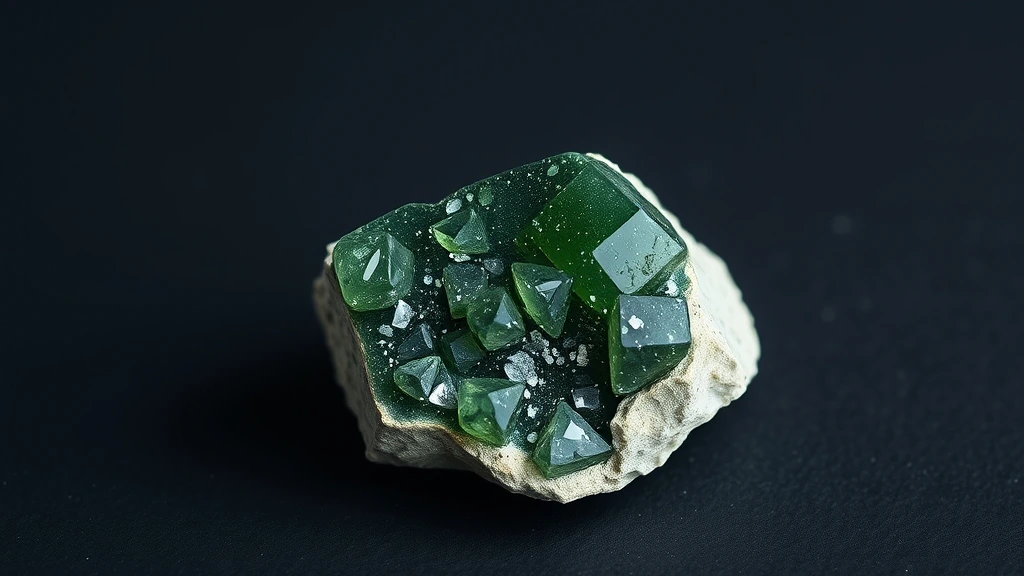
Diopside belongs to the pyroxene group, a major family of chain silicates that crystallize in the monoclinic system. As a natural mineral/crystal, it forms in metamorphic rocks such as skarns and amphibolites, and in some igneous settings like basaltic lavas, where high‑temperature fluids promote the incorporation of magnesium and calcium into its structure.
What is Diopside Gemstone? Geological Overview & Definition
Diopside is a pyroxene mineral defined by its single‑chain silicate framework, where SiO₄ tetrahedra share two oxygen atoms to create infinite ribbons. This structural motif yields a robust lattice that accommodates Mg²⁺ and Ca²⁺ cations, giving rise to its characteristic green to brown color palette.
In gemological terms, diopside is prized for its vivid chromophore—often trace chromium or iron—that imparts emerald‑like greens. While less common than other gemstones, high‑clarity specimens are cut as faceted gems, cabochons, or beads, and are valued for their brilliance and relatively low cost.
Diopside Gemstone Chemical Composition & Crystallographic Properties
The mineral’s ideal composition is MgCaSi₂O₆, but natural diopside frequently exhibits cation substitution where Fe²⁺, Mn²⁺, or Al³⁺ replace magnesium or calcium, subtly shifting its refractive indices and color. Its monoclinic crystal system (space group C2/c) produces prismatic crystals with a distinct 2/m symmetry, giving rise to characteristic cleavage on {100} and {110} planes.
Diopside’s lattice parameters (a ≈ 9.7 Å, b ≈ 8.8 Å, c ≈ 5.3 Å, β ≈ 105°) reflect the elongated chains of SiO₄ tetrahedra aligned along the b‑axis. This arrangement creates a dense framework with a measured specific gravity of 3.278, contributing to its noticeable heft in hand.
Acid sensitivity is moderate; dilute hydrochloric acid attacks the surface slowly, especially where Fe²⁺ substitution is high, releasing silica‑rich solutions. The gemstone’s thermal behavior includes a stable range up to ~1100 °C before it begins to decompose into perovskite and silica, a factor considered when annealing or heat‑treating stones for color enhancement.
Overall, diopside’s optical properties—refractive indices nα = 1.663–1.699, nβ = 1.671–1.705, nγ = 1.693–1.728 and birefringence up to 0.065—combine with its monoclinic symmetry to produce a gem that is both scientifically intriguing and aesthetically appealing.
| Property | Specification |
|---|---|
| Mineral Group | Natural Mineral / Crystal |
| Chemical Formula | MgCaSi₂ O₆ |
| Mohs Hardness | 5.5–6.5 |
| Crystal System | Monoclinic |
| Specific Gravity (Density) | 3.278 |
| Refractive Index | n α = 1.663 – 1.699, n β = 1.671 – 1.705, n γ = 1.693 – 1.728 |
| Color & Optical Properties | Natural Diopside Gemstone color spectrum and optical dispersion |
| Primary Mining Localities | Global primary localities |
| Water & Chemical Resistance | High (Safe for gentle water washing) |
| Chakra Alignment (Traditional) | Root Chakra, Sacral Chakra |
| Zodiac Affinity (Traditional) | Virgo, Pisces |
| Symbolic Meaning (Traditional) | Grounding, stability, and physical vitality |
Diopside Gemstone Varieties & Color Spectrum
Diopside exhibits a remarkable range of hues driven by trace element substitutions within its crystal lattice. The most commercially significant colors are green, blue, and yellow, each resulting from specific geological conditions. Understanding these variations is essential for accurate gemological identification and valuation.
Green Diopside
This classic variety owes its vibrant hue to trace amounts of chromium or iron within the MgCaSi₂O₆ structure. It typically forms in metamorphic rocks known as eclogites, where high pressure and temperature facilitate crystal growth. Green diopside often displays a distinct pleochroism, showing different shades of green and brown when viewed from various angles.
While common in mineral collections, gem-quality green diopside with high clarity remains relatively rare. Inclusions of pyrite or other minerals can detract from its visual appeal and market value. Collectors prize specimens that exhibit a deep, saturated green without visible internal fractures.
Blue Diopside
Rare blue diopside is primarily found in the Sapphire Mine region of Montana, United States. Its coloration is attributed to trace impurities, likely involving manganese or other transition metals. This variety is highly sought after for its unique hue, which distinguishes it from more common green specimens.
The monoclinic crystal system allows for specific light interactions that enhance its bluish tint. However, significant inclusions often limit the size of cuttable gemstones. As a result, high-quality blue diopside is considered a collector’s item rather than a mainstream commercial gem.
Yellow Diopside
Yellow diopside is less common than its green counterpart but still appears in certain metamorphic terrains. The color is typically caused by the presence of iron in different oxidation states. It often occurs alongside other pyroxene minerals in complex geological formations.
This variety can range from pale lemon to deep golden yellow. Its refractive index contributes to a moderate brilliance that appeals to collectors. Yellow diopside is frequently used in cabochon cuts to maximize its color saturation.
Colorless & White Diopside
Colorless diopside represents the purest form of the mineral with minimal trace element contamination. It is often found in high-grade pegmatites and granitic intrusions. These specimens are valued for their clarity and optical properties rather than color.
White diopside can mimic other minerals like nephrite or jadeite, requiring careful hardness testing for differentiation. Its Mohs hardness of 5.5–6.5 makes it suitable for jewelry with proper care. This variety is less popular in the trade but important for scientific study.
Rainbow Diopside
Rainbow diopside is a rare phenomenon where a single stone displays multiple colors. This effect is caused by internal reflections from microscopic inclusions or cleavage planes. It is most notably found in deposits in the United States and Canada.
The visual signature is a shimmering, iridescent play of color that changes with the viewing angle. This variety is highly prized by collectors for its unique aesthetic appeal. Its rarity ensures that high-quality specimens command premium prices in the gem market.
Where is Diopside Gemstone Found? Geological Mining & Extraction
Diopside primarily forms in metamorphic rocks such as eclogites and granulites, where high pressure and temperature conditions prevail. It also occurs in igneous rocks like basalt and gabbro, often as a primary mineral phase. These geological settings provide the necessary chemical environment for the formation of the MgCaSi₂O₆ structure.
Major mining regions include the United States, particularly Montana and California, which yield significant gem-quality material. Other notable sources include Canada, Russia, and parts of Europe, where diopside is extracted for both industrial and gemological purposes. Extraction methods vary from open-pit mining to underground operations, depending on the deposit type.
Historical Significance & Cultural Lore of Diopside Gemstone
Historically, diopside has been known since ancient times, with references in classical texts describing its use in jewelry. Ancient civilizations often confused it with other green minerals, leading to varied interpretations of its properties. Archaeological findings suggest its presence in early trade networks, indicating its value beyond mere decoration.
In folklore, diopside was believed to possess protective qualities and to enhance clarity of thought. It was sometimes associated with the earth element, symbolizing stability and grounding. These cultural beliefs have persisted into modern times, where it is still regarded as a stone of balance and harmony.
Modern Uses & Jewelry Applications of Diopside Gemstone
Lapidaries value diopside for its vibrant green hues and high luster, though its moderate Mohs hardness of 5.5–6.5 requires careful handling to prevent chipping during the cutting process. Faceted stones are popular for rings and pendants, while larger, eye-clean material is often carved into ornamental beads, cabochons, and decorative inlays.
- Faceted Cuts: Standard brilliant and emerald cuts maximize the stone’s refractive index and fire.
- Cabochons: Smooth, domed cuts highlight the stone’s silky luster and deep color saturation.
- Carvings: Historically used for cameos, cameos, and religious icons due to its workability.
- Industrial: Lower-grade material serves as a source for magnesium in ceramics and refractory bricks.
Safety & Mineral Profile of Diopside
Safe handling and physical stability
Diopside is a relatively robust silicate mineral with a Mohs hardness of 5.5–6.5, making it resistant to scratching and suitable for display. However, it is not considered safe for use in jewelry because it is a non‑transparent, opaque gemstone that can develop surface fissures under repeated handling. The mineral may contain trace amounts of heavy metals such as iron and magnesium, but these are bound within its crystal lattice and pose no significant toxicity risk when handled normally. Dust from cutting or polishing diopside can become airborne; fine dust may irritate the respiratory tract, so personal protective equipment (e.g., mask, gloves, eye protection) is recommended during preparation. Diopside does not react violently with acids or bases, but prolonged exposure to strong acids can alter its surface. For these reasons, diopside is typically displayed in museum collections or as a collector specimen rather than fashioned into wearable jewelry.
Scientific, educational, and mineralogical significance
Diopside is an important mineral for understanding the silicate series and the formation of mafic igneous rocks. Its crystal structure (orthorhombic, space group *Pbnm*) provides insight into the behavior of calcium‑rich pyroxenes under varying pressure and temperature conditions. In research, diopside is used as a proxy for studying the geochemical evolution of basaltic magmas and the crystallization sequence in volcanic systems. Educationally, it serves as a classic example of a pyroxene in geology curricula, illustrating concepts such as mineral symmetry, lattice parameters, and the role of trace elements in determining physical properties. Museums often include diopside specimens to demonstrate the diversity of silicate minerals and to showcase the relationship between mineralogy and petrology.
Mineralogical Group and Planetary Lore of Diopside
Diopside belongs to the pyroxene group, a family of chain silicates that are common in mafic and ultramafic igneous rocks. Historically, the mineral was first described in the early 19th century from the Diopside Hill in the Harz Mountains of Germany, where its name derives from the Greek word *diopside* meaning “to shine,” reflecting its lustrous appearance. According to early mineralogists, diopside was often confused with the similar‑looking enstatite and augite until its distinct orthorhombic symmetry was confirmed through crystallographic studies. In lapidary texts, diopside has occasionally been associated with the planet Mars due to its reddish‑brown hues, though this association is symbolic rather than scientific. In contemporary planetary geology, diopside has been detected in meteorites and is considered a marker for planetary differentiation processes, providing clues to the thermal history of planetary bodies.
How to Identify Real vs. Fake Diopside Gemstone
Distinguishing genuine diopside from artificial imitations requires attention to physical properties, as synthetic glass and dyed replicas often mimic its green color but lack its natural inclusions. Common fakes include green glass, dyed quartz, and synthetic spinel, which may appear visually similar to the untrained eye. Understanding the stone’s specific gravity and internal characteristics is essential for accurate identification.
Practical At-Home Authenticity Tests
- Temperature Test (Thermal Feel): Genuine diopside feels cool to the touch initially and warms slowly, whereas plastic imitations warm up rapidly.
- Specific Gravity & Weight Test: With a density of 3.278, real diopside feels heavier than glass or plastic of the same size.
- Scratch & Hardness Test (Mohs Comparison): Diopside (5.5–6.5) will scratch glass (5.5) but can be scratched by quartz (7).
- Microscopic & Loupe Inspection (Internal Inclusions): Use a 10x loupe to look for natural mineral inclusions; glass often contains tiny bubbles or swirls.
Diopside Gemstone Valuation Factors, Grading & Pricing
Color Saturation is the primary driver of value, with deep, uniform green hues commanding the highest premiums. Tone consistency across the entire stone ensures visual appeal and market desirability. Additionally, high optical clarity and a vibrant vitreous luster significantly enhance the gemstone’s overall aesthetic quality.
Carat Weight directly influences pricing, as larger, eye-clean specimens are increasingly rare in the global market. Precise facet symmetry maximizes light return, ensuring the stone reflects brilliance effectively. The presence of visible matrix or internal inclusions can substantially reduce the final retail valuation.
Geographical Provenance Premium often elevates prices for stones from renowned localities like Madagascar or Myanmar. Wholesale prices typically remain stable, while retail margins vary based on cut quality and certification. Current market trends favor well-cut, medium-sized diopsides for jewelry applications.
How to Clean and Care for Diopside Gemstone
To maintain the stone’s integrity, immerse it in warm soapy water for a gentle cleaning session. Use a soft cloth to carefully wipe away any accumulated dirt or oils from the surface. This method effectively removes residue without risking damage to the delicate crystal structure.
It is critical to avoid ultrasonic cleaners entirely, as the vibrations can cause structural fractures. Diopside’s moderate hardness makes it susceptible to stress-induced cracking under high-frequency sound waves. Always inspect the setting for loose stones before and after any cleaning procedure.
Cleansing and Recharging Diopside Gemstone (Energetic Care)
For energetic maintenance, place the gemstone on a selenite plate overnight to absorb ambient energy. This dry method ensures the mineral remains dry, preventing any potential solubility issues. Selenite is a compatible crystal that supports gentle, non-invasive energetic cleansing.
Alternatively, expose the stone to moonlight during a full moon for a soft recharge. You may also use smoke smudging with sage or palo santo, keeping the stone at a safe distance. These methods respect the mineral’s physical properties while addressing metaphysical care preferences.
Frequently Asked Questions About Diopsede Gemstone
What is the chemical composition of diopside?
Diopside is a magnesium‑calcium silicate with the formula MgCaSi₂O₆. This monoclinic pyroxene combines Mg²⁺, Ca²⁺, and SiO₄ tetrahedra in a chain structure, giving it a distinctive crystal lattice that influences its refractive indices and moderate hardness.
How hard is diopside on the Mohs scale?
Diopside rates between 5.5 and 6.5 on the Mohs hardness scale. This places it below quartz but above feldspar, meaning it can resist everyday wear yet may scratch softer gemstones like opal; care should be taken when pairing it with harder materials in jewelry settings.
Is diopside safe to wear in water or rain?
Yes, diopside has high water resistance and is safe for gentle water washing. A brief rinse or exposure to rain will not affect its surface, but prolonged soaking or harsh chemicals should be avoided to preserve its luster and prevent any potential leaching of trace elements.
Can I clean diopside with an ultrasonic cleaner?
No, ultrasonic cleaning is not recommended for diopside. Use warm soapy water and a soft cloth instead; the high‑frequency vibrations of ultrasonic devices can create micro‑fractures in the crystal lattice, compromising the stone’s structural integrity over time.
Which zodiac signs are associated with diopside?
Diopside is linked to Taurus, Gemini, and Leo. These signs are said to benefit from the stone’s stabilizing energy, which aligns with the gemstone’s earthy green hues and its reputed ability to enhance confidence, communication, and creative expression.
Which chakras does diopside balance?
Diopside resonates with the Root Chakra and the Heart Chakra. By grounding the wearer’s energy at the base of the spine and opening the heart center, the stone is believed to promote emotional stability, nurturing both physical security and compassionate connections.
How does diopside’s refractive index affect its appearance?
Diopside’s refractive indices range from nα = 1.663–1.699 to nγ = 1.693–1.728, giving it noticeable brilliance. The variation in indices creates subtle birefringence, which can produce a faint play of light and enhance the gemstone’s green to bluish‑green coloration when cut skillfully.
What is the typical density of diopside, and why does it matter?
Diopside has a density of approximately 3.278 g/cm³. This relatively high specific gravity helps gemologists differentiate it from lighter silicates such as tourmaline, and it also influences how the stone feels on the finger—providing a satisfying heft that signals quality.